Technique
Zardozi bead embroidery
Seed and bugle bead couched onto a stiffened ground in the zardozi tradition: the stitch, the interval, the failure modes and why images live here.
Specs and sizes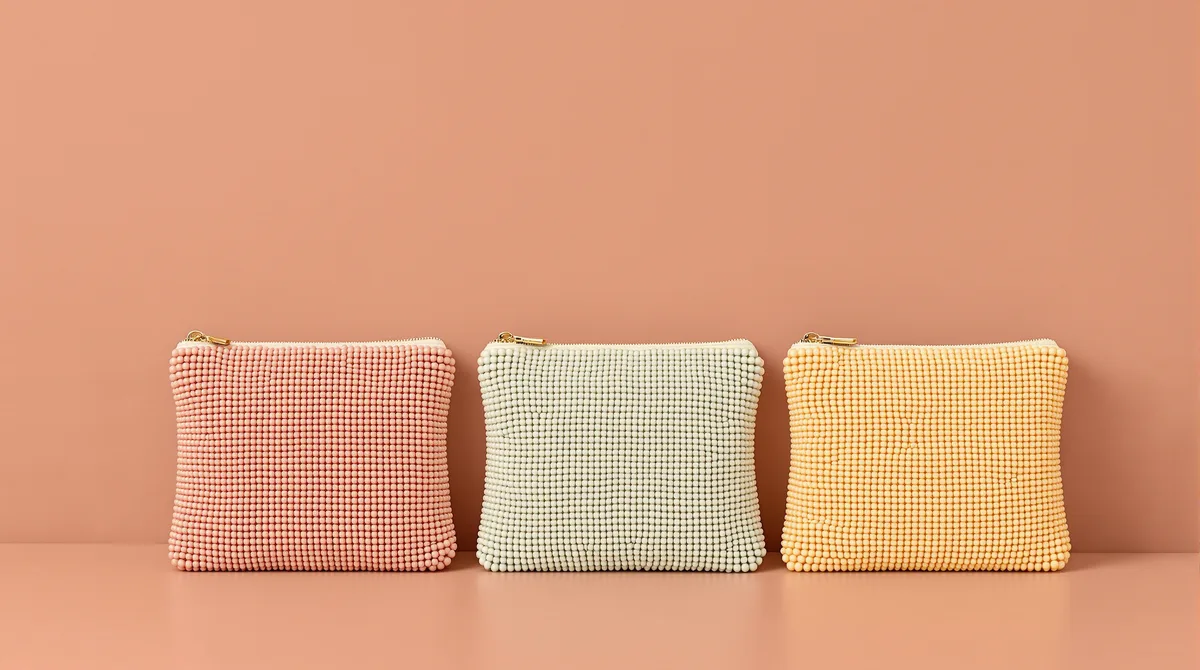
Craft topic
A beaded purse is made twice. First it is a flat embroidered panel, beaded taut on a frame. Then it is cut, lined and assembled into a bag — and the second operation is where beaded purses are won or lost.
Beaded pouches in a row, each front panel covered in couched glass-bead embroidery on stiffened fabric, one with a metal zip and a short beaded loop at the pull, in sun-baked…
A beaded clutch or pouch is beaded flat first. The panel is couched on a stiffened ground held taut, then cut, lined and made up into a bag. The construction decisions that matter all happen at that second stage: a bead-free seam allowance, a lining that carries the contents, and a beaded field that stops short of every fold.
A beaded purse is an embroidered panel made up into a bag. The construction is old and extremely widespread: wherever there was bead embroidery, there were beaded bags, because a small flat panel is the most economical way to show a lot of handwork.
In the subcontinent the drawstring form is a potli, gathered at the top rather than seamed flat, and that tradition sits alongside the framed and zipped evening bag of European making. Both are the same two-stage object: bead the panel, then build the bag.
Because beading a finished bag is impossible and beading a flat panel is routine.
Couching needs the ground held taut. A needle has to pass from front to back and return, which requires access to both faces. A made-up bag has a lining on the inside and a closed seam all round, so neither condition holds. So the panel is beaded flat, on a frame, while it is still a piece of cloth.
Everything that follows is garment making rather than beadwork, and that is the half of the job that decides durability.
Three things, all of which have to be drawn before the first bead goes on.
A bead-free seam allowance. The stitch line has to pass through cloth, not beads. A panel beaded to its cut edge means the machine runs over glass, which crushes beads, deflects the needle and leaves a weak seam.
A bead-free fold. Anywhere the finished bag folds — the bottom of a flat pouch, the hinge of a flap — the beaded field has to stop short. Beads on a fold work loose every time the bag is opened.
A lining. The lining takes the abrasion from the contents and carries their weight off the back of the couching. An unlined beaded bag loses beads from the inside out, which is invisible until a whole patch goes.
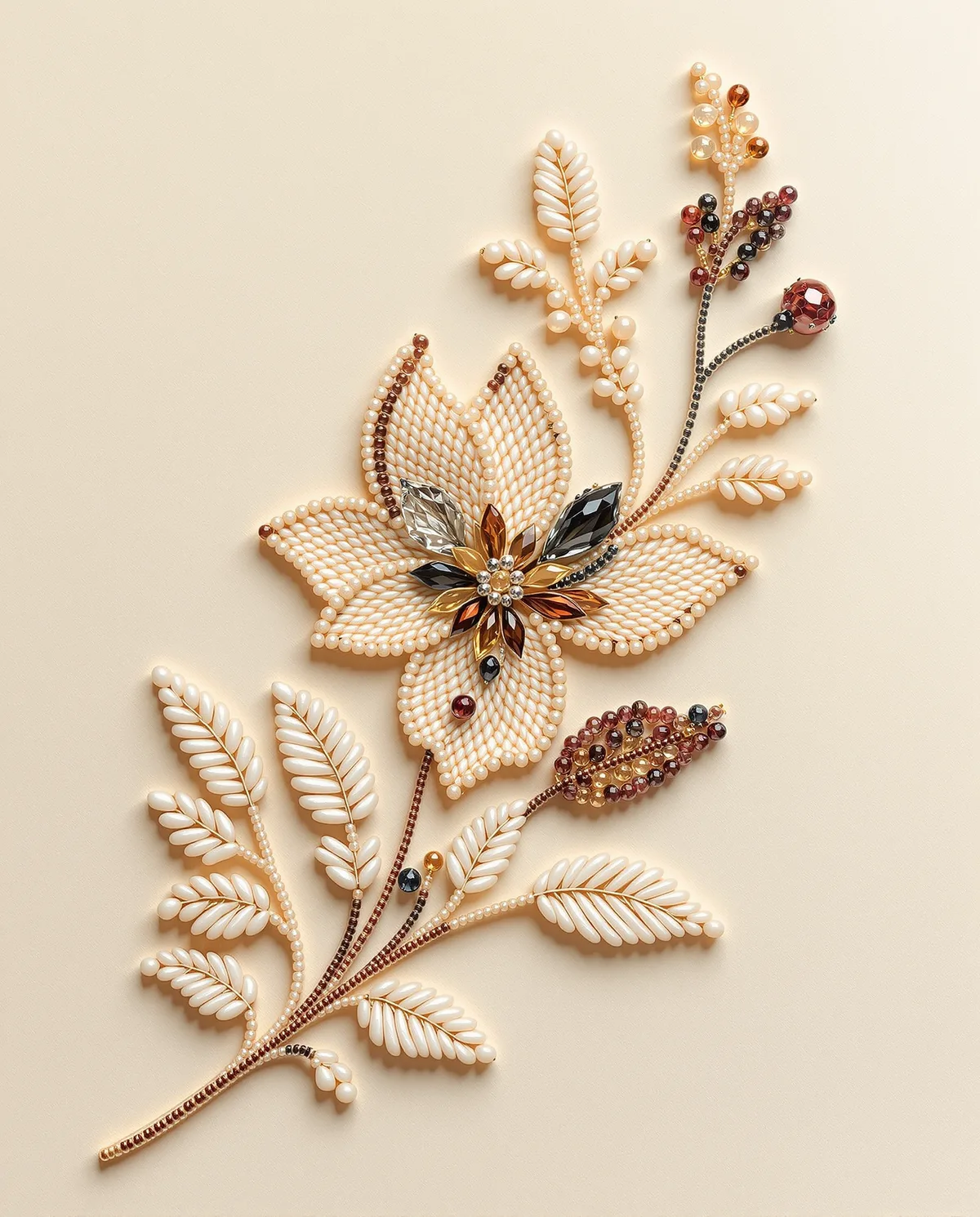
Glass seed and bugle beads for the field, with metallic thread and zari in the same couched stitch, plus sequins, cabochons and small rhinestone settings. Grounds are stiffened cotton or silk, often with an interlining to hold the panel flat. Linings are a separate, smoother fibre chosen to slide rather than to grip.
The hardware is where a purse stops being beadwork: zips and their tape, frames, clasps, chain or cord handles, and feet. Metal components are made, finished and plated in our own metal plants, in eight standard finishes, which is worth knowing because a beaded panel against the wrong metal finish is a design failure nobody can fix afterwards.
This is one of the strongest areas of our small-object work. Beaded zodiac purses, beaded city postcard purses, monogram round cases, a glass-bead-embroidered coin purse with a zip top and a tassel and lined beaded jewellery boxes all come off the same bench. The couched technique behind every one of them is a standing craft family in our own beadwork studios.
The ordinary caveats apply and they are the only ones: nothing is held in stock, everything is made to order against an approved sample, and minimums and pricing are set per design and confirmed with your quote.
An image. Glass seed beads at one to three millimetres behave like pixels, so a purse panel can carry a monogram, a city skyline, a zodiac figure, a face — things that no strung construction can approach, because a strand can only ever be a line.
That is why the purse is the format where bead embroidery earns its cost. The same hours spent on a hanging panel buy texture; spent on a purse panel they buy a picture, and a picture is what a customer pays a premium for.
Open it and look inside the seam. Then the lining attachment. Then the fold lines. Then the closure: a zip sewn through a beaded edge binds, and a frame set against a beaded panel needs the panel to stop short of the channel. Then the reverse of the panel if it is visible, for exposed thread ends.
Then the set, for a collection — purses in one range have to agree with each other on bead size as well as on palette, because two different bead gauges in one window look like two different products.
Hand bead embroidery at purse scale is concentrated in India, and it is the format that sustains the largest number of bead-embroidery livelihoods anywhere. At the volume end there is a large machine-embroidered and glued market, and the difference shows at the seam and the fold rather than on the face.
Spot-clean only: soft brush for dust, barely damp cloth on the beads, dry immediately. Never immerse one. The ground is stiffened, the lining is a different fibre, and the two shrink at different rates, so a wash puts a permanent ripple into the panel. Store it stuffed lightly with the closure fastened, not folded flat.
Because this part of the property documents objects, and the purse is one we build often enough to describe its construction with confidence. It is written as craft for the same reason the toran page is written as craft — the section's job is to explain the object honestly — and the difference is simply that here the answer is yes, we build these.
Good to know
They are among the objects our beadwork studios build most: beaded zodiac purses, beaded city postcard purses, monogram round cases, a glass-bead-embroidered coin purse with a zip top and a tassel, and lined beaded jewellery boxes. Everything made to order against an approved sample.
The panel is beaded first. A stiffened ground is held taut on a frame and the design is couched onto it, bead by bead, with the thread crossing between beads at every stitch. The finished panel is then cut, the lining and any interlining are made up, the closure is fitted, and the bag is assembled with the seams taken through bead-free allowances.
Clutch, pouch, coin purse, potli, evening bag and case all overlap. A potli is the drawstring pouch form of the subcontinent, gathered at the top rather than seamed flat. In trade terms the useful distinction is between a shaped bag with a frame or a zip and a flat pouch that closes by drawstring or overlap, because they are made up quite differently.
Open it and look at the inside of the seam. A bead-free allowance means the panel was planned for making up; beads crushed under the stitch line mean it was not, and that seam will fail. Then check the lining is attached rather than loose, and look at the fold lines — a beaded field running over a fold will shed at that fold within weeks.
Standing or lying flat, with the beaded face lit from the side rather than head on, because couched beadwork reads by the shadow between beads. On a shelf a purse photographs and sells best stuffed lightly so it holds its shape, which is also how it should be stored — a beaded panel left folded keeps the crease.
Spot-clean only. Lift dust with a soft brush, wipe the beads with a barely damp cloth, dry immediately. Never immerse it: the ground is stiffened, the lining is a different fibre, and the two shrink differently. Store stuffed lightly rather than flat or folded, and keep the closure fastened so the panel is not pulled out of square.
This is a normal development for us. A motif, a ground specification, a bead and colour direction, a size, a closure, a lining and a hardware decision, then a bead map and a sample. Sampling usually runs 16 to 20 days from an agreed brief, and production 40 to 60 days after sample approval.
Keep exploring
Technique
Seed and bugle bead couched onto a stiffened ground in the zardozi tradition: the stitch, the interval, the failure modes and why images live here.
Specs and sizesIndex
Seventeen beaded objects documented from inside the craft — what each one is, how the tradition builds it, and what it would take to develop one.
How it is madeCraft topic
The formats a three-week window supports, why opaque beads beat translucent for this palette, and the backwards calendar that puts the brief in spring.
See the detailCraft topic
Thresholds and lamps: the two organising ideas behind Diwali beadwork, the zari and mirror techniques involved, and a note on what we make.
Specs and sizesCraft topic
Backdrop, aisle run and favour — three scales, three constructions, three lead times, and the fixed date that makes the arithmetic unforgiving.
Read the guideManufacturing
The couched bead-and-metal-thread technique behind the flat beaded objects: what it is, what it can depict, and the forms built with it.
How it is made
Start a conversation
Send a reference, a colour chip or a sketch. Minimums are set per design and confirmed per quote; sampling is quoted separately and usually runs 16 to 20 days from an agreed brief.