Manufacturing
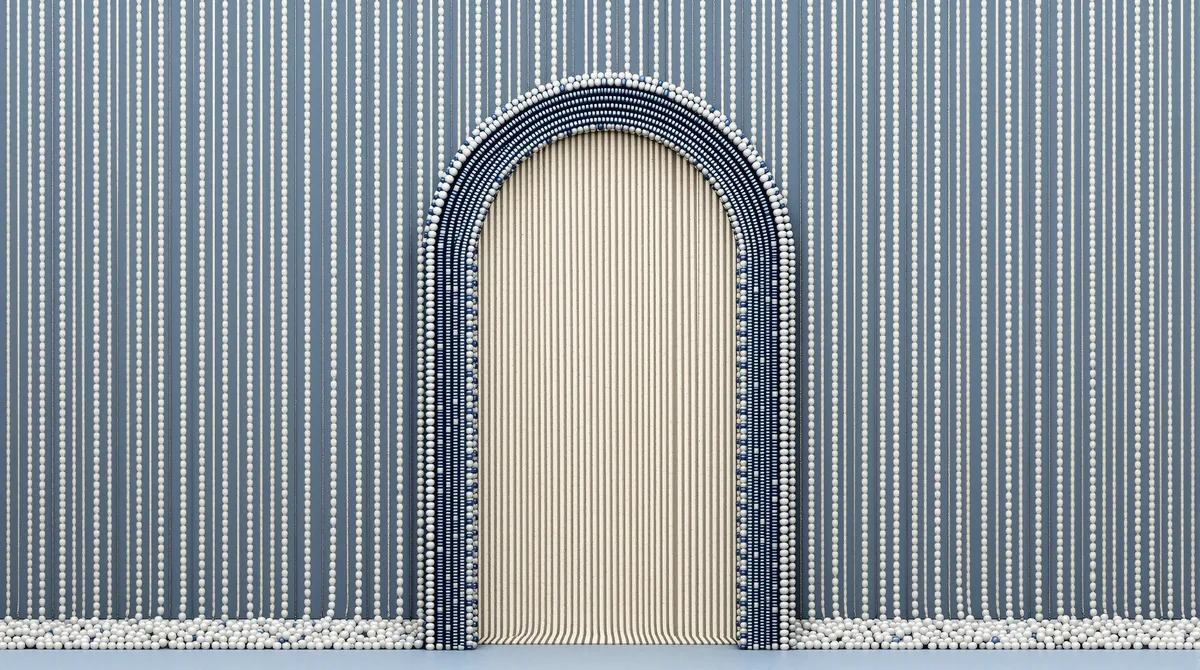
Beaded door portals: an opening framed in beads
Strands that frame an opening and leave a clear walk-through: arched and inverted-V drops, built to order on a turned dowel or a stained rail.
How it is made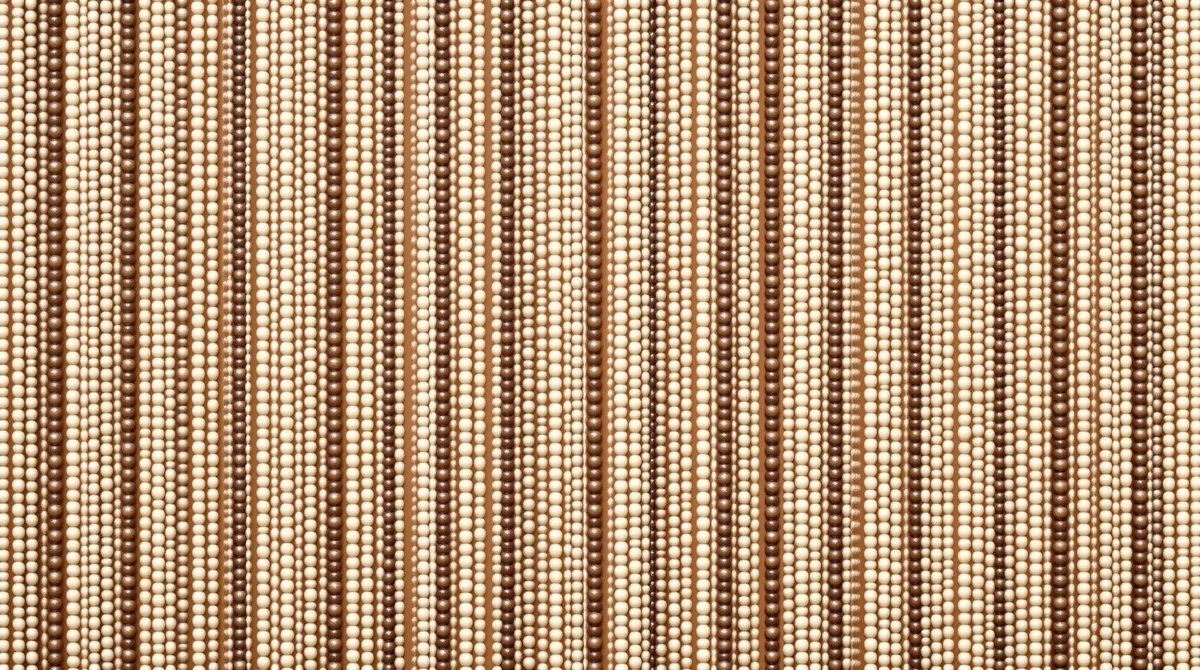
Design · Mushroom Beaded Portal
A figurative bead is the hardest kind to scatter, because the eye finds a row in it instantly. This build is written so no row can form.
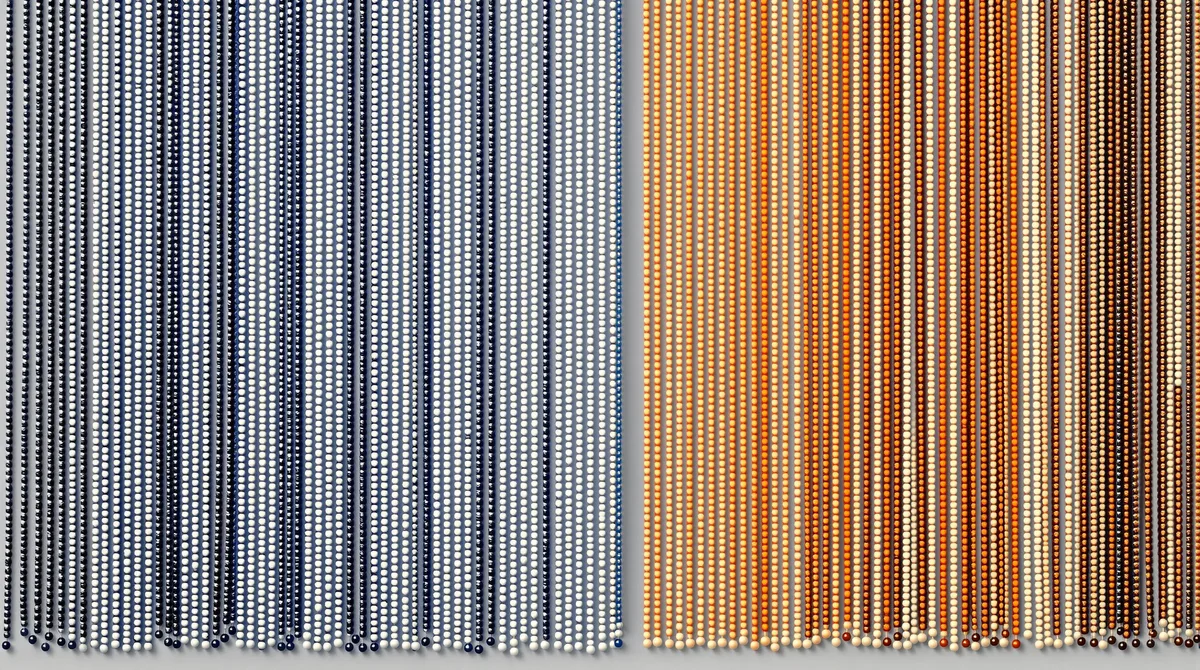
A full-length beaded portal of close strands in honey, chocolate and cream glass, the colour changing strand by strand into vertical bands.
The Mushroom portal is a 200 × 90 cm doorway on 30 hand-strung strands: a cream glass seed-bead base with small amber accents, carrying about 120 glass mushroom beads. Mushrooms go up to four to a strand, placed from a map so they never align into a row, and alternate orange and brown across the panel. End suspension loops let it hang level on a door or a wall.

The Mushroom portal is a 200 × 90 cm doorway on 30 hand-strung strands. The ground is cream glass seed beads with small amber accents; the feature is a glass mushroom bead, around 120 of them in a curtain.
It was approved in August 2026 and is shipping as part of the beaded portal programme. Of all the designs in the library it is the one that best shows how much of a figurative design is actually a distribution problem.
Up to four mushrooms per strand, placed from a map, offset strand to strand so that no horizontal row can form.
The offset rule is stricter here than on an abstract accent, and for a good reason: the eye finds a row of recognisable shapes much faster than a row of coloured dots. Three dots almost in line read as a scatter; three mushrooms almost in line read as a mistake. So the map does more work on this design than on any other scattered build in the library.
Two sheets matter more than the rest here. The colour-count sheet carries the mushroom map, without which the scatter is unrepeatable. And the header specification carries the suspension loops, which are the reason one build serves both a door frame and a wall. The panel weight is established on the sample and drives what will hold the panel.
| Specification | Value |
|---|---|
| Finished size | 200 × 90 cm |
| Strand count | 30, hand-strung on cord |
| Base | Cream glass seed beads with small amber accents |
| Feature bead | Glass mushroom beads, about 120 per curtain |
| Scatter rule | Up to four per strand, offset so no row forms |
| Feature colourway | Mushrooms alternating orange and brown |
| Header | Single turned wooden dowel |
| Mounting | End suspension loops for a level door or wall fix |
| Production | 40 to 60 days after sample approval |
The mushroom, and the cream ground that lets it show. Glass beads here are drawn and hand-strung in our own Firozabad glass works, and the mushroom is a specialty moulded form rather than a standard round — which is why there are around 120 of them and several thousand seed beads.
The amber accents in the ground are the quietly clever part. They warm the cream just enough that an orange or brown mushroom sits on the ground rather than against it, which is the difference between a design and a sticker.
Straight. The same logic as every scattered-accent design in the library: the scatter is the pattern, and a shaped hem competes with it.
A single turned wooden dowel from our own Saharanpur wood factory, with end suspension loops as part of the build. The loops are the detail worth copying. A loop at each end of the header lets the piece hang level from two fixings on a wall, as well as sitting inside a door frame on a rod, so one build serves two installations. That was a design-stage decision rather than an afterthought, and it is the kind of thing that stops a doorway design being refused for a wall position.
Both, and the two levers are independent. The mushroom colours change freely — the published build alternates orange and brown across the panel, which was itself a change made during development. The ground can move from cream to any off-white, warm or cool.
Of the two, the ground is the bigger change. Move the ground cool and the whole design goes from woodland to graphic, with the same mushrooms on it.
Retailers and own-label brands, strongly in kids, teen and dorm ranges, and in gift and lifestyle. A figurative bead gives a beaded curtain a subject, and a subject is what makes it giftable.
It is in production as part of the beaded portal programme. We work to a client's own packaging, finish and specification, and we do not compete with clients at retail.
That alternating the feature colour solves two problems at once. Alternating orange and brown mushrooms across the panel was asked for during development, and it both adds variety and makes accidental rows much harder to see — two mushrooms almost in line read as unrelated if they are different colours.
The second lesson is the mounting one. Adding end suspension loops cost almost nothing at design stage and widened where the piece can go. Retrofitting that onto an approved build would have meant a new sample.
Inner packing is agreed on the sample, because a moulded figurative glass bead has thinner sections than a round and is correspondingly easier to chip.
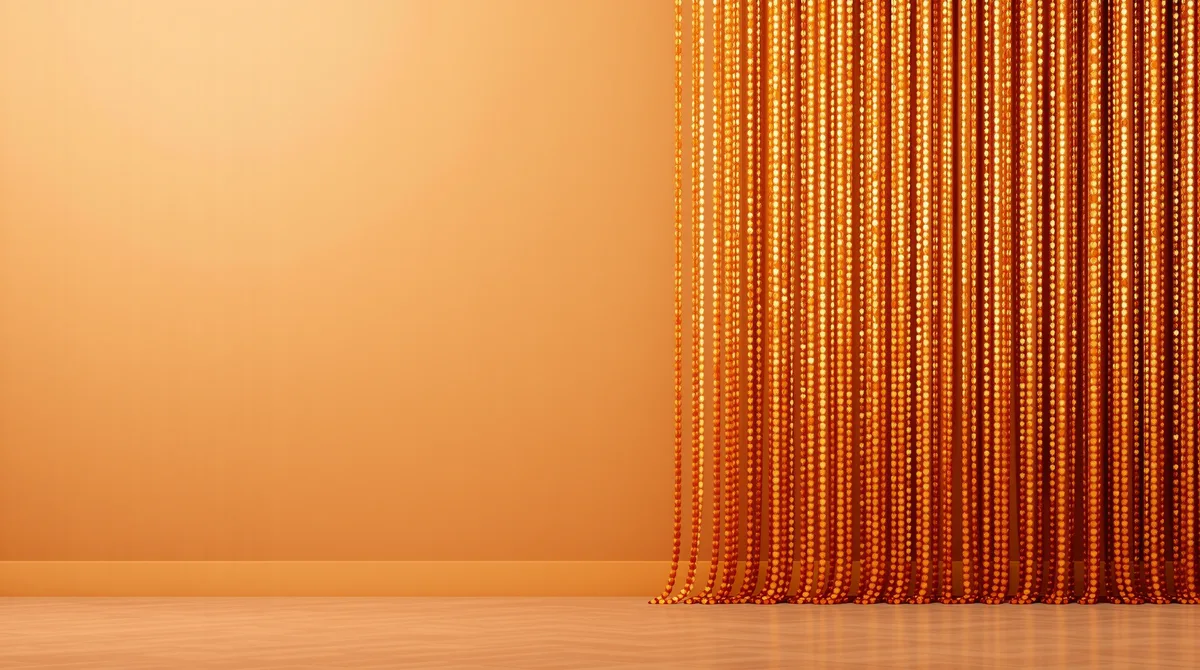
The imagery on this page is editorial: it shows how a scattered accent sits on a fine seed-bead ground and how light behaves through a 30-strand panel. It is not a photograph of the piece a buyer receives, and it is not captioned as one.
None of the fourteen named 2027 stories. Its own colourway is described as cream and amber with mushrooms alternating orange and brown, and it belongs to the production programme rather than to the design-render library.
Good to know
Strands are kept in order and protected against knocking in transit, then packed to your carton, label and packaging specification and shipped to the port or warehouse you name. A figurative glass bead is more fragile than a round, so inner packing is agreed on the sample.
Yes. A sketch, photo or artwork with size, materials, colours and quantity becomes a colour-count sheet, with a rough cost sheet produced before any sample is made so the cost levers are visible early.
Yes, in two places independently. The mushroom colours can change — the published build alternates orange and brown — and the ground can move from cream to any warm or cool off-white. Changing the ground changes the design more than changing the mushrooms does.
Yes, with the mushroom count recalculated rather than scaled. Up to four per strand is a density rule, so a shorter strand needs a decision about whether to keep four and accept a busier panel or reduce to two or three.
Cream glass seed beads as the ground, small amber glass accents, and glass mushroom beads as the feature. Glass beads are drawn and hand-strung in our own Firozabad glass works, and the mushroom is a specialty moulded glass form rather than a standard round.
Exclusivity is a commercial decision taken per programme rather than a property of the design. Name it in the brief and it is quoted alongside the piece.
Keep exploring
Manufacturing
Strands that frame an opening and leave a clear walk-through: arched and inverted-V drops, built to order on a turned dowel or a stained rail.
How it is madeDesign
The full-length doorway designs, 90 × 200 to 120 × 210 cm, documented by strand count, hem shape and bead count.
Open the referenceDesign
Large hand-made Venetian glass beads on a hand-strung doorway, with the palette edited for glass strength rather than for looks.
Specs and sizesDesign
Lime glass seed-bead strands with spaced deep forest rounds at 76 × 140 cm, cut to an arched drop.
Read the guideColour story
Cornsilk to deep amber down the drop, with the colour change landing on a change of bead size rather than on a dyed gradient.
Read the guideMaterial
How seed beads are drawn, why dye lots are quoted per run, what the drill hole limits, and where seed-bead work earns its cost.
Open the reference
Start a conversation
Send a reference, a colour chip or a sketch. Minimums are set per design and confirmed per quote; sampling is quoted separately and usually runs 16 to 20 days from an agreed brief.