Material
Seed beads, in detail
How seed beads are drawn, why dye lots are quoted per run, what the drill hole limits, and where seed-bead work earns its cost.
View the range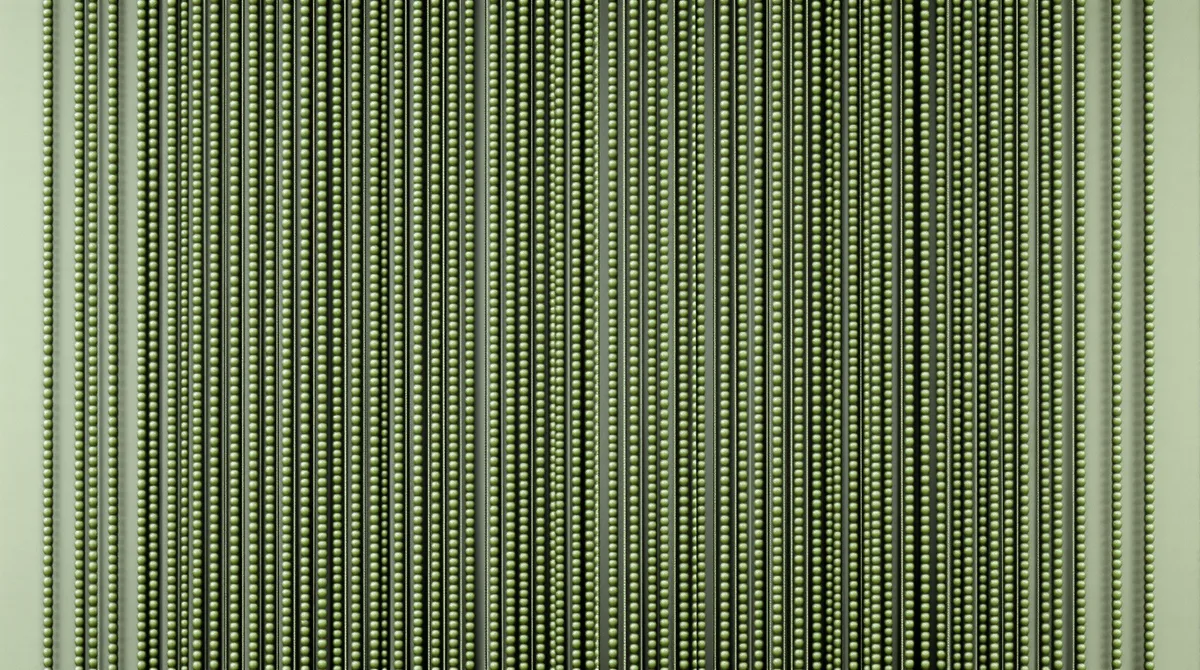
Design · Naia Green
Two greens and two bead scales. The contrast is carried by the change in bead size, not by the distance between the colours.
A beaded curtain of close strands in olive, moss and emerald green glass, the small beads packed solid down every cord.
Naia Green is a 76 × 140 cm portal — 30 × 55 in — built from lime glass seed-bead strands with deep forest-green round beads spaced along them, on a stained wooden header rail. Its contrast comes from the change in bead scale rather than from the gap between the two greens, and the drop is cut to an arch so the centre opens for a walk-through.

Naia Green is a door portal at 76 × 140 cm — 30 × 55 in — built from lime glass seed-bead strands with deep forest-green round beads spaced along them, on a stained wooden header rail. The drop is cut to an arch.
It is in production and shipping as part of the beaded curtain programme. Its real interest is that it solves the hardest problem in green beadwork without using a wide palette.
Each strand is a seed-bead body with larger rounds spaced into it at intervals written on the count sheet. The seed beads fill the strand; the rounds interrupt it.
That gives a much denser object than a spaced portal. A strand filled with seed beads carries many times the bead count of a strand with beads spaced along bare cord, and the hand is different — heavier, quieter and more textile. It is also why the stringing time per strand on this design is high relative to its size.
A dense seed-bead build changes which figures matter. Coverage per panel is high, so the bead count is the dominant quantity rather than the strand count. The arch is a set of strand lengths, so the longest and shortest drop are both specification items. And retail packing matters more than usual, because filled strands tangle where spaced ones do not.
| Specification | Value |
|---|---|
| Finished size | 76 × 140 cm, or 30 × 55 in |
| Format | Door portal with an arched-cut drop |
| Strand build | Lime glass seed beads with spaced forest-green rounds |
| Contrast mechanism | Bead scale change, not hue distance |
| Hem shape | Arched cut — centre strands shortened |
| Header | Stained wooden header rail |
| Where it is made | Glass drawn and hand-strung in our own Firozabad glass works |
| Related build | Shares its construction with the honey ombre version of the same design |
| Production | 40 to 60 days after sample approval |
Both. The important thing to preserve when recolouring is not the greens but the scale change: a fine ground bead with a much larger spaced bead on it. Two colours a half-step apart will still read strongly if the scale contrast is there, and two colours far apart will look clumsy if it is not.
Resizing means redrawing the arch rather than scaling it. An arch that reads correctly at 76 cm wide looks shallow at 120 cm unless the centre strands are shortened further, because the arch is a set of strand lengths and not a curve.
Retailers and own-label brands, and it has particular appeal where a green is specified — wellness and yoga studios, plant-led interiors, and hospitality spaces that want a screen rather than a feature.
In production in the two-tone green colourway. We work to a client's own packaging, finish and specification.
That a green design survives at scale by changing bead type, not by adding colours. Green has the least internal value contrast of any hue family, and the usual fix — more greens — just produces a muddle. Naia Green instead holds two greens and introduces a second bead scale, and the piece stays legible across a 140 cm drop.
That is the most transferable lesson in the doorway group, and it is why this design is the right reference for anyone briefing a tonal palette.
Seed-bead strands tangle more readily than spaced ones, so they are bundled in order rather than packed loose, and the piece is always lifted by the header rather than by the strands.
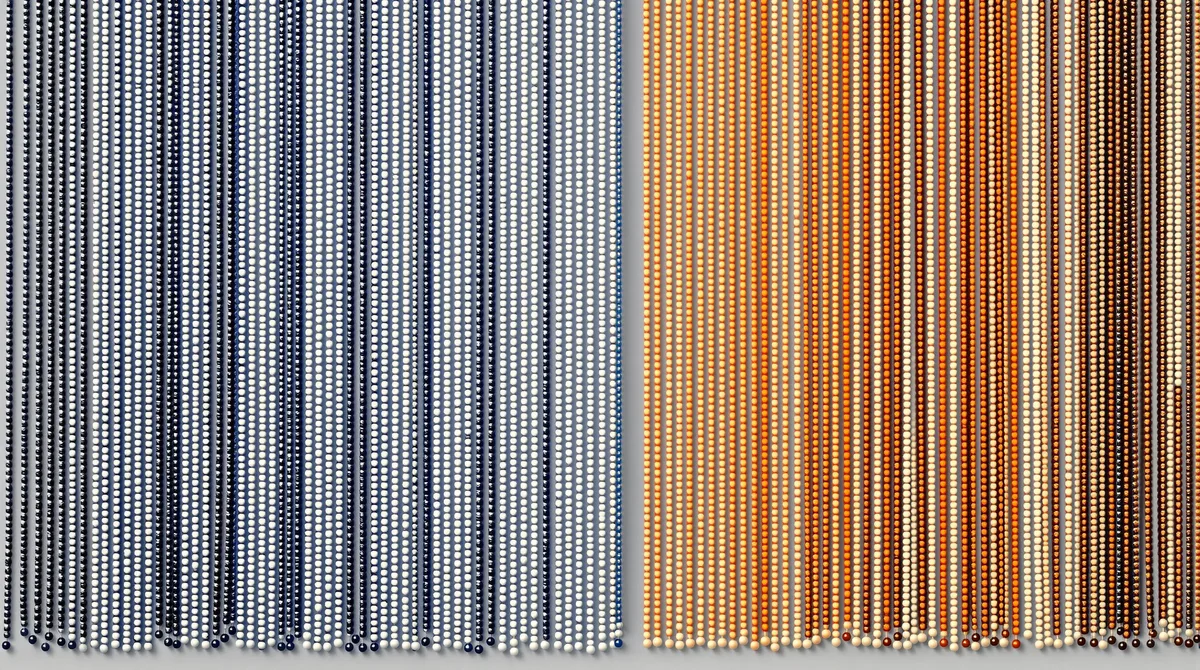
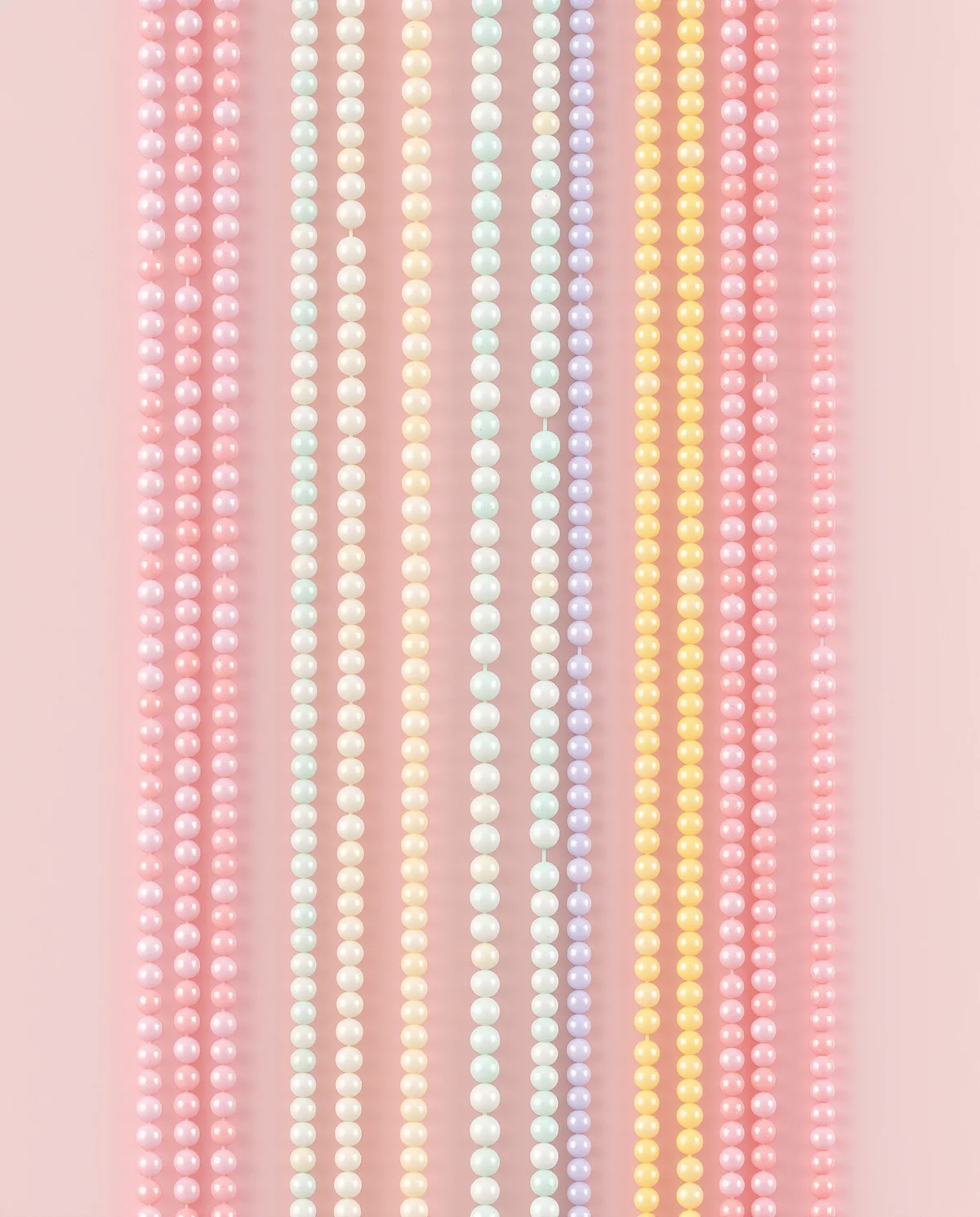
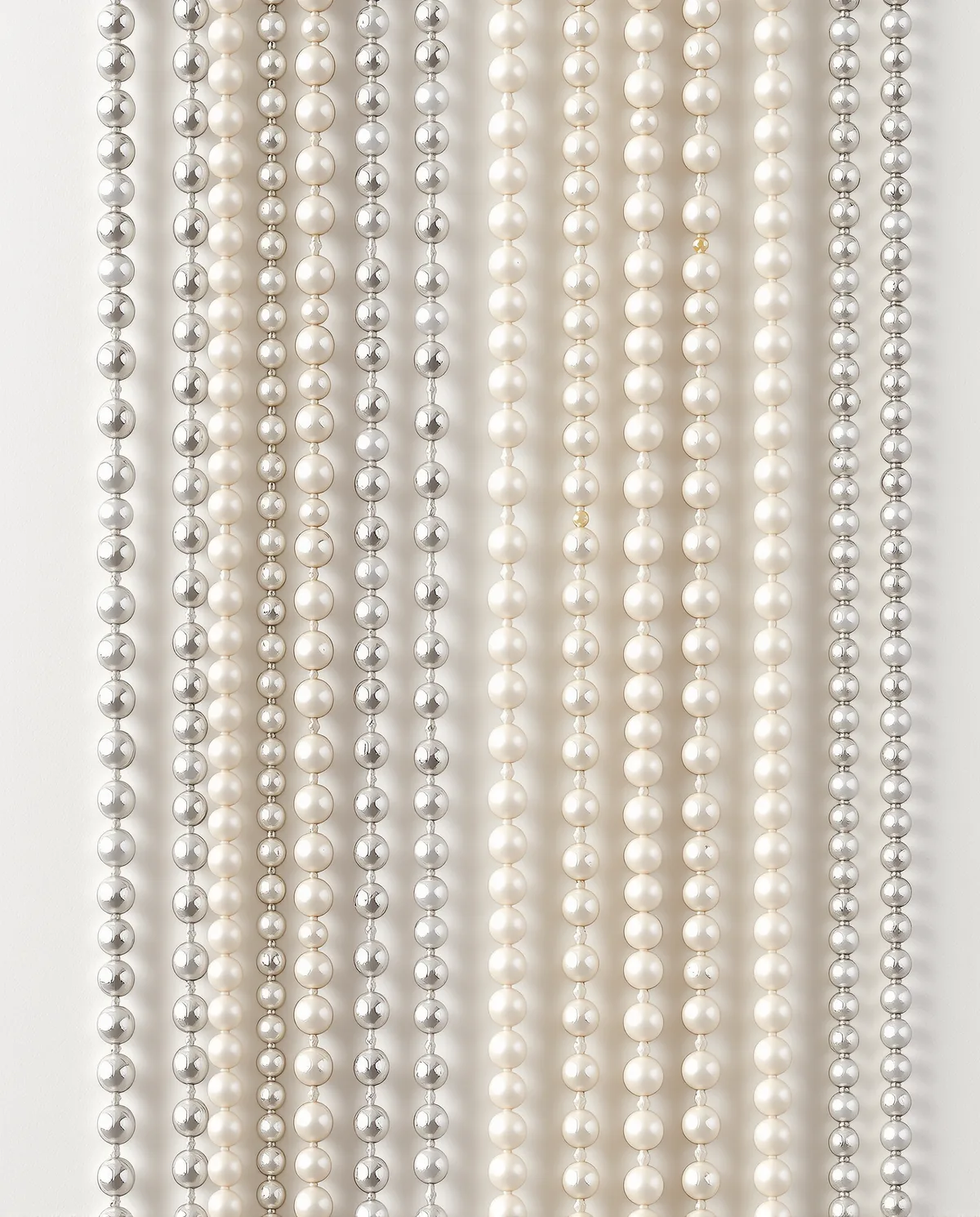
Construction: a seed-bead ground, a spaced round, an arched opening, and how light reads through a dense strand. It is not a photograph of the piece a buyer receives and is not captioned as one.
None of the fourteen named 2027 stories. Its colourway is described as a two-tone green — lime seed bead with forest-green rounds — and it belongs to the production programme.
The design matters to the colour-story pages all the same, because it is the sampled proof of a method the Olive Press story has only as design intent.
Both, in different ways. The seed bead carries the colour field and the hand; the round carries the rhythm. Remove the rounds and the piece becomes a flat lime panel. Remove the seed beads and it becomes a sparse green curtain. Neither alone is the design.
The arch is cut, which means the centre strands are made shorter on the count sheet so the middle of the panel opens. Nothing is shaped by the beads themselves.
That is the single construction fact that separates a portal from a curtain, and it is why a portal has to be quoted as a portal: the strand-length map, the bead count and the carton height all change.
A stained wooden header rail. A dense seed-bead build in glass is heavier per square metre than a spaced build, so the fixing should be rated accordingly — a rod with brackets into the frame rather than a tension rod.
Good to know
Yes. Width, drop and strand count are set per order, and the arch geometry is redrawn for the new proportions rather than scaled — an arch that looks right at 76 cm wide looks shallow at 120 cm unless the centre strands are shortened further.
Lime glass seed beads forming the body of each strand, with deep forest-green round beads spaced along it. Both are drawn and hand-strung in our own Firozabad glass works. The same construction also carries the honey ombre colourway, where the contrast is by bead size rather than by bead type.
Exclusivity is a commercial decision taken per programme rather than a property of the design. Name it in the brief and it is quoted alongside the piece.
The imagery here is editorial and shows construction — a seed-bead ground, a spaced round, an arched opening. It is not a photograph of the piece a buyer receives, and it is not captioned as one.
Strands are kept in order and protected against knocking in transit, then packed to your carton, label and packaging specification. A seed-bead strand is more prone to tangling than a spaced one, so strands are bundled in order rather than loose.
Yes. A sketch, photo or artwork with size, materials, colours and quantity becomes a colour-count sheet, with a rough cost sheet before any sample is made.
Yes, and the mechanism travels. What matters is keeping the scale change — a fine ground bead and a much larger spaced bead — rather than keeping the two greens. Any two colours in the same family will work if the scale contrast is preserved.
Keep exploring
Material
How seed beads are drawn, why dye lots are quoted per run, what the drill hole limits, and where seed-bead work earns its cost.
View the rangeDesign
The full-length doorway designs, 90 × 200 to 120 × 210 cm, documented by strand count, hem shape and bead count.
View the rangeDesign
90 × 200 cm on 40 strands at about 2.25 cm pitch, with a diagonal hem and roughly 3,100 beads.
Specs and sizesDesign
120 × 180 cm on 60 strands at about 2 cm pitch, with pastel accents placed from a written bead map and a straight hem.
Read the guideDesign
120 × 210 cm, the largest drop in the library, in silver, clear and off-white faceted glass.
Specs and sizesColour story
Cornsilk to deep amber down the drop, with the colour change landing on a change of bead size rather than on a dyed gradient.
Compare the options
Start a conversation
Send a reference, a colour chip or a sketch. Minimums are set per design and confirmed per quote; sampling is quoted separately and usually runs 16 to 20 days from an agreed brief.