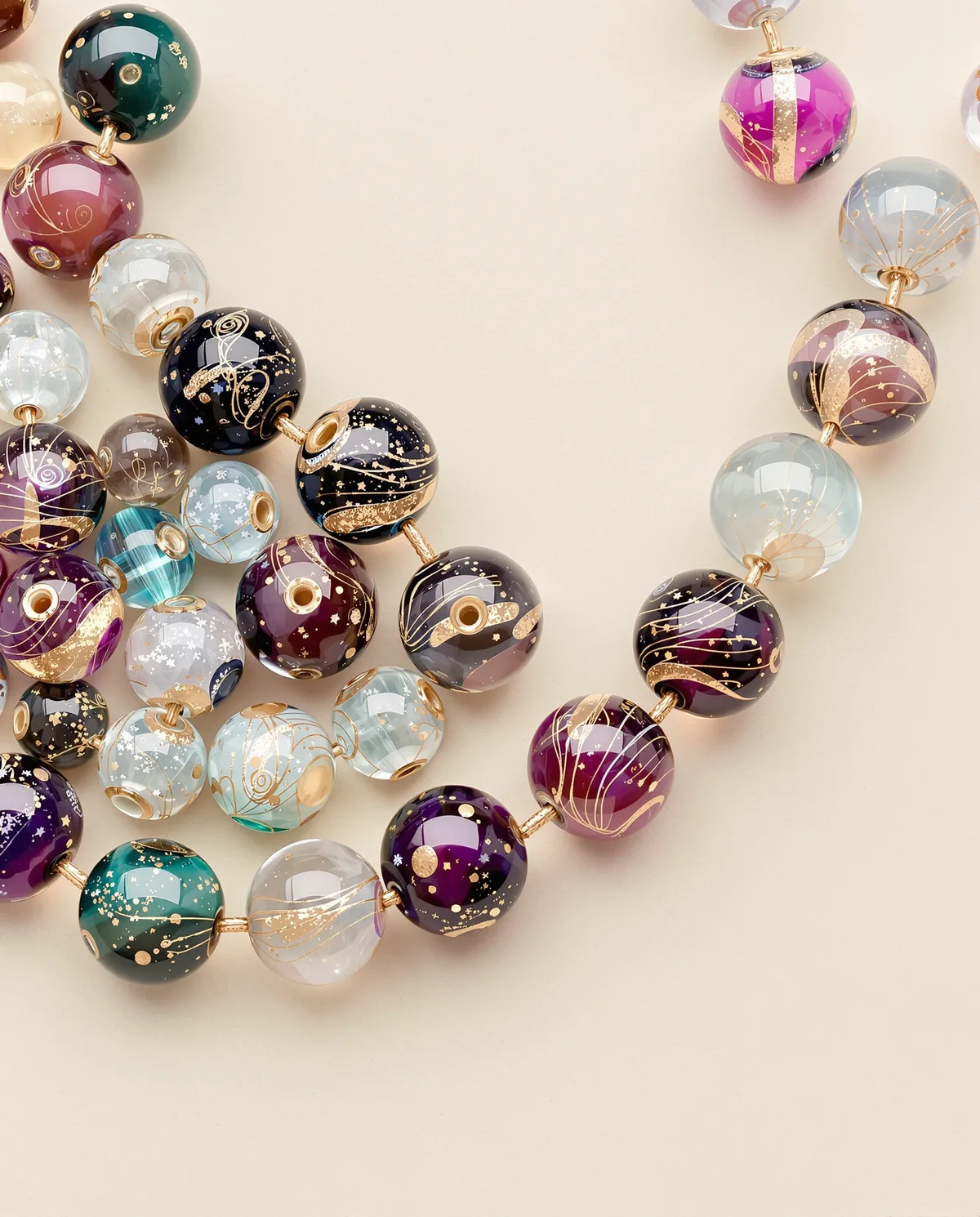
Process
Annealing
What annealing relieves, why a colourant changes the glass it colours, and how a real breakage problem was solved by changing the furnace and the palette.
See the detail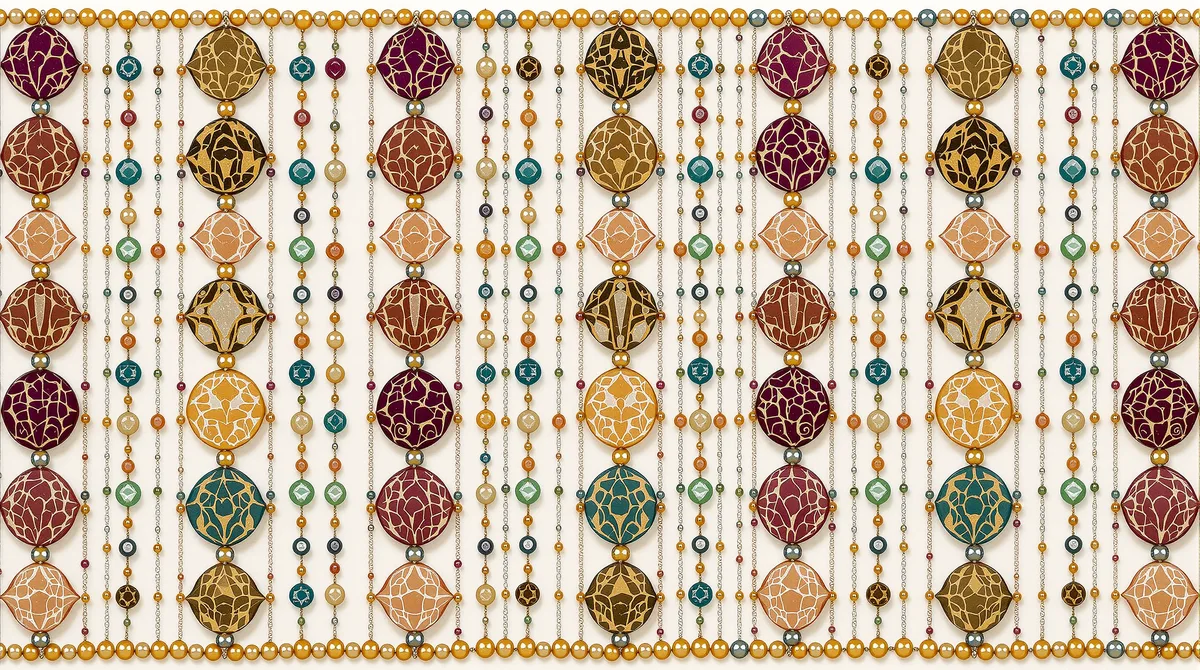
Design · Gigi Venetian Portal
The design that broke, and then did not. Fixing it meant changing the furnace process, annealing the beads and editing the palette on strength grounds.
A beaded portal of large hand-wound Venetian glass beads in plum, teal and amber with aventurine fleck and spiral trails, each separated by small plain rounds.
Gigi is a hand-strung doorway portal built from large hand-made Venetian glass beads. It is the design that established two things in our own works: that breakage in a hanging curtain is solved at the furnace by changing the process and annealing the beads, and that glass strength is colour-dependent, so some colours cannot be hung next to each other where they will clink.
Gigi is a hand-strung doorway portal built from large hand-made Venetian glass beads — glass with swirls and inclusions worked into each bead individually, rather than pressed from a mould.
It is the most instructive design in the library, because its development was not about appearance at all. It was about whether a large hand-made glass bead can survive being a curtain.
Conventionally: beads hand-strung on cord in a written sequence, gathered on a header. There is no scatter rule and no graphic map, and that is a direct consequence of the bead.
A hand-made bead varies in size. Variation of a millimetre or two per bead is invisible on a single strand and fatal to a mapped pattern, because by the bottom of a 200 cm drop the accumulated difference puts every strand's rows in a different place. So Gigi is built as a sequence, and any design that needs a graphic repeat uses pressed glass instead.
The sheet for this design carries one entry the others do not. Every large feature bead is annealed, and the annealing is specified rather than assumed. Beyond that, the strand count, the stringing medium and the panel weight are the three figures a quote is built from, and all three are confirmed on the approved sample rather than taken from a drawing.
| Specification | Value |
|---|---|
| Format | Doorway portal, hand-strung on cord |
| Feature bead | Hand-made Venetian glass, large format |
| Bead character | Swirls and inclusions; each bead individually made |
| Strength treatment | Annealed — heat-treated for strength |
| Process change | Furnace process altered to remove breakage in service |
| Palette constraint | Colours selected for strength and mutual compatibility |
| Where it is made | Drawn, lampworked and hand-strung in our own Firozabad glass works |
| Finished size | Confirmed with your quote |
| Production | 40 to 60 days after sample approval |
A header rail or a single turned wooden dowel, depending on the build. Weight is a larger question here than on any other doorway in the library, because large hand-made glass is the densest material in the range at roughly 2.5 g/cm³ as a general property of glass. A wide Gigi is a heavy object and the fixing has to be rated for it — a rod with brackets fixed into the frame or wall, not a tension rod.
Resized freely. Recoloured within engineering limits, which is the unusual answer this design forces.
Glass strength is colour-dependent. The colourants and the working temperatures differ between colours, and the result is that two individually sound beads can be a poor pair when they strike each other thousands of times in a hanging curtain. Gigi's palette was altered during development for exactly that reason, and any new palette for this design gets a strength check before an aesthetic one.
As the premium piece in a beaded range. Hand-made glass is the one material in the library that a customer can be told is individually made, and that is a retail story a pressed bead cannot tell.
It is in production as part of the beaded portal programme, and it suits interior and hospitality specifiers who want a statement screen. Our reference project in the category is the beaded décor walls at a US casino resort — large beaded wall panels.
More than any other design here. Three things.
The breakage was real, and it was solved at the furnace rather than at the bench. Changing the furnace process and annealing the beads — controlled cooling that relieves internal stress — removed the failures. Annealing is now what we apply to larger glass feature beads as a matter of course.
Second, that colour and strength are linked, which meant editing a palette on engineering grounds. Third, that clinking is a design load. A curtain bead is struck by its neighbours constantly, so mutual compatibility between the colours in one curtain is a requirement rather than a nicety.
On this design the packing specification is part of the engineering answer rather than a separate step: the same knocking that the annealing protects against in service happens in transit, concentrated.
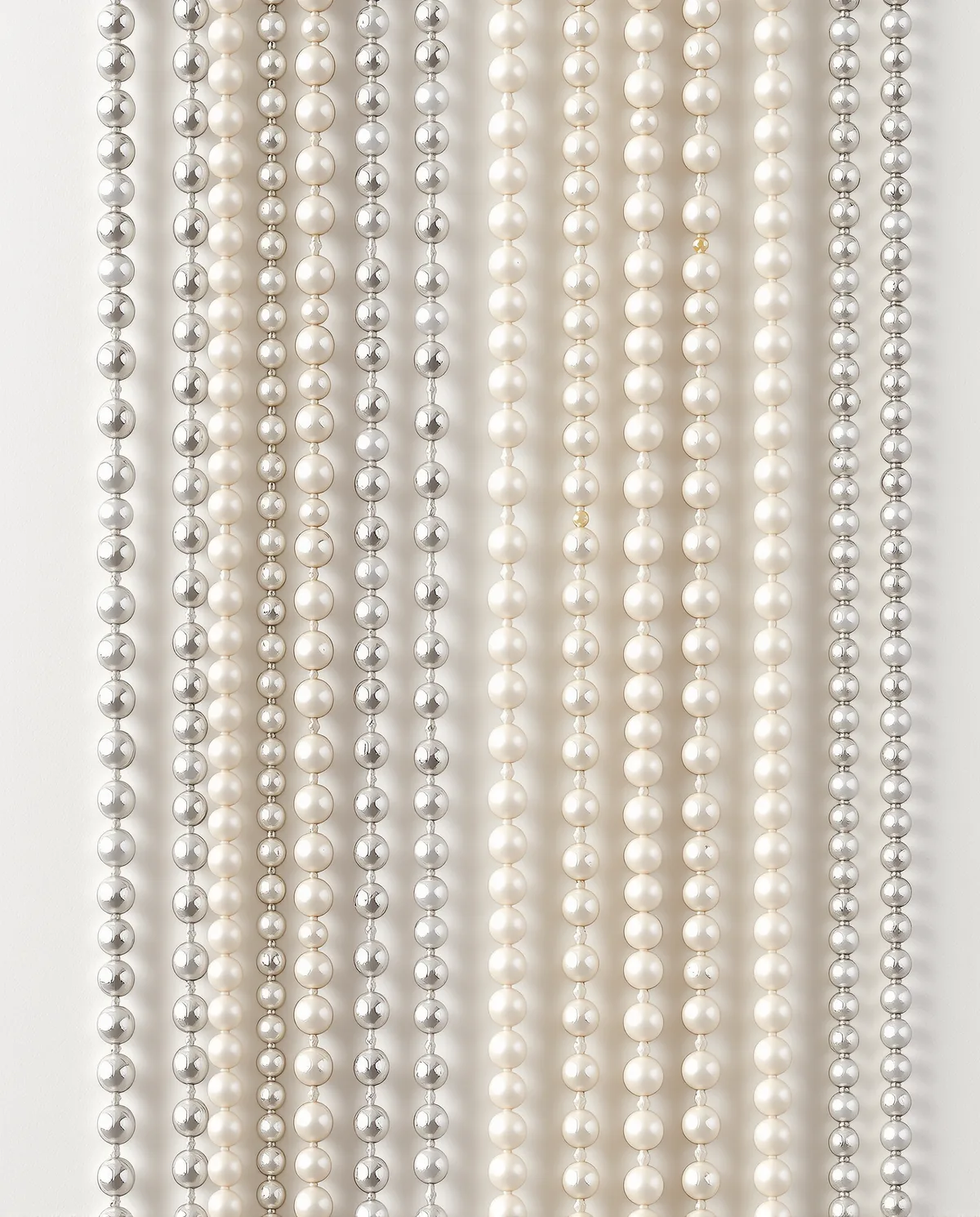
The imagery on this page is editorial and shows the material: swirl, inclusion, and how light enters a hand-made bead. What a buyer receives is the approved sample, matched in production.
The note is that the real photography for this design is production-floor and quality-control material — beads after the annealing fix, on a bench. It is valuable evidence and it is not styled imagery, so it is not used here as if it were.
None of the named 2027 stories. Gigi's palette is described as a Venetian multi, revised for strength, and it belongs to the production programme rather than to the design-render library.
The Venetian bead, entirely. Nothing else in the build is doing visual work, which concentrates both the cost and the risk in one component — and is why the development effort went where it did.
Good to know
Within limits, and the limits are structural rather than stylistic. Glass strength is colour-dependent, and some colours are not compatible when they clink against each other in a hanging curtain. Any new palette for this design is checked for strength before it is checked for looks.
Yes. Width, drop and strand count are set per order. A larger piece raises the number of large feature beads, which raises both cost and the importance of the annealing step, because there are more knocking surfaces.
Large hand-made Venetian glass beads with swirls and inclusions, lampworked and strung in our own Firozabad glass works. The beads are individually made rather than pressed from a mould, which is what gives them their character and their variation.
Exclusivity is a commercial decision taken per programme rather than a property of the design. Name it in the brief and it is quoted alongside the piece.
The imagery here is editorial and shows the material — the swirls and inclusions of a hand-made glass bead and how light enters it. What a buyer receives is the approved sample, matched in production and inspected against it. The working photography for this design comes off the production floor rather than out of a studio.
Strands are kept in order and protected against knocking in transit, then packed to your carton, label and packaging specification. On a large hand-made glass bead the packing specification is part of the engineering answer, not a separate concern.
Keep exploring
Process
What annealing relieves, why a colourant changes the glass it colours, and how a real breakage problem was solved by changing the furnace and the palette.
See the detailDesign
The full-length doorway designs, 90 × 200 to 120 × 210 cm, documented by strand count, hem shape and bead count.
Compare the optionsDesign
120 × 210 cm, the largest drop in the library, in silver, clear and off-white faceted glass.
See the detailDesign
120 × 200 cm on 60 strands with an inverted-V hem, in glossy orange, canary, chocolate and cream soda.
See the detailDesign
Thirty hand-strung strands of translucent acrylic at 90 × 200 cm on a stained header rail, recoloured season after season on one construction.
Specs and sizesMaterial
How seed beads are drawn, why dye lots are quoted per run, what the drill hole limits, and where seed-bead work earns its cost.
How it is made
Start a conversation
Send a reference, a colour chip or a sketch. Minimums are set per design and confirmed per quote; sampling is quoted separately and usually runs 16 to 20 days from an agreed brief.