Material
Seed beads, in detail
How seed beads are drawn, why dye lots are quoted per run, what the drill hole limits, and where seed-bead work earns its cost.
How it is made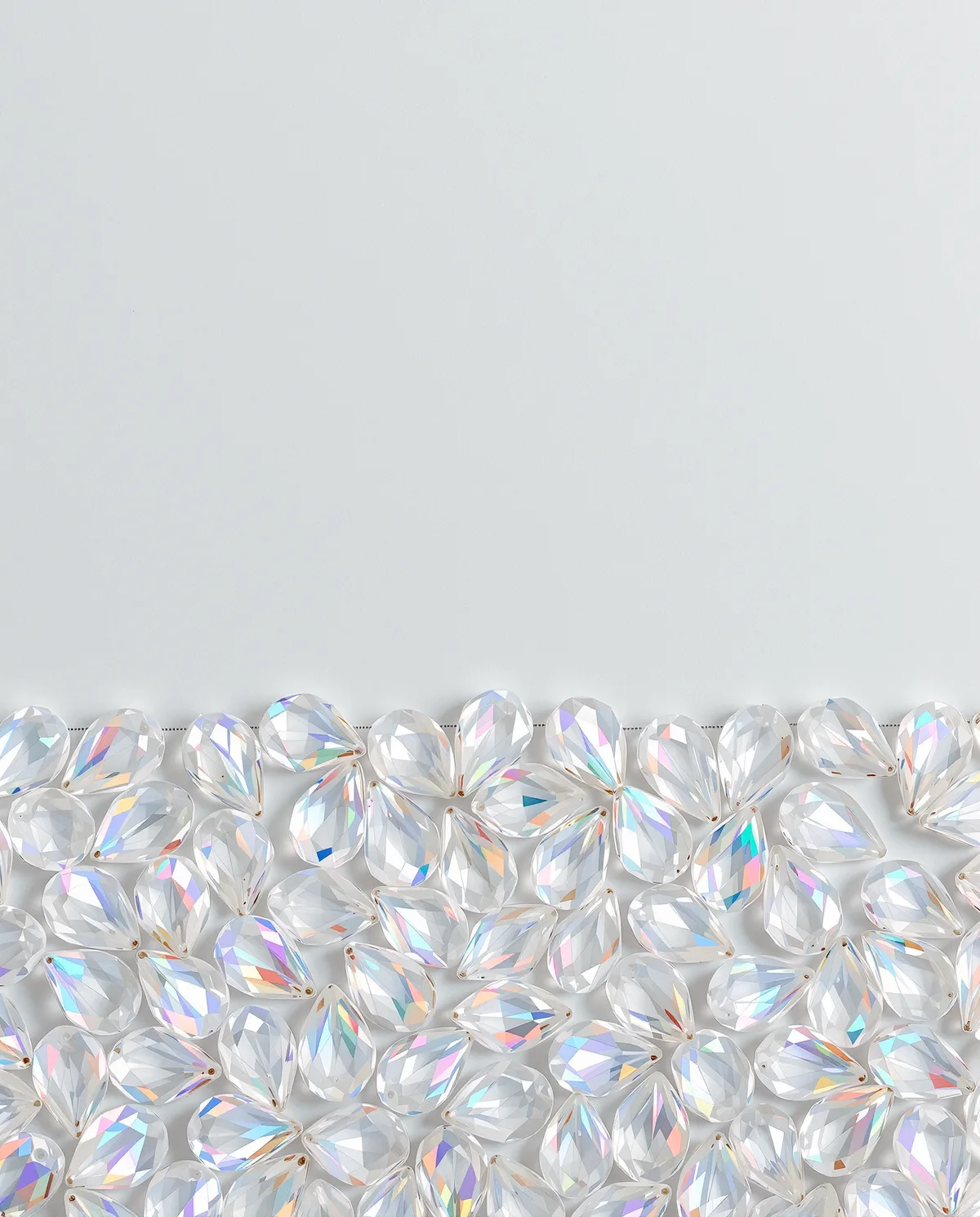
Material · Glass
Buyers ask for crystal. What ships is cut or faceted glass, and we write it down that way every time. The facets are the whole product: they are what turn one light source into forty points of light.
Faceted crystal teardrop beads with a pearlised iridescent AB finish, machine cut to even facets over a clean white glass body.
A crystal beaded curtain is made from cut or faceted glass beads, and we describe them as glass in every specification. Faceting replaces a curved surface with flat planes, so light refracts and reflects in separate directions instead of smearing across a dome. That is what produces sparkle, and it is also what adds weight and cost.
It is a glass bead whose surface has been replaced, in part or whole, by flat planes set at angles to one another. Those planes may be ground and polished onto a formed bead, or pressed into it directly in a mould. Either way the optical result is the same: light entering the bead meets flat interfaces rather than a continuous curve.
The material underneath is ordinary soda-lime glass. There is no leaded crystal in the range, and there is no version of this page where we call it crystal in a specification.
Two routes. A pressed faceted bead takes its facets from the mould, which makes the geometry exact and cheap at volume. A cut faceted bead has its planes ground onto a formed blank and then polished, which gives crisper edges and a brighter return, at more cost per bead.
Both happen in our own Firozabad glass works. Cutting, etching and decoration sit on the capability list for that plant next to glass drawing and hand-stringing, which is why a faceted accent and the seed-bead base it sits on come out of one building.
Points of light instead of a sheen. A curved glass surface returns one broad highlight that slides as you move. A faceted surface returns many small highlights, each at a fixed angle, so a slight movement of the panel or the viewer swaps one set of highlights for another. The effect reads as sparkle, and it is entirely a function of geometry.
This is why the frosted variant is interesting: it is the same material doing the opposite job. Irregular frosted beads of about four to five millimetres, strung alongside glass seed beads, give a soft diffused glow — the sea-glass look — because the surface scatters light rather than refracting it in lines.
It wants a light source and a direction. Doorway curtains, window panels and valances in a room with daylight or a lamp earn it. A corridor with flat overhead light does not: the facets have no single source to split, the sparkle never arrives, and the buyer has paid for an optical effect that cannot happen.
It also wants restraint on pitch. Faceting multiplies whatever density the panel already has, so a tightly spaced faceted panel in strong light does not read as luxurious — it reads as glare. The open-pitch build is usually the better one here, which is the reverse of the instinct.
Shape and nominal dimensions. Facet count or cut style. Whether the surface is polished, frosted or coated. The hole diameter. The colour method, and in particular whether an iridescent or pearlised effect is body colour or a surface layer. That last distinction is the one that causes arguments later, because a coating wears and cleans differently from glass that is coloured through.
The word crystal should not appear in the pack at all, including in the style name a retailer uses on the shelf. What a retailer calls it at point of sale is their decision; what the manufacturing document calls it is ours.
To the melt and through the cut. The glass is melted, formed, faceted, finished and hand-strung in a plant we own. The practical consequence is that the three things that decide whether a faceted bead works — body colour, facet geometry and surface finish — are all adjustable on a sample run rather than fixed by what happens to be available.
That it is crystal, lead crystal or a named crystal brand. That faceting makes a bead stronger: it does not, and a cut edge is if anything a stress concentration, which is why larger faceted feature beads are annealed. And that sparkle is a property of the bead alone — it is a property of the bead, the light and the pitch together, and a sample photographed under a soft box tells a buyer almost nothing about how the panel will read in their store.
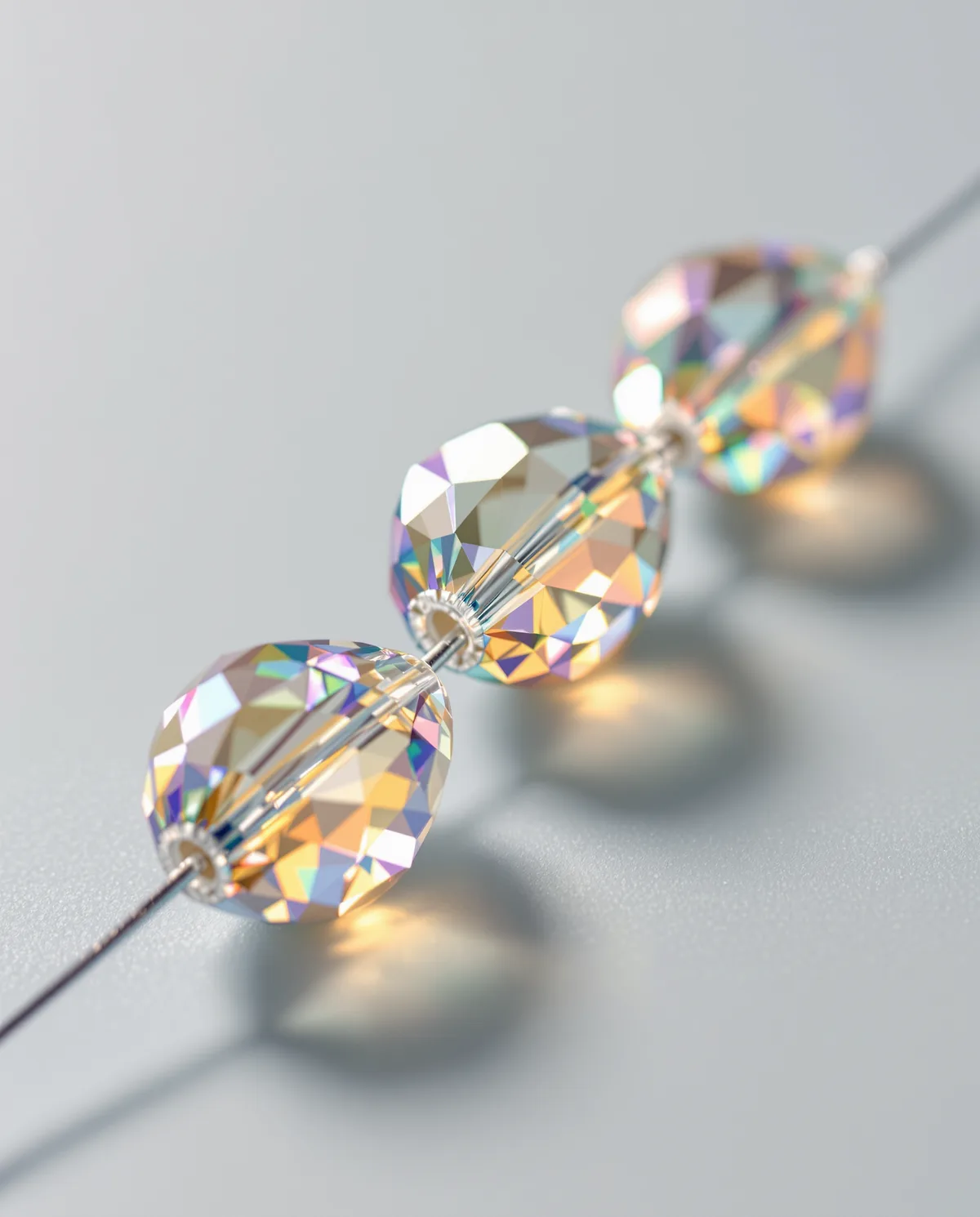
Two recorded constructions. The first is an iridescent portal built on faceted teardrop beads with a pearlised finish, strung on a clean white base — the faceting carries the piece and the base stays silent. The second is a valance built on irregular frosted beads of about four to five millimetres strung with glass seed beads, with larger drop beads at the strand ends and a scalloped arch hem, fullest at the sides.
The second is also a real lesson in cost. That valance was re-engineered by cutting its height, because the bead count follows the drop and the drop is the cheapest thing in a design to shorten.
A ten-millimetre faceted drop works out near 1.2 to 1.4 g, so a hundred land around 130 g — arithmetic from a nominal 2.5 g/cm³ rather than weighed samples. Faceted shapes are solid and compact, so they sit at the heavy end of their nominal size rather than the light end.
On a panel that weight is useful: it pulls the strand straight and stops it swinging, so a faceted drop at the hem does the job a weighted end bead is otherwise added for. It is less useful on the fixing. A faceted glass door panel is one of the heavier things in the category, and it belongs on a rod with brackets fixed into the frame rather than on a tension rod.
Tinted transparent glass is where this material is at its best, because colour and refraction compound: a light passing through amber glass and out through three facets delivers three amber highlights rather than one amber wash. Body colour comes from the melt, so the palette is the melt palette and a new colour is a furnace trial.
Surface finishes extend it. An iridescent or pearlised coating shifts hue with angle, which on a moving panel is an asset. Declare it as a coating, because it is one.
The hole is measured on the bead and confirmed at specification stage, where it is written onto the stringing sheet along with the facet count and the finish. What governs the build is the smallest hole in it. On almost every faceted panel that is the seed-bead base rather than the faceted accent, so the cord decision is made at the base strand and the accent simply has to accept it.
The geometry repeats, because a cut or a mould is geometry. Colour and coating are what need holding. A body-coloured tint is matched to the approved sample bead; a surface coating has to be held on both hue and coverage, because thin coverage reads as a different colour rather than as a thinner one.
For a programme that reorders across seasons, the specification that survives names the bead, names the finish type, and points at a retained approved sample. A colour reference on its own will not settle a dispute about an iridescent coating.
| Specification | Working value | Why it matters |
|---|---|---|
| Material | Soda-lime glass, cut or pressed with facets, then polished | Not leaded crystal; the specification says glass |
| Recorded formats | Faceted iridescent teardrops; irregular frosted beads about 4–5 mm | Two opposite optical jobs from one material family |
| Surface options | Polished, iridescent or pearlised, frosted | Polished refracts; frosted diffuses; iridescent shifts hue by angle |
| Weight behaviour | A 10 mm faceted drop works out near 1.2–1.4 g, about 130 g per hundred | Arithmetic from nominal density; faceted shapes are solid and compact |
| Drill hole | Confirmed per bead on the stringing sheet | Cord is sized from the smallest hole in the build, not this one |
| Colour route | Body colour from the melt, or a surface coating | A coated iridescent finish is a surface and must be declared as one |
| Where it earns its cost | Rooms with one strong light source | In flat ambient light faceting returns very little |
| Made where | Cut, finished and hand-strung in our own Firozabad glass works | Cutting, etching and decoration are capabilities in the plant |
Good to know
No. We use cut or faceted glass beads to give a crystal look, and we describe them as glass. Leaded crystal is a different material with a different composition, and calling soda-lime glass by that name would be a claim we could not stand behind on a specification sheet.
Hanging work in a room with a real light source — doorway curtains, valances and window panels where daylight or a lamp can strike the beads from an angle. In flat, even light the facets have nothing to work with, and a faceted panel looks like an expensive plain one.
The shape, the nominal dimensions, the facet count or cut style, whether the surface is polished, frosted or coated, the hole diameter, and the colour method. If the finish is a surface coating rather than body colour, that has to be stated, because a coating behaves differently in wear and in cleaning.
Yes. Cutting, etching and decoration are capabilities in our own Firozabad glass works, alongside drawing and pressing, and the beads are hand-strung in the same plant. No agents, no brokers.
Body colour comes from the melt, so the palette is the melt palette, and tinted transparent glass is where faceting looks best — colour plus refraction together. Iridescent and pearlised effects are surface finishes layered over that, and they shift hue with viewing angle, which is a feature on a hanging piece and a nuisance on a flat one.
It depends on the bead and is confirmed on the stringing sheet. The figure that actually governs a build is the smallest hole in it, which on a mixed panel is the seed-bead base rather than the faceted accent — so a faceted drop with a comfortable hole does not rescue a cord that is too thick for the base strand.
The cut is, because it is geometry. The body colour needs holding against the approved sample bead, and a surface coating needs holding against both colour and coverage. Where a programme reorders over a long period, the safest specification names the bead, the finish type and the approved sample, rather than a colour reference alone.
Keep exploring
Material
How seed beads are drawn, why dye lots are quoted per run, what the drill hole limits, and where seed-bead work earns its cost.
How it is madeMaterial
Why a mould, not a draw: how a pressed shape repeats across a run, what the mould seam costs you, and where a feature bead earns its weight.
Specs and sizesGuide
Resolution, weight, repeatability, cost per covered area and breakage risk, with the working figures from production.
How it is madeTechnique
The bead map, the cord, thirty strands on a dowel, hem shapes, suspension loops — and the three levers that move the cost.
See the detailReference
Nine material families, what each gives in light, weight and colour, and how far our own manufacturing reaches into every one of them.
Compare the options
Start a conversation
Send a reference, a colour chip or a sketch. Minimums are set per design and confirmed per quote; sampling is quoted separately and usually runs 16 to 20 days from an agreed brief.