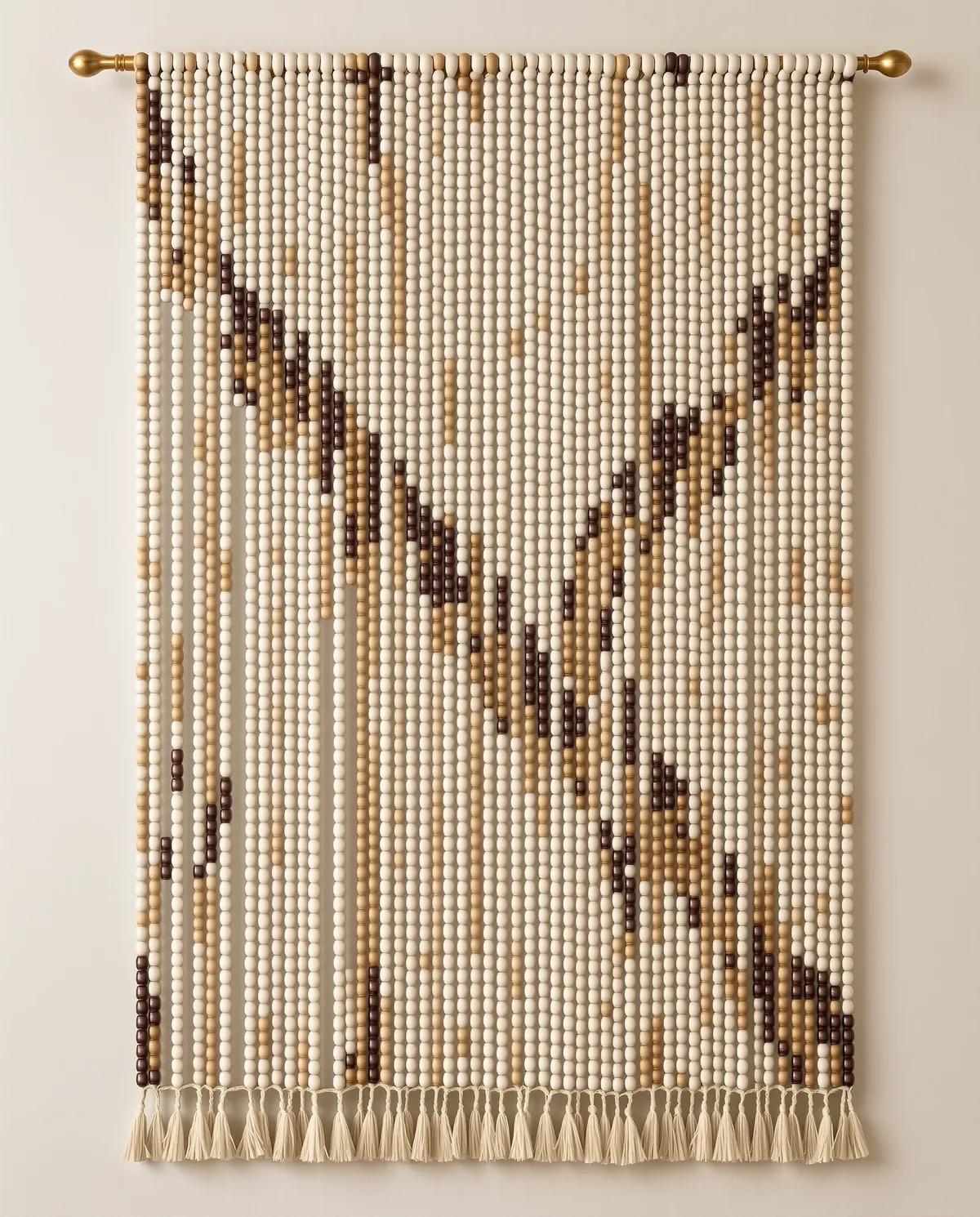
Specification
The specification sheet
Diameters, drill holes, cord selection, strand counts and format dimensions — the sheet to copy into a tech pack.
Read moreReference · Formats
The format table, with the origin of every figure marked. Some of these are shipped dimensions; some are drawn library values, and the difference matters when you cost them.
The standard door panel is about 90 by 200 cm, roughly 35 by 79 inches, hung from a wooden dowel or rod. Portals run 76 by 140 cm and a dual wall-hanging format 90 by 67 cm. Valances sit around 120 by 35 cm or 76 by 61 cm, and strung wall hangings run 50 to 76 cm wide.
Four values: width, the longest drop, the shortest drop where the hem is shaped, and the header depth. Everything else on a format line — strand count, bead count, weight, carton size — follows from those four and the construction.
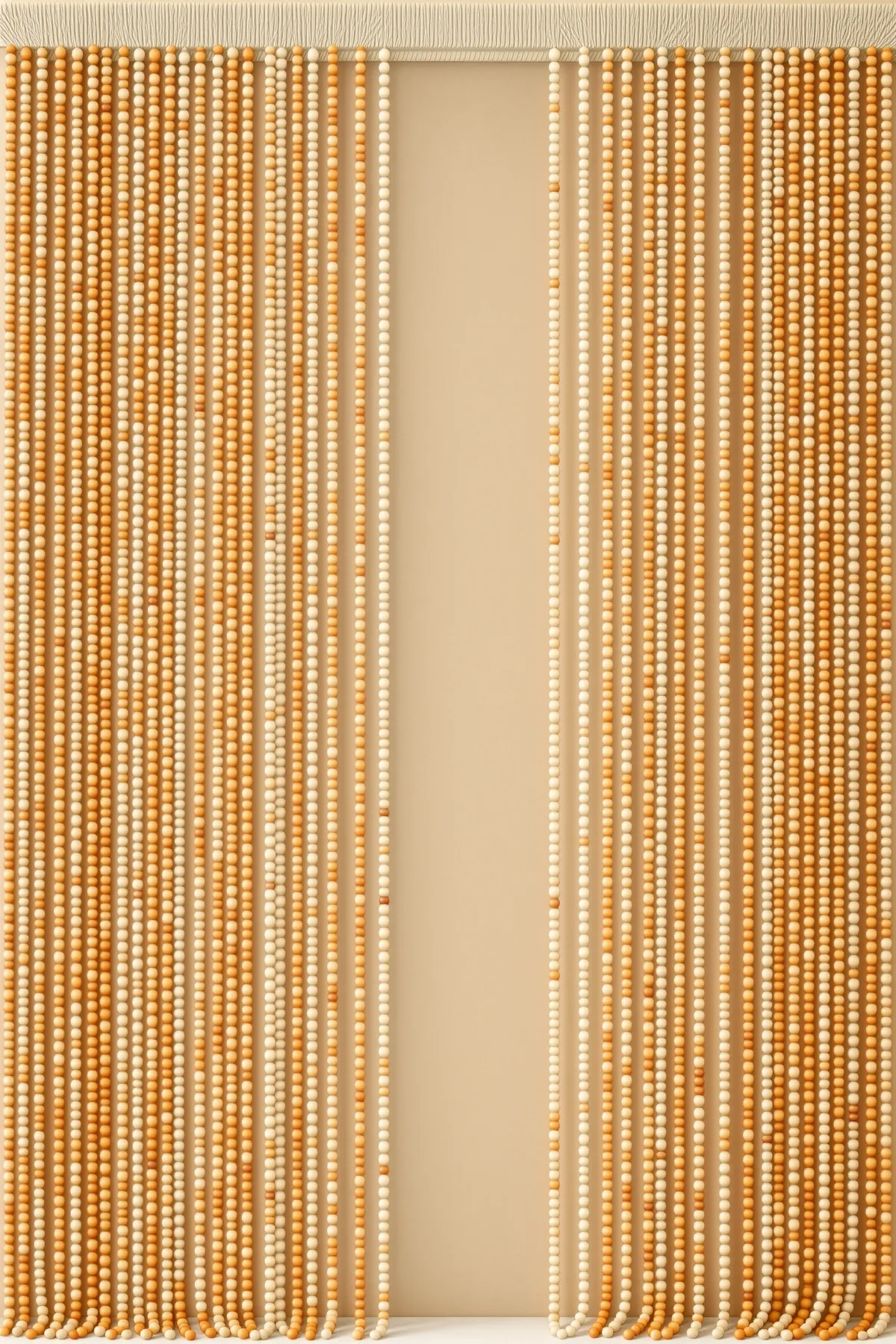
A format is not a product. Two 90 by 200 cm panels can differ in bead count by a factor of three, so the format fixes the envelope and the construction fixes what fills it.
| Format | Finished size | Strands or columns | Origin |
|---|---|---|---|
| Door panel | About 90 × 200 cm (35 × 79 in) | 30 hand-strung strands on a single dowel | Record |
| Door panel, wide | 120 × 200 cm | Up to 60 strands | Record (image alt) |
| Door panel, short drop | 120 × 180 cm | Up to 60 strands | Record (image alt) |
| Doorway portal | 76 × 140 cm (30 × 55 in) | 27–40 strands | Record |
| Wall hanging and portal, dual format | 90 × 67 cm | Not stated | Record |
| Café curtain | 24 × 30 in plus a 3 in rod pocket | Cotton header band | Record |
| Valance | 120 × 35 cm | 56–60 strands | Record (image alt) |
| Valance, arched | 30 × 24 in (76 × 61 cm) | 30 strands, longest drop 24 in, shortest 10 in | Record |
| Wall hanging, strung | 50–76 cm wide, 46–100 cm high | 20–40 strands | Library |
| Wall hanging, laser-cut blossom | 18 × 30 in | 130 blossoms on a rod pocket, 155–170 on a dowel | Record |
| Linked faux-capiz hanging | 70 × 130 cm to 90 × 200 cm | 12–16 columns, about 239–497 discs | Library |
| Full-length panel, library range | 90 × 200 cm to 120 × 210 cm | 40–60 strands | Library |
The door panel figure is the one with the strongest record behind it: about 90 by 200 cm, roughly 35 by 79 inches, hung from a wooden dowel or rod, thirty hand-strung strands on a single dowel being the common build. The 120 by 200 cm and 120 by 180 cm panels and the 120 by 35 cm valance are shipped sizes too.
The library rows are different in kind. They come from the 2027 design renders — drawn designs — and where a figure is drawn the table says so. A specifier costing against a library row should expect it to move on the first sample.
Width across the header, because strands drift at the hem and a hem measurement is not reproducible. Drop from the underside of the header to the bottom of the end bead. Header length separately, since it usually overhangs the beadwork at each end.
Overall height, where a retail ticket needs it, is the drop plus the header depth and is a different number. Mixing the two is the commonest dimensional error in an incoming brief.
The format envelope does not change with material, but what fits inside it does. A glass panel at 90 by 200 cm weighs considerably more than an acrylic one of the same dimensions, because glass runs around 2.5 grams per cubic centimetre against acrylic at about 1.2 and most woods below 1.
Increments change too. Strung beadwork can be tuned bead by bead, so almost any drop is achievable. A linked disc construction steps one disc at a time: with 25 mm and 50 mm discs in the library, the achievable drops form a ladder rather than a range.
It has to be stated, not assumed. A hand-strung panel at a two-metre drop is assembled bead by bead against a counted sheet, and a cumulative difference of a bead or two across a long strand is normal rather than defective.
The useful discipline is to give a tolerance on width, on the longest drop and on the shortest drop, and to accept that the tightest of the three should be the one the design actually depends on.
Height is a major cost lever, because it multiplies directly into bead count and stringing time. In our own record a valance height was cut from 30 inches to 26 specifically to reduce bead consumption, and the cost moved with it.
Width drives cost through strand count rather than directly: a wider panel at the same pitch simply has more strands. That is why trimming width rarely saves what a buyer expects, and trimming drop usually saves more than they expect.
That the format set is wider than the catalogue language suggests. Alongside door panels the record carries portals at 76 by 140 cm, a 90 by 67 cm dual wall-hanging and portal format developed in 2026, café curtains at 24 by 30 inches on a cotton header with a three inch rod pocket, arched valances at 30 by 24 inches with a longest drop of 24 inches and a shortest of 10, and laser-cut blossom wall hangings at 18 by 30 inches.
That last one carries a detail worth noting: the dowel version takes 155 to 170 blossoms and the rod-pocket version 130, for the same finished size. The header changes the piece.
In the dimension block, as width by longest drop, with the shortest drop and the header depth on their own lines. Inches or centimetres, consistently, and stated — a mixed-unit pack is how a 30 inch valance becomes a 30 cm one.
Café curtains and valances are commonly specified in inches because the buyer-side window-panel standards they follow are, and converting them to centimetres for internal tidiness loses the relationship to those standards.
The drawing, for width and header length, and the colour-count sheet for the drops, because the sheet is where the bench's working drop values live. First-article inspection measures them on the opening pieces before the balance of the run is strung.
Shaped hems get the most attention, since an error in a single strand reads as a notch in the hem line rather than as a dimension that is slightly out.
Three, repeatedly. Ninety centimetres is about 35 inches, not 36, which matters because a 36 inch door needs the 120 cm panel. Two hundred centimetres is about 79 inches, and a brief that converts it to 80 and then specifies to the floor ends up with the hem on the floor.
And the valance one: 30 by 24 inches is a width of 30 and a drop of 24, while 120 by 35 cm is a width of 120 and a drop of 35. Both are width first. Packs that silently switch to height first are the reason we restate the axis in words.
The spec table above. It is deliberately organised by format rather than by size, because a specifier starts from what the thing is and only then asks how big it is.
North American door-fit guidance sits alongside it: interior doors commonly run 28 to 36 inches wide, a 90 cm panel covers most of that range, and 120 cm is the answer for a 36 inch door and for wider openings.
A universal standard size. There is none. Nor is there a published weight per format, a minimum order quantity per format or a price per format, and none of those appears here.
Room divider dimensions deserve their own caution. Divider formats exist in the design library, but no beaded room divider has been made, sampled or shipped. Those figures are drawn concepts and specifying one as a current product would be a fabrication.
The format defaults to the nearest library design, which is usually the 90 by 200 cm panel. For a buyer who wanted a café length or a wide opening, that default is a wasted sample cycle.
Where only an opening size is given, the maker has to infer the floor gap and the header depth. Both inferences are visible on the hung sample, and neither is the maker's decision to make.
Good to know
Width, the longest drop, the shortest drop if the hem is shaped, and the header depth. Those four fix the format. A single overall height is not enough, because it does not say how much of it is header and how much is floor gap.
Finished width across the header, the longest and shortest drops, and the header length against the drawing. On the first-article pieces these are measured rather than compared by eye, and they are read against the colour-count sheet, which carries the drop values the bench worked to.
Because no industry standard exists for beaded panel sizes, and we would be presenting house figures as norms. What is published is the set of formats we actually build, with the origin of each figure named, which is more use to a specifier than a single invented standard.
For a door panel, about 90 by 200 cm, roughly 35 by 79 inches, on a wooden dowel or rod. That is the size most single interior doors take and the one most of our shipped work sits at.
Width across the header, not across the hem, because strands move. Drop from the underside of the header to the bottom of the end bead. Overall height, where it is quoted, includes the header and is a different number from the drop.
State one. Hand-strung work holds a tolerance rather than a dimension, and a drawing that gives a finished size with no tolerance has left the acceptance criterion to be argued about at inspection. No tolerance allowance is published for beadwork; the tolerances page sets out which dimensions need one and what hand work can realistically hold.
The formats do not, but the achievable increments do. A strung panel can be tuned bead by bead to almost any drop. A linked faux-capiz hanging moves one disc at a time, so with 25 mm and 50 mm discs the achievable drops are a series rather than a continuum.
Keep exploring
Specification
Diameters, drill holes, cord selection, strand counts and format dimensions — the sheet to copy into a tech pack.
Read moreSpecification
The dimensions, strand values, fixings and performance limits a drawing and schedule have to carry.
How it is madePillar
Door curtains, portals, café lengths and valances: the standard sizes, the strand counts and the one question each format answers.
Compare the optionsReference
Specification sheets and definitions — the pages to send a designer before they draw.
How it is madeSpecification
Why beadwork is a volume problem before a weight problem — carton sizes, pieces per master, and the effect on a landed price.
Compare the options
Start a conversation
Send a reference, a colour chip or a sketch. Minimums are set per design and confirmed per quote; sampling is quoted separately and usually runs 16 to 20 days from an agreed brief.