Glossary
Drop, defined for beadwork
The finished length of a strand — and why a shaped hem needs the longest and the shortest drop, not a hem name.
Read the guideSpecification · Geometry
The hem is the only drawn line on a bead panel. A hem named but not dimensioned is a line somebody else is going to draw for you.
A hem is specified by three things: the profile, the longest drop and the shortest drop. A name alone — scalloped, V-point, swag — does not tell the bench where each strand ends. From our own record, an arched valance ran a longest strand of 24 inches against a shortest of 10 across a 30 inch width.
The only drawn line on the whole panel. Strands are vertical and visually interchangeable; the hem is where a bead panel becomes a shape rather than a field.
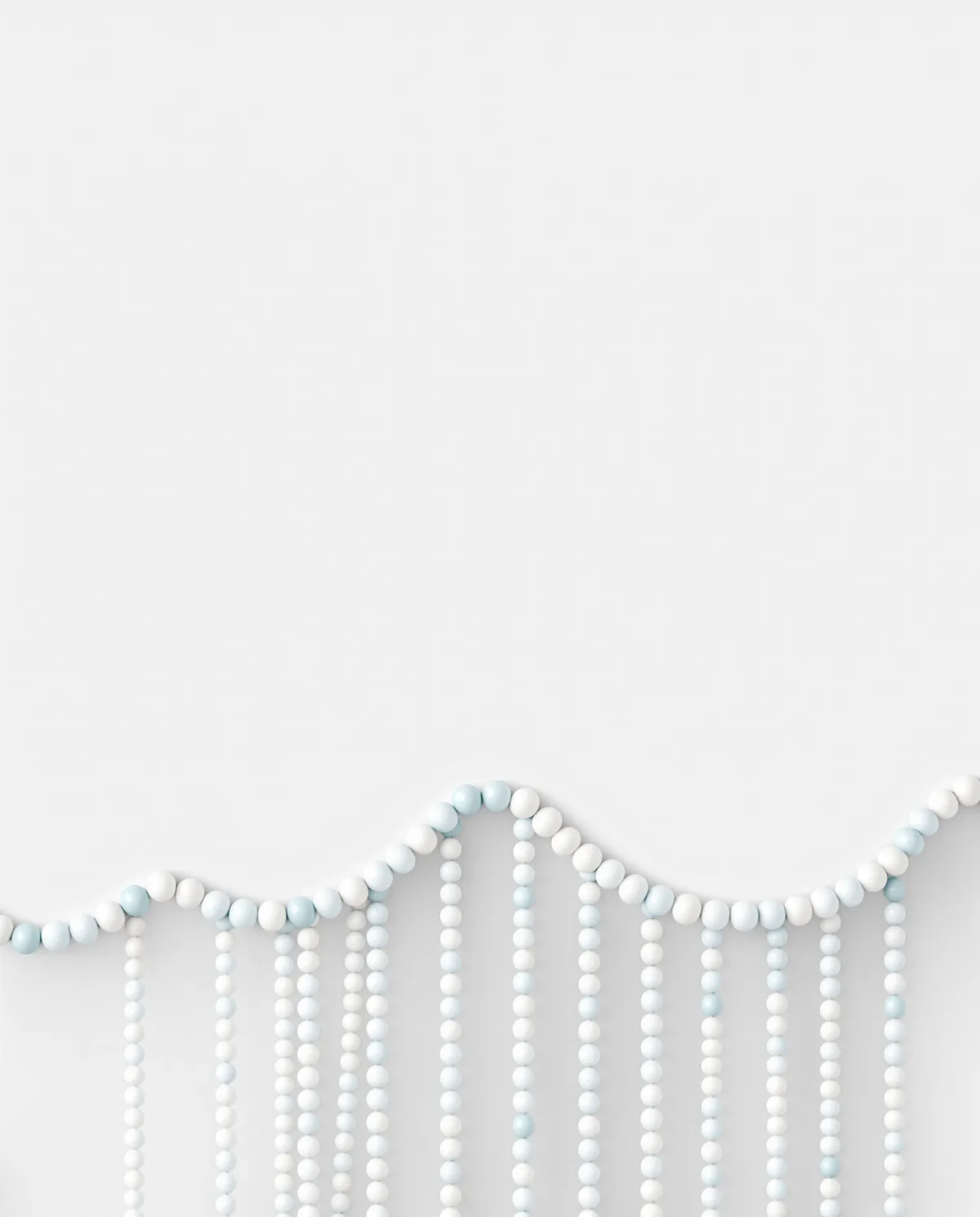
The decision is a profile, two drops and — on anything that repeats — a repeat width. Three or four values, and the hem is specified.
| Profile | What it looks like | What must be stated |
|---|---|---|
| Straight | All strands the same drop | One drop |
| Scalloped | Repeating curved dips across the width | Longest and shortest drop, plus the repeat width |
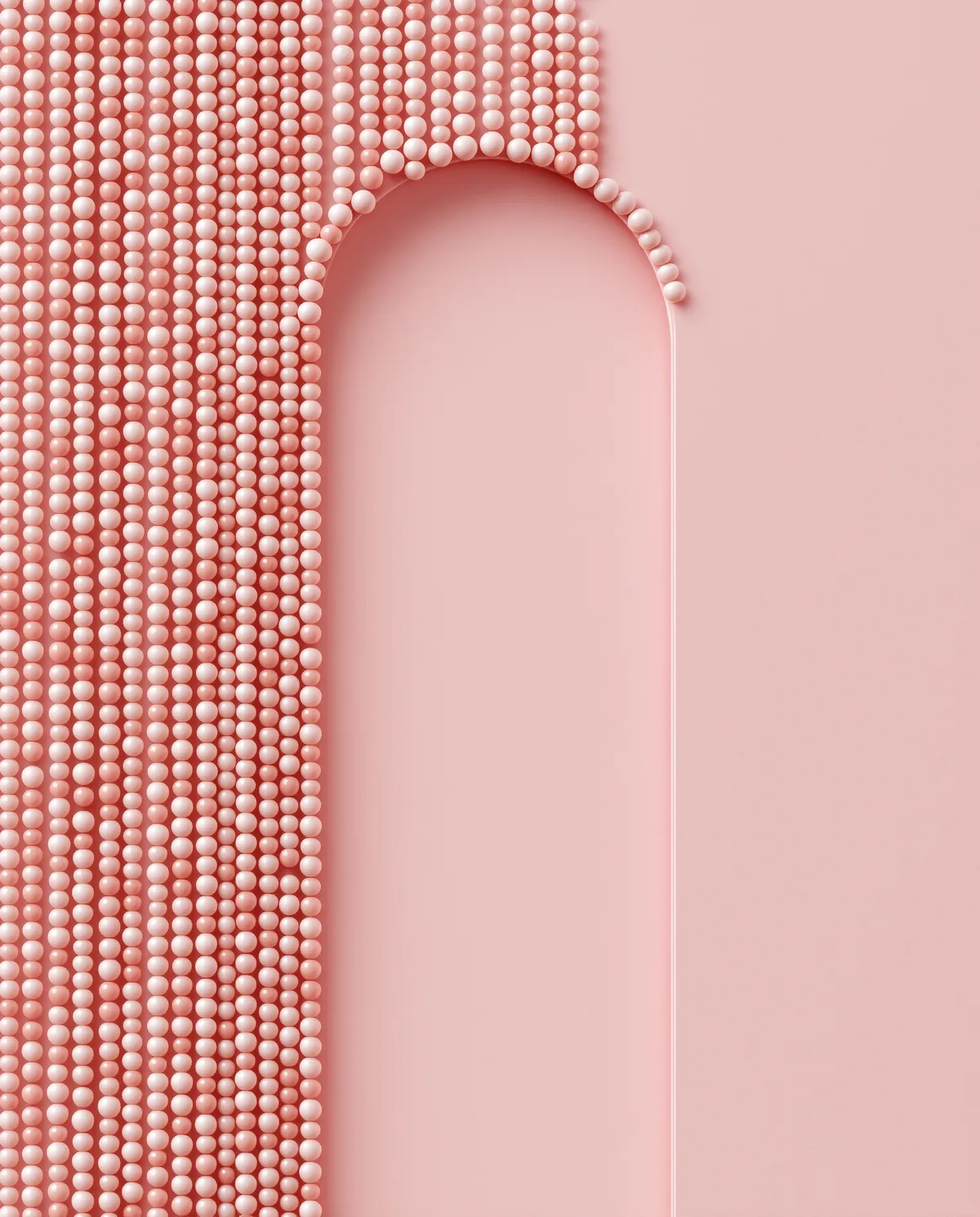
| Scalloped arch | One sweep up to the centre, fullest at the sides | Longest and shortest drop; 24 in to 10 in on a recorded 30 in valance |
| Scalloped chevron | Repeating angular dips | Longest and shortest drop, plus the repeat width |
| V-point | Single point at the centre, longest in the middle | Longest and shortest drop |
| Inverted-V | Shortest at the centre, longest at the sides | Longest and shortest drop |
| Swag | Shallow curve hanging between two high points | Longest and shortest drop, plus the high-point positions |
| Diagonal | One continuous slope across the width | Drop at each end |
| Staggered or uneven | Deliberately irregular | A drop range and a reference image or count sheet |
| Fan arch | Repeating fan sweeps | Longest and shortest drop, plus the repeat width |
| Arched-cut drop | An arched opening cut out of the middle of the panel | Opening width and height, plus the drops either side |
The profile by name, the longest drop, the shortest drop, and the repeat width where the profile repeats. For an arched-cut drop, the opening width and height as well.
A name on its own is the commonest failure. Scalloped describes a family of shapes that can be a 20 mm dip or a 300 mm one, and the bench cannot choose between them.
Start from the opening and the longest drop, because the longest drop is what has to clear the floor. Then decide where the panel should be fullest: at the sides, in the centre, or evenly.
Then set the shortest drop, which fixes the depth of the shape, and the repeat width if there is one. Finally check the bead count, because a shaped hem removes beads and a deep profile removes a lot of them.
Through the floor rather than the fixing. A profile has a longest drop and that is the dimension that has to clear the finished floor, not the average drop and not the drop at the centre.
A panel specified from its average will drag at its longest points, and on a doorway in use that wears the end beads at exactly the places the design made longest.
The specification carries the profile and the geometry, because the hem is usually common to the whole package. The schedule carries the drops per opening, since drops change with the opening height even when the profile does not.
Where the profile genuinely varies between openings, it belongs in the schedule with a note confirming the variation is deliberate.
When a shaped hem was dimensioned from the drawing's average rather than its extremes, so the longest strands touch the floor. And when a repeat width was not stated, so the profile does not centre on the opening and ends on a half scallop at one side.
Both are drawing-stage errors and both are visible from across the room.
The hem at full drop, across at least one complete repeat. A half-repeat sample shows the beads and tells you nothing about the shape.
For an arched-cut drop, sample the full opening height, because the way the arch reads depends on how the strands either side of it fall rather than on the arc itself.
A profile with its longest strands at the edges of a doorway puts its most exposed beads where hands and door frames are. Those are the strands that will need end beads replaced.
A straight hem wears evenly. A deep V-point wears at one point. That is worth knowing on a hospitality installation with a real maintenance budget.
A shaped hem reads only if the shape is deeper than the strands move. Strands on a hanging panel settle and sway, and a shallow profile — a 20 mm scallop on a two-metre drop — disappears into that movement.
Deep profiles read. The recorded arched valance, with a longest drop of 24 inches and a shortest of 10 across a 30 inch width, is deep enough that the shape is unmistakable, which is why it works.
Several profiles in production. A scalloped arch hem, fullest at the sides, on a frosted sea-glass valance at 30 by 24 inches with the longest strand at 24 inches and the shortest at 10. A scalloped chevron hem on a café curtain with moulded daisy connectors. An arched-cut drop on door panels, where an arched centre opening frames a walk-through.
Those are shipped shapes with shipped dimensions, which is why they are worth quoting rather than describing in the abstract.
The profile name, the longest and shortest drops as built, the repeat width, and the colour-count sheet. The sheet records the drop of every individual strand, which is what makes an ordered replacement strand the right length rather than approximately right.
It changes the increment the hem can be drawn in. Strung beadwork adjusts bead by bead, so a profile can be hit closely. Linked faux-capiz columns step one disc at a time, so a shaped hem in 50 mm discs is drawn in 50 mm steps whether the profile wants them or not.
Bead diameter does the same on a smaller scale: a profile built from 13 by 22 mm ovals is drawn in 22 mm steps, while one built from seed beads at 1 to 3 mm is effectively continuous.
The tightest on the package, on the longest and shortest drops. Those two define the shape and the eye reads them directly.
Intermediate strands can carry more, but the tolerance should be stated as a deviation from the drawn profile rather than per strand, because what matters visually is whether the line is smooth, not whether any single strand is exact.
Good to know
Tighter than anywhere else on the panel. The hem is read as a drawn line, so an error in one strand shows as a notch rather than as a dimension slightly out. Hold the longest and shortest drops tightest and allow more on the intermediate strands.
The hem at full drop, across at least one complete repeat of the profile. A shaped hem sampled over half a repeat tells you about the beads and nothing about the shape, and the shape is the whole reason for specifying it.
A hem with long strands at the sides catches on door frames and furniture where a straight hem does not. On a doorway in daily use, the longest drop is the part that wears, so a profile whose longest strands sit at the edges of the opening will need more end-bead replacement.
A hem on a hanging panel is only as crisp as the strands are still. Strands move, and a very fine profile — a tight scallop with a shallow depth — will not read as a shape on a panel in use. Deep profiles read; shallow ones blur.
Not the fixing, but the floor. A shaped hem has a longest drop, and it is the longest drop that has to clear the floor, not the average. A profile specified from its average drop will drag at its longest points.
The profile name, the longest and shortest drops as built, the repeat width where there is one, and the colour-count sheet, which records the drop of every strand individually. That sheet is what makes a replacement strand the right length.
Keep exploring
Glossary
The finished length of a strand — and why a shaped hem needs the longest and the shortest drop, not a hem name.
Read the guideSpecification
The dimensions, strand values, fixings and performance limits a drawing and schedule have to carry.
See the detailSpecification
Width at three heights, the drop against the floor gap, and the header depth — the measurements a quote needs.
Read the guideSpecification
How pitch, diameter and opacity combine into a sightline — and the distance at which concealment stops working.
Read moreSpecification
How transmission, refraction and cast bead-shadows behave through the day — and where glare control fails.
Read more
Start a conversation
Send a reference, a colour chip or a sketch. Minimums are set per design and confirmed per quote; sampling is quoted separately and usually runs 16 to 20 days from an agreed brief.