Glossary
The beadwork glossary
The words a bead tech pack uses, defined one term to a page so a specification can cite them.
View the rangeGlossary
One number tells you how long a strand is. Two numbers tell you what shape the hem is. Most briefs send one.
Drop is the finished length of a beaded strand, measured from the underside of the header to the bottom of the end bead. A straight hem needs one drop. A shaped hem needs two — the longest and the shortest — plus the profile between them, because a hem name on its own does not tell the bench where each strand ends.
Drop is how long a strand finishes, measured from the underside of the header to the bottom of the last bead. It is a finished dimension, not a cut length: the cord is longer than the drop because it has to be knotted at the header and secured at the end bead.
That distinction is why drop belongs to the specifier and cut length belongs to the bench. A buyer states the drop they want to see; the maker works out the cord.
In the dimension block, as a pair: longest drop and shortest drop. Beside it sits the overall finished size, which is a different thing — the overall size includes the header and describes the product on a swing ticket, while the drops describe the geometry the bench builds.
A pack that gives only an overall size has not specified the hem.
Because the hem is the only part of a hanging panel that a person standing in the room reads as a line. Strands are vertical and visually interchangeable; the hem is a drawn edge. If the drops are wrong the edge is wrong, and no amount of correct beadwork above it recovers that.
It also matters at the floor. A beaded panel that touches the floor stops swinging freely, collects dust at the hem and wears the end beads. The floor gap is a design decision, and the drop is how it gets specified.
The maker reverse-engineers it from the overall height, subtracting an assumed header and an assumed floor gap. Two assumptions, each worth a few centimetres, and both of them visible when the panel hangs.
It is the most avoidable sample revision in the category.
The definition does not. What changes is the increment. On strung beadwork the drop can be tuned bead by bead, so almost any value is achievable. On a linked faux-capiz hanging the drop moves one disc at a time, so the achievable drops are a series rather than a continuum — 25 mm and 50 mm discs give very different step sizes.
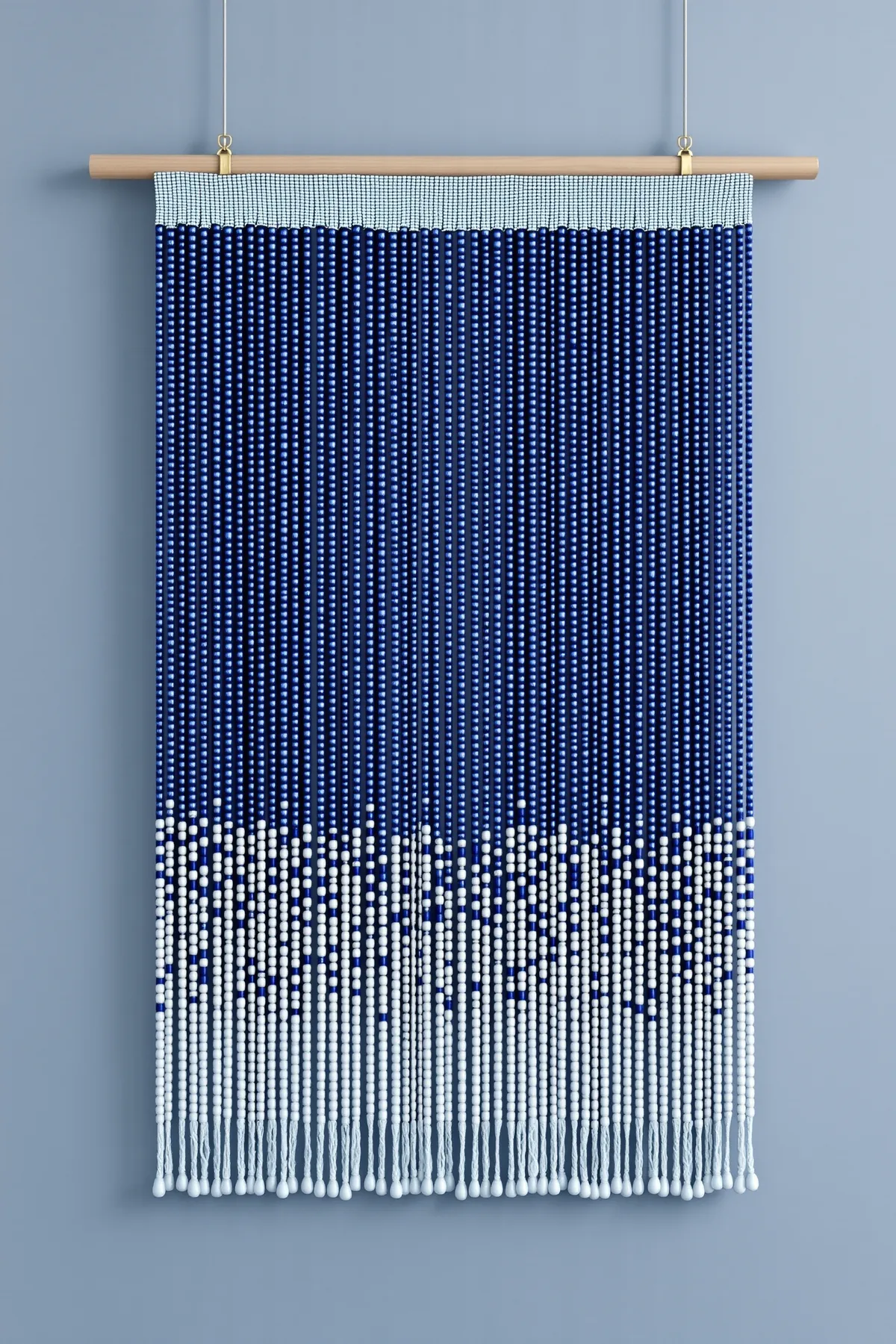
On a graded design the drop also interacts with the bead sizes: where an ombre is built by grading bead size, the drop is what decides how many beads of each size appear, and therefore how sharply the colour steps read.
The buyer or the specifier, from the measured opening. It is one of the few values on a bead specification that the maker genuinely cannot supply, because it depends on a building we have not seen.
The maker's job is to say what the drop implies: the bead count, the weight, the cord, and whether the hem profile asked for is achievable across that range of drops.
From soft furnishings, where drop has meant finished curtain length for as long as curtains have been made to measure. Beadwork inherited the word along with the rod pocket and the valance, which is why a textile-trained specifier uses it correctly without being told.
The one import that does not travel is fullness. A fabric curtain has fullness; a beaded panel has pitch instead.
How long each strand finishes up. For a shaped hem: how long the longest one is and how long the shortest one is.
Overall panel height, opening height and rod-to-floor dimension. All three are larger than the drop and all three turn up in briefs labelled as drop.
It is also, occasionally, confused with the drop bead — the last bead on a strand. The two words sit a centimetre apart on the same product and mean entirely different things, which is why the end-bead entry is worth reading beside this one.
A door panel runs a drop of around 200 cm. A café-length piece is far shorter. From our own valance record, a 30 by 24 inch piece ran a longest strand of 24 inches against a shortest of 10, which is a deep scalloped arch, fullest at the sides.
Where a valance height was cut from 30 inches to 26 to reduce bead consumption, the drop was the lever that moved. Height is a real cost driver, and drop is the number it is expressed in.
By measuring the longest and shortest strands on the first-article pieces and comparing them with the colour-count sheet. Intermediate strands are spot-checked, because on a shaped hem an error in one strand reads as a notch in the edge.
Tolerance is stated, not assumed. Hand work holds a tolerance; a drawing that gives a drop with no tolerance has left the acceptance criterion to be argued about later.
The stringing specification sheet, which carries drop alongside the rest of the dimension set, and the strand pitch entry, because pitch and drop together are the whole geometry of a hanging panel.
The tech pack entry sets out which block of the document each of these values belongs in.
Extractable data
| Field | Value |
|---|---|
| Term | Drop |
| Also written | Finished drop; strand length |
| One-line definition | Finished strand length, header underside to bottom of the end bead |
| Where it appears | The dimension block, as longest drop and shortest drop |
| Confused with | Overall panel height, opening height, rod-to-floor dimension |
| Who states it | The buyer or specifier, from the measured opening |
Good to know
On a door panel the drop is around 200 cm, which with a header puts the hem just clear of the floor. On a valance from our own record the longest strand ran 24 inches and the shortest 10, across a 30 by 24 inch piece. Those are the two shapes of answer: one value, or a pair.
The maker works the drop back from the overall height, which means guessing how much the header takes and how much floor gap you wanted. Both guesses land in the sample, and a 30 to 50 mm error at the hem is visible on a hung panel in a way it is not on a drawing.
The finished length of a strand, from the underside of the header to the bottom of the end bead.
In the dimension block, written as longest drop and shortest drop. It should sit beside the overall finished size rather than inside it, because the two are different measurements and conflating them is the commonest dimension error in an incoming brief.
Overall panel height, which includes the header, and opening height, which includes whatever gap you want at the floor. A 200 cm opening does not take a 200 cm drop, and a brief that assumes it does arrives with the hem on the floor.
Keep exploring
Glossary
The words a bead tech pack uses, defined one term to a page so a specification can cite them.
View the rangeSpecification
Diameters, drill holes, cord selection, strand counts and format dimensions — the sheet to copy into a tech pack.
Open the referenceGlossary
The centre-to-centre distance between strands at the header — width divided by pitch is the strand count.
Read the guideGlossary
The last bead on a strand: it closes the cord, finishes the hem, and weights a light strand so it hangs straight.
Specs and sizesGlossary
The historical name for a curtain hung at a doorway — and why the word still earns its place on a brief.
Read the guide
Start a conversation
Send a reference, a colour chip or a sketch. Minimums are set per design and confirmed per quote; sampling is quoted separately and usually runs 16 to 20 days from an agreed brief.