Compliance
Fire testing beadwork
What NFPA 701 burns, why the cord and header carry the result, and how a project gets a report against its own build.
Open the referenceSpecification · Fire
There is no fire rating for a strung bead panel. This page is about writing the requirement anyway, so that what can be tested is tested and nothing is implied that is not true.
A flammability rating belongs to a build rather than to a product name, so a fire requirement has to name the combustible components — the cord, any textile header and any organic bead — the standard required, and the build to be tested. Testing is then arranged against that specific build and quoted with the project.
Whether to commission a test. That is the real decision, because there is nothing to select from: no bead panel we make carries a published flammability rating.

If the project has a fire requirement that reaches soft finishes, the panel is tested as a build. If it does not, the drawing should say the beaded element is decorative and carries no fire classification, so that nobody assumes otherwise.
| Item | What the specification must state | What we can confirm today |
|---|---|---|
| Classification | Named in the specification, not assumed | Tested on the specified build and quoted with the project |
| Combustible components | Cord, textile header, canvas mount, organic beads | These are the components a test would address |
| Non-combustible components | Glass, ceramic, metal, stone beads | These do not burn; they can still fail by thermal shock |
| Acrylic and resin beads | Named as thermoplastic | They soften and melt rather than char; behaviour is established on the tested build |
| Standard required | Named explicitly by the specifier | We arrange testing against the standard named |
| Build to be tested | The complete assembly, not a component | A result applies only to the build tested |
| Test report | Required as a deliverable | Issued by an independent testing house |
| Testing cost and lead time | Quoted separately | Testing is quoted separately from the product |
| Treatment or coating | Named if required | Confirmed per programme and proved on the tested build |
Not a classification, because we have none to offer. What goes on the drawing is the standard the specifier requires, the build to be tested, and a requirement that a test report be issued as a project deliverable.
Naming the build matters as much as naming the standard. A result applies to the assembly tested — that cord, that header, those beads — and not to the format in general.
Ask the fire engineer what reaches this element. In many interiors a decorative hanging at a doorway is outside the scope of the fire strategy; in a hotel corridor, a casino floor or a place of assembly it may not be.
If it is in scope, identify the combustible components, name the standard, and commission a test on the complete build early enough that a failure can be designed around. Testing is quoted separately from the product and takes its own time in the programme.
It decides what the fuel is. Glass, ceramic, metal and stone beads do not burn. If a panel were glass beads on a non-combustible cord with a timber dowel, the only organic components would be the dowel and the cord.
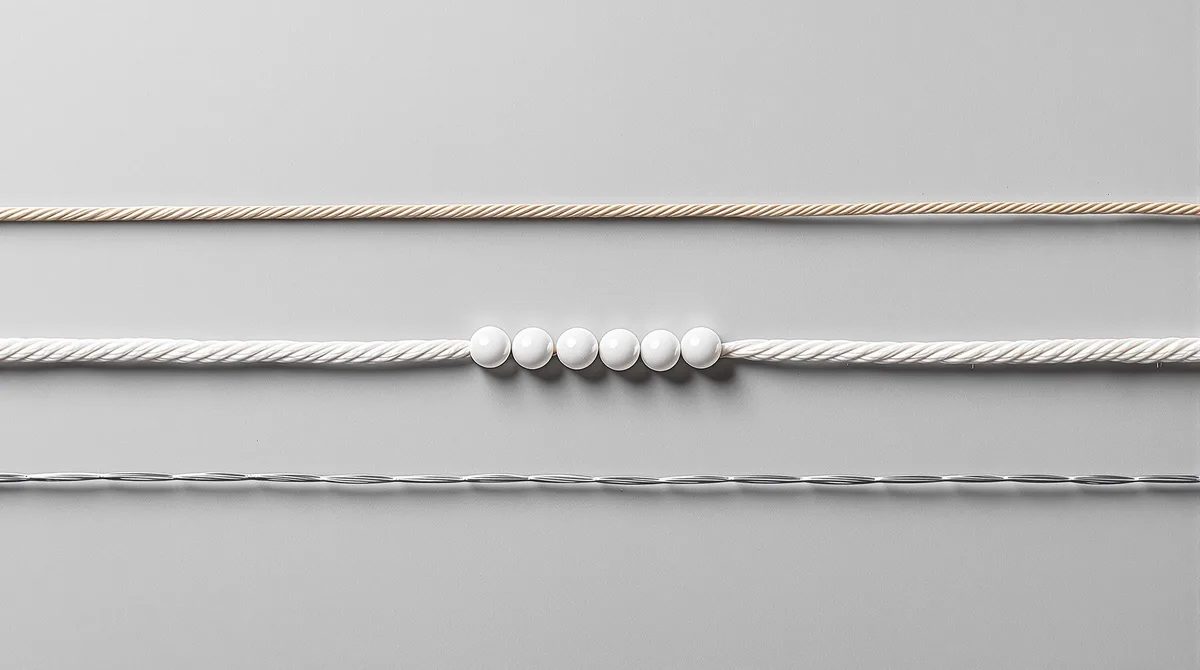
Most panels are not that. Cotton or waxed cord, a stitched cotton header band, a canvas mounting panel, wood or bamboo beads, and acrylic or resin beads are all organic. Acrylic and resin behave differently again: they are thermoplastics, and they soften and melt rather than char. None of that behaviour has been tested by us, and describing it is not the same as rating it.
None. A fire requirement is pass or fail against a named standard, and there is no tolerance band to negotiate.
What the drawing can allow is substitution control: a note that no component of the tested build may be substituted without re-testing. That is the clause that keeps a test result valid through value engineering.
Through the fire strategy rather than the finishes package. Where a bead panel sits on an escape route, in a protected corridor or near a means of escape, its position and its fixing become life-safety items and the fire engineer owns them.
Practically, the coordination item is often simpler than it sounds: the panel gets relocated a metre, out of the protected route, and the requirement disappears.
The specification carries the standard, the build description, the substitution control and the test report requirement. The schedule carries which openings the requirement applies to, because it often applies to some and not all.
Where no test is being commissioned, that note belongs in the specification itself rather than buried in a schedule line.
By assumption. A glass bead panel is assumed non-combustible because the beads are, and the cord and the stitched header are never considered. The assumption survives until a fire officer asks for a certificate.
The second failure is a cord substituted during production for a visually identical one, invalidating a test nobody re-ran.
A test specimen, not a visual sample. The complete build as it will be made, sent to an independent testing house against the named standard.
A visual sample is evidence of appearance. It is not evidence of flammability and should never be filed as though it were.
Cleaning products and dressings can change a tested result. A panel tested as made and then treated with a proprietary cleaner or an anti-static dressing is no longer in the condition it was tested in.
That makes the maintenance schedule part of the fire documentation on a tested installation: it has to specify cleaning methods consistent with the test.
A rating belongs to a build, not to a product name, which is why the report is produced against the construction a project actually buys and quoted with the project. Anyone offering a rating for a bead panel off a page — including anyone quoting a figure for a competitor's product — should be asked which standard, which laboratory, which date and which exact build, because without those four it describes one specific construction and does not say which.
It is a real gap, it is a measurement task rather than a writing task, and it would be published the day a tested build exists.
That testing happens programme by programme rather than as a published product property. Lead testing against consumer-safety requirements is handled as standard on the bead programme, incremental testing for other markets is handled as it arises, and flammability testing appears in the record as a testing category that is arranged and quoted rather than as a held certificate.
That is the accurate picture: the construction is controlled, and the result is produced against the build a project buys.
The test report, in full, naming the standard, the laboratory, the date and the exact build. Plus the substitution control clause, so that a facilities team replacing a strand in three years knows the replacement has to match the tested build.
Where no test was commissioned, the pack should say so explicitly. A silent gap in a handover file reads as compliance to whoever inherits it.
Good to know
For a fire requirement, a test specimen rather than a visual sample: the complete build as it will be made, sent to an independent testing house against the named standard. A visual sample tells you nothing about flammability and should not be treated as evidence.
Cleaning agents and dressings can change a tested result. A panel tested in its as-made condition and then treated with a proprietary cleaner has not been tested in the condition it is now in, which is why the maintenance schedule has to be consistent with the test.
Fire performance is tested on the specified build, so a bead panel enters a project with a report against that build once the project commissions the test. Glass beads do not burn, which is often assumed to settle the question, and it does not: the cord and any textile header are what a test is actually about.
Not relevant to the rating, but relevant to the clause: where a fire strategy requires an escape route to remain clear, the fixing and the panel position become a life-safety matter rather than a decorative one, and that belongs with the fire engineer rather than with the finishes schedule.
The test report, if one was commissioned, naming the standard, the laboratory, the date and the exact build tested. Without the build description a report is not transferable to a replacement panel, and a replacement in a different cord is a different build.
The standard required, the build to be tested, and a test report as a deliverable. Where no test is being commissioned, say so on the drawing: the beaded element is decorative and no fire classification is claimed for it, so compliance is never assumed by omission.
Keep exploring
Compliance
What NFPA 701 burns, why the cord and header carry the result, and how a project gets a report against its own build.
Open the referenceCompliance
BS 5867-2, EN 13773, DIN 4102-B1, NF P92-503, CAN/ULC-S109 and IMO FTP — what each asks and why they do not interchange.
Specs and sizesSpecification
The dimensions, strand values, fixings and performance limits a drawing and schedule have to carry.
View the rangeSpecification
How transmission, refraction and cast bead-shadows behave through the day — and where glare control fails.
Open the referenceSpecification
A hanging bead panel scatters a little high frequency and reduces nothing meaningfully — and what to specify instead.
Open the reference
Start a conversation
Send a reference, a colour chip or a sketch. Minimums are set per design and confirmed per quote; sampling is quoted separately and usually runs 16 to 20 days from an agreed brief.