Compliance
Fire standards abroad
BS 5867-2, EN 13773, DIN 4102-B1, NF P92-503, CAN/ULC-S109 and IMO FTP — what each asks and why they do not interchange.
See the detailCompliance · Fire
Fire performance is tested on the build a project specifies. Everything useful on this page follows from that: what the test actually burns, why the cord carries the result, and what a specified project has to do.
A flammability rating belongs to a build rather than to a product name. NFPA 701 is a flame-propagation test for textiles and films, so on a strung panel the result is governed by the cord and any textile header rather than by the glass. A specified project has the actual build tested at an accredited laboratory, with the report naming the method and the construction, quoted with the project.
NFPA 701 is a standard setting out test methods for flame propagation of textiles and films. It is not a building code and it does not itself require anything; codes and authorities having jurisdiction require compliance with it for certain materials in certain spaces, which is why hospitality, assembly and institutional projects ask for it.
The standard contains two test methods. One is a smaller-scale vertical test suited to lighter single-layer materials; the other is a larger-scale test for heavier, multi-layer, coated or folded assemblies. Both expose a specimen to a flame for a defined period and then measure what happened. The headline criteria are a limit on how much of the specimen mass is lost, and a requirement that any burning residue falling from the specimen must not continue to flame on the floor.
Take the exact scope, specimen preparation, method selection and pass criteria from the current edition of the standard. They have been revised, and a specification should cite an edition.
It applies when a code or an authority having jurisdiction says so: a hanging panel in a hotel lobby, a restaurant, a bar, a casino, a theatre, a retail build-out, a hospital or a school. It rarely applies in a private home.
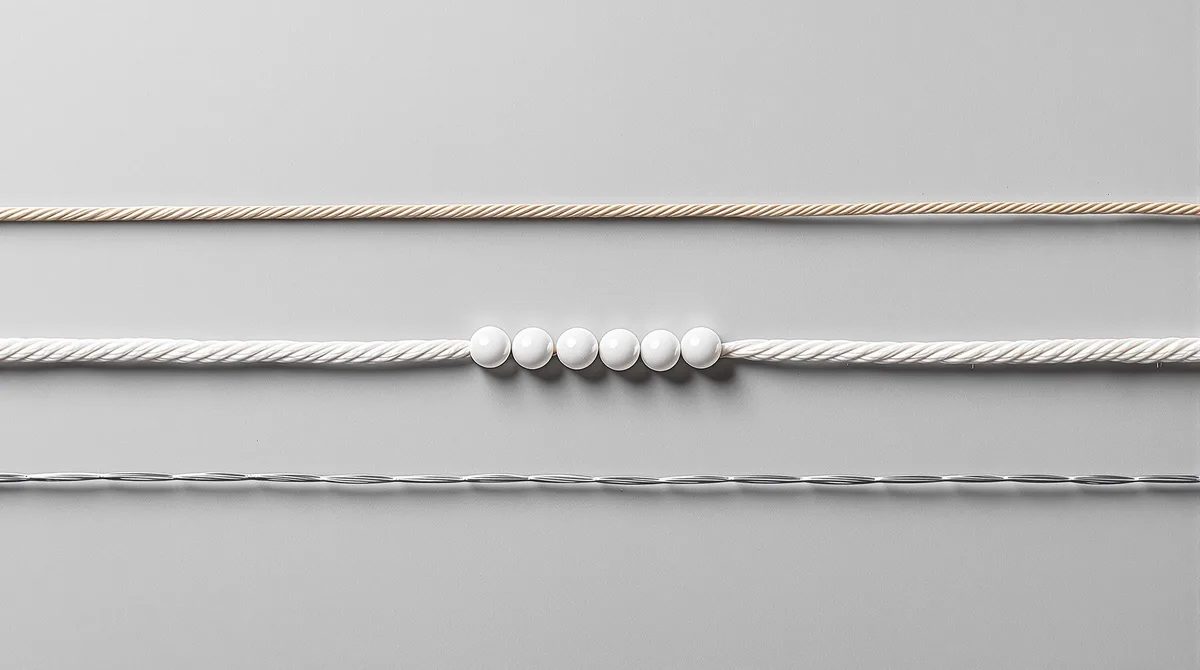
Whether it reaches a bead panel at all is a live question: the standard is written for textiles and films, and a strung panel is a set of discrete non-combustible objects on a continuous combustible thread. Some authorities want flame-propagation evidence; others look at the cord alone. Establish which view applies before design.
Test the build. Not the product line, not the bead, not the design name — the build, with its actual cord, its actual header and its actual adhesive if it has one.
That is the whole answer, and it is why a blanket rating for a category like this does not really exist anywhere. Change the cord from a cotton one to an inherently flame-resistant synthetic and the panel behaves differently. Add a cotton header with a rod pocket and the specimen is a different specimen. A rating that does not name the construction is not telling you anything.
A test report on the specified build. Fire performance is tested on the construction a project actually buys — bead, cord, header and mount together — at an accredited laboratory, with the report naming the method and the construction, and the testing quoted with the project. A rating belongs to a build, not to a product name. A flame-rating document reaching you from elsewhere should be treated as unverified until it names its method and construction.
Holds: control of the construction. Cord, header, bead material and assembly are all specified by us and can be built to a requirement. The quality and packing house in Greater Noida does first-article and lot AQL inspection, so a tested construction can be held constant across a run — which is the part that actually matters once a report exists, because a report describes a construction and production has to stay inside it.
What a specified project therefore does: agree the required standard and test method with the authority having jurisdiction, specify a cord and header chosen to pass it, build specimens to that construction, test at an accredited laboratory, and then produce to the tested construction with the report referenced in the purchase order. That path is open and it is quoted per project.
On a commercial project, a panel without acceptable fire evidence does not get installed, or is removed at the first inspection. The cost is the opening date, not the panel.
The worse failure is a report that does not match the goods — a report describing a cotton-cord construction with a panel shipped on a different cord. Nobody notices until an inspection, which is why the tested construction belongs in the order and is policed at inspection.
There is no warning route. A fire requirement is satisfied or the panel does not go in.
The design levers are all in the thread and the header. Specify a cord with inherent flame resistance rather than a treated natural one, because an inherent property survives cleaning and a topical treatment may not. Keep textile area to a minimum: a panel on a stained wooden header rail carries far less combustible material than one on a cotton header with a three-inch rod pocket. Use glass, ceramic or metal beads where the requirement is strict, and treat acrylic and resin as part of the test question.
And design the mount so the panel is not adjacent to an ignition source. Specifiers sometimes solve this problem by moving the piece rather than by changing it.
Almost every market outside the United States has its own standard and they are not interchangeable: the UK, Germany, France, Canada and the marine sector each ask for their own classification. A specification written around NFPA 701 does not travel, and a project in two countries may need two reports on the same build.
Within the United States, some jurisdictions also recognise field-applied flame-retardant treatment with its own registration and inspection regime. Whether that route is available for a bead panel is a question for the authority having jurisdiction rather than for the manufacturer.
Panel headers belong in the same clause, because a cotton rod pocket adds far more combustible area than a wooden dowel.
The standard, the edition and the test method. The exact construction to be tested and shipped, down to the cord and the header. Who commissions, pays for and holds the report. A requirement that the tested construction is the shipped construction. A re-test trigger on any change of cord, header or adhesive. And the identity of the authority having jurisdiction, because that is who the evidence is ultimately for.
One more clause, rarely present and worth having: a statement that no fire rating is claimed except as evidenced by a named report. That protects both sides from a verbal assurance becoming a contractual one.
The specifier carries it, to the authority having jurisdiction. The importer carries the commercial consequence. The manufacturer carries the obligation to build to the agreed construction and not to deviate from it.
That division is worth stating because fire compliance is the one area in this section where a buyer cannot simply push the duty onto the factory. A factory can make a panel that passes a named test. It cannot decide what the fire marshal will accept in a particular lobby.
A test report from an accredited laboratory, naming the standard and edition, the method, the specimen construction, the conditioning, and the result against the criteria. Where a treatment is used, the treatment product, its application rate and any registration or certificate for it.
Four things make a report useful: an accredited laboratory, a named method, a described construction, and a result. A certificate carrying only a logo and the words "fire retardant" has none of them.
Lab testing covers how specimens are commissioned, and the seasonal calendar is where the time for it has to be found.
Both are quoted per project, because both depend on how many constructions are tested and which method applies. Treat it as a development stage, not a line item: specimens are built, sent, tested and reported, and the result may send the cord specification back a step.
Put it in front of the production window. A project that discovers its fire requirement after sample approval loses the time twice: once to testing, once to the re-approval a changed cord makes necessary.
The bead materials reference sets out which families pass flame without comment and which do not.
Glass, ceramic and metal beads do not propagate flame and are not the risk. Wood is combustible but in bead form is discrete rather than continuous. Acrylic and resin beads are the bead family that genuinely belongs in the question, because thermoplastics soften, drip and can carry flame, and the standard's criteria specifically address burning residue reaching the floor.
But the governing material on almost every strung panel is the cord, and after it the header. A hospitality specification that interrogates the beads and ignores the thread has asked the wrong question thoroughly.
Two neighbours complete this. The international fire standards page covers what a project outside the United States will ask for instead, and the stringing medium is the component that actually decides the result on a strung panel. A hotel lobby is the setting where this question arrives most often, and it should be settled before the bead material is chosen rather than after.
Fire requirements are set by occupancy, not by age. A panel in a school or a children's hospital faces a stricter requirement than one in a private house, and the reason is the building rather than the user.
Age intersects in a nursery or a children's ward, where the children's-product rules apply at the same time: stricter chemical limits and a fire requirement on one piece. That combination narrows the material list fast, and it is better narrowed at the brief than at approval.
Extractable data
| Element | What it means for a bead panel | Status at Gemixx |
|---|---|---|
| What the standard covers | Flame propagation of textiles and films, in two test methods | Understood, not held |
| Test Method 1 | Smaller-scale vertical test for lighter single-layer materials | No report held |
| Test Method 2 | Larger-scale test for heavier, multi-layer, coated or folded assemblies | No report held |
| Headline pass criteria | A limit on specimen mass lost, and burning residue that must not continue to flame on the floor | No report held |
| The combustible components on a strung panel | The cord, a cotton or poly-cotton header, a rod-pocket textile, any adhesive | Specified per build |
| The non-combustible components | Glass beads, ceramic beads, metal spacers | Material known |
| Variable components | Acrylic and resin beads, wood beads, bamboo | Behaviour established on the build tested |
| What a rating attaches to | A specific construction, named in the report | No construction currently tested |
| Who accepts the evidence | The authority having jurisdiction for the space | Outside our control |
Good to know
A test report from an accredited laboratory, naming the standard and edition, the test method used, the specimen as constructed, and the result against the pass criteria. A certificate without those four things on it is not evidence. No such report exists for a Gemixx bead panel today.
Neither, finally. The authority having jurisdiction over the space decides what is acceptable, and the specifier is responsible for satisfying it. The manufacturer's role is to build to a construction that can be tested and to hold that construction constant once it has been.
Not the beads you would expect. Glass, ceramic and metal do not propagate flame. The combustible part of a strung panel is the cord, plus any cotton or poly-cotton header, rod-pocket textile or adhesive. Acrylic and resin beads behave differently from glass in a flame and are the one bead family that genuinely belongs in the test question.
A test report on the specified build. A rating under NFPA 701 or any other standard belongs to a construction rather than to a product name, so it is produced against the cord and header a project actually specifies, at an accredited laboratory, and quoted with the project. What that buys is a report that names the method and the construction, which is the only version a fire file can use.
Laboratory turnaround on a flame-propagation test is typically a matter of weeks once specimens are with the laboratory, and specimens have to be built first. For a specified project, treat the whole exercise as a development stage in its own right and put it in front of the production window rather than inside it.
Name the standard, the edition and the test method. Name the exact construction to be tested, including the cord, the header and any adhesive. State who commissions and pays for the testing and who holds the report. Require that the tested construction is the construction shipped, and that any change to cord or header triggers a re-test.
Keep exploring
Compliance
BS 5867-2, EN 13773, DIN 4102-B1, NF P92-503, CAN/ULC-S109 and IMO FTP — what each asks and why they do not interchange.
See the detailSpecification
Large-format panels, fire performance, the maintenance plan and the approvals a lobby specification has to clear before it gets built.
Open the referencePillar
Lead, CPSIA, Prop 65, REACH, fire standards, electrical listing and audit — what applies, who carries it, and what we hold.
Open the referenceCompliance
Why lead oxide is used in cut glass, which bead families are affected, and what the limits actually measure.
Open the referenceCompliance
The children’s-product determination for décor, the four factors it rests on, and what the 100 ppm limit actually covers.
View the range
Start a conversation
Send a reference, a colour chip or a sketch. Minimums are set per design and confirmed per quote; sampling is quoted separately and usually runs 16 to 20 days from an agreed brief.