Technique
How a panel is strung
The bead map, the cord, thirty strands on a dowel, hem shapes, suspension loops — and the three levers that move the cost.
View the range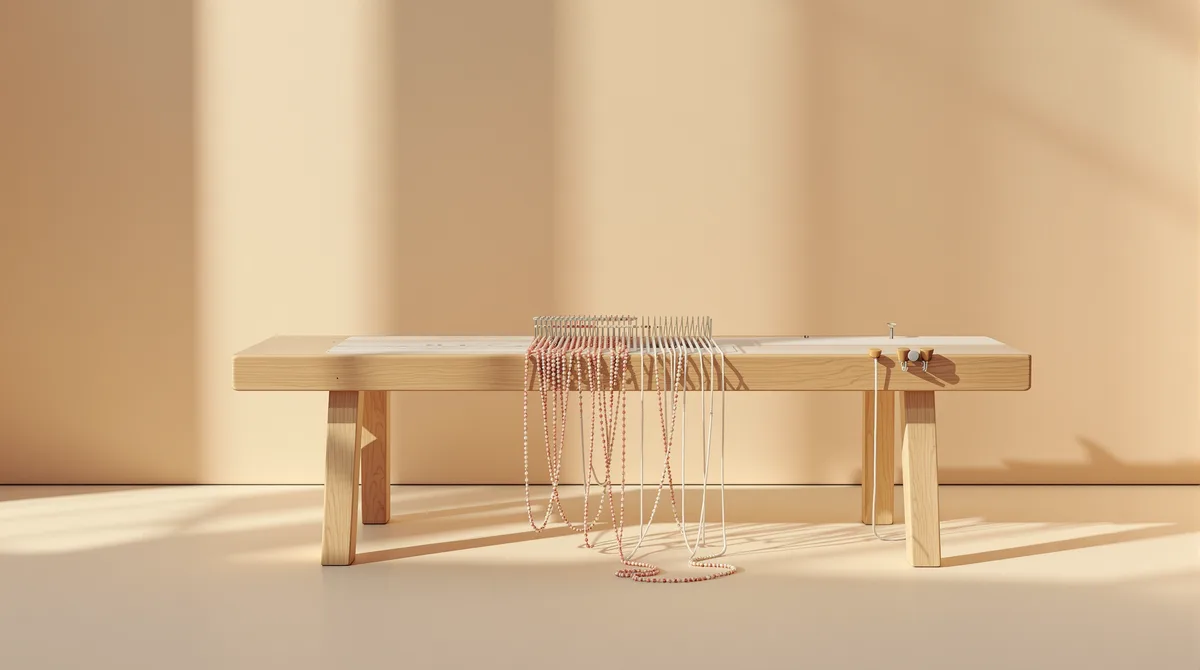
Manufacturing · Pattern
Yes, and the limit is arithmetic rather than skill. The grid a bead panel offers is three to five times wider than it is tall, and every graphic has to be redrawn onto it.
A beadworker's bench with cord, needles, a brass wire armature and a part-strung strand resting across a wooden dowel.
Yes. Artwork is converted into a bead map — a grid where every bead position carries a colour — and the stringer works strand by strand against that sheet. Bead size sets the resolution: the grid is as wide as the strand pitch and as tall as one bead, so horizontal detail resolves far better than vertical detail.
Patterned beaded panels: a motif, a repeat, a word or an image carried across the strands of a hanging piece. The construction is hand-strung — beads threaded one after another down waxed cord — and the thing that makes it a graphic rather than a colourway is the document behind it. Every bead position is assigned a colour on a bead map, and the stringer works strand by strand against that sheet. Without the map there is no pattern, only an instruction nobody can follow twice.
The artwork, the palette, the bead material and the format are all open. What is fixed is the grid. A panel offers one position per strand across and one position per bead down, and those two numbers are set by the width, the strand count and the bead size. A graphic can be redrawn to suit that grid; it cannot be printed onto it. Any brief that treats a bead panel as a printable surface will produce a sample that disappoints for reasons nobody can fix at the stringing bench.
Artwork, a format and a palette. Artwork as a file is the single biggest cost lever on this page: a vector or a flat raster file can be mapped to the grid directly, and a photograph of a reference cannot. We have built a live design from a reference image alone, with the whole pattern mapped bead by bead at the bench and assembled against that map — and that is the lesson. A motif with no artwork file has to be mapped at the bench, and the mapping is the cost. Send artwork — or budget for the mapping. The format fixes the resolution. The palette fixes the number of picking operations.
Glass seed beads where the design needs resolution, because at one to three millimetres they behave as a continuous material and can carry an image. Pressed glass where a shape needs to repeat exactly from a mould. Acrylic dyed to colour where the palette must be exact and the weight low. Wood, ceramic, metal and faux capiz where the design wants their surfaces. Opaque beads read graphics better than translucent ones, because geometry depends on edges and a translucent bead softens every edge it sits on.
A doorway curtain at about 90 by 200 centimetres on forty strands, or 120 centimetres on sixty for wider openings. Portals at 76 by 140 centimetres. Café curtains, valances and wall hangings follow the design library's documented ranges, which are render-library specifications and are design intent rather than shipped product. For a graphic, wider is almost always better: sixty strands across 120 centimetres gives a finer horizontal grid than forty across 90.
Against a Pantone reference or a physical chip, confirmed on the sample and never on a screen. On a patterned build there is an extra approval that a plain build does not need: the bead colour sequence on the map is approved before anything is strung, so the pattern and the palette are signed off as separate decisions. That ordering saves a full sampling cycle when a palette is right and a pattern is not, or the reverse.
Brief, then a rough cost sheet before anything is made. Then the artwork is converted to a patterned strand layout and the map is approved, including the bead colour sequence. Then a sample, usually 16 to 20 days from an agreed brief, photographed for approval before it ships. Sampling is quoted separately. The approved sample and the approved map together become the production standard, and both are retained for reorders.
Beaded décor runs 40 to 60 days after sample approval. A graphic build does not run longer in production, but it does carry the bead-map approval step ahead of sampling, so the total elapsed time from brief to shipment is longer than for a plain colourway. Where a date is critical, the map approval is the step to pull forward.
To your carton, label and packaging specification, with inner packing agreed at sampling, and shipped to the port or warehouse you name. One packing detail is specific to patterned work: a mapped panel has to be packed so the strands cannot cross each other, because untangling a patterned panel means getting the strands back into the right order rather than simply separating them. That is agreed at sampling and inspected at packing.
Glass beads are drawn and hand-strung in our own Firozabad glass works, a vertical that dates to 1992. Wood beads and curtain dowels are turned in our own Saharanpur wood factory. Ceramic is glazed and fired in our own Khurja plant and metal is finished and plated in our own Moradabad plants. Acrylic and resin beads are moulded and dyed to our colour, to our own dies where a design needs a custom bead — we have funded our own dies for custom moulded shapes, including three-inch almond beads used as daisy connectors. Bamboo is confirmed per design rather than held as an owned capability.
First-article and lot inspection to an AQL standard, through our own Greater Noida house, against the approved sample and the approved map. On a graphic the inspection is checking pattern registration across the full width rather than individual strands: a pattern that drifts by two beads per strand produces a visibly crooked line across the panel even though every strand passes on its own. Product issue rates across the network run at a fraction of a percent.
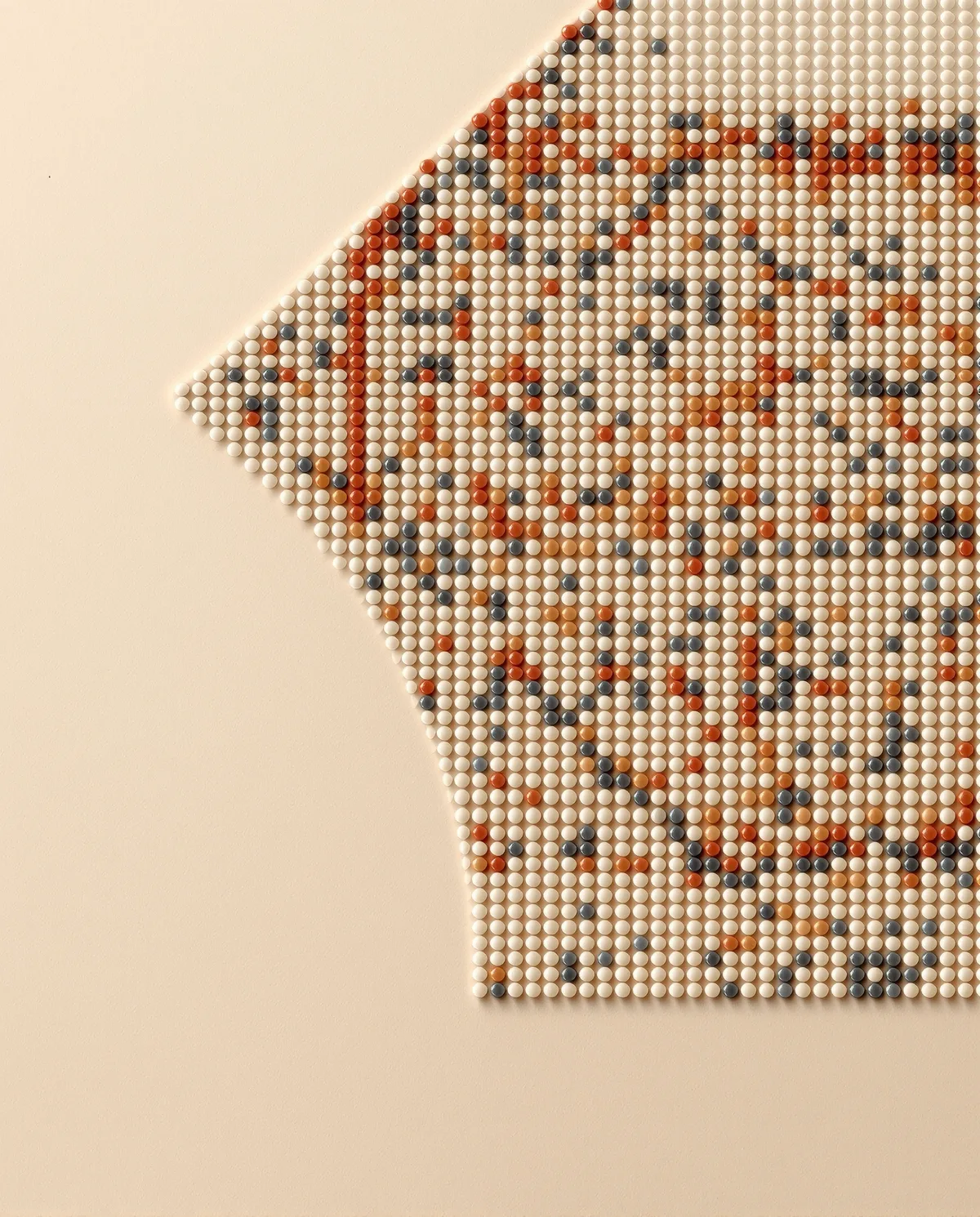
Divide the panel width by the strand count. A 90-centimetre curtain at forty strands gives a horizontal step of about 2.25 centimetres; a 120-centimetre curtain at sixty strands gives about two. Vertically the step is one bead — a few millimetres for a seed bead, more for a larger one. So the grid cell is three to five times wider than it is tall. The consequences are consistent and predictable. Horizontal bands, chevrons and waves resolve cleanly. Vertical edges are coarse and stepped. A diagonal drawn at forty-five degrees on paper arrives on the panel as a much shallower line with visible steps. Lettering is the hardest case of all: a readable character needs several strands per stroke, so a 90-centimetre panel realistically carries a very short word at a large size, and a sentence is not available at any bead size that would still look like beadwork.
Bead size and material first, then construction, then strand spacing, then the dowel and the packing, then the height — the same order as any beaded build. What a graphic adds sits on top of that: the number of colour changes per strand, and the number of distinct strand sequences in the panel. A two-colour horizontal band is cheap because it batches. A check that changes every third bead across sixty strands is not, because nothing batches. The figures that frame the conversation: a spaced panel at 90 by 200 centimetres runs around 3,100 beads, and a densely patterned one at the same size can reach about 11,800.
Often, and it should be offered before a graphic is quoted. A scattered accent — a large patterned bead placed three or four to a strand, at random, never level across adjacent strands, on a ground dyed to match it — gives much of the visual interest of a pattern with one additional bead line, no registration across strands, and a count sheet that carries permitted positions rather than a full sequence. Every one of the dense-look designs adopted into production in our own 2026 programme was built that way. Where a true graphic is the point, we build the map; where the brief simply wants the panel to look designed rather than plain, the accent reaches the same place for a fraction of the picking.
Extractable data
| Specification | Value |
|---|---|
| Formats | Doorway curtains, portals, café curtains, valances, wall hangings, panels |
| Standard door curtain | About 90 × 200 cm (35 × 79 in) on a wooden dowel |
| Strand pitch | 90 cm at 40 strands is about 2.25 cm; 120 cm at 60 strands is about 2 cm |
| Horizontal resolution | One strand pitch — about 2 to 2.25 cm |
| Vertical resolution | One bead — a few millimetres, set by the bead chosen |
| Bead materials offered | Glass seed and pressed, acrylic, wood, ceramic, metal, faux capiz |
| Construction | Hand-strung strands on cord, sequenced per strand against a bead map |
| Top fixing | Turned wooden dowel, stained header rail, or cotton header with a 3 in rod pocket |
| Pattern document | Bead map or colour-count sheet, approved before stringing |
| Bead count, spaced 90 × 200 | About 3,100 |
| Bead count, densely patterned 90 × 200 | About 11,800 |
| Sampling | Usually 16–20 days from an agreed brief, quoted separately |
| Production | 40–60 days after sample approval |
| Packing | To your carton, label and packaging specification |
Good to know
Yes, and a graphic needs redrawing rather than scaling. Changing the width changes the strand count, which changes the horizontal resolution, so a motif that reads at 120 centimetres on sixty strands may not read at 90 on forty. We recalculate the map and check the pattern still reads before quoting the new size.
Beaded décor runs 40 to 60 days after sample approval. Sampling usually takes 16 to 20 days from an agreed brief and is quoted separately, and you approve photographs before the sample ships. A graphic build should allow for a bead-map approval step before the sample is strung.
To your carton, label and packaging specification, with inner packing agreed at sampling, and shipped to the port or warehouse you name. Export packing and consolidation run through our own Greater Noida house. Patterned panels are packed so the strands cannot cross, because a tangled patterned panel is far harder to settle than a plain one.
Glass beads are drawn and hand-strung in our own Firozabad glass works. Wood beads and dowels are turned in our own Saharanpur wood factory. Ceramic is glazed and fired in Khurja and metal is finished and plated in Moradabad. Acrylic and resin beads are moulded and dyed to our colour, to our own dies where a design needs a custom bead. We own the plants — no agents, no brokers.
No. Minimums are set per design and confirmed with your quote, and a graphic is exactly why. A plain-strand panel and a fully mapped graphic use very different amounts of material and stringing time, so one figure across the range would be wrong for most of it.
No. There is no retail stock programme. A pattern is agreed as a bead map, a sample is approved against it, and production runs against that approved sample.
Keep exploring
Technique
The bead map, the cord, thirty strands on a dowel, hem shapes, suspension loops — and the three levers that move the cost.
View the rangePillar
A live app holding the full bead library and the Gemixx 2027 collections: build a design, render it in about a minute, take it to tech pack and costing.
Compare the optionsManufacturing
Brief, rough cost sheet, colour match, sample, production, packing — the route from a sketch to a packed carton, in plants we own.
Read the guideManufacturing
Your label, your packaging, your SKU structure, built in plants we own — and we never compete with our clients at retail.
Read the guideManufacturing
Strands, trims, panels and framed shapes built to another maker's drawing, inspected, kitted and delivered to their line.
Specs and sizes
Start a conversation
Send a reference, a colour chip or a sketch. Minimums are set per design and confirmed per quote; sampling is quoted separately and usually runs 16 to 20 days from an agreed brief.