Guide
Beads against a noren
What a noren actually is, how it differs from strung beadwork, and which of the two a threshold brief needs.
Compare the options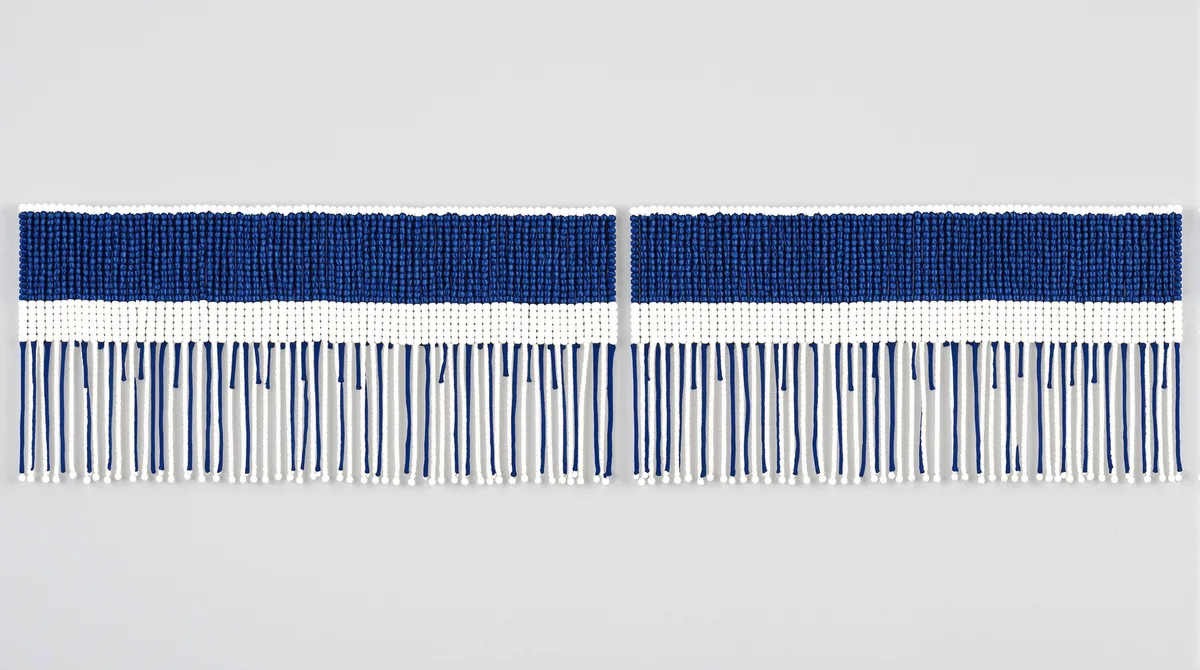
Style · Era
Most people typing this phrase are picturing a noren, which is dyed fabric split into panels and contains no beads. The two objects do the same job and are made by completely different trades.
A beaded panel split by a vertical centre gap, both halves hung from one header band in deep indigo, the close pale strands falling below it.
A noren is a split fabric panel hung at a shop or room threshold, dyed and sewn with a rod sleeve across the top. It contains no beads. A bead panel does the same threshold job — marks a boundary, allows passage, filters sight rather than air — but it is strung glass or wood, made by a different trade entirely.
From a textile, not from beadwork. The noren is a Japanese threshold curtain — a panel of dyed fabric, traditionally hung at the entrance of a shop or bathhouse and between rooms in a house, split vertically into two to five sections so a person can push through. It carries a sewn sleeve at the top for a rod and often a shop's mark or a plain indigo field. It is sewn and dyed. There is no strung bead tradition behind it, and that single fact explains almost all the confusion around this search term.
Restraint, and a visible split. The register is produced by removing things: one or two colours, one bead size, an even pitch, a hem cut straight, no motif, and a matte surface. The split down the centre is what carries the reference, because that is the noren's defining feature and the one thing a bead panel can borrow. Everything else that gets added in the name of a Japanese look — cranes, blossom, wave patterns, characters — pushes the object towards souvenir.
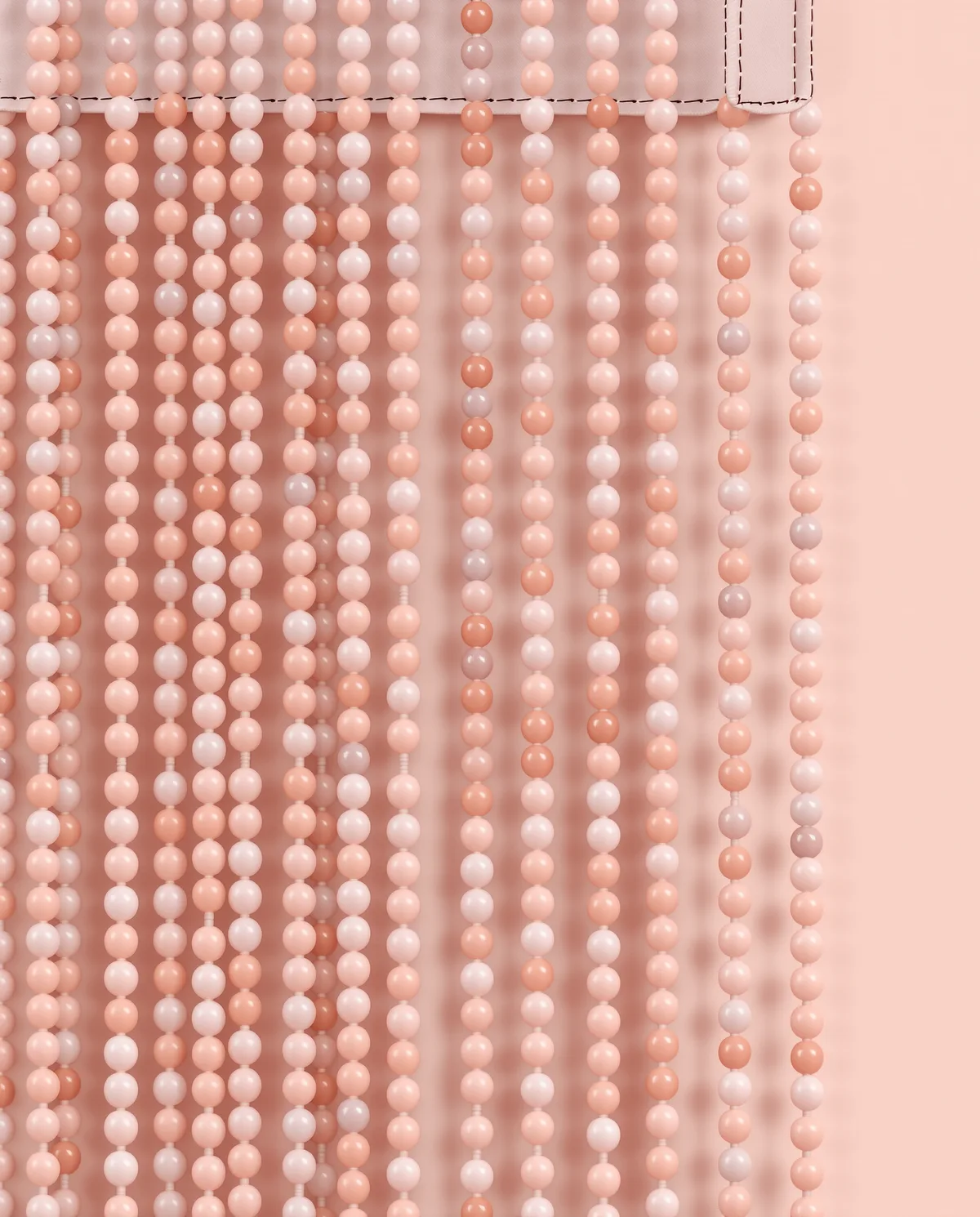
Matte or frosted glass at one bead size, in chalk white, indigo, charcoal or a single soft earth tone. Pale turned wood is the quieter alternative. The header matters more than usual: a rod pocket header in narrow stitched cotton reads much closer to the reference than the wooden dowel does, and panel headers of that kind are standard on café-length work. Hems are straight, always.
It photographs flat, head on, with the split centred and light behind it. It sells on that one frame, because the register has no detail to reward a macro shot. Commercially it is an unusual case: a lot of the demand behind the search term is for a product we do not make, so the conversion is to explain the difference and offer the bead object on its own terms.
Restaurants, cafés, salons and small retail interiors wanting a threshold marker, plus home buyers in minimal interiors. In practice this register overlaps heavily with the minimalist one, and most briefs that arrive describing a Japanese look are asking for the same thing a minimalist brief asks for: one bead, one colour, even pitch, nothing else.
A printed polyester panel with a stock woodblock-style graphic, sold as a noren. In beads, the cheap version is a glossy white acrylic panel at an uneven pitch. Gloss is the specific failure: the register depends on the surface absorbing attention rather than reflecting it, and a glossy bead at a tight pitch produces a wall of highlights.
There is no pattern, so the controlled dimensions are pitch and strand length. Strand pitch is the architectural variable in this register — it decides how much of the opening is visible through the panel, and it is the main lever on visual privacy — and it has to hold across the full width, which means the header spacing is drilled or marked rather than judged. Strand length tolerance is tight, because a straight hem shows every millimetre of drift, which makes this register a good test of realistic tolerances in hand work.
This is the plain strand. It is the floor of the medium: one bead line, no colour matching beyond a single reference, no accent, no shaped hem. If a budget is tight and the register is acceptable, this is the correct answer rather than a compromise.
Thresholds between a kitchen and a dining room, a service opening in a café, a changing area in a shop, and any interior where the brief is to mark a boundary without closing it. The register suits low, even light and plain surrounding surfaces. It does badly in a room with a lot of competing texture, where its quietness reads as absence.
Widen the pitch and change the hem once. The most useful contemporary move is to widen the strand pitch well beyond the usual two centimetres so the panel becomes a screen of lines rather than a surface, and then to cut the hem in a single shallow curve rather than straight across. That is one deviation from the reference, and it is enough to make the object current rather than quotational.
A fixture in hospitality. The noren itself has been in continuous use for centuries and its logic — mark the threshold, keep the sight line broken, let people and air through — is permanent. The bead version of that logic will keep being asked for, and the demand is driven by the function rather than by a fashion cycle.
Everything. A noren is a dyed textile with a sewn sleeve, made by a textile trade, and a brief for one should go to a textile maker. A bead panel is strung glass or wood gathered on a dowel or a rod pocket. They share a job and a silhouette and nothing else. We make the second and we are clear that we do not make the first.
Good to know
No — a Japanese reading is close to the cheapest build available, because it wants one bead in one or two colours at an even pitch with a straight hem. The cost lever that matters is strand pitch: widening it reduces strand count directly, and a wider pitch is correct for this register anyway.
A door-height panel with a visible central split, or a short valance-depth panel over a shop or kitchen opening — the two positions a noren occupies. A rod-pocket header rather than a dowel is the closer match to the reference, and we build rod-pocket headers.
Remove the motifs. The failure mode here is a bead panel carrying cherry blossom, cranes, waves and a kanji character at once, none of which belongs on a strung panel. A two-colour panel at an even pitch with a straight hem reads correctly and contains no imagery at all.
Yes, with one useful caveat: a large share of the interest is people looking for a noren rather than a bead curtain. That is why the entity distinction matters more here than the style advice.
Matte or frosted glass in chalk white, indigo or charcoal, at one consistent bead size. Pale turned wood is the alternative. What does not work is anything glossy or iridescent, because a specular highlight introduces exactly the visual incident the register is trying to remove.
We match a reference's look, colours and bead sizes in new materials as an inspired design, and we do not reproduce another brand's protected design. For a noren specifically we would decline on capability rather than on principle: it is a dyed textile and we are a bead maker.
Keep exploring
Guide
What a noren actually is, how it differs from strung beadwork, and which of the two a threshold brief needs.
Compare the optionsIndex
Twenty-four named looks, each described by the material, palette, pitch and hem that actually produce it.
Specs and sizesStyle
Four rules that make a loose look cohere, and the one that briefs almost always miss.
Specs and sizesStyle
Why deco needs pressed glass rather than seed beads, and why symmetry is the expensive part rather than the palette.
Specs and sizesStyle
Turned wood in walnut tones, consistent sizes and straight hems — the quiet register, and why it is quieter than retro.
Read the guide
Start a conversation
Send a reference, a colour chip or a sketch. Minimums are set per design and confirmed per quote; sampling is quoted separately and usually runs 16 to 20 days from an agreed brief.