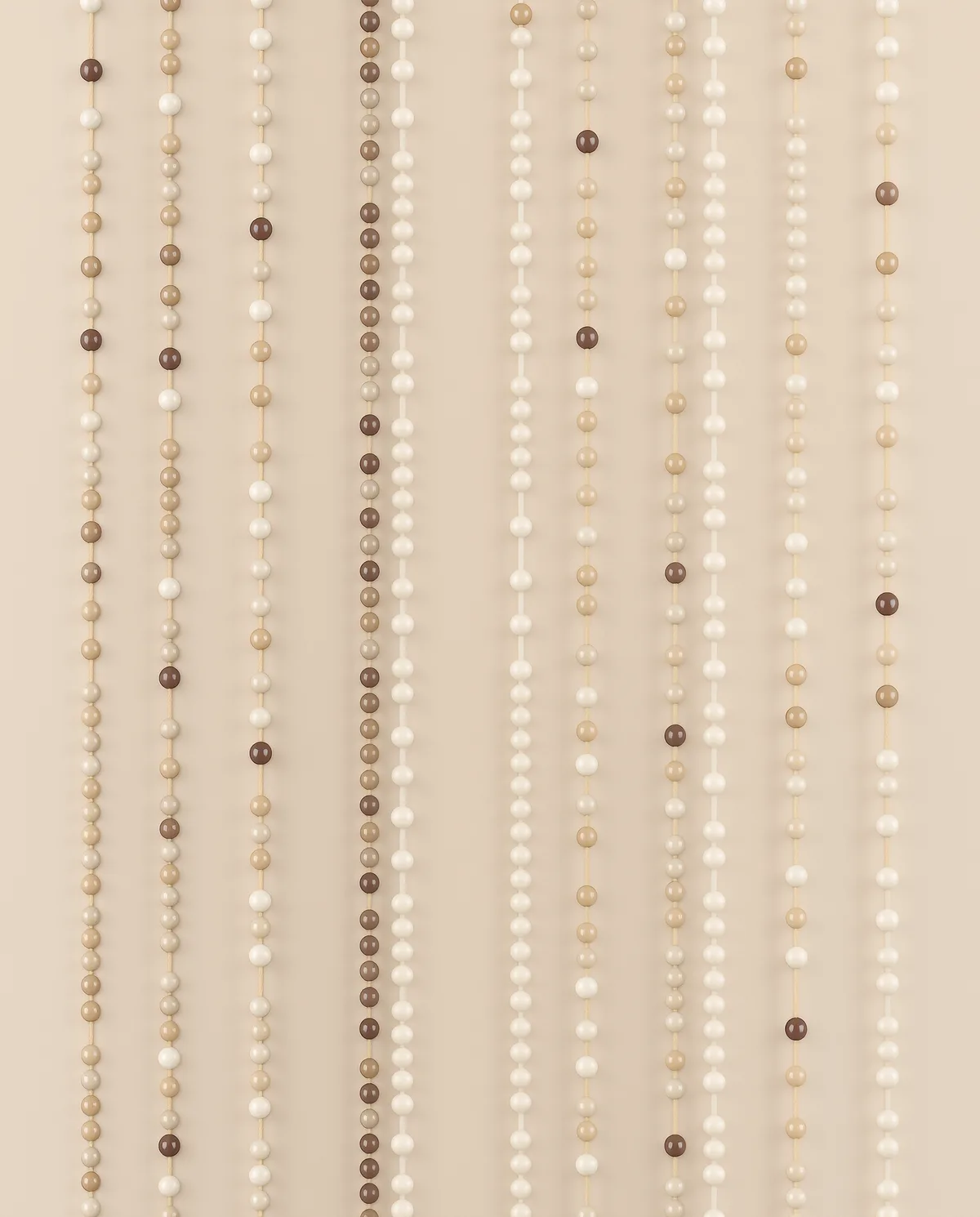
Colour story
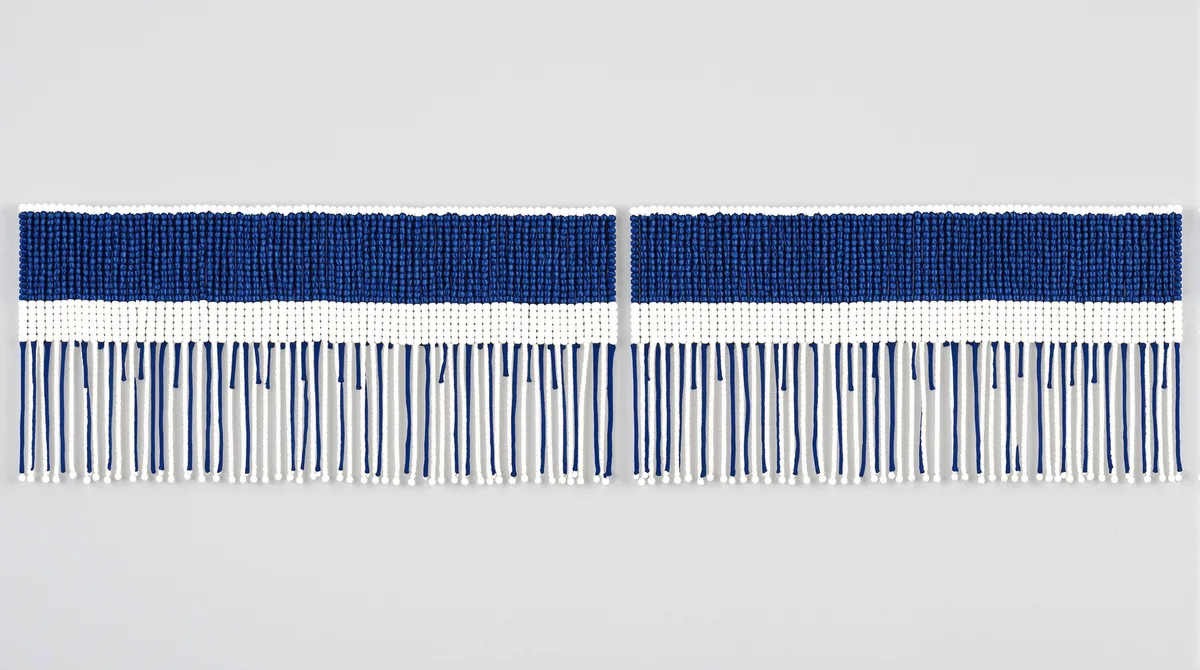
The Wavy Check story
A graphic check across the strands, which holds only when the pattern is mapped to the bead grid rather than sketched.
Compare the options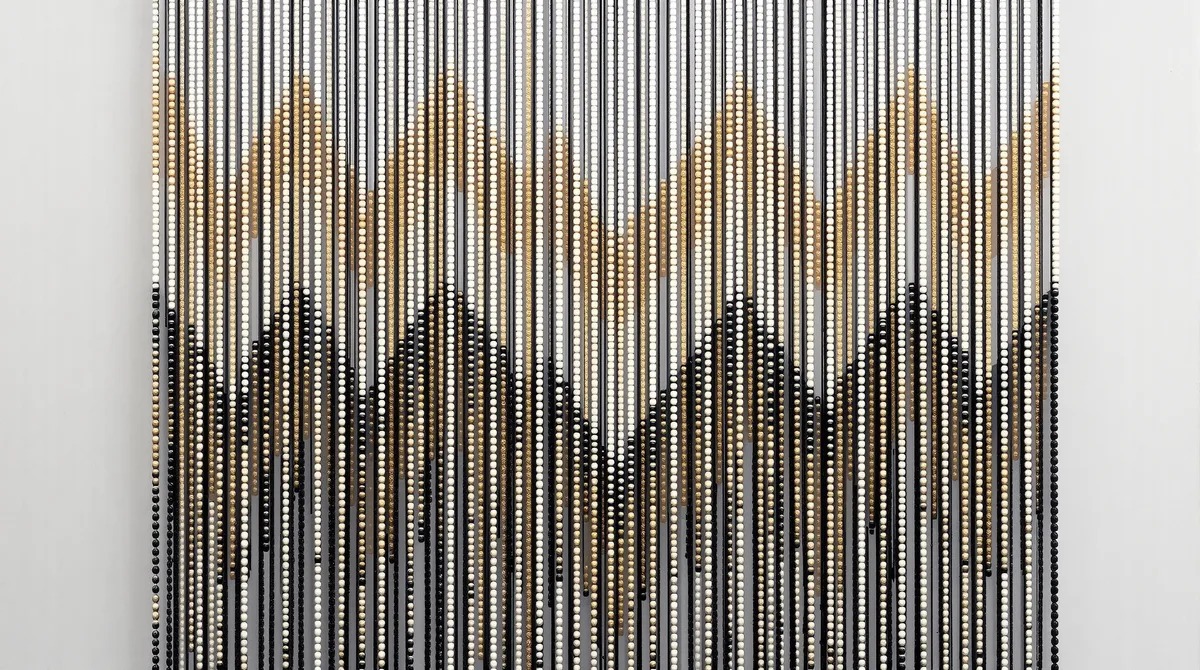
Style · Era
A bead panel is a grid, and it is a lopsided one. Roughly two centimetres across, six millimetres down. Every geometry that works on a strand works because of that ratio, and every one that fails fails because of it.
A beaded panel in jet black, chalk white and antique gold, the colour changing bead by bead so sharp chevrons and zigzags step across the separate strands.
Geometry on a bead panel is drawn on a grid of strand positions across and bead positions down. That grid is uneven — about two centimetres between strands against a few millimetres between beads — so horizontal bands and chevrons resolve cleanly, while vertical edges and shallow diagonals step visibly. Bead size sets the limit.
Two sources, a decade apart. The first is textile: checks, chevrons and zigzags are what you get when you weave on a grid, so every woven tradition arrives at them independently, and a strand of beads is a one-dimensional weave. The second is the op-art and hard-edge abstraction of the early 1960s, which gave the décor market a vocabulary of waves, pennants and optical repeats that suited flat printed surfaces. A bead panel sits between the two: it has the grid of the first and wants the graphics of the second.
Repetition at a legible scale with a hard edge. The pattern has to be big enough that a viewer standing in the room completes the repeat with their eye, and the colour change has to be abrupt. The second requirement is where most geometric briefs fail: a chevron in three similar tones is a texture, not a chevron. Flat opaque colour and a steep tonal step are what makes geometry read on a hanging panel.
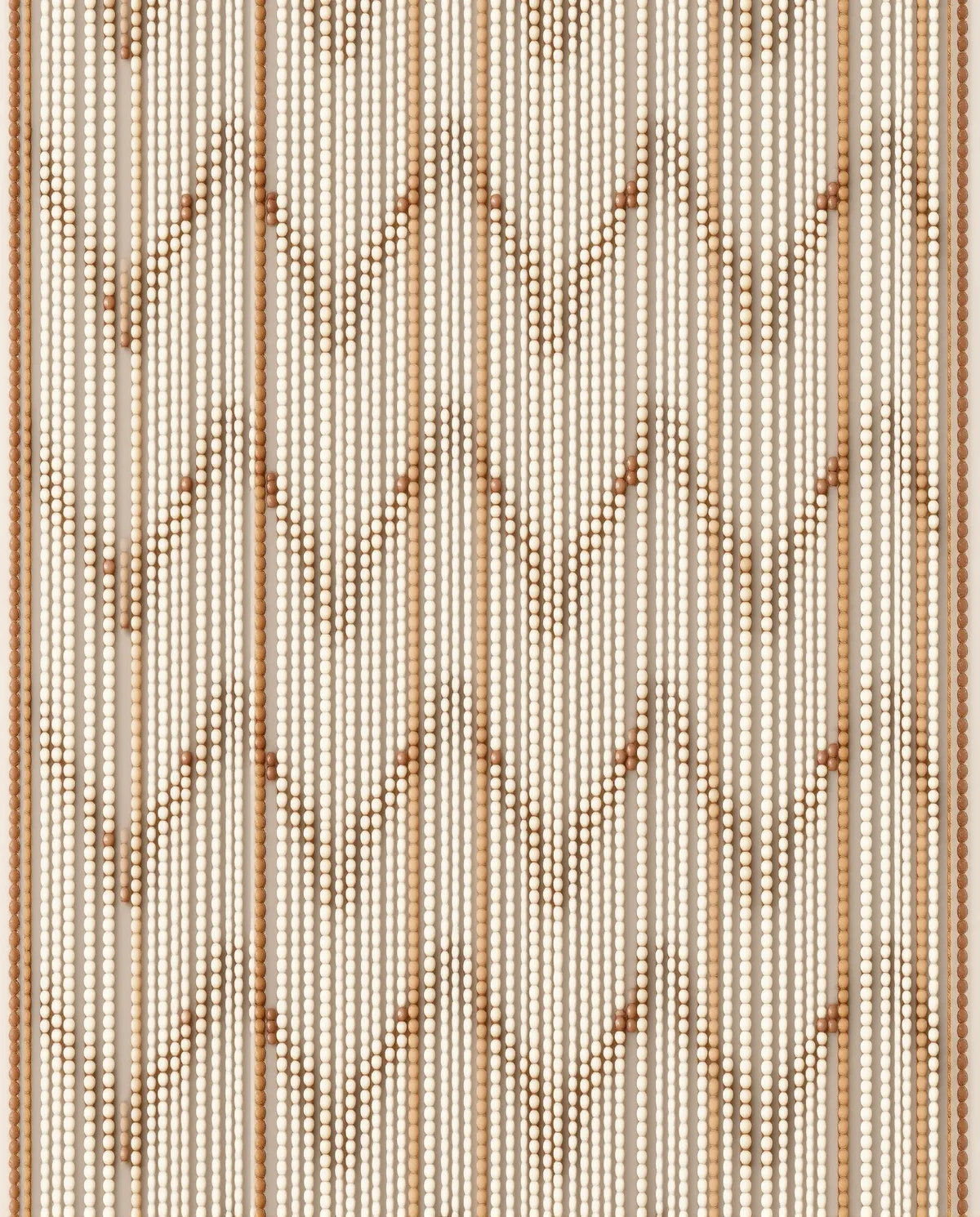
One bead, one size, opaque, in two or three flat colours. Our Wavy Check story is built exactly this way — the colour changes bead by bead so a check steps right across the panel — and the Op Pennant design does the same with cream, lagoon and jade glass ovals on twenty-seven strands to a V-point hem. Hems are straight or V-point, because a shaped hem fights a pattern for attention and usually loses.
Wavy Check is the direct one. Op Pennant is the period one. Sterling Swan — mirrored silver with pearl and chalk white — gives a geometric reading that depends on reflection rather than on hue, which is a quieter route to the same effect. All three sit in the design library with their strand counts and hems recorded, which is what makes a geometric brief specifiable rather than a drawing.
It photographs flat, head-on, with no perspective and no cast shadow — the same flat-elevation frame we use for pattern work generally — because perspective destroys a repeat. It sells on the strength of the pattern read at thumbnail size, which is the one register in beadwork where a small image works in your favour.
Brands buying under their own label who want a graphic home accessory, interior designers specifying a feature threshold, and display and event companies. Geometric panels also do well as wall pieces rather than doorways, because a pattern reads better on a flat static surface than on one that moves.
A geometric pattern attempted at too low a resolution. If the design has a diagonal and the bead is large, the diagonal becomes a staircase with four steps and the whole panel looks like a mistake rather than a pattern. The cheap version is not cheap beads; it is a good pattern specified at the wrong bead size. The fix is to redraw the geometry to suit the grid rather than to shrink the bead.
With graphic bead patterns drawn to the grid. A geometric panel cannot be strung from a verbal description, so the artwork is converted to a grid where every bead position carries a colour, and the stringer works strand by strand against that sheet. It is the same artefact as a loom chart, and it is the document that makes a reorder identical to the first run.
Above it, in a way that bead count does not predict. The drivers are the number of colour changes per strand and the number of distinct strand sequences in the panel. A two-colour horizontal band is cheap. A check that changes every third bead across sixty strands is not, because nothing can be batched. One lever we have used on a wall piece is to substitute a repeating pattern for a continuous gradient, which cut cost without changing the register.
Rooms with plain walls and no competing pattern — offices, galleries, retail interiors, modern kitchens. A geometric bead panel is a graphic object and it needs quiet around it. In a room that already has a patterned floor or a wallpaper it becomes noise.
Enlarge the repeat and drop a colour. The contemporary version of a geometric panel is one big wave or one wide check at near-architectural scale, in two colours. The 1960s version was small, dense and high-contrast; scaling it up is what moves it from period reference to current design.
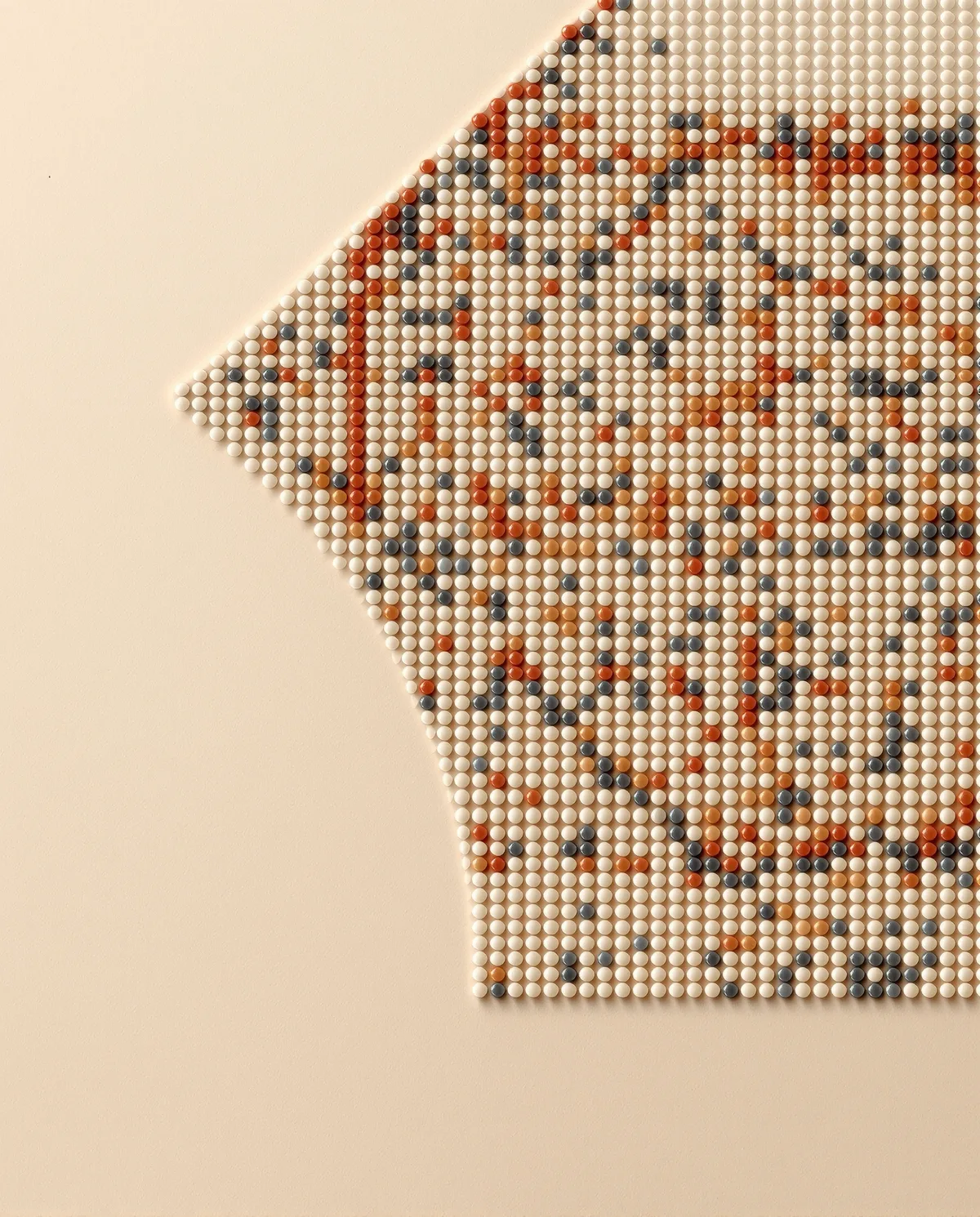
Take the panel width and divide by the strand count. A ninety-centimetre curtain at forty strands gives a horizontal step of about 2.25 centimetres; a 120-centimetre curtain at sixty strands gives about two. Vertically the step is one bead — a few millimetres. So the grid cell is three to five times wider than it is tall. That is why a horizontal band has a clean edge and a vertical one has a jagged one, and why a 45-degree diagonal on paper arrives on the panel as a much shallower, visibly stepped line. Design to the grid and the geometry is effortless; design against it and no amount of care rescues the result.
Good to know
Two or three, with a hard tonal gap between them. Geometry needs contrast to read, and a geometric panel in three close tones becomes texture rather than pattern. Oat with chocolate and chalk white is the quiet version; lagoon, jade and cream is the period version.
Yes, and the cost is in picks rather than beads. A plain strand is one bead line at one station. A check changes colour every few beads, so each change is a separate selection, and the sequence differs from strand to strand. Bead count can be identical and the labour can double.
Wide ones. Geometry needs horizontal room to establish a repeat, so a 120 cm curtain at sixty strands carries a check far better than a 90 cm one at forty. Valances work for a single band; short narrow formats do not have the strand count to show a repeat.
Keep one geometry and let it run. Op-art pastiche comes from stacking a chevron, a wave and a check on one panel. The strongest geometric pieces in our library carry exactly one repeat, edge to edge, and nothing else.
Commercially this arrives as a design request inside a broader brief — a buyer wants a graphic panel — rather than as a shopper search, so we treat it as a specification page.
Opaque beads of one size. Geometry depends on edges, and a translucent bead softens every edge it sits on by passing light through it. A uniform opaque oval or round at a consistent bead size gives the cleanest pattern; glass seed beads give the highest resolution if the design needs fine detail.
We match a reference's look, colours and bead sizes in new materials as an inspired design, and we do not reproduce another brand's protected design. With op-art references in particular, check whether the original artwork is still in copyright before it becomes a bead map.
Keep exploring
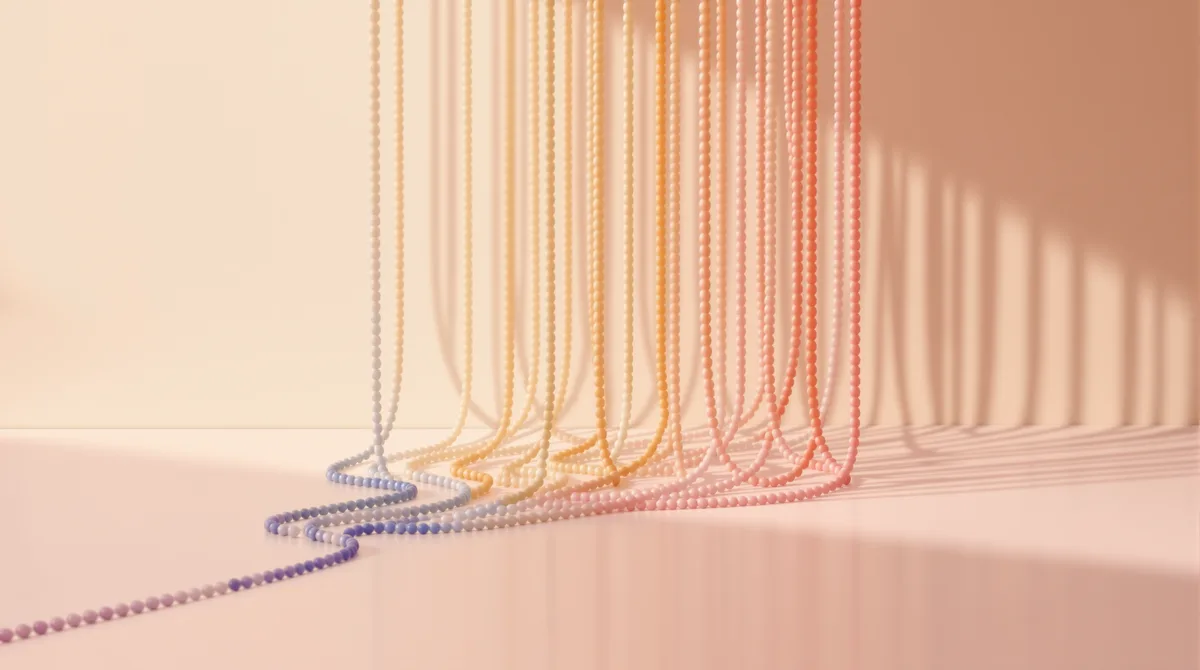
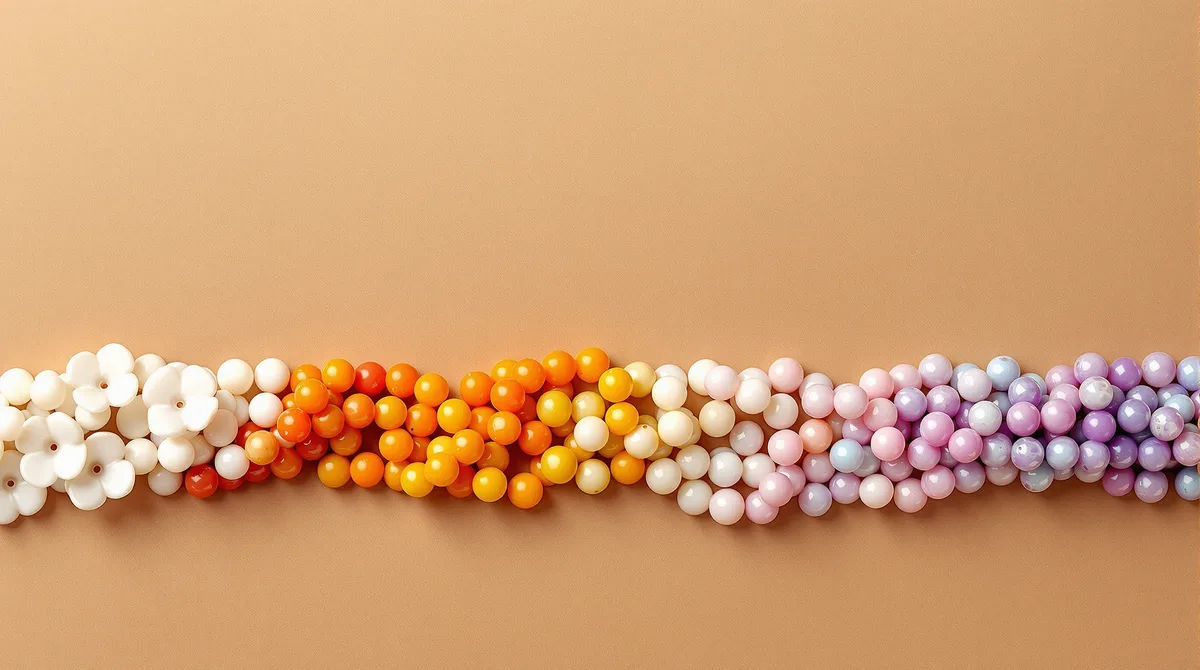
Colour story
A graphic check across the strands, which holds only when the pattern is mapped to the bead grid rather than sketched.
Compare the optionsManufacturing
Artwork to bead map, the resolution limit set by bead size, and why a scattered accent costs a fraction of a graphic.
Compare the optionsIndex
Twenty-four named looks, each described by the material, palette, pitch and hem that actually produce it.
View the rangeStyle
A noren is split dyed fabric; a bead panel is strung glass. Same threshold job, different object, different maker.
Specs and sizesStyle
Sixties geometry, seventies warmth, nineties translucence — separated by palette, bead shape, material and hem.
Specs and sizes
Start a conversation
Send a reference, a colour chip or a sketch. Minimums are set per design and confirmed per quote; sampling is quoted separately and usually runs 16 to 20 days from an agreed brief.