Design
Dot Beaded Portal
Dotted oval glass beads at 13 × 22 mm, scattered three or four to a strand on a seed-bead base dyed to match each dot.
Compare the options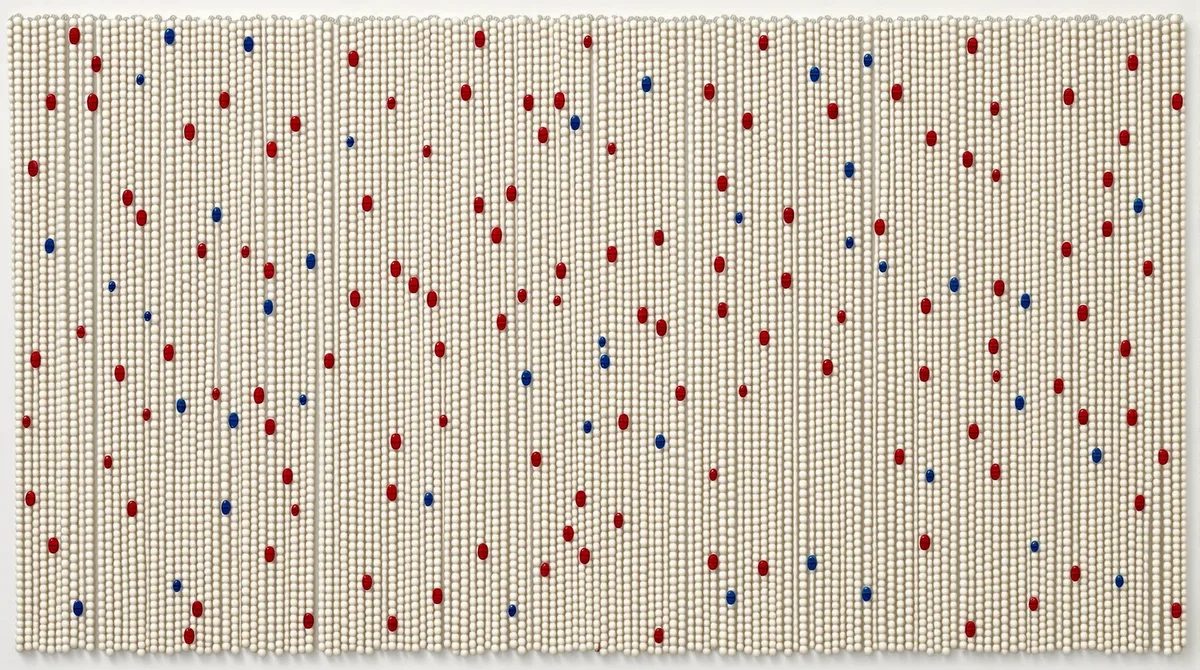
Style · Era
Three or four dots to a strand, placed at random, never level with the dot on the next strand. That last clause is the entire design, and it cannot be achieved by telling anybody to improvise.
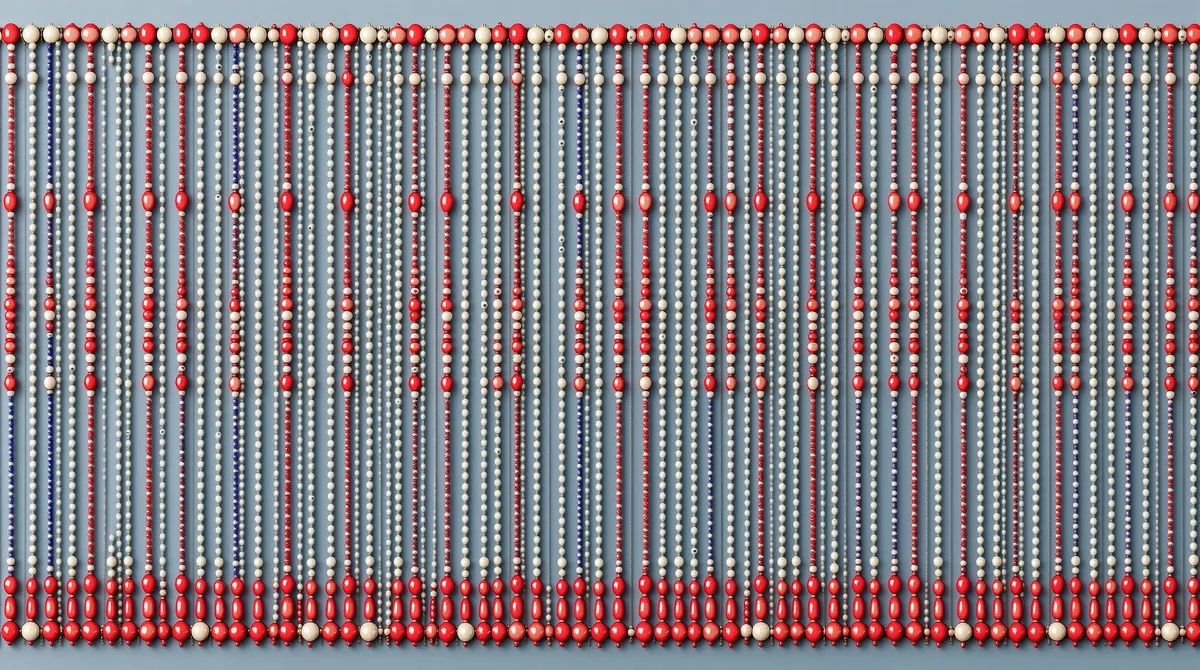
A beaded panel in chalk-white glass with large dotted oval pressed-glass beads in cherry red and cobalt scattered through it, each set at a different height so the dots never…
Dots are scattered to a written rule, not improvised. On a thirty-strand portal, around ninety to a hundred and twenty dotted oval glass beads are placed three or four to a strand, at random positions, with none level across adjacent strands. One aligned row turns the scatter into a stripe.
From textiles, and from a long way back. The polka dot is one of the oldest printed patterns in European clothing, and its appeal in every medium is the same: a regular object at irregular intervals, which the eye reads as liveliness rather than as pattern. In beadwork it arrives twice — once through the dotted glass bead itself, a wound or pressed bead carrying raised contrasting dots, and once through the compositional idea of scattering a large bead through a field of small ones.
Two scales and no alignment. The dot bead has to be clearly larger than the ground bead, so it reads as a separate object rather than as a colour change. And the dots must be unaligned in both directions: not level across adjacent strands, and not evenly spaced down any single strand. Even spacing is the failure mode people do not anticipate — a strand with dots at regular intervals reads as a dashed line rather than as a scatter.
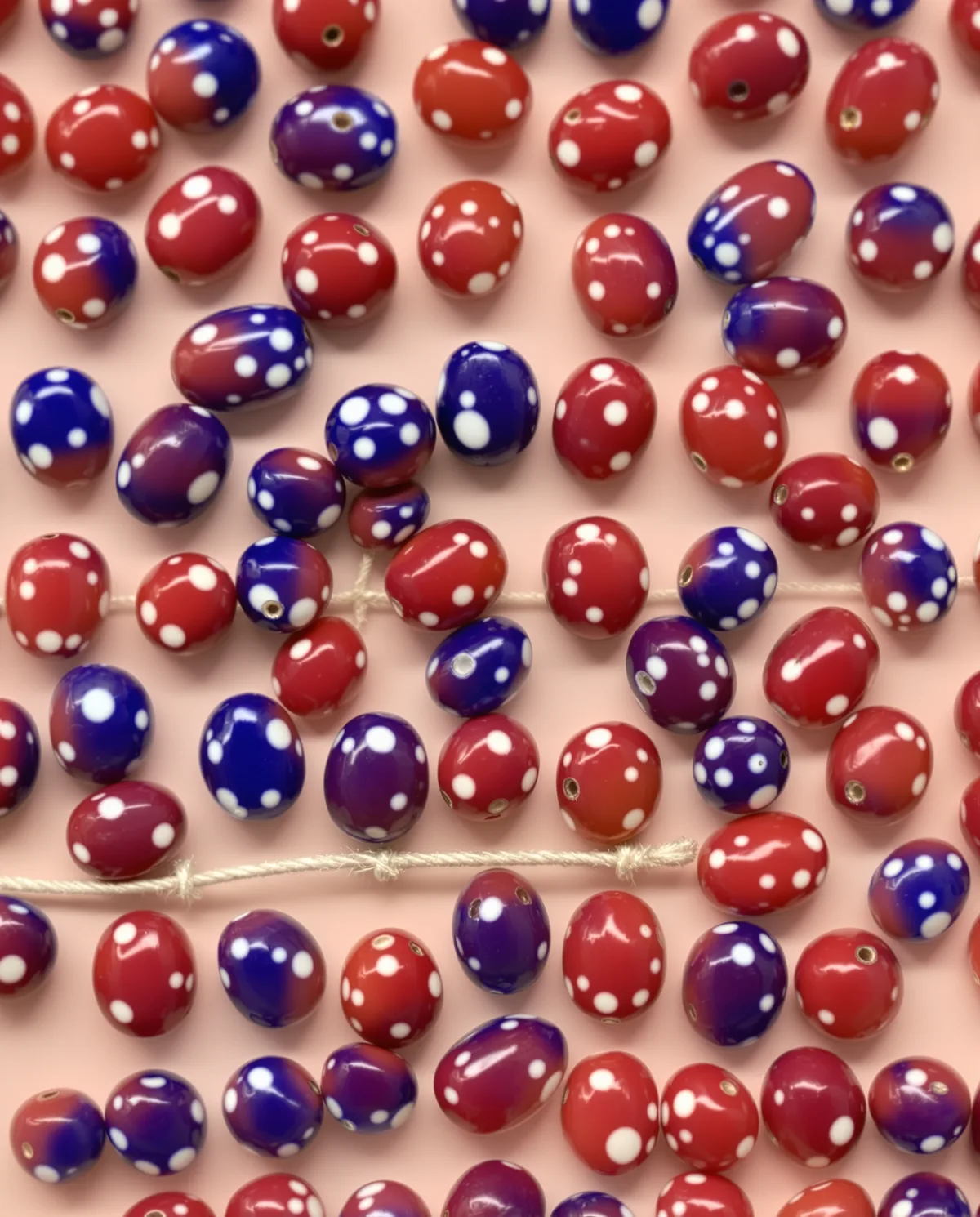
A dotted oval pressed glass bead at roughly thirteen by twenty-two millimetres over a glass seed-bead ground, with the ground dyed to match each dot colour. Our own dotted portal is built as thirty hand-strung strands on the wooden dowel, with the dots scattered three to four per strand at a strand pitch of about three centimetres. Hems are straight, because a shaped hem introduces a second rhythm that competes with the scatter.
Change the ground, not the dot. The dated version has a bright multi-colour ground competing with bright multi-colour dots. The current version puts the same dotted bead over a single quiet ground — oat, charcoal, chalk — so the dot does all the work. That one change takes the look from novelty to design and costs nothing.
A fixture that is currently in favour. The dot has never left decorative design and it is presently being actively asked for: warm, dotted and amber looks are what buyers across the home-and-lifestyle channel are requesting. That combination of permanence and current demand makes it one of the safest investments in this library.
The dotted bead itself is largely unchanged — it is still a pressed or wound glass bead with raised dots. What has changed is the composition. The historical use was dense and all-over; the version that sells now is sparse, with the dots as occasional events on a plain ground. The second change is control: the scatter is now written down, so the piece can be reordered identically.
The Polka Dot café curtain in the design library is the direct expression, at seventy-six by seventy-six centimetres and around eighteen hundred beads. Seventies Sunroom carries the dotted idea in its warm register — glossy orange, canary, chocolate and cream soda — and Honey Hour includes polka-dot drop beads at the strand ends. All three are documented with their bead and strand counts, which is what lets a dot brief be costed rather than guessed.
It photographs at mid range — close enough to see that the dot is a raised feature on a glass bead, far enough to see that the scatter is unaligned. One frame has to carry both facts, which is why a partial crop across four or five strands works better than either a macro or a full elevation. It sells extremely well on a thumbnail, because a dot is legible at any size.
Home and lifestyle retailers and brands buying under their own label. A dotted portal was developed through 2026 and built in both translucent and opaque versions; the opaque version was the one approved, and it is in continuous production. That translucent-against-opaque decision is the design lesson: an opaque bead holds the dot, a translucent one dissolves it.
Printed dots on a flat acrylic disc, or dots aligned in rows. The print fails because a raised dot catches light at its edge and a printed one does not, so the bead loses its dimensionality at exactly the distance a doorway is viewed from. Alignment fails more completely: a dotted panel with its dots in rows is no longer a dotted panel, it is a striped one, and no palette rescues it.
With a permitted-position rule. The stringing sheet carries, for each strand, the positions where a dot may fall, a maximum per strand, and a rule that no two adjacent strands may use the same position band. The stringer is not improvising; the sheet is doing the randomising. The result is a scatter that looks spontaneous and repeats exactly on a reorder, which is the only way a scattered design can be a production product.
Both a translucent and an opaque version of the dotted bead were made. In a hanging panel with daylight behind it, the raised white dots on a translucent body wash out — the light comes through the bead body and through the dot at similar intensity, and the contrast that makes the dot a dot disappears. On an opaque body the dot holds in every lighting condition. The opaque version was the one approved, and the lesson generalises: any raised or applied decoration on a backlit bead needs an opaque body behind it.
Good to know
It is selling now. A dotted portal in its opaque version is approved and in continuous production, and warm dotted looks are what buyers are asking for across the home-and-lifestyle channel.
A dotted oval pressed glass bead, around thirteen by twenty-two millimetres, with raised dots over a body colour. Pressed glass is the right trade because the dot has to be identical on every bead, and a mould is the only thing that guarantees that.
We match a reference's look, colours and bead sizes in new materials as an inspired design, and we do not reproduce another brand's protected design. With dotted references, measure the dot density per bead as well as the bead size — that ratio is what makes a dotted bead read as cheerful rather than as speckled.
A warm saturated body with white raised dots is the version that has sold: tangerine, rust, poppy red and a clear blue, with the seed-bead ground dyed to match each dot colour. A monochrome version — white dots on charcoal — works and reads much more adult.
Yes, by the dot bead line plus a placement operation. The dotted bead is a larger pressed glass bead and costs accordingly, but there are only three or four per strand, so the total is modest. The placement rule costs more than people expect because it has to be written and then checked.
Portals and café curtains. A café curtain at about seventy-six centimetres square carries a bead count around eighteen hundred and gives the scatter enough room to read, which makes it the economical format for this look. On a full-height panel the dots at floor level are wasted.
Keep exploring
Design
Dotted oval glass beads at 13 × 22 mm, scattered three or four to a strand on a seed-bead base dyed to match each dot.
Compare the optionsIndex
Twenty-four named looks, each described by the material, palette, pitch and hem that actually produce it.
Specs and sizesStyle
Rust, mustard, olive and amber at ten to sixteen millimetres in glass — why the palette needs the bead size.
Read the guideStyle
Hard flat colour, discs and ovals, op-art repeats and a fabric-mounted header — and how it differs from the seventies.
Specs and sizesStyle
Translucent acrylic, frosted pastels and iridescent finishes — a material decade rather than a motif one.
Read the guide
Start a conversation
Send a reference, a colour chip or a sketch. Minimums are set per design and confirmed per quote; sampling is quoted separately and usually runs 16 to 20 days from an agreed brief.