Style
Y2K beaded curtains and the motifs that carry it
Smileys, mushrooms, daisies and cherries on translucent and iridescent grounds, scattered to a rule.
Read the guide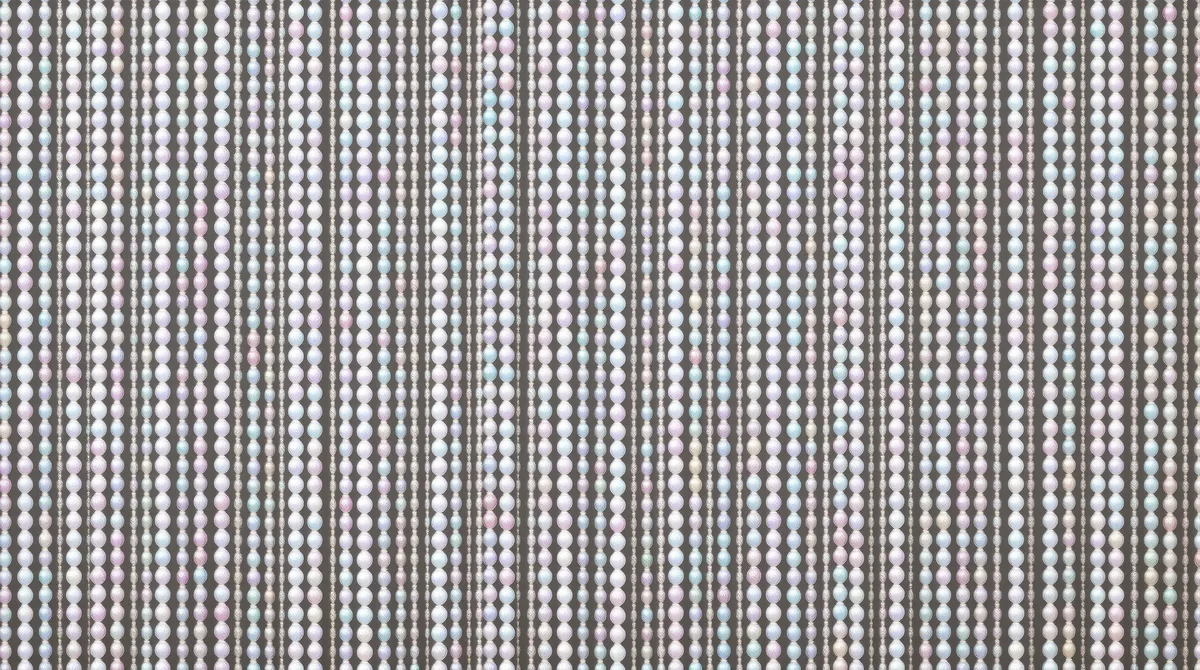
Style · Era
This is the decade where the bead stopped being glass. Acrylic is half the weight, takes any colour, and moves completely differently — and all three facts are visible in the panel.
A beaded doorway curtain of chunky frosted translucent plastic barrels with an iridescent sheen, in pale lilac, aqua and smoke grey on widely pitched strands.
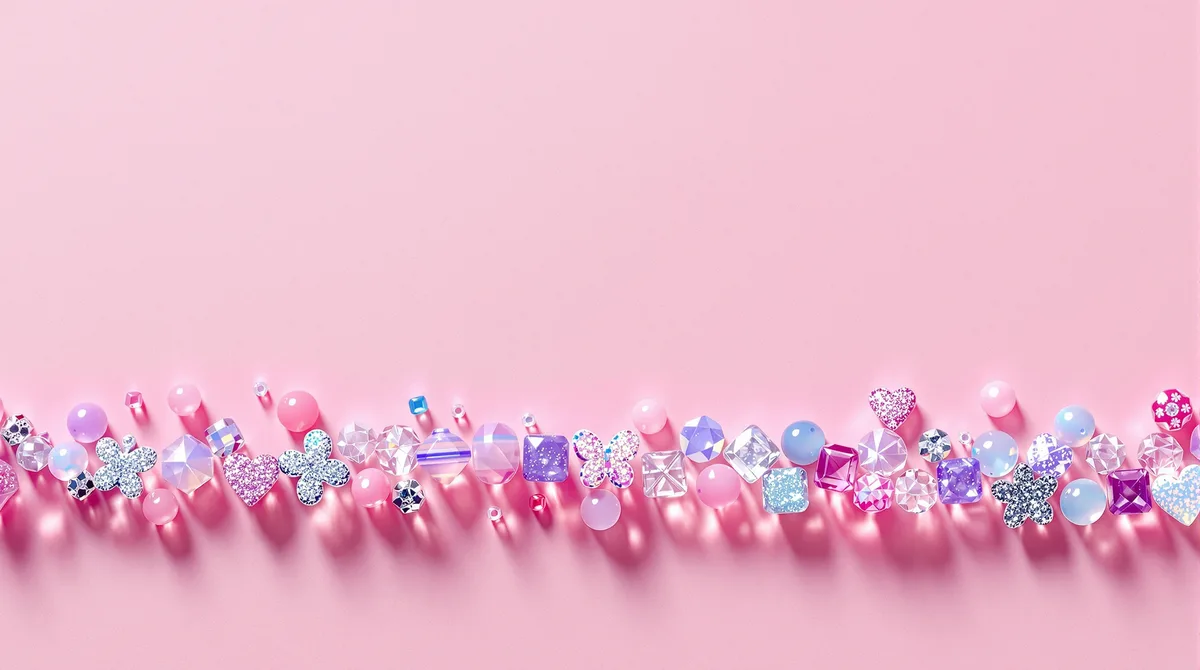
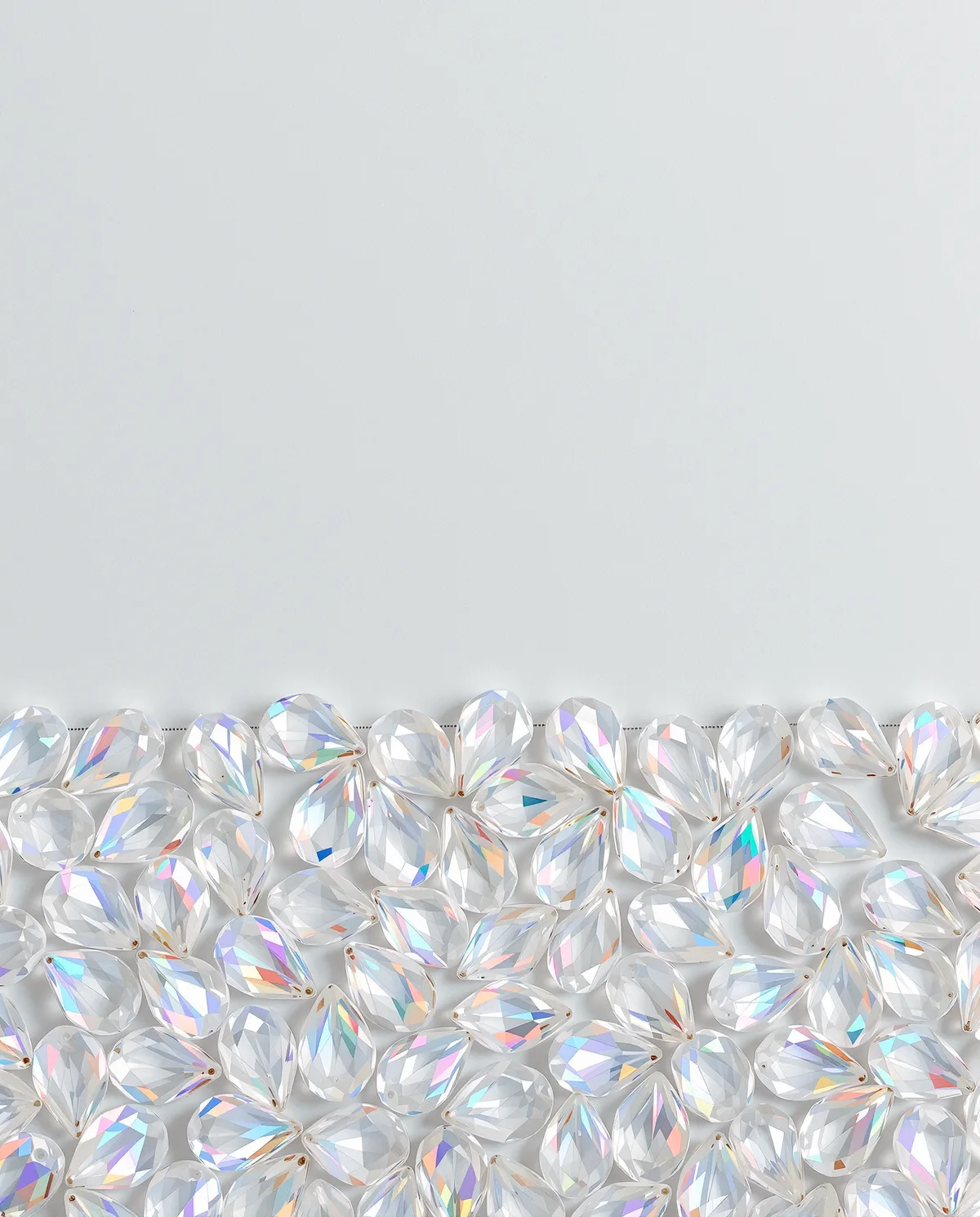
The nineties belong to translucent acrylic and iridescent finishes: frosted mint, lilac, ice blue and clear, moulded and dyed rather than drawn from glass, with faceted teardrops carrying a pearlised sheen. The decade is identified by material and finish rather than by any motif, which is what separates it from Y2K.
From a material change rather than from a design movement. Injection-moulded acrylic became cheap enough in the 1980s and 1990s to displace glass in decorative beadwork, and everything characteristic of the decade follows from that one substitution. Acrylic can be dyed to any colour, moulded to any shape, and is roughly half as dense as glass, so the panels of the period are brighter, lighter, cheaper and noisier than anything before them. Nineties bead design is a story about plastic.
Translucence plus a cool pale palette plus a surface finish. The bead is see-through rather than opaque, the colour is frosted rather than saturated, and the accent carries an iridescent or pearlised sheen. Motifs are largely absent — this is a decade of material and finish, not of imagery, which is exactly the line that separates it from the Y2K look that follows it.
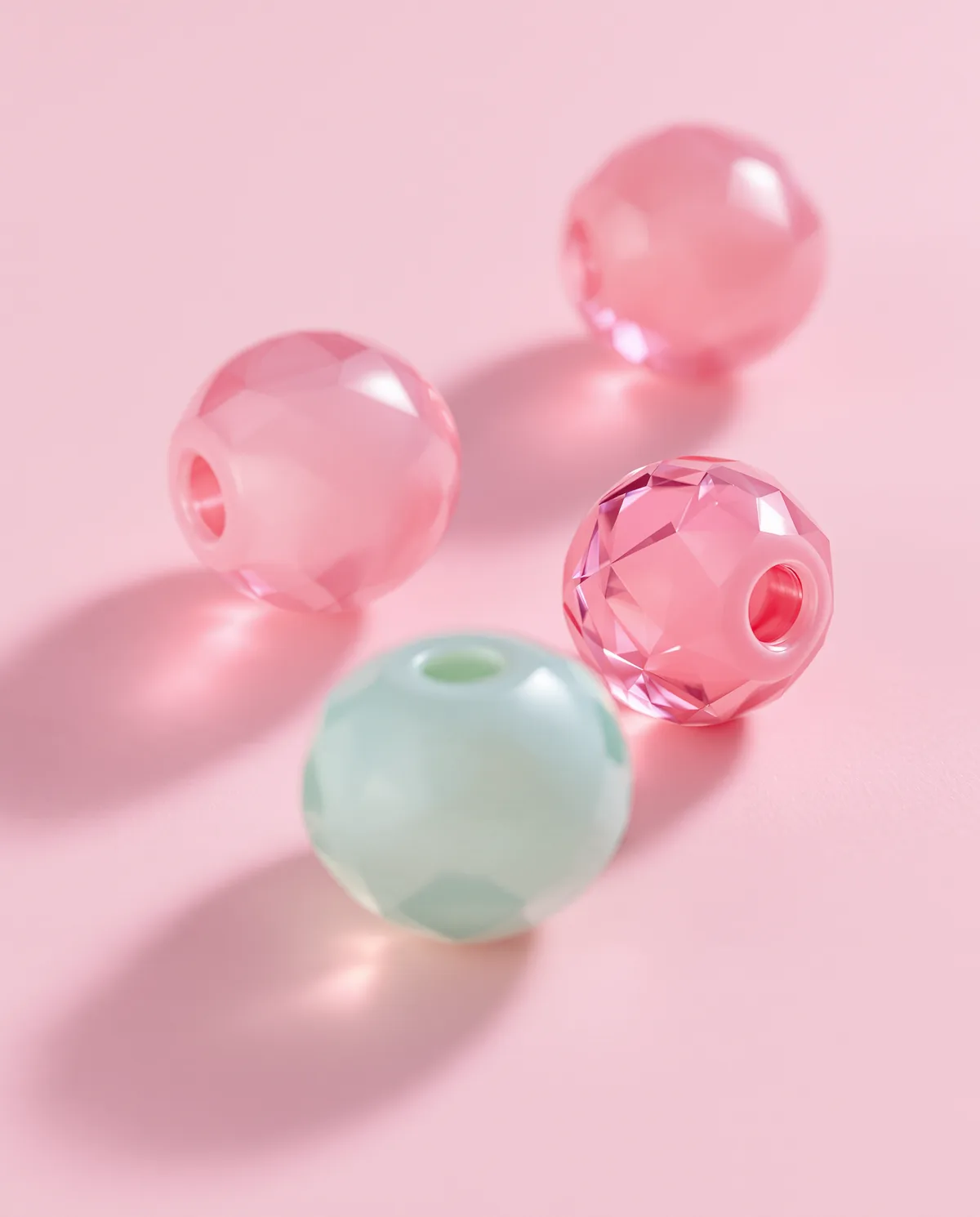
Moulded acrylic in translucent and frosted bodies, dyed to colour, with faceted iridescent teardrops as the feature. One of our shipped portals is built on exactly that feature bead — faceted iridescent teardrop in a pearlised crystal finish on a clean white base. Hems are straight. The important construction note is weight: acrylic is around 1.2 grams per cubic centimetre against roughly 2.5 for glass, so a light strand needs a weighted end bead or it will not hang plumb.
It photographs beautifully backlit, because a translucent bead is a light-transmitting object and it has nothing to show in reflected light. It sells strongly on nostalgia at the lower price points, and the acrylic material is a genuine commercial advantage — far lighter to ship than glass, impact tolerant, and hangable on a tension rod with no drilling.
Home and lifestyle e-commerce sellers, brands buying under their own label for bedroom, dorm and teen ranges, and gift retail. The buyer profile overlaps heavily with Y2K, and in practice the two are usually briefed together: a nineties ground with a Y2K motif scattered on it.
An acrylic panel moulded from recycled stock with visible flow lines and uneven colour, at too low a bead count. Translucent beads are unforgiving of moulding faults, because light passes through the defect and magnifies it. The second failure is uneven pitch, which a light panel reveals instantly because the strands swing and the gaps open up.
Through the colour match rather than through a patterned strand layout, because most nineties-register panels have no pattern. Acrylic beads are moulded and dyed to colour, which repeats more reliably across runs than a surface-dyed glass bead does, and a translucent body colour is set in the material rather than on it. Colour is matched to a Pantone reference or a physical chip and confirmed on the sample, never on a screen.
It is close to the floor and it is the cheapest route to a full-height panel. Acrylic costs less per bead than glass, weighs less to ship, and tolerates a larger bead size without a weight penalty. Where cost appears is in the finish: an iridescent or pearlised accent bead is a different unit price from a plain translucent one, so the sensible build uses it sparingly as the feature.
Bedrooms, dorms, bathrooms, rented flats and anywhere the fixing has to be non-destructive. It also suits photo and film sets dressing the period, where the finish is the single most recognisable cue. Avoid specified interiors, where the gloss and the lightness read as temporary.
Keep the translucence and drop the iridescence. The part of this decade that still looks good is the light passing through a frosted pastel bead; the part that dates it is the rainbow surface sheen. A frosted-acrylic panel in one pale colour at a wide pitch is a thoroughly contemporary object, and it is also one of the cheapest things in this library to make.
A revival cycle rather than a fixture. It returns with nineties fashion nostalgia generally, and it is currently carried along by the Y2K revival rather than running on its own. Treat it as a palette and finish option within a Y2K range rather than as a standalone line.
The original was often an unbranded import with uneven moulding and whatever colour the run produced. A modern build is moulded and dyed to a specified colour, to our own dies where a design needs a custom bead, which means the revival can be consistent in a way the original never was. The one thing the revival should not do is reproduce the original's glitter-filled and multi-finish mixing, which is the detail that makes a period panel look like a period panel rather than a design.
Sorbet Parade is the direct fit — candy pink, lemon, mint and lilac mixed so each strand reads as scattered confetti. Moonwater gives the cooler, more adult reading, with silver-lined crystal and pearl white against grey-blue. Sterling Swan works where the brief wants the period's reflective finishes without its pastels. All three are recorded in the design library by construction rather than by palette alone.
Good to know
Full-length door curtains, which is what the decade actually used, and they work especially well in acrylic because the weight is manageable on a tension rod with no drilling. That matters commercially: the format sells into rented rooms where a glass panel cannot be hung.
Pick one finish and hold it. The period reflex is to combine frosted, clear, iridescent and glitter-filled beads on one panel. A single finish across one tonal family — all frosted, all ice-blue — reads as a considered design rather than as a 1997 bedroom.
Yes. It sits among the stronger consumer-demand registers in the style cluster, which makes it a range page rather than a reference one.
Moulded acrylic, translucent or frosted, dyed to colour, with faceted iridescent teardrops as the accent. We have built and shipped a portal using faceted iridescent teardrop beads with a pearlised crystal finish, which is the period's signature bead almost exactly.
We match a reference's look, colours and bead sizes in new materials as a vintage-inspired design, and we do not reproduce another brand's protected design. Nineties references are usually easy, because the beads were moulded and a mould shape can be matched more reliably than a hand-made one.
Frosted mint, lilac, ice blue, bubblegum pink, lemon and clear, in translucent bodies. The decade's palette is cool and pale where the seventies is warm and deep, and that temperature difference is the quickest way to place a panel in the right decade.
Keep exploring
Style
Smileys, mushrooms, daisies and cherries on translucent and iridescent grounds, scattered to a rule.
Read the guideMaterial
Moulded to our dies and dyed to the reference: the widest colour latitude in the library, half the weight of glass, and no shatter risk.
Compare the optionsIndex
Twenty-four named looks, each described by the material, palette, pitch and hem that actually produce it.
See the detailStyle
Unmatched beads and uneven strands are the signature, not a palette — and genuine randomness has to be engineered.
Read the guideStyle
Four rules that make a loose look cohere, and the one that briefs almost always miss.
Compare the options
Start a conversation
Send a reference, a colour chip or a sketch. Minimums are set per design and confirmed per quote; sampling is quoted separately and usually runs 16 to 20 days from an agreed brief.