Technique
Couched beadwork
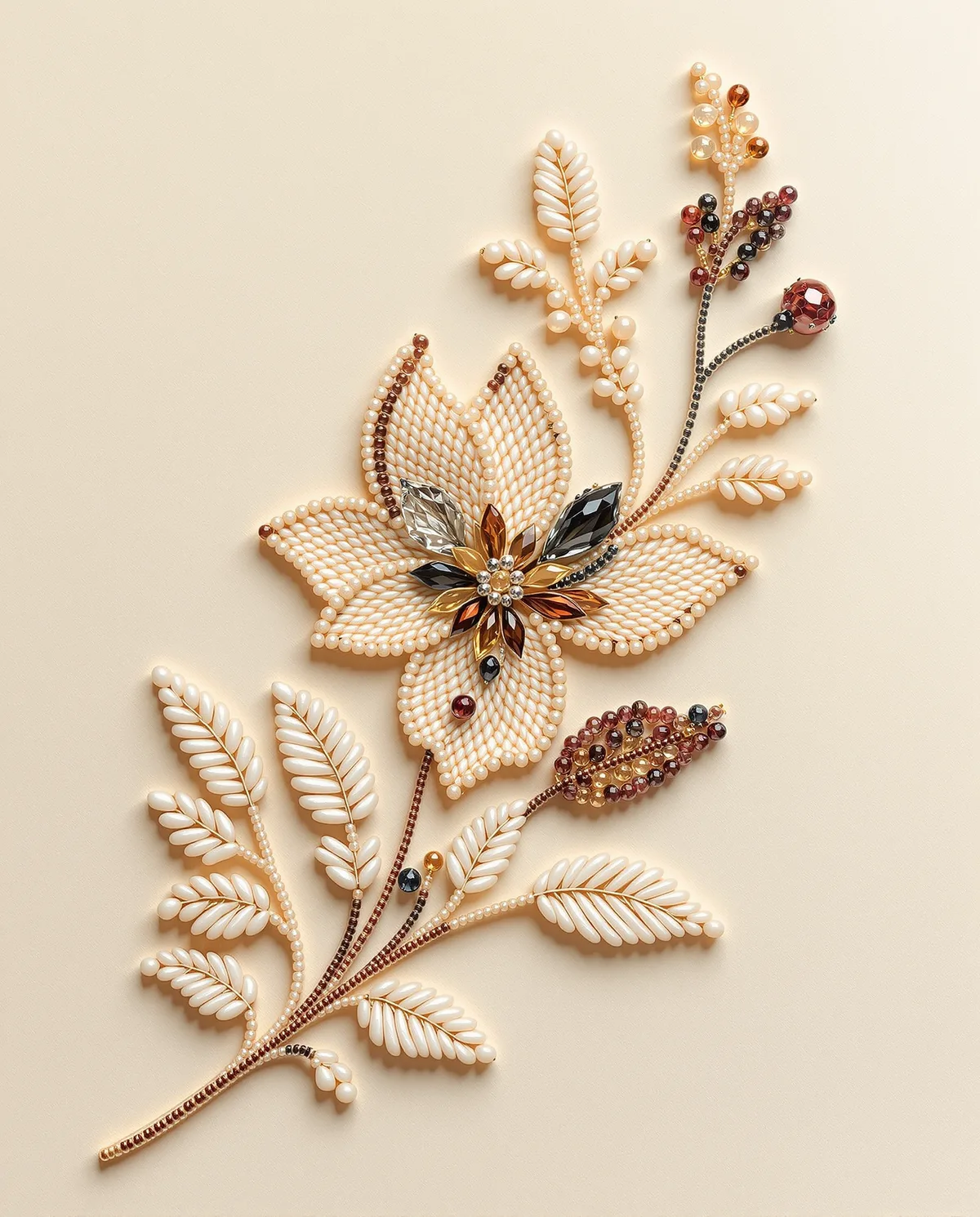
Seed and bugle bead couched onto a stiffened ground in the zardozi tradition: the stitch, the interval, the failure modes and why images live here.
View the range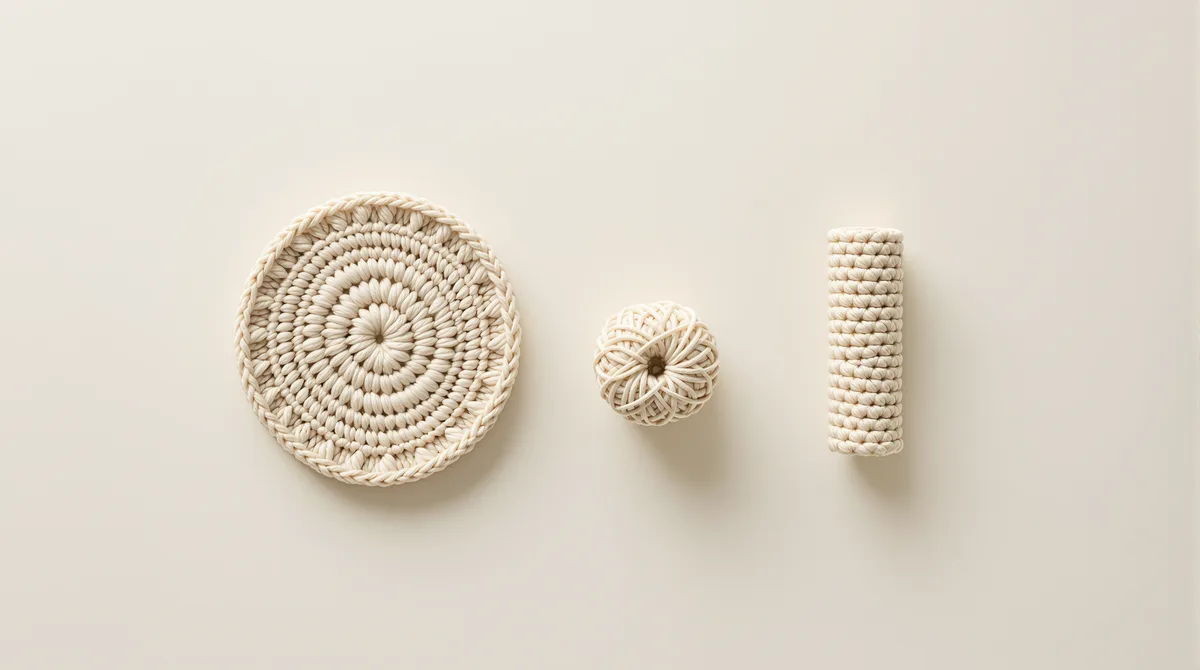
Technique · Crochet
Crochet is the largest family in our technique catalogue and the only one with no beads in it by default. It sits here because it shares the studios, the formats and the buyers — and because a crocheted shape does something no beaded one can.
Three small hand-crocheted forms in natural undyed cotton yarn — a flat spiral disc, a stuffed ball and a short tube — every stitch and the twist of the yarn readable.
Hand crochet builds a shape stitch by stitch from cotton yarn, worked flat for appliqué or in the round and stuffed for amigurumi. It is the largest of the five craft families we run, and it shares the studios and the formats with the beadwork rather than the materials.
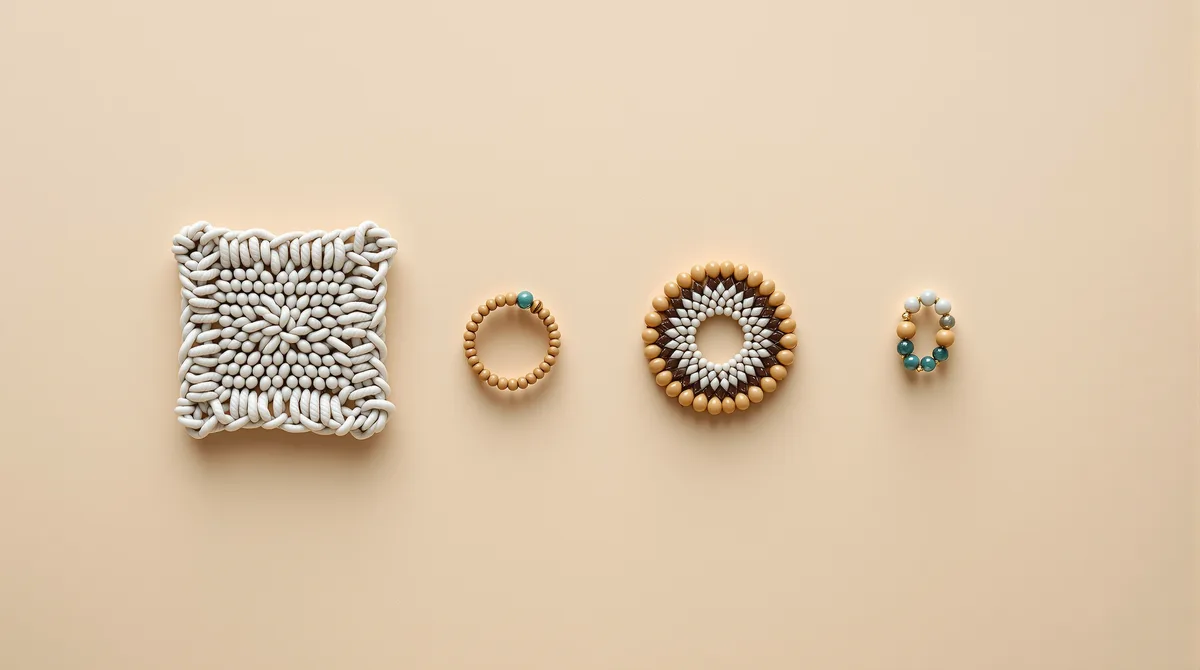
Crochet builds a fabric from a single working thread, one loop pulled through another, with a hook. Because each stitch is anchored only to its neighbours, the maker can add or remove stitches anywhere and the fabric will curve — which is how a flat disc becomes a dome and a dome becomes a closed ball.
Worked flat it produces appliqué: a panel, a face, a motif to be applied to something else. Worked in the round and closed, it produces amigurumi — a stuffed three-dimensional figure. Both are documented here, and crochet is the largest of the five craft families.
Seven stages, and the first one is the specification. Yarn ply and hook size together set the stitch gauge, and gauge is what converts a written pattern into a finished size. A brief that names a dimension without a gauge has named an aspiration.
A soft, solid figure. Nothing in beadwork produces that. Strung work hangs, embroidered work lies flat, and wire-wrapped work is rigid because a metal armature is holding it. A crocheted figure has no armature at all — the fabric is the structure, which is why it is light, why it is squeezable, and why it reads as a different category of object entirely.
That is also why crochet sits beside the beadwork rather than inside it. It shares the studios, the formats — ornaments, napkin rings, wall pieces — and the buyers, and it shares almost no materials.
In our own craft studios, with hooks and a written pattern. There is no machine stage anywhere in the process: machine knit and machine lace are different fabric structures and look different, so a hand-crocheted piece cannot be substituted with one.
The company's stated mission is to give second and third generation artisans modern manufacturing tools so they can work with their ancestral skills, and crochet is the family where the tooling contribution is smallest and the skill contribution is largest.
The documented formats are ornaments at 7 to 11 cm, napkin rings, garlands as craft pieces, and statement wall faces at around 25 cm.
The upper limit is arithmetic rather than craft. Stitch count rises roughly with area, so a flat piece at twice the dimensions is around four times the work, and somewhere past the wall-face scale the hours stop being justified by the effect. A larger wall piece is better served by hand-knotted work on a frame, where cord thickness does the covering instead of stitches.
To gauge, to firmness and to shape. Flat pieces are blocked and measured. Stuffed pieces are checked for firmness against the retained sample, because firmness is a judgement rather than a dimension, and then for the closing seam, which should not be findable.
Applied detail is checked by light tension, exactly as on bead-embroidered pieces: a bead that looks attached and is not will come away.
Yarn ply. Hook size or gauge — one of the two, and gauge is better. The shape, as a reference or a drawing. Finished dimensions. Whether the piece is flat or stuffed, and for stuffed pieces the fill and the firmness, approved on sample. Any applied detail. And the hanging or attachment method.
Gauge is the entry that is almost always missing and the one that decides whether the piece comes out the size that was agreed.
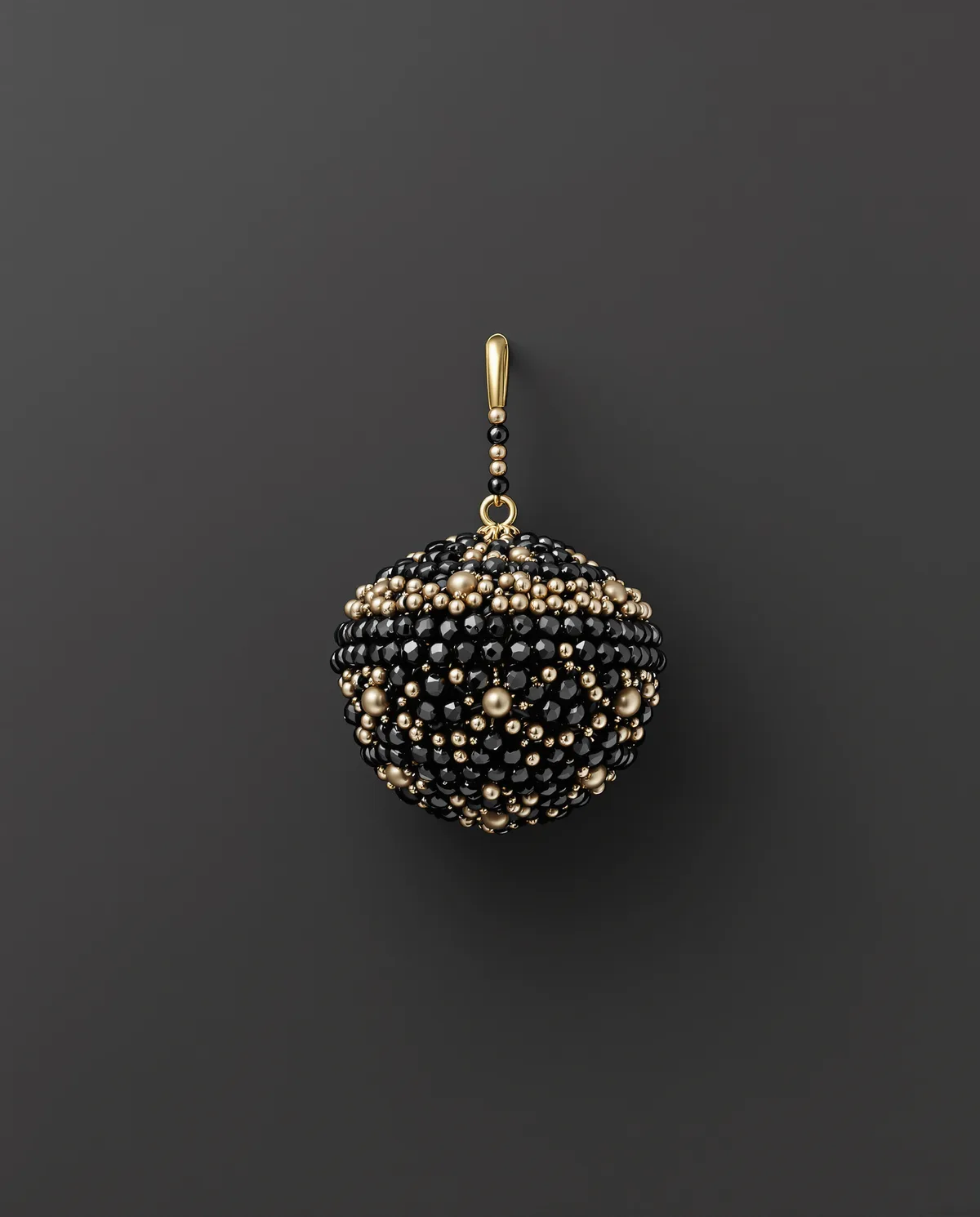
The ornament and small-object work. Ornaments run right across our gift work, with a holiday range of their own inside it, and the crochet family supplies the flat appliqué and amigurumi constructions behind the soft ones.
One entry deserves a flag. A crocheted moon-and-stars garland is a documented craft piece on this bench. A beaded garland is available to develop rather than a current line, so garlands appear here as a craft category rather than as an offer.
For crochet the equivalent document is the written stitch pattern, and it does the same job: rounds or rows, with increases and decreases at named positions, so the shape can be reproduced from the document rather than from memory. It carries the yarn ply, the hook size, the gauge and the fill firmness.
Where beads are applied, the piece gets a second sheet in the ordinary form described in bead maps and colour-count sheets — bead identity and position, because applied beads are placed rather than counted.
Cotton yarn at four to eight ply, with polyester fill. That is what the catalogue documents and what the studios work in.
Beads are additive here, and the distinction is worth holding onto. In wire-wrapped beadwork the metal is the structure and the beads are the skin. In crochet the yarn is the structure and the beads are decoration, which means a bead can be removed from a crocheted design without the piece ceasing to exist. That changes how the cost responds to a bead-count reduction: on a beaded panel it saves the design, and here it barely moves the number.
Stitches. Each one is a hand movement, and nothing in the process batches. That gives crochet a cost curve closer to hand-made lampwork glass than to anything strung: the hours per piece do not fall with volume, because there is no process to spread across the run.
The levers are pattern complexity and size, in that order. A simpler pattern with fewer shaping rounds is faster at the same size; a smaller piece is faster at the same complexity. Yarn ply is the third lever — a heavier ply covers the same area in fewer stitches, at the cost of fineness in the detail.
By gauge, measured on the work rather than assumed from the pattern, against a retained sample. Gauge drift is the characteristic failure of hand-worked fabric: a maker's tension changes over a long run, and the pieces get quietly larger or smaller.
The practical control is to check gauge at intervals through the run rather than only at the start, and to hold the retained sample at the bench rather than in an office.
Extractable data
| Stage | What drives the labour | What is rejected here |
|---|---|---|
| Yarn and hook | One decision; sets gauge and therefore size | A gauge that misses the target size |
| Stitch pattern | Complexity of the shape | A pattern that cannot be reproduced from the written form |
| Flat or in the round | Closed forms take longer than flat panels | A form worked the wrong way for its use |
| Shaping | Number of increase and decrease rounds | Lopsided or puckered shaping |
| Stuffing | Firmness approved on sample | Sag, or visible stitch gaps from over-filling |
| Closing and applied detail | One pass per detail | Visible closing seam, loose applied beads |
| Documented formats | Ornaments 7–11 cm; napkin rings; statement wall faces about 25 cm | Pieces outside the documented range need a new pattern |
| Craft family | The largest of the five craft families | — |
Good to know
Cotton yarn at four to eight ply is the documented material, with polyester fill for stuffed pieces. Beads enter as applied detail rather than as structure — a crocheted shape holds itself up, so a bead on it is decoration, which is the opposite of wire-wrapped work where the metal is the structure.
By gauge and by the written stitch pattern together. Gauge is stitches and rows per unit length; it is what converts a pattern into a size, and gauge drift across a long run is the characteristic failure. The retained sample is what gauge and firmness are measured against.
Gauge drift, which shows as pieces that are slightly different sizes. Lopsided shaping from a misplaced increase. Sag in an under-stuffed piece, or visible stitch gaps in an over-stuffed one. A visible closing seam. And loose applied beads, which on a stuffed piece is a safety point as well as a quality one.
Up to a point, and the economics are the limit rather than the craft. Stitch count rises roughly with area, so doubling a flat piece's dimensions roughly quadruples the work. Our catalogue tops out at statement wall faces of about twenty-five centimetres, which is where the ratio of effect to hours still makes sense.
None of it. Hand crochet cannot be machine-reproduced — machine knit and machine lace are different structures with a different appearance. That is why the family sits in a craft catalogue rather than in a textile one.
It is stitch count, and stitch count is set by the pattern rather than by the material. A seven-centimetre ornament is a short piece of work; a twenty-five-centimetre wall face is a long one. Production for this kind of work follows the 60 to 90 day band our bohemian and craft categories run to, rather than the 40 to 60 days beaded décor runs to.
A crocheted garland is a documented craft piece on this bench. A beaded garland is available to develop, so this page describes the craft category rather than offering the product.
Keep exploring
Technique
Seed and bugle bead couched onto a stiffened ground in the zardozi tradition: the stitch, the interval, the failure modes and why images live here.
View the rangeTechnique
Bead wrapped over a shaped brass armature: flat-back for rings, full three-dimensional for figural work, and why the wire gauge is the real specification.
How it is madeTechnique
The bead map, the cord, thirty strands on a dowel, hem shapes, suspension loops — and the three levers that move the cost.
Read moreMaterial
How seed beads are drawn, why dye lots are quoted per run, what the drill hole limits, and where seed-bead work earns its cost.
View the rangeReference
Five craft families — strung, embroidered, wire-wrapped, knotted and wrapped fibre — and what each one is good for.
Read more
Start a conversation
Send a reference, a colour chip or a sketch. Minimums are set per design and confirmed per quote; sampling is quoted separately and usually runs 16 to 20 days from an agreed brief.