Style
70s beaded curtain
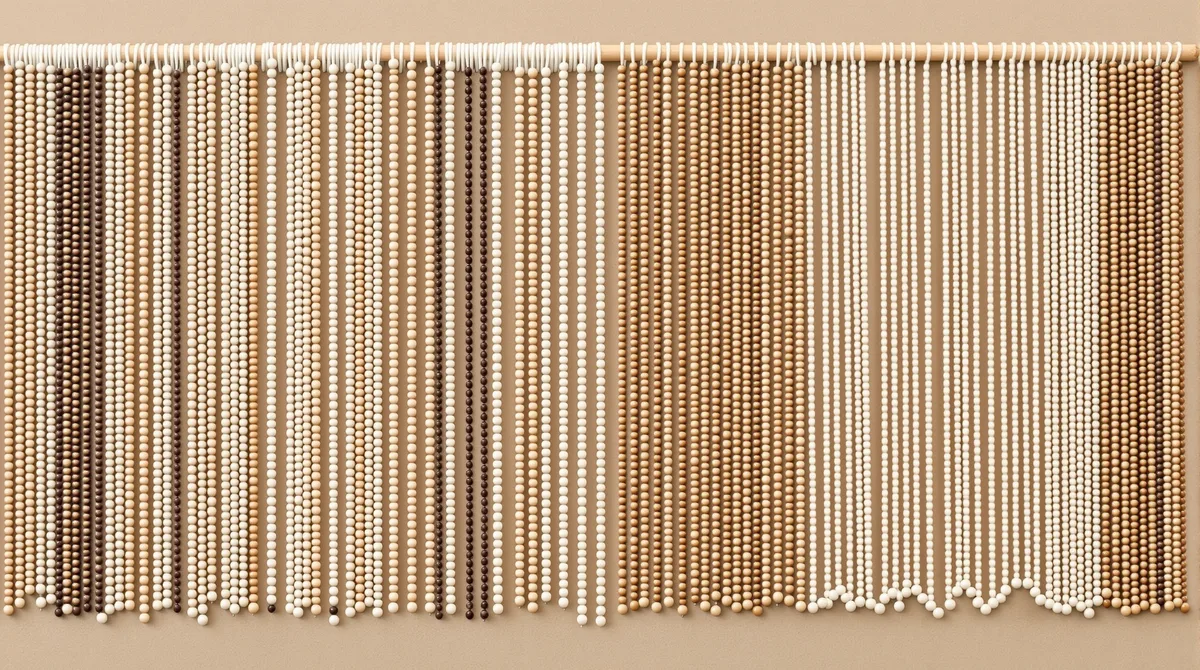
Rust, mustard, olive and amber at ten to sixteen millimetres in glass — why the palette needs the bead size.
See the detail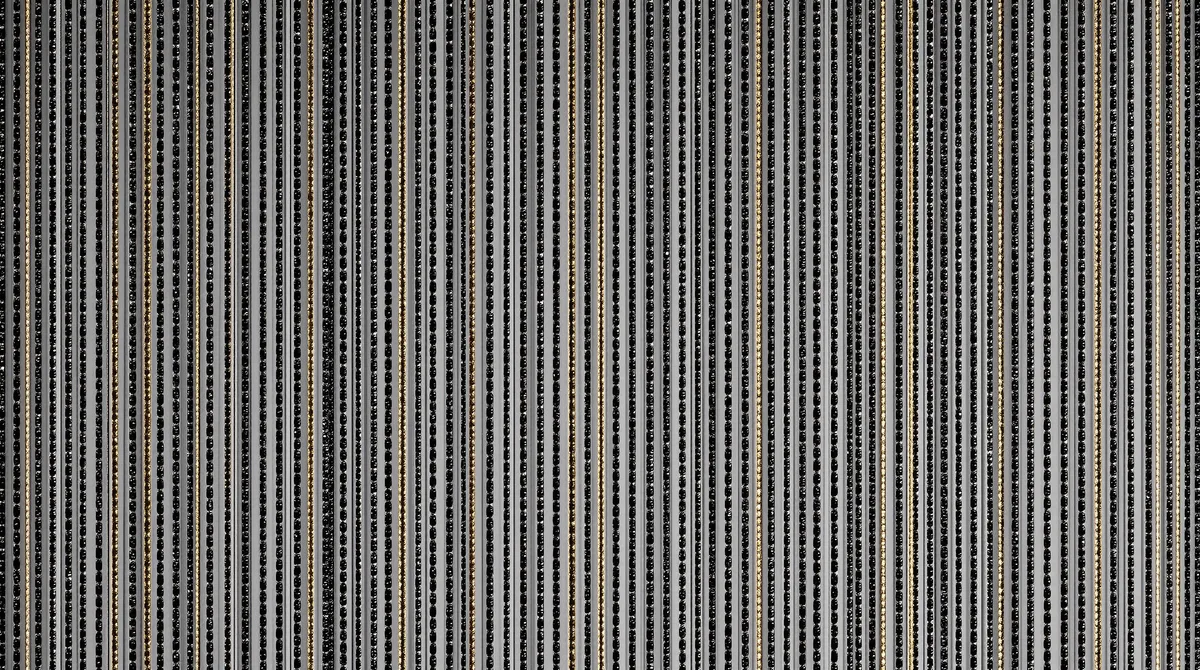
Application · Sets
On a set, a bead curtain has three jobs: be the right decade, behave under the lamps, and make no noise while the camera is running. Only the first of those is ever briefed.
A beaded doorway curtain in jet black, smoke crystal and antique gold, the strands close packed and strictly even to a straight hem.
Set beadwork is specified for three properties: period accuracy, which for a seventies build means glossy orange and canary glass with chocolate and cream; behaviour under the lamps, where clear faceted glass flares and frosted or opaque beads hold; and silence on a live take, which pushes the choice towards wood or a wider pitch.

Be the right decade, convincingly, in shot. Beaded curtains are period shorthand — put one in a doorway and the audience reads the seventies before anyone has spoken — which makes set and photographic work a small but recurring demand in this category.
A set brief is short on detail and absolute about dates. What is rarely written down is the second half of the job: the piece has to behave under the lamps and it has to be silent while sound is recording.
Period accuracy, which is a palette and a bead-shape question rather than a construction one.
Predictable behaviour under a hard light source. Clear faceted glass flares and blooms; frosted, opaque and body-coloured beads hold their shape in frame.
Silence on a take. Every bead family has a voice. A bright glass chime at a doorway is a problem for a boom operator.
Speed. Rig, shoot, strike, travel, rig again.
For a seventies build, the palette is specific and we have done the work on the seventies look: glossy orange and canary glass, chocolate brown, cream soda. Our Seventies Sunroom collection is built on exactly that, in a 120 × 200 cm door curtain, a 120 × 35 cm sunburst valance and a 60 × 100 cm wall hanging — design-library formats rather than shipped pieces.
For the practical build, the standard door curtain at about 90 × 200 cm with end suspension loops at each strand is the fastest thing to rig. For sound, wood beads are the quietest family — a soft knock — while clear faceted glass chimes brightly and bamboo rattles. Where glass is needed for the look, widen the pitch: fewer bead-to-bead contacts is the real volume control.
The period design work is real and it is ours: the Seventies Sunroom collection, developed around glossy orange and canary glass with chocolate brown and cream soda.
What that gives a set decorator is the palette research and the construction, built to the drawing and the schedule a set works to. Bring the shoot date early, because the fire test and the build both sit on the critical path.
Clear faceted glass at a tight pitch on a sound stage. Bamboo anywhere a microphone is live. A bespoke new design against a shoot date inside two months. And tight bundling for transport, which is how a set piece arrives tangled.
We would also advise against assuming a flammability report can be arranged quickly. A stage fire marshal can refuse a hanging piece on the day, and the lead time on testing does not compress to suit a call sheet.
The production designer or set decorator owns the look. The sound department has an effective veto nobody writes into the process, and it is worth consulting them before the order rather than after. The stage or studio fire marshal has a real veto.
Our sign-off is the sample, and for set work a sample is unusually valuable: it can be hung under the actual lamps and walked through while someone listens on headphones. Thirty seconds of that settles more than any specification.
Pipe, a set rail or a scenery flat — all the production's. We make the panel, the dowel or header rail, and the suspension loops.
Build for rigging rather than for permanence: a light header, loops at each strand so the piece hangs level without adjustment, and a hem that will not snag when the piece is carried through a doorway by one person. The panel is weighed on the approved sample and the fixing is sized to that weight.
Studio and stage fire regulations, which normally require a flammability report on hanging decorative material — commonly NFPA 701 in the US, with equivalents elsewhere. Fire performance is tested on the specified build and quoted with the project.
On a set that is a sharper problem than it is in a fit-out, because the person enforcing it is standing on the stage. The real build can be tested, bead and cord and header all matter so it has to be the real build, and that testing is quoted and scheduled separately. A production that needs a certificate should treat it as a pre-production task with a lead time of its own.
Beyond fire, two things to plan around: beadwork is a visual and spatial device rather than an acoustic one, and on-camera colour is judged on the sample under the lighting you will actually shoot. Rigging sits with the set builder.
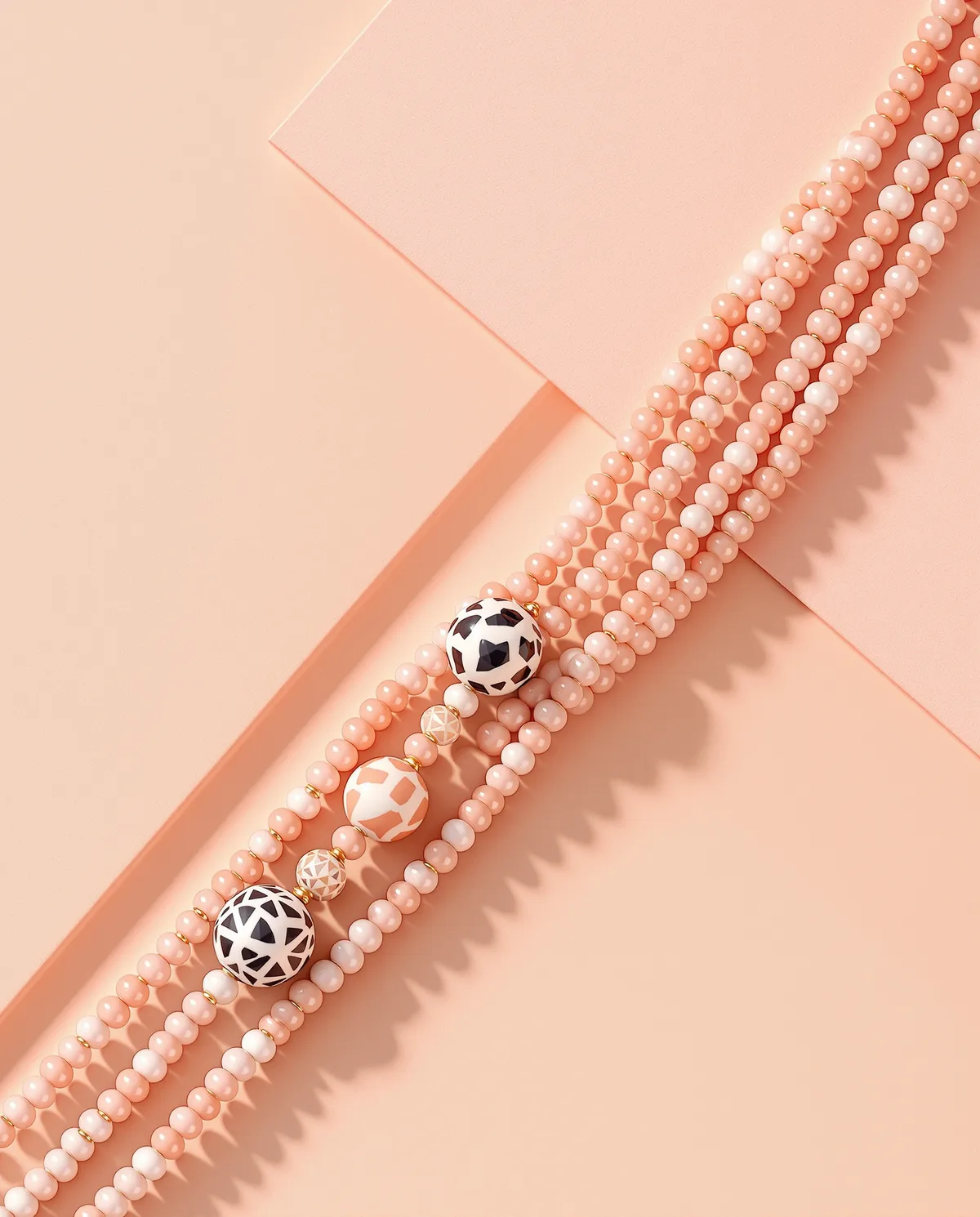
A set piece spends most of its life in storage, so the real maintenance question is storage. Bundle loosely, in tied groups rather than one mass; lift and carry by the rail, never by the strands; store flat or hanging, never compressed in a box.
Cleaning between builds: dry dusting down each strand from header to hem, then a damp spot-clean of the beads with a cloth wrung nearly dry, dried in the same pass. The cord never gets wet.
Tangle. It is the defining failure of travelling beadwork and it happens in the van, not on the stage. A tangled panel on a shoot day is an hour of someone's time that the schedule does not have.
After tangle, strand loss at the header from repeated handling, which is why spares strung with the original run are worth ordering. Bead damage is rare; set pieces are handled by people who handle fragile things for a living.
Sampling runs 16 to 20 days from an agreed brief with photographs approved first, and the production lead time is 40 to 60 days after sample approval. Minimums and pricing are set per design and confirmed with your quote.
That is the obstacle and it should be the first thing discussed on a set enquiry. Two months is tight for a new design; six weeks is not feasible. The workable routes are to come in early in pre-production, or to specify an existing library design where the bead map is already written and the development step disappears.
The bead materials, the hand-strung construction behind every panel and the cost levers that set a quotation are each documented separately.
Extractable data
| Item | What a set needs | Note |
|---|---|---|
| Seventies palette | Glossy orange and canary glass, chocolate brown, cream soda | From our Seventies Sunroom collection story |
| Seventies formats | Door curtain 120 × 200 cm; sunburst valance 120 × 35 cm; wall hanging 60 × 100 cm | Formats from the current design library |
| Shipped format | Door curtain ≈90 × 200 cm, 30 strands on a dowel | The safest thing to order against a date |
| Under a hard source | Frosted, opaque or body-coloured beads | Clear faceted glass flares and blooms |
| Under tungsten | Warm palettes read warmer; test on camera | No colorimetric data is held |
| Quietest option | Turned wood — a soft knock | Bench comparison, not measured |
| Loudest options | Clear faceted glass — a bright chime; bamboo — a dry rattle | Avoid on a live take |
| Volume control | Wider pitch, fewer bead-to-bead contacts | The main lever |
| Rigging | End suspension loops per strand | Shipped construction; fast level hang |
| Strike and travel | Light header, strand order preserved in packing | Bundle loosely, lift by the rail |
| Sampling | 16–20 days from an agreed brief | Photographs approved before the sample ships |
| Production | 40–60 days after sample approval | The schedule constraint on set work |
| Flammability | Tested on the specified build and quoted with the project | Studio fire rules usually require a report |
Good to know
Whatever can be hung and struck fastest, which usually means a standard door curtain at around 90 × 200 cm on a single dowel with end suspension loops at each strand, so it hangs level on the first attempt. For a window or a dressing flat, a valance — the sunburst valance in our seventies collection is 120 × 35 cm — because a short piece travels and rigs in minutes.
Pipe, a set rail or a scenery flat, and nothing we supply. Set rigging is the production's business and it changes between stages. What we can do is build the panel so it suits it: a light header, suspension loops rather than a fixed knot pattern, and a hem that will not catch when the piece is carried. The panel is weighed on the approved sample and the fixing is sized to that weight.
Studio and stage fire regulations, which usually require a flammability report on hanging decorative material — commonly NFPA 701 in the US. Fire performance is tested on the specified build and quoted with the project, and on a set that is a scheduling item rather than a paperwork one: a stage fire marshal can refuse a piece on the day, so the report has to be in hand before the build. Book the test with the design, not with the shoot.
Dry dusting between builds, down each strand from header to hem, and a damp spot-clean of the beads with a cloth wrung nearly dry. A set piece lives in storage more than it lives in use, so the realistic maintenance is about storage rather than cleaning: bundle loosely rather than tightly, lay flat or hang from the rail, and never store it compressed in a box.
Sampling is 16 to 20 days from an agreed brief and production is 40 to 60 days after sample approval. That is the obstacle to set work: a shoot date two months out is tight and six weeks out is not feasible for a new design. A set designer should either come to us early in pre-production or specify from an existing design where the bead map already exists.
Tangle, from transport and storage. A set piece is hung, struck, bundled and moved repeatedly, and strand order is what suffers — a tangled bead curtain is a repair job on a shoot day, which is the worst possible day for one. The fix is packing discipline and a build with a slightly wider pitch than a decorative panel would use.
Not on a set. What exists is the period design work: our Seventies Sunroom collection was developed around glossy orange and canary glass with chocolate brown and cream soda, in a 120 × 200 cm door curtain, a 120 × 35 cm sunburst valance and a 60 × 100 cm wall hanging. Those are library designs available to develop, and a set build starts from them.
Keep exploring
Style
Rust, mustard, olive and amber at ten to sixteen millimetres in glass — why the palette needs the bead size.
See the detailPillar
Twenty settings, from a closet front to a hotel lobby, each with the format that suits it, the fixing it needs and the standard that applies.
Open the referenceSpecification
Ceiling fixing, double-sided reading, strand drift in airflow, and a plain account of what a bead division will not do.
Compare the optionsSpecification
Grease, steam and daily traffic: which bead materials survive a kitchen opening, which finishes do not, and how often it needs cleaning.
Read the guideSpecification
Large-format panels, fire performance, the maintenance plan and the approvals a lobby specification has to clear before it gets built.
Read the guide
Start a conversation
Send a reference, a colour chip or a sketch. Minimums are set per design and confirmed per quote; sampling is quoted separately and usually runs 16 to 20 days from an agreed brief.