Guide
How to clean beaded curtains without damaging the cord
Dry dusting first, spot cleaning the beads, keeping the cord dry, what never to use, and how to handle a broken strand.
Read the guide
Guide · Care
Dusting is the whole maintenance regime for a bead panel, and it is directional. Downwards the dust leaves; upwards it ends up in the one place nothing can reach.
A soft brush drawn down a hanging strand of frosted sea-glass beads to lift dust from between the beads.
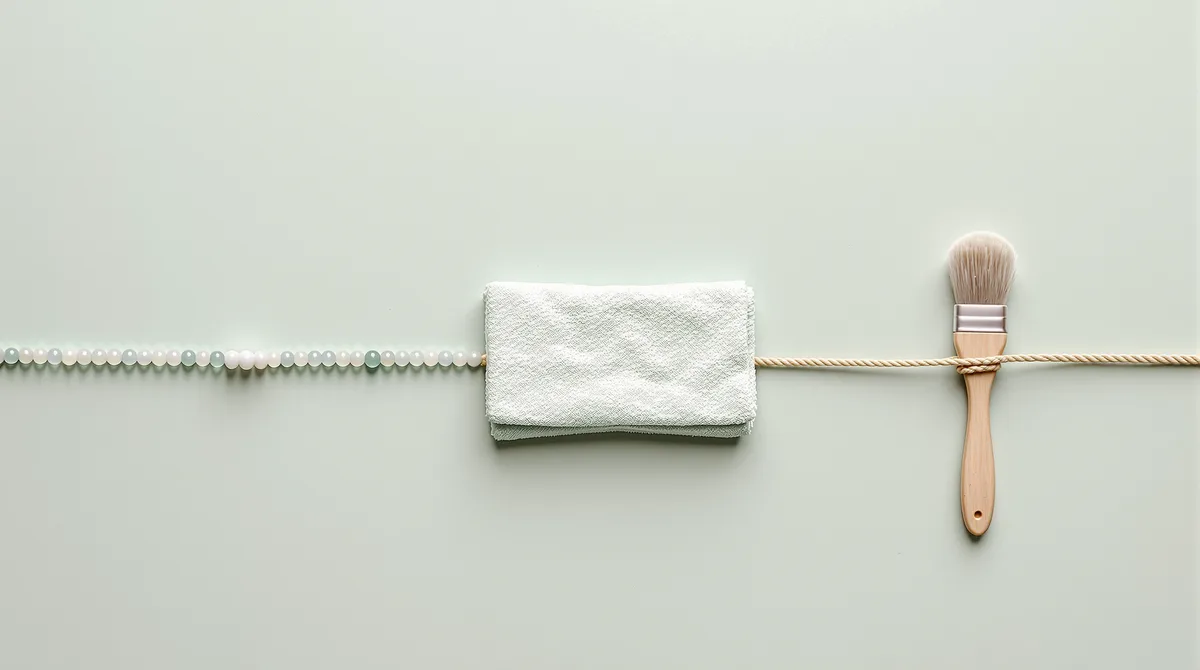
Draw a soft dry brush or a dry microfibre cloth down each strand, from the header towards the hem, so dust leaves the panel at the bottom. Work strand by strand rather than sweeping across the face. Monthly suits a normal room; weekly suits a kitchen or a smoking area. Nothing wet, and nothing at all into the header.

Dry, then damp, then nothing else. Ever.
Dry brushing removes loose dust, which on a panel in a normal room is essentially all of it. A barely damp cloth is reserved for a film that dry work has already failed on. There is no third step: no solvent, no spray, no steam, no immersion. The reason is below, and it is the same reason for every instruction on this page.
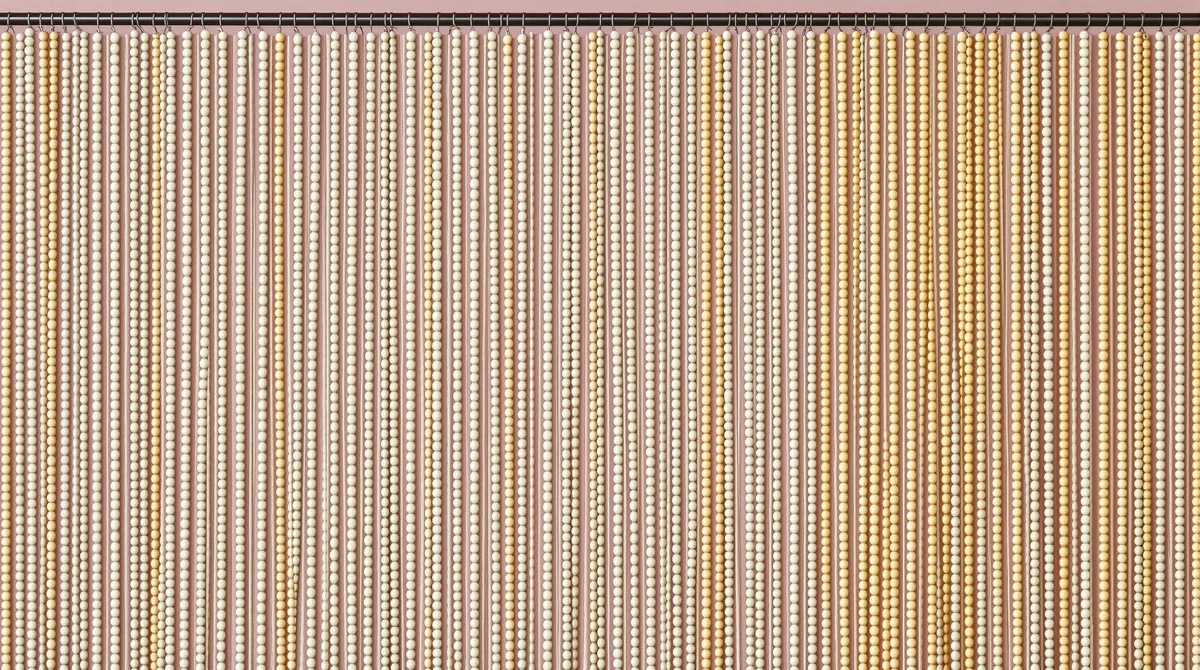
A strung panel is a set of cords doing structural work. Thirty lengths of cord can carry several thousand beads — a densely patterned 90 × 200 cm curtain holds about 11,800 — and the glass is close to indestructible in domestic use. The cord is not.
Wet cotton cord slackens, discolours, holds dust and abrades against the drill hole of every bead it passes through under load. So the rule behind the whole method is keep the cord dry, and the header, where every cord is knotted, is the wettest place a careless cloth will reach.
Dry brushing removes loose dust, which on a panel in a normal room is essentially all of it.
Support the strand loosely from behind with one hand.
Draw a soft dry brush — a clean paintbrush, a make-up brush, a dry microfibre cloth folded over — down the strand from the header to the hem in one movement. Release, move to the next strand.
Do not sweep across the panel's face. A cross-sweep moves dust sideways onto the neighbouring strands and then tips it into the header when the brush lifts. Do not work bottom-up for the same reason, and with more force behind it: upward brushing is the one method that reliably makes the problem worse.
Dust both dry, along their length, and stop there. A turned wooden dowel raises its grain if it gets wet, and a stitched cotton header band wicks water straight into the knots above every strand.
A barely damp cloth is reserved for a film that dry work has already failed on.
There is no third step: no solvent, no spray, no steam, no immersion. Keep a vacuum nozzle away, because suction pulls strands against their knots.
Thirty strands take about ten minutes done properly.
Monthly is enough in an ordinary bedroom or hallway. Every week or two in a kitchen doorway, a shop entrance or a room where anybody smokes.
The variable is not time, it is air. Dust arrives on air movement and sticks where there is something for it to stick to. A doorway in a cross-draught loads several times faster than an alcove panel in still air, and airborne grease is what turns loose dust into a film that no amount of dry brushing will shift.
| Component | Dry brush | Dry cloth | Damp cloth | Note |
|---|---|---|---|---|
| Glass beads, body colour | Yes | Yes | Yes | The most tolerant surface in the category |
| Frosted or sea-glass beads | Yes, light pressure | Yes | Lightly | Hard rubbing polishes the matte surface away |
| Surface-dyed beads | Yes | Yes | Lightly | Dye is a surface property; no solvents |
| Acrylic beads | Yes | Yes | Yes | Scratches more easily than glass; no abrasives |
| Wood beads and dowel | Yes | Yes | Barely damp | Water raises grain and can lift a lacquer |
| Faux capiz discs | Yes, light pressure | Yes | Lightly | Laser-cut edges and pearlised faces mark easily |
| Cotton cord and header | Yes | Yes | Avoid | Wet cord is the failure point of the whole panel |
Lightly, and never with an abrasive. Surface-dyed beads carry their colour as a coating, so pressure and any solvent lift it; that includes any bead dyed to match another bead in the build, which is most grounds on an accented design.
Frosted and sea-glass beads are a different trap. They are matte because the surface is textured, so rubbing hard does not clean them, it polishes them. A section of a frosted valance buffed to gloss cannot be returned to matte, and it will always catch the eye because the panel around it is still correct.
Dust both dry, along their length, and stop there.
A turned wooden dowel raises its grain if it gets wet and can lose a lacquer or wax finish. A stitched cotton header band — the construction used where a panel hangs from a rod pocket rather than a bare dowel — behaves like any cotton: it shrinks unevenly, marks, and wicks water straight into the knots above every strand. Neither is improved by damp work and both are made worse by it.
In frequency, in who does it, and in what is written down. A hospitality or retail panel in a walked-through doorway needs a scheduled dry dust, because housekeeping will otherwise reach for the spray bottle they use on everything else.
On a cleaning schedule the frequency matters more than the method. A doorway panel in daily use wants a monthly pass; a wall piece in a still room wants two a year. Both are the same thirty seconds of work per strand, and the difference is entirely how much dust the position collects.
Four things. A frosted bead polished to gloss. A surface dye lifted by solvent or by abrasion. A lacquered dowel that has been wet and then dried with the grain raised. And a header knot that has been pulled loose by suction or by force, because the strand below it then has to be re-strung rather than re-tied.
Everything else on a bead panel is recoverable. These four are not, and all four are dusting errors.
Hang it where air is still rather than where air moves, if the room allows a choice. Keep it out of a kitchen doorway unless you accept a weekly habit. And specify bead size with dust in mind on a panel that will never be maintained: small beads strung close hold less dust than large beads, because the upward-facing surface per unit of coverage is far smaller.
That last point is a design decision, not a care one, which is why it belongs in the brief rather than on the care card.
Dry work only, and it is a check rather than a clean. Panels are inspected at our quality control and packaging house at Greater Noida, which runs first-article and lot inspection on an AQL plan before export packing.
The inspection looks at the things dusting cannot fix: strand length consistency, knot seating at the header, bead alignment and any chipping. Then the panel is packed with the strands held in order, which is the reason a new panel arrives untangled rather than as a problem.
Solvents, bleach, abrasive cream, steam, hot water, a vacuum nozzle, and a stiff brush. Each has a specific failure: solvent lifts surface dye, abrasive cream scratches acrylic and dulls faux capiz, steam and hot water soften acrylic and soak cord, suction pulls strands against their knots, and a stiff brush polishes frosted glass.
None of them is necessary. A dry brush and a barely damp cloth do everything a bead panel ever needs.
Good to know
A vacuum with a brush head on a hanging panel, a feather duster that pushes dust sideways, any cleaning spray, and a stiff brush. The vacuum is the worst of them: suction grabs a strand, the strand pulls against its header knot, and the knot is the thing holding several hundred beads.
No. Water raises the grain on a turned dowel and will lift a lacquer or wax finish, and the dowel is also where every strand is knotted, so water there reaches the cord too. Dust it dry along its length and keep damp work for the beads.
Lift rather than brush. On embroidered work every bead is couched to a ground individually, so a brush drags at threads instead of past them. Use a soft dry brush with almost no pressure, or lift dust with the sticky side of low-tack tape, and never immerse the piece.
No. A broken strand is a repair, not a write-off: the strand is re-strung in its original bead order and re-knotted at the header. If it parted during dusting, the likely cause was pressure pulling the strand against the knot — which is the argument for brushing downwards with the strand supported.
Hanging is better than boxed, and out of a direct draught is better than in one. Dust arrives on air movement, so a panel in a cross-draught doorway loads faster than the same panel in an alcove. If it is going away for a season, loosely tied bundles in a closed box beat a hanging panel in an empty room.
No, and this is the one absolute. A strung panel has no textile structure — the cord does all the work — so a drum tangles the strands into one mass and abrades the cord at every drill hole it passes through. Even hand immersion soaks the cord, and the cord is the part that fails.
Dry brush the whole panel first, then assess. Dry work removes loose dust, and loose dust is most of what is there. What remains after that is film, and film is the only case for a barely damp cloth and the only case where a mild detergent is justified.
Keep exploring
Guide
Dry dusting first, spot cleaning the beads, keeping the cord dry, what never to use, and how to handle a broken strand.
Read the guideGuides
One guide per question that arrives often enough to be worth answering properly.
Read moreGuide
Solvents, bleach, abrasive cream, steam and hot water — what each does to dye, to frosted surfaces, to acrylic and to the cord.
Read the guideGuide
Why the cloudiness is mineral film rather than damage, and why how you dry matters more than what you clean with.
See the detailGuide
Which beads can be swapped, why re-dyeing a strung panel does not work, and the replace-or-live-with-it call.
Specs and sizesGuide
The one case for a mild detergent: how to lift kitchen or smoke film without soaking the cord, and why dry dusting comes first.
Read the guideGuide
The four dos, the four nevers, the material note and the one line about the cord that prevents most returns.
Compare the options
Start a conversation
Send a reference, a colour chip or a sketch. Minimums are set per design and confirmed per quote; sampling is quoted separately and usually runs 16 to 20 days from an agreed brief.