Guide
How to clean beaded curtains
Dry dusting first, spot cleaning the beads, keeping the cord dry, what never to use, and how to handle a broken strand.
See the detail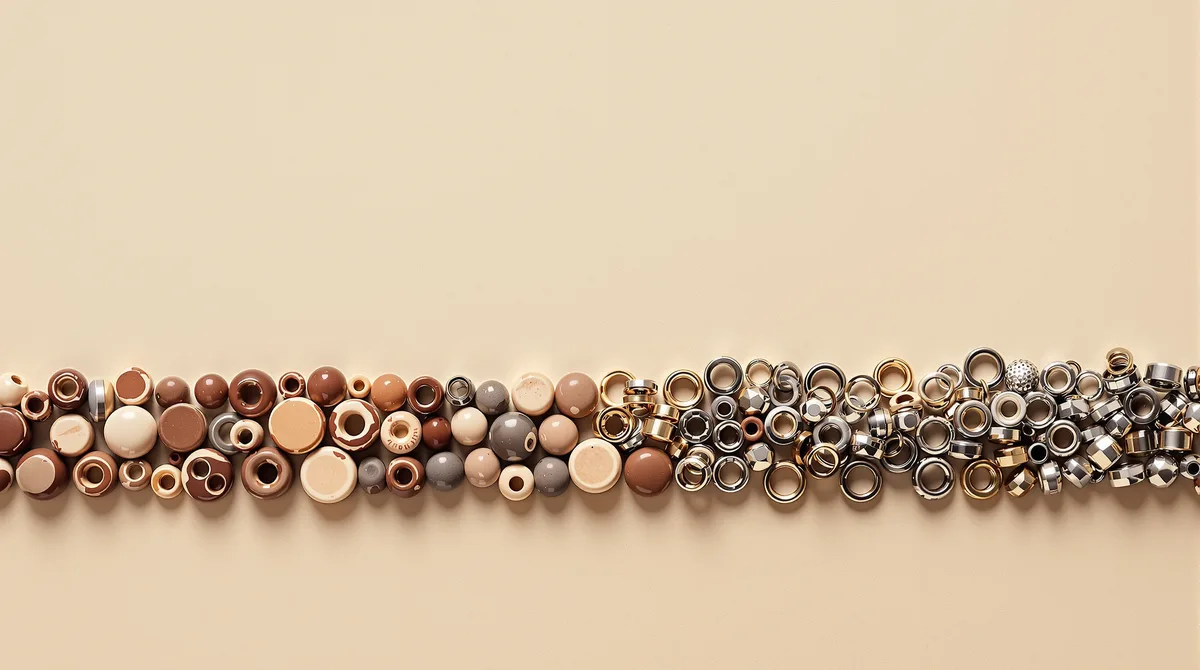
Application · Application
A kitchen doorway is a doorway with a chemistry problem. Everything that hangs in one is being basted in aerosolised fat and then wiped, and only one bead material is genuinely indifferent to that.
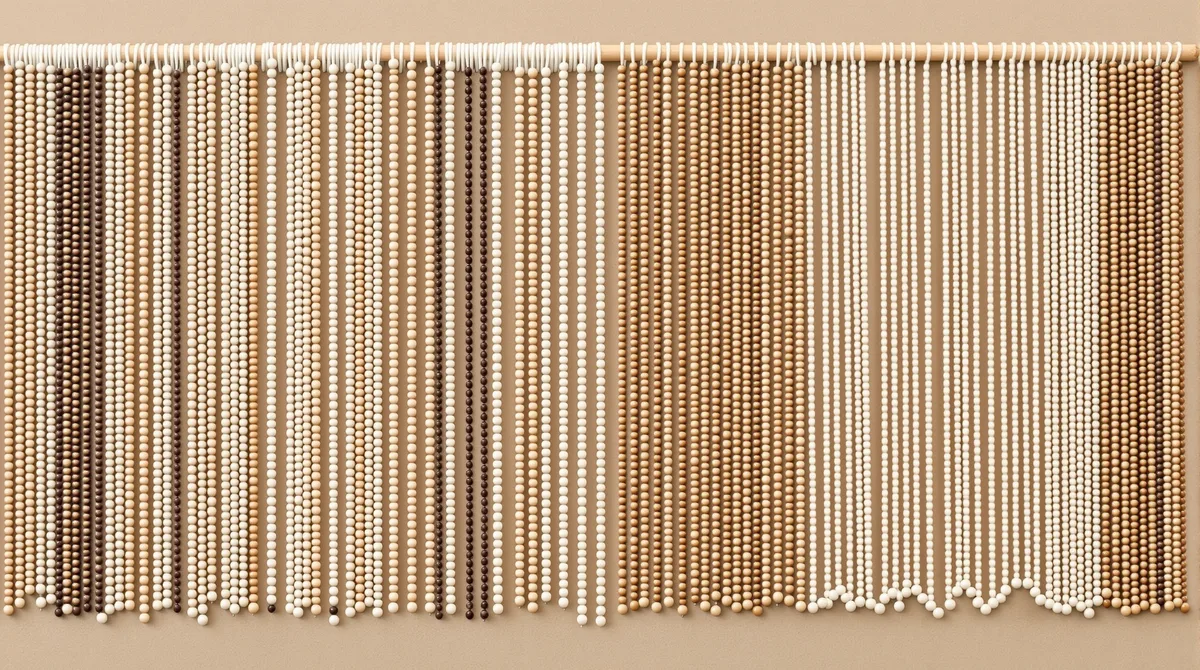
A close band of hard-surfaced beads — turned wood, glazed ceramic and plated metal — their drilled threading holes facing the camera.
A kitchen or pantry doorway combines airborne grease, steam and daily traffic, so body-coloured pressed glass is the material that survives it and surface-dyed beads, bare wood and bamboo are the ones that do not. Cleaning frequency rises to roughly monthly, damp rather than dry, and the cord still has to be kept out of the water.

Screen the kitchen without putting a door in the way, and keep the opening workable with full hands. In a domestic kitchen the motive is usually a view the client would rather not have from the dining table. In a pantry or utility opening it is simply that a door is in the way.
Both are good uses of beadwork. The difference between them is severity: a cooking doorway lives in the grease and steam plume, a pantry opening mostly does not, and they deserve different specifications.
A surface that survives repeated wiping, because the grease film forces damp cleaning no amount of dusting will handle.
Indifference to steam, which rules wood out of a direct steam path and rules bamboo out altogether.
Heat clearance. Acrylic is a thermoplastic and softens well below the point glass would notice, so it stays away from hobs and ovens.
A generous pitch, because this is a doorway people walk through carrying things.
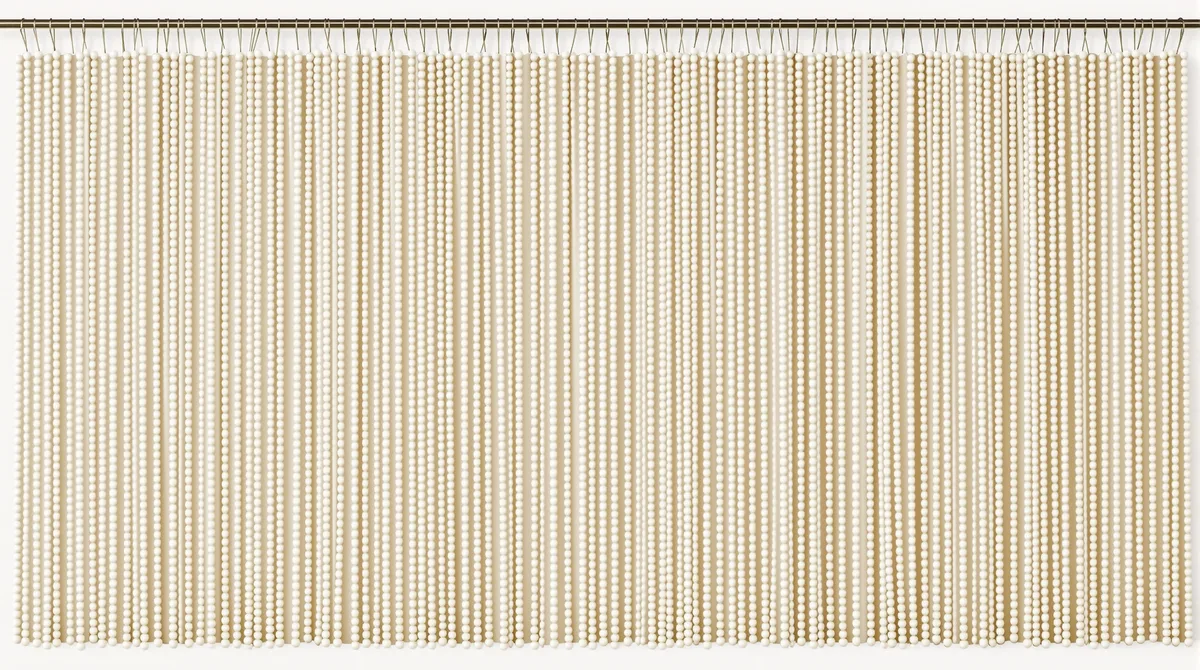
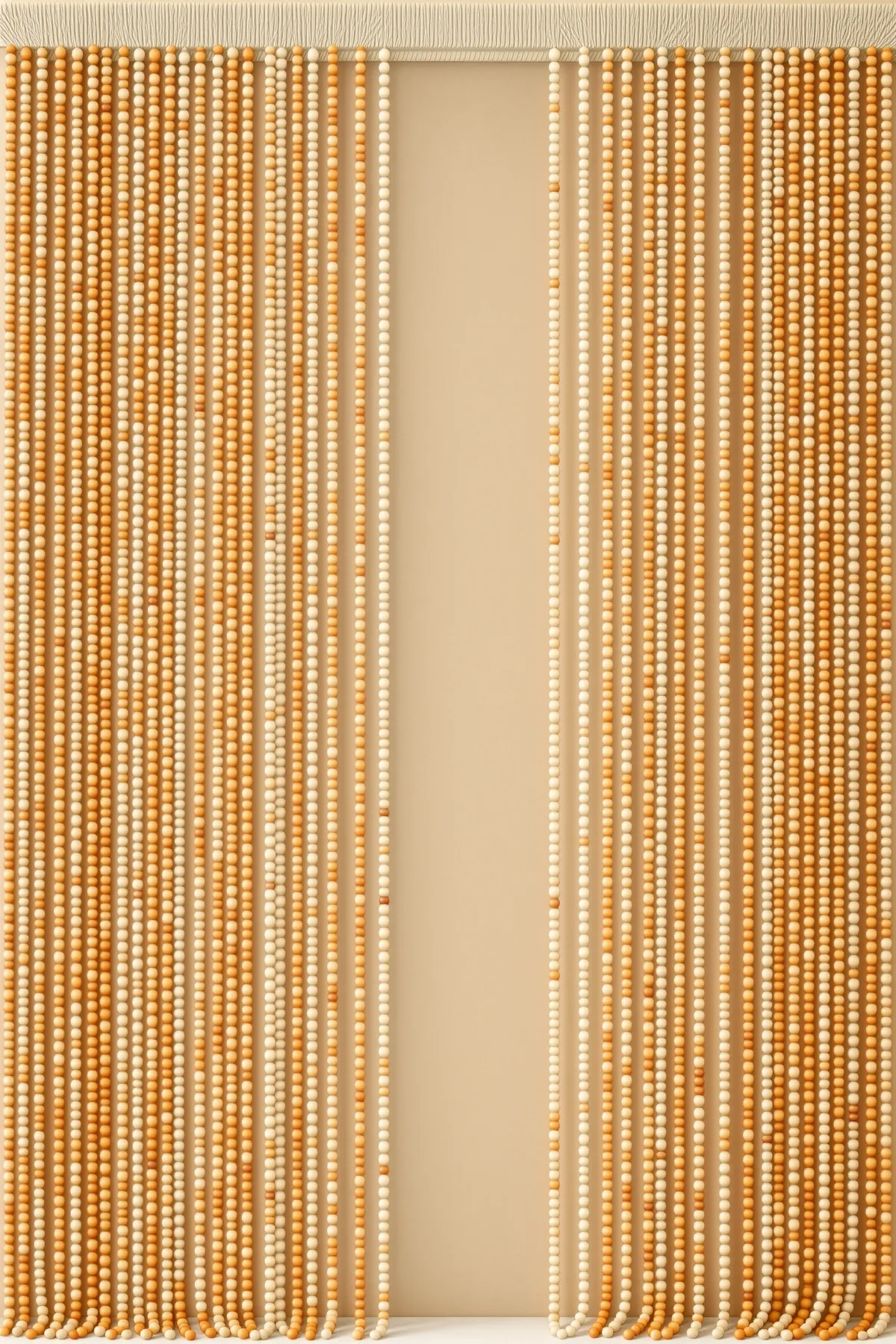
Format: the shipped standard, a door curtain at about 90 × 200 cm — roughly 35 × 79 inches — hung from a wooden dowel, commonly thirty hand-strung strands. For a wider opening, 120 cm with sixty strands at about 2 cm pitch, which is a design-library figure rather than a shipped build.
Material, in order: body-coloured pressed glass, because the colour is fired into the glass and wiping cannot reach it. Then moulded acrylic, dyed to colour, light and unbreakable, kept clear of heat. Use frosted or sea-glass beads with care — they are matte because the surface is textured, and hard rubbing polishes them into a gloss that cannot be reversed. Avoid surface-dyed beads, bare or waxed wood in a steam path, and bamboo, which marks in damp.
Door curtains in this exact format are the backbone of the programme: portals, curtains, café curtains, valances and wall hangings leave our plants continuously.
That is the construction settled — the format, the header, the cord and the bead families, proved at volume. What this page adds is where that construction belongs in a kitchen plan, and which bead family to put near heat, steam and grease.
Bamboo, anywhere near a kitchen. Surface-dyed beads in a panel that will be wiped. Wood in a direct steam path — the care guidance for wood is to dust or wipe dry, not to soak and not to keep near constant steam. Acrylic within reach of a hob.
Also: a panel hung so low that it hangs in the plume. Raising the fixing 100 mm and shortening the drop costs nothing and halves the problem.
In a home, the client, and it is worth having the conversation about cleaning before they fall in love with a dyed colour. In a commercial kitchen, the chef or kitchen manager, the environmental health position, and the fire file holder.
The panel hangs from a wooden dowel or stained header rail, turned in our own Saharanpur wood factory, and that part is ours. Brackets, hooks and rods are the project's.
Fix above the architrave into solid substrate, high enough to clear any remaining door swing. In a commercial kitchen area specify corrosion-resistant fixings. The panel is weighed on the approved sample and the fixing is sized to that weight; a glass panel weighs materially more than an acrylic one of the same size.
Domestic kitchen: none. Commercial kitchen area: two.
Flammability. A hanging decorative panel in a commercial interior is normally asked to meet NFPA 701 in the US, or the local equivalent. Fire performance is tested on the specified build and quoted with the project.
Food safety. Beads are decorative and are not a food-contact surface. The FDA food-grade and California Proposition 65 statements on our compliance page cover our stainless steel and copper lines and do not transfer to beadwork. Keep a panel away from an open plating or prep surface.
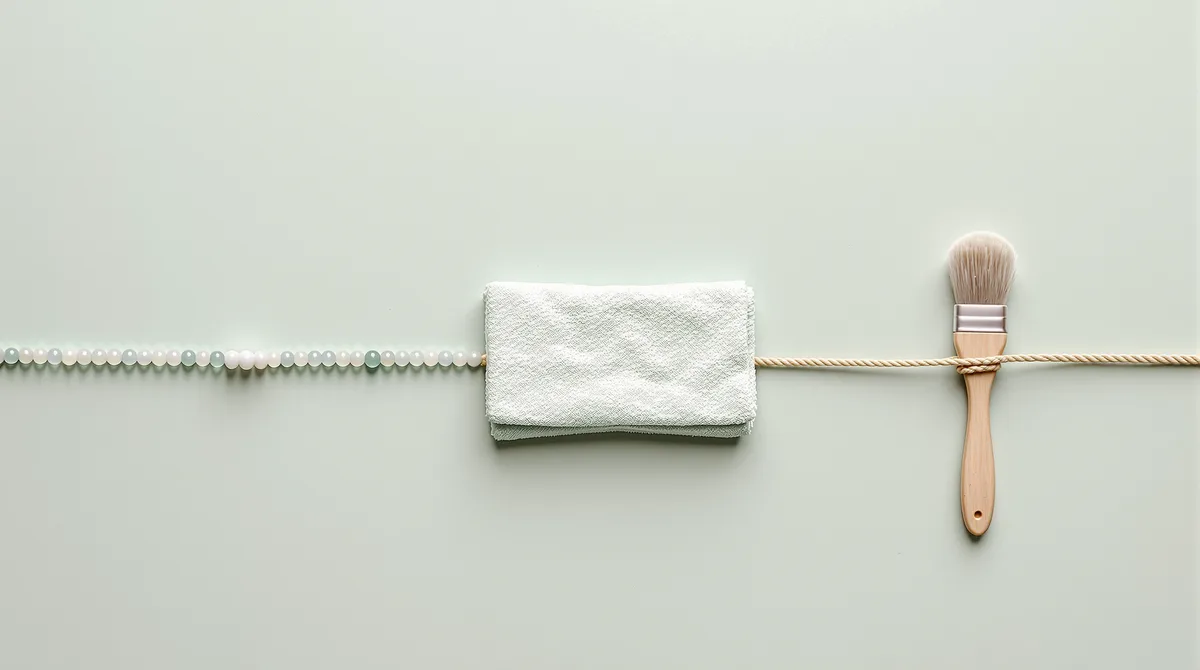
Monthly as a baseline, more often in a kitchen that cooks hard. Dry first: a soft brush or dry microfibre cloth drawn down each strand from header to hem, so dust leaves the panel at the bottom rather than travelling up into the header, which is the hardest part to reach.
Then damp: cloth wrung until barely moist, bead wiped, dried in the same pass with a second cloth. Work down a strand rather than across the panel so you can see what is done. The cord never gets wet.
The bead surface, through the wipe cycle rather than the grease itself. Surface dye goes first, frosted finishes second.
Then cord discolouration — cosmetic, but it is the thing a guest sees at close range. Then the ordinary doorway failure of strand drift. Genuine bead breakage is rare in a domestic kitchen and not common in a commercial one.
Sampling 16 to 20 days from an agreed brief, photographs approved before the sample ships, production 40 to 60 days after sample approval. A domestic opening needs nothing more.
A commercial kitchen doorway should add the flammability test schedule if the project needs a report, started at sample approval rather than at hand-over, and quoted separately. Formal quotes follow within 48 hours of a specification.
Opening dimension, then finished width and longest drop measured from the underside of the fixing, allowing clearance above the plume. Strand count or pitch. Bead material, shape and size, with hole diameter. Colour as Pantone references or physical chips. Header type and length. Hem shape.
Then the two kitchen-specific notes: the cleaning method and frequency, written as a specification clause rather than left to a care card, and an explicit statement that the panel is not food-contact and must clear plating areas.
A kitchen opening benefits from two cost levers pulling the same way — a wider pitch is both cheaper and more serviceable. And the reason a patterned panel costs what it does is bead count and hand-stringing hours: a densely patterned 90 × 200 cm curtain can hold about 11,800 beads.
Routine care, the cost levers behind a quotation and the wording for specifying beadwork in a commercial kitchen each have a page of their own.
Extractable data
| Item | What suits a kitchen opening | Note |
|---|---|---|
| Format | Door curtain ≈90 × 200 cm, 30 strands on a dowel | Shipped standard; suits most single interior doors |
| Wider opening | 120 cm width, 60 strands at ≈2 cm pitch | A current design-library figure |
| Best bead material | Body-coloured pressed glass | Colour is in the glass, so wiping cannot lift it |
| Workable alternative | Moulded acrylic, dyed to colour | Light and unbreakable; softens with heat |
| Avoid | Surface-dyed beads | Dye is a surface property; solvents and repeated wiping lift it |
| Avoid | Bare or waxed wood in a steam path | Water raises grain and can lift a lacquer |
| Avoid | Bamboo | Marks in damp; indoor and dry only |
| Frosted or sea-glass beads | Use with care | Rubbing hard polishes the matte surface into gloss |
| Top fixing | Wooden dowel or header rail above the architrave | Brackets and hooks supplied by the project |
| Cleaning cycle | Dry dust monthly or more; damp spot-clean beads | Our guidance for the material, not a tested figure |
| Never use | Degreaser, solvent, bleach, abrasive cream, steam, hot water | Each one damages either the bead surface or the cord |
| Sampling | 16–20 days from an agreed brief | Photographs approved before the sample ships |
| Production | 40–60 days after sample approval | Published lead time for beaded décor |
| Food contact | No approval held | Our FDA and Prop 65 statements cover steel and copper lines |
Good to know
Sampling is 16 to 20 days from an agreed brief, with photographs approved before the sample ships, and production is 40 to 60 days after sample approval. A domestic kitchen opening needs nothing beyond that. A commercial kitchen doorway in a restaurant or hotel should allow for flammability testing on top, which is quoted and scheduled separately.
The bead surface. Airborne fat binds dust into a film, the film is wiped, and it is the wiping rather than the grease that lifts a surface dye or buffs a frosted bead to gloss. Body-coloured pressed glass does not care. After the surface, cord discolouration, which is cosmetic but obvious at arm's length, and then the usual strand drift of any used doorway.
The format is a shipped one — door curtains at around 90 × 200 cm on a wooden dowel are the core of our beaded programme. Read the record as evidence of the construction and the material behaviour, and read this page for where a panel belongs in a kitchen plan.
A standard door curtain at about 90 × 200 cm covers most single interior doors; a 120 cm width suits a wider opening. Keep the pitch on the generous side, because a kitchen doorway is walked through with hands full and a tight pitch interlocks. For a pantry, where traffic is lighter, a tighter and more decorative build is defensible.
Fix the dowel or header rail above the architrave into solid substrate, high enough that the panel clears a door swing if there is still a door. In a commercial kitchen area use corrosion-resistant hooks or brackets: a mild-steel fixing in a grease-laden extract path will rust. Brackets, rods and hooks are the project's; we make the panel and its header.
In a home, none. In a commercial kitchen area, two things come up. First, flammability — NFPA 701 or the local equivalent — and fire performance is tested on the specified build and quoted with the project. Second, food safety: beads are decorative and are not a food-contact surface. The FDA food-grade and California Proposition 65 statements we publish cover our stainless steel and copper lines, so keep a panel away from an open plating or prep area.
Dry first, monthly or more often: a soft brush drawn down each strand from header to hem so dust leaves at the bottom. Then damp spot-cleaning of the beads with a cloth wrung nearly dry, dried in the same pass. Keep the cord and any fabric header dry. No degreaser, no solvent, no bleach, no abrasive cream, no steam, no hot water.
Keep exploring
Guide
Dry dusting first, spot cleaning the beads, keeping the cord dry, what never to use, and how to handle a broken strand.
See the detailPillar
Twenty settings, from a closet front to a hotel lobby, each with the format that suits it, the fixing it needs and the standard that applies.
Specs and sizesSpecification
Ceiling fixing, double-sided reading, strand drift in airflow, and a plain account of what a bead division will not do.
Specs and sizesSpecification
Walk-through wear, strand drift, header load and the frame-to-panel gap — what a doorway in constant use demands of a bead panel.
Specs and sizesSpecification
Daylight and fade, sill-set lengths, the fabric header with a rod pocket, and why a window brief is a light brief rather than a privacy one.
Read the guide
Start a conversation
Send a reference, a colour chip or a sketch. Minimums are set per design and confirmed per quote; sampling is quoted separately and usually runs 16 to 20 days from an agreed brief.