Index
Craft topics: seventeen beaded objects documented
Seventeen beaded objects documented from inside the craft — what each one is, how the tradition builds it, and what it would take to develop one.
Specs and sizes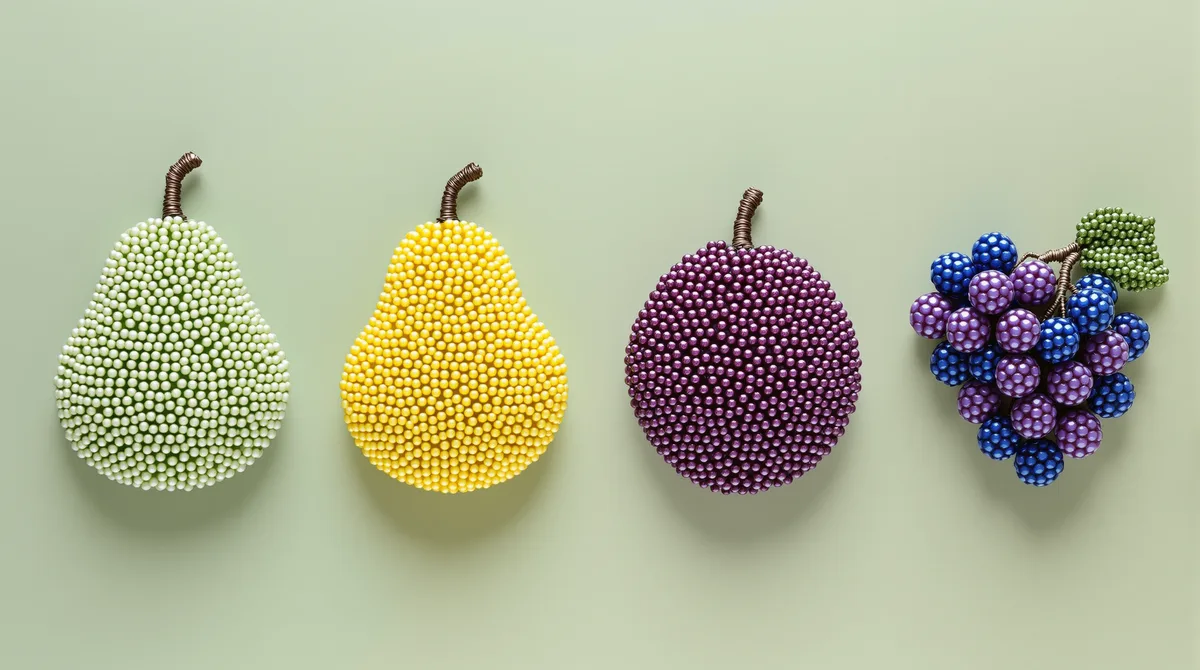
Craft topic
Beaded fruit was a kit, not a product. Thousands of people made it at home in the mid twentieth century by pinning beads to a foam form, which is why no two pieces match and why the surviving ones are collected rather than sold.
Four beaded fruit forms in a row — pear, lemon, plum and grapes — built by pinning small faceted glass beads and sequins in close overlapping rows over a shaped core, each with a…
Vintage beaded fruit is a mid-twentieth-century craft object: a polystyrene fruit form covered with beads, each bead pinned individually with a sequin under the pin head. It was made at home from kits rather than manufactured, which is why it survives as a collectible and not as a product line.
Beaded fruit is a decorative fruit — an apple, a pear, a bunch of grapes, a lemon — whose entire surface is covered in beads. It belongs almost entirely to the middle of the twentieth century, roughly the 1950s through the 1970s, and it was sold as a kit rather than as a finished object.
That is the single most important fact about it. Beaded fruit was not manufactured; it was assembled at home, in enormous quantities, by people following an instruction sheet. Everything collectors care about follows from that.
One bead at a time, with a pin.
A polystyrene form in the shape of the fruit came in the kit. A straight pin — a sequin pin or a short dressmaker's pin — was passed through a bead, almost always with a small sequin threaded behind the bead so the pin head had something to bear against, and then pushed into the foam. Repeat until the form is covered. A large piece carries well over a thousand pins.
Leaves were strung beads on wire, or cut felt. Stems were wrapped wire or cord. Grapes were often individual beaded balls wired onto a stem armature rather than a single form.
Because it is a construction with four built-in failure modes, and they are exactly what a collector inspects.
Pin corrosion. Steel pins in foam, in a house, for sixty years. Rust stains the beads around the pin head and spreads.
Foam degradation. Polystyrene crumbles and yellows with age and sunlight, and once a bare patch opens the foam at that point is exposed.
Bead loss. A pin works loose and a bead goes. The hole left behind is the size of the pin, so the loss is permanent and visible.
Missing leaves and stems. These were always the most fragile parts and they are the first to be lost, which is why a piece with original leaves is worth more than one without.
It made variation the norm. Two people building the same kit produced recognisably different fruit, because bead spacing, pin depth and how neatly the base was finished were all down to the maker. A kit that ran short of beads near the end — a common complaint at the time — produced a piece with a thin or bare base.
That is why beaded fruit is collected rather than catalogued. There is no canonical version of most pieces, so condition, completeness of a set and the survival of the fragile parts carry the value.
Polystyrene foam forms. Glass and plastic beads, mostly small rounds and faceted bicones — the bead shapes that were cheapest to buy in bulk at the time. Sequins, in cup or flat form, as pin washers. Steel pins. Wire for leaves and stems, sometimes with floral tape. Occasionally felt, velvet or flocking on the base.
The technique is pinning — which is not a bead technique in any of the beadwork techniques we document. There is no thread, no cord, no wire wrapping and no couching. It is closer to upholstery tacking than to beadwork, which is part of why nothing in professional bead manufacture inherited it.
We do not make beaded fruit. The construction a modern version would use — a netted or couched surface over a solid form — is ours, so the object is available to develop rather than a line to order.
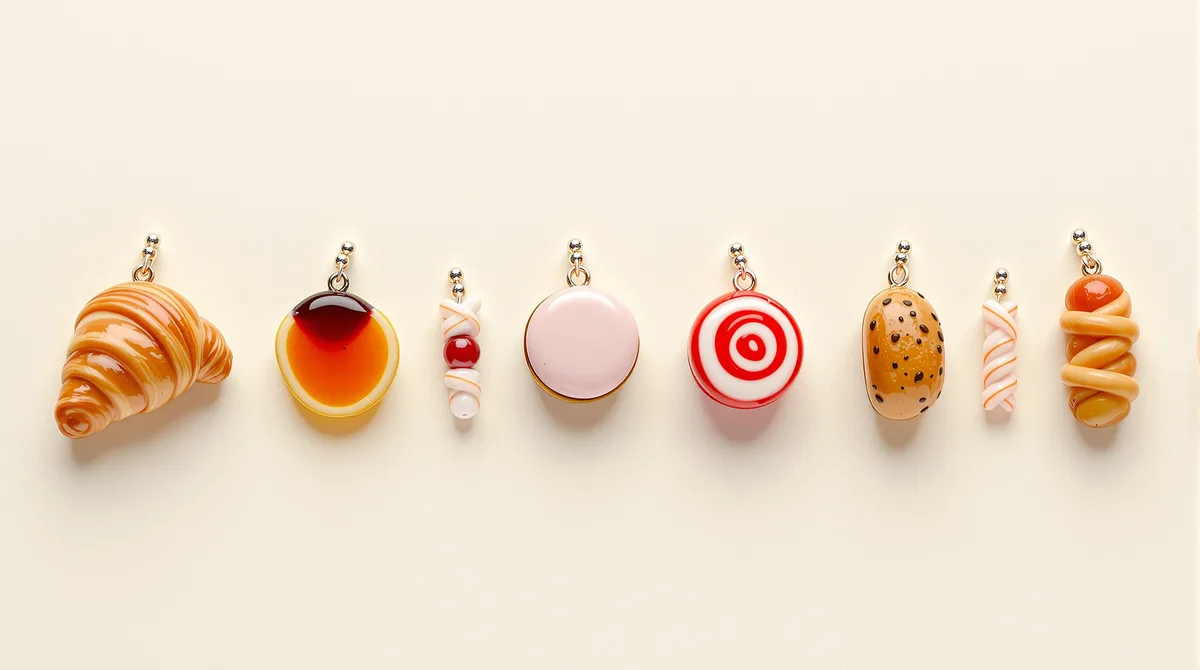
The genuinely adjacent thing is a bead rather than an object, and it is worth naming because it is our newest glass development: hand-shaped lampwork glass beads in food forms, including blood oranges alongside croissants, macarons, peppermints, sourdough and candy ribbons, finished as wine charms. Those are beads shaped like food, made one at a time at the torch. Beaded fruit is the opposite — a fruit built out of ordinary beads.
Fundamentally. Every technique family in our reference holds the bead with a flexible line: cord in hand-strung strands, thread in bead embroidery, wire in wire wrapped beadwork, knotted cord in macramé. Pinning holds the bead with a rigid spike into a soft body.
That difference is why the method does not scale and does not travel. Pins loosen with handling, foam does not tolerate compression in a carton, and nothing about the construction can be inspected after assembly. It was a good home craft and it was never a manufacturing method.
Almost nobody, as new production. There is a small revival among craft makers working from original patterns, and some reproduction kits exist. The market is overwhelmingly secondary: vintage pieces traded between collectors, priced on condition and completeness.
Modern decorative fruit sold as beaded is usually something else — a netted surface, a moulded shell with a bead-effect finish, or a couched fabric form — and worth identifying as such before paying a vintage price for it.
Turn it over and look at the base. Check pin heads for rust. Look for crumbling at any bare patch, and look at the drill hole of any loose bead for pin damage. Confirm the leaves and stem are original. Then, for a set, check that the fruits were made by the same hand: a mixed bowl assembled from several sources shows immediately in bead spacing and pin depth.
Because it is a collectible, and a manufacturer publishing a beaded fruit range would be answering a different question from the one people are asking. The search interest here is overwhelmingly about identifying, valuing and caring for existing pieces. That is a question we can answer usefully, and it is the whole reason this page exists.
Good to know
In a bowl, which is how it was always meant to be seen: a mixed group of fruit piled in a footed dish, as a permanent centrepiece. Individual pieces display on a stand or a plate. Nothing about beaded fruit is designed to hang, and a piece with a hanging loop is almost certainly a later modification.
A soft brush, dry, and nothing else. Never wet it. Water swells the foam core and rusts the steel pins from the inside, and both of those are irreversible. Keep it out of direct sun, which yellows older plastic beads and foam alike, and store it loose in a box rather than wrapped tight, because pressure pushes pins deeper and distorts the form.
The answer is that nobody should reproduce the original construction. Pinned beads on foam is not a durable method and it is not a method suited to shipping. A modern beaded fruit would be a different object — a netted or couched surface over a solid form — and it would need a form specification, a bead plan and a sample. Available to develop on that basis.
No. There is no beaded fruit in our production record. The adjacent and genuine thing is a bead rather than an object: our newest glass development is hand-shaped lampwork icon beads, including blood oranges alongside croissants, macarons, peppermints, sourdough and candy ribbons. Those are beads shaped like food, not fruit built from beads.
A polystyrene form in the shape of a fruit is covered bead by bead. A straight pin is passed through a bead, usually with a small sequin behind it to spread the load, and pushed into the foam. Thousands of pins cover the form. Leaves are made from wire-strung beads or felt, and the stem is wrapped wire or cord.
Beaded fruit, sequin fruit, pin-and-sequin fruit and push-pin fruit all describe the same construction. Collectors often date pieces by the kit brand or the import origin rather than by style, and the broader category of mid-century pinned-sequin work includes Christmas baubles and ornaments made exactly the same way.
Turn it over and look at the base, which is where kits ran out of beads and where the foam shows. Check the pin heads for rust, because corrosion stains the beads around it and spreads. Look for crumbling foam at any bare patch. Then check the leaves and stem are original, since they are the first parts to be lost and the hardest to replace convincingly.
Keep exploring
Index
Seventeen beaded objects documented from inside the craft — what each one is, how the tradition builds it, and what it would take to develop one.
Specs and sizesStyle
Turned wood in walnut tones, consistent sizes and straight hems — the quiet register, and why it is quieter than retro.
See the detailCraft topic
Head, skirt and loop — how each part is built, and the neck that decides whether it survives.
Compare the optionsCraft topic
How a bead is trapped between knots rather than strung, why the cord gauge limits the bead, and why knotted work runs 60 to 90 days rather than 40 to 60.
Specs and sizesCraft topic
The portière, the screen and the divider — three different jobs that look alike in a photograph, and which of them we actually build.
Read the guideCraft topic
A hoop, a clasp and one hand-formed bead — and why lampwork, where each bead is shaped at the torch, is the technique this format exists for.
Read the guide
Start a conversation
Send a reference, a colour chip or a sketch. Minimums are set per design and confirmed per quote; sampling is quoted separately and usually runs 16 to 20 days from an agreed brief.