Glossary
Bead terminology
The words a bead tech pack uses, defined one term to a page so a specification can cite them.
Specs and sizesReference · Bead shapes
Shape decides how a strand reads before colour gets a say. Naming the shape correctly is what stops a sample coming back right in colour and wrong in character.
A bead specification names a shape as well as a material and a diameter. Rondelles stack flat, bicones sit point to point, pony beads read as a plain round field, tiles and coins lie flat to the viewer, trapezoids and teardrops hang directionally, and a cabochon has no hole at all and has to be glued.
A shape name, the two dimensions that describe that shape, the drill hole, the drill direction and the material. Five values per bead, repeated for every accent in the design.
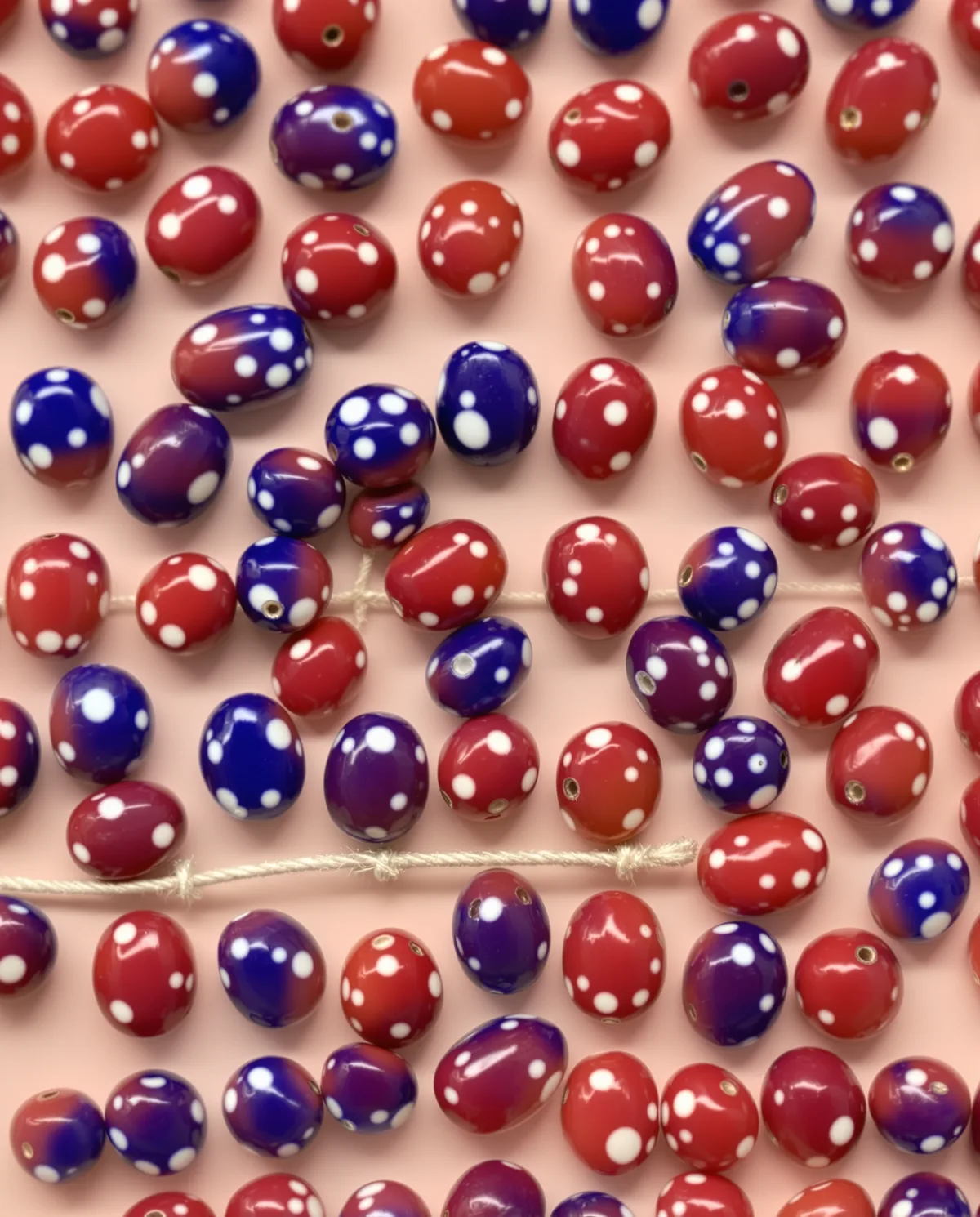
Shape is not decoration on top of a material specification. It determines how much of each bead the viewer sees and therefore how the strand reads as a whole, which is why two strands in the same colour and the same material can look unrelated.
| Shape | Form | What it does in a strand |
|---|---|---|
| Seed bead | Tiny round or slightly squared tube, about 1–3 mm | Base strand and embroidered grounds; reads as continuous colour |
| Bugle bead | Short glass tube | Directional texture; reads as a dash rather than a dot |
| Round | Spherical | Neutral field; the default where shape should not be noticed |
| Pony | Short, wide-holed round | Plain round field on heavier cord; forgiving of cord gauge |
| Rondelle | Flattened disc drilled through the axis | Stacks flat so a run of them reads as a solid column |
| Bicone | Two cones base to base, drilled through the points | Sits point to point; gives a faceted, sparkling line |
| Tile | Flat square or rectangle, drilled across | Lies flat to the viewer; reads as a surface, not a point |
| Coin drop | Flat disc drilled near the edge | Hangs face-on and swings; strong light-catcher |
| Trapezoid | Tapered flat form | Directional; used to turn a corner or step a pattern |
| Oval | Elongated round, including the 13 × 22 mm dotted glass accent | Fills drop fast; reads as a feature rather than a field |
| Teardrop | Faceted drop, often iridescent | End bead and accent; catches light at the hem |
| Almond | Long moulded form, about 3 in in our daisy connectors | Connector bead forming a larger motif from few parts |
| Millefiori | Glass with embedded cane pattern | Feature bead; pattern is in the glass, not on it |
| Lampwork | Hand-formed at the flame | Figurative and icon beads; priced per piece |
| Cabochon | Domed face, flat undrilled back | Glued to a seat; cannot be strung at all |
The shape names come from the trade and from our own design library. Where the record carries a real dimension behind a name it is given: the dotted oval glass accent at 13 by 22 mm, the moulded almond connector at about 3 inches forming a 6 inch motif, the frosted sea-glass bead at about 4 to 5 mm, the seed bead at 1 to 3 mm.
Several shape names carry no fixed dimension, because the shape is the name and the size is the design. A rondelle is a flattened disc at whatever diameter the design needs, confirmed on the sample.
With two dimensions, not one. A rondelle has a diameter and a thickness, and the thickness is what decides how many stack into a given drop. A bugle has a length and a bore. An oval has both axes, which is why the dotted accent is specified as 13 by 22 mm.
Drill direction is recorded separately from the dimensions, in words: through the axis, across the face, near the edge. It is not a measurement and it changes everything about how the bead hangs.
A size behind a shape name. Nobody publishes a standard rondelle diameter or a standard pony bead length, and asserting one would be inventing a standard.
Nor is there a published bead weight by shape, a published count per kilogram, or a hole size implied by any shape name. Hole and diameter are specified independently of shape, every time.
The shape defaults to round, because round is the safest neutral and the most widely stocked form. A design drawn with flat tiles and specified only as beads will come back as a round field: the right colour, the right count, the wrong character.
Drill direction defaults to whatever is conventional for the shape, which is usually right and occasionally the opposite of what the design needed.
Some shapes exist only in some processes. Seed beads and bugles are drawn glass. Rondelles, bicones, dotted ovals and tiles are pressed. Faux-capiz blossoms are laser-cut from sheet or cast to shape. Almond connectors are injection moulded to dies we fund and own where a design needs a custom bead.
That means a shape name is sometimes also a process commitment. A hand-formed lampwork shape cannot be delivered with pressed-glass consistency, and a pressed shape cannot carry the individuality of lampwork.
For pressed and moulded beads, shape is held tightly by the die. For hand-formed beads it is not, and that is the point: lampwork icon beads — croissants, macarons, peppermints, candy ribbons — are hand-shaped individually and vary from piece to piece.
A specification that calls for hand-made beads and then imposes a machine tolerance has specified something that cannot be supplied. The correct approach is a sealed sample and a stated acceptable variation.
Through how much drop each bead fills and how it is made. A large pressed oval fills drop fast and is cheap per centimetre of strand. A seed bead fills slowly and is cheap per bead but expensive per centimetre once the labour is counted.
Hand-formed and moulded specialty shapes are costed per piece, which is why they appear as scattered accents of ninety to a hundred and twenty per panel rather than as fields.
That the working vocabulary is narrower than the catalogue. Across the shipped bead programme the shapes doing real work are seed beads, rounds, graduated rounds, dotted ovals, frosted irregulars, faceted iridescent teardrops, glass mushrooms, moulded almond connectors and laser-cut blossoms.
Bugles, rondelles, bicones, tiles, coin drops and trapezoids appear in the design library and in flat embroidered work. Both sets are real; one is what ships at volume and the other is what the library draws from.
In the bead block, one line per bead: shape, both dimensions, hole, drill direction, material, colour reference. The main bead first, accents after, with the accent count per strand beside each.
Where a shape is unusual, a reference photograph attached to the pack and numbered is worth more than a longer description.
The sealed sample, bead by bead on selected strands. Shape is compared, drill direction is checked, and accent positions are read against the colour-count sheet.
The failure inspection is actually looking for is substitution: a similar shape in the right colour that was easier to obtain. It is visible immediately when the panel is read against the sample and almost invisible without one.
Describing an oval by one number. A 22 mm oval could be 13 by 22 or 22 by 22, and the two are different beads with different counts per strand.
The other is treating faceted and cut as interchangeable with crystal. Cut or faceted glass beads give a crystal look and are described as glass, not crystal — a distinction worth holding in retail copy as much as in a specification.
The spec table above, which is organised by shape rather than by format because shape travels across formats. The same bicone appears in a door panel, a valance and a lamp shade.
Where a shape has a format-specific count — accents per strand, blossoms per hanging — that number lives on the bead count sheet rather than here.
Good to know
Shape and drill direction against the sealed sample, bead by bead on selected strands. Drill direction is the one that gets missed: a coin drop drilled through the centre instead of near the edge is the right shape in the wrong orientation and changes how the whole strand hangs.
Because shape names are not dimensioned standards. A rondelle is a flattened disc at any diameter, and no trade body publishes a size behind the name. Where our record carries a real dimension — a 13 by 22 mm dotted oval, a 3 inch almond connector — it is given; where it does not, nothing is invented.
There is none for shape. The dimensional values that go beside a shape name are the outside diameter and the drill hole, and both are in the stringing specification sheet rather than attached to the shape itself.
By the two dimensions that describe the form, not by one. A rondelle needs a diameter and a thickness. A bugle needs a length and a bore. An oval needs both axes, which is why the dotted accent in our record is written as 13 by 22 mm rather than as a single figure.
Pressed and moulded beads hold shape closely within a die or mould. Hand-formed lampwork beads do not and should not be expected to: variation between pieces is the character of the technique, and a drawing that specifies hand-made beads to a machine tolerance has specified a reject.
Some shapes belong to a process. Seed beads and bugles are drawn glass. Rondelles, bicones and dotted ovals are pressed. Almond connectors are injection moulded to our own dies. Millefiori and lampwork are hand-formed. Asking for a lampwork seed bead is asking for two incompatible processes.
Shape name, both describing dimensions, drill hole, drill direction and material, for the main bead and for every accent. Five short values per bead, and the sample stops being a guess.
Keep exploring
Glossary
The words a bead tech pack uses, defined one term to a page so a specification can cite them.
Specs and sizesReference
Nine material families, what each gives in light, weight and colour, and how far our own manufacturing reaches into every one of them.
Compare the optionsSpecification
Diameters, drill holes, cord selection, strand counts and format dimensions — the sheet to copy into a tech pack.
See the detailReference
Specification sheets and definitions — the pages to send a designer before they draw.
Read moreSpecification
How bead count is estimated from size, pitch and diameter — and why density matters more than dimensions.
Compare the options
Start a conversation
Send a reference, a colour chip or a sketch. Minimums are set per design and confirmed per quote; sampling is quoted separately and usually runs 16 to 20 days from an agreed brief.