Glossary
Portiere
The historical name for a curtain hung at a doorway — and why the word still earns its place on a brief.
See the detail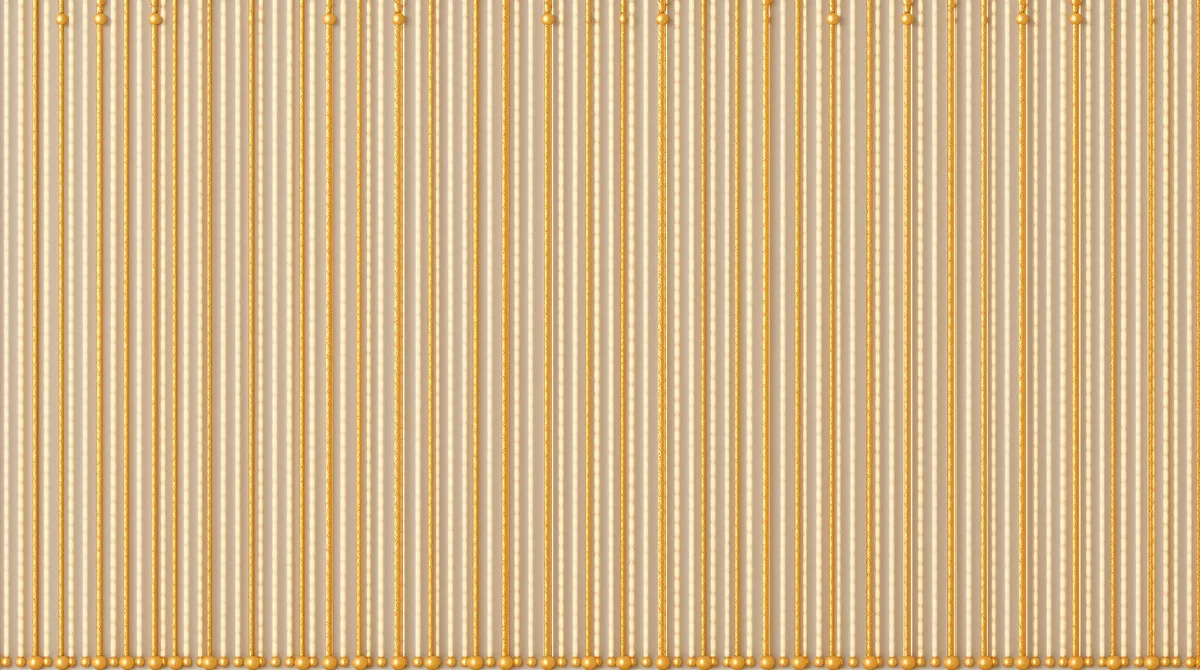
Craft topic
The portière is the ancestor of every bead divider on the market, and it was never a doorway curtain. It was a hanging that closed a room off, which is a different structural problem from the doorway curtain.
A tall beaded partition, close cords of antique gold, honey amber and cream glass beads worked into a fine repeating pattern across the strands.
A portière is a curtain hung across a doorway or opening to close it off, from the French porte. Bead portières became fashionable in late nineteenth and early twentieth century interiors, built as dense strand work on a header board. A partition or divider screens part of a room rather than an opening. A divider is a development piece rather than a line to order.

A portière is a curtain hung across a doorway or an opening in order to close it. The word is French, from porte, and the object predates beads entirely — nineteenth-century interiors used heavy fabric portières to stop draughts between rooms and to give a doorway a sense of occasion.
Beads arrived into that existing habit. By the late nineteenth and early twentieth century, bead portières were fashionable interior objects, and they kept the fabric portière's structural logic: dense material on a rigid header, closing an opening rather than decorating it.
Three jobs, three sets of requirements, one photograph.
A portière closes an opening. It needs enough density that the next room is not simply visible through it, and enough weight that it settles rather than swinging.
A partition or divider screens part of a room, usually standing away from any wall. It needs the same density plus a fixing into structure, because nothing but the ceiling is holding it.
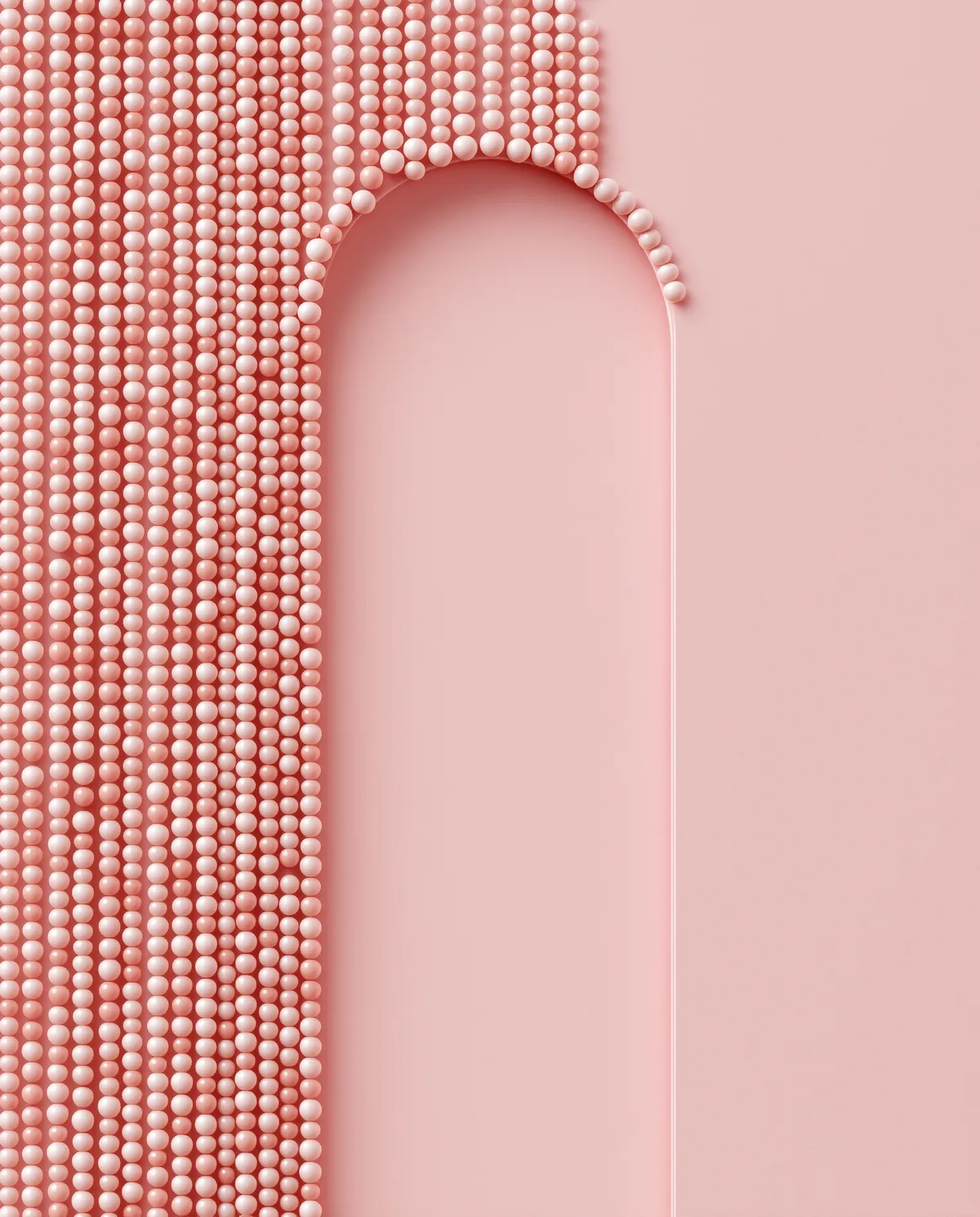
A portal frames a walk-through and deliberately leaves the middle open — an arched cut, strands at the sides and across the top. Its design problem is the opposite: it must not obscure.
Specifying one and receiving another is the most common failure in this category, and it almost always comes from a reference photograph rather than from a written brief.
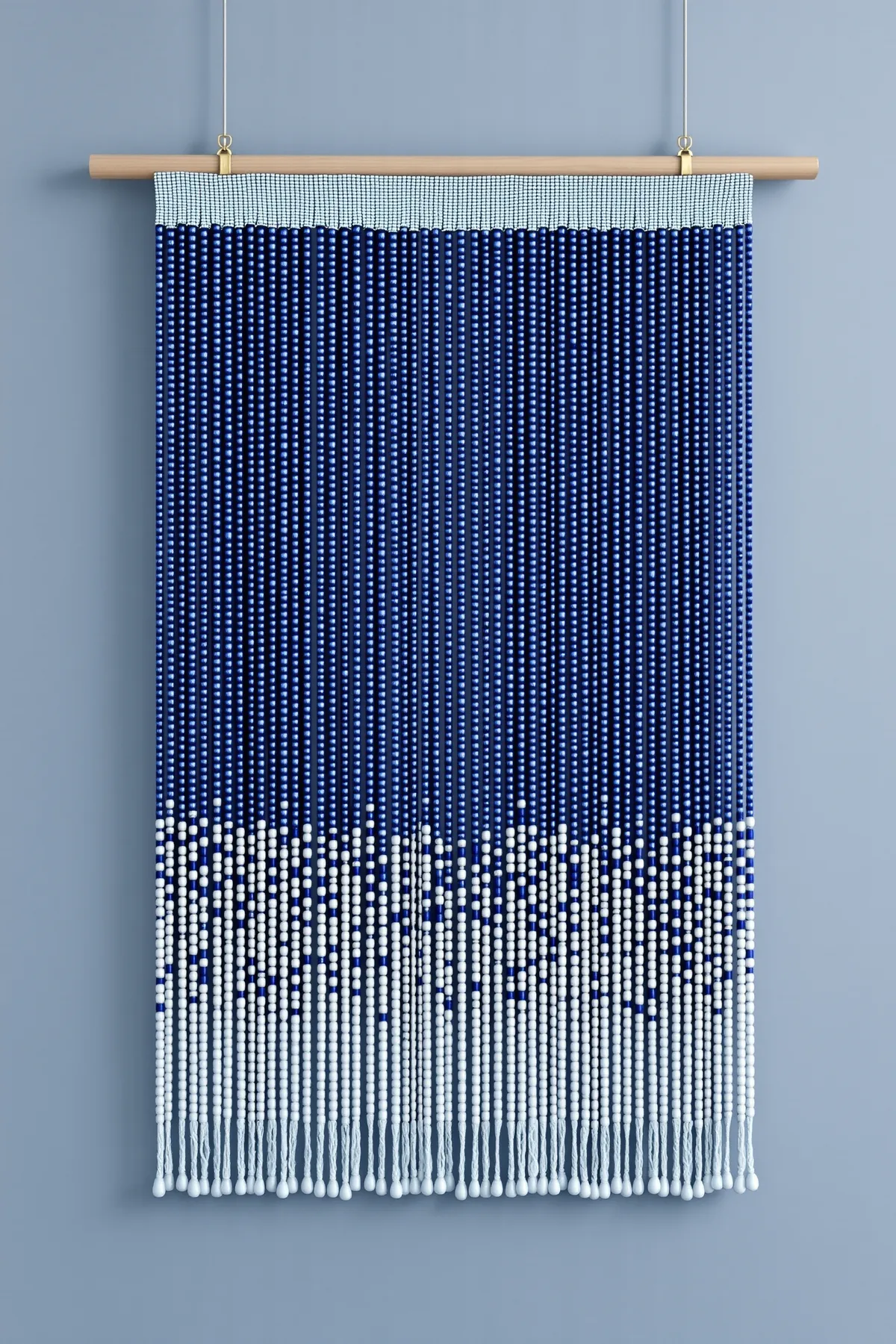
Dense strand work on a rigid header. Strands are hung on close pitch from a board or a heavy rod, each strand strung to a count sheet so the lengths match, and the hem is weighted — a heavier terminal bead, or simply a larger bead size through the bottom third — so the panel hangs still.
Historic examples used what was available and cheap in volume: tubular bugle beads, turned and stained wood, cut bamboo, and from the 1920s the early moulded plastics that made a mass-market bead curtain possible for the first time.
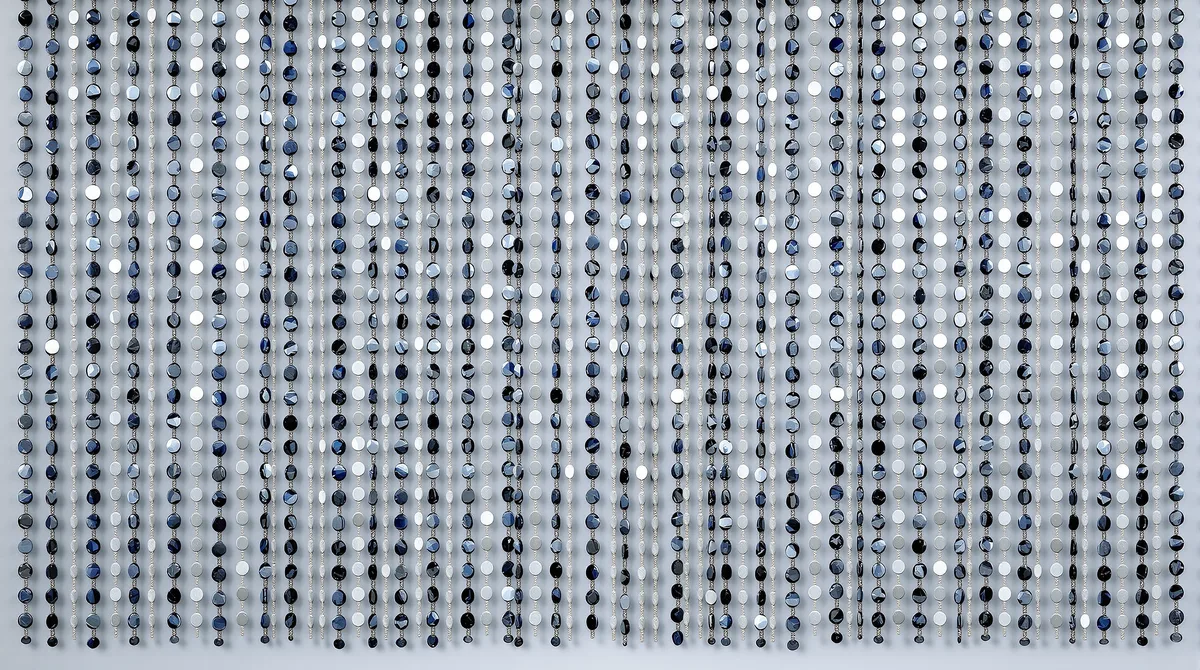
Bead room dividers and partitions are a craft category here rather than a current Gemixx range. A faux capiz division is drawn and available to develop, which is a development with a sample at the end of it rather than a line to order from.
What we do make, and ship in volume, is the portal and curtain family: beaded doorway portals and door curtains at around 90 by 200 cm, café curtains, valances and wall hangings. Those are hand-strung on cord and gathered on a turned wooden dowel. A portal is the object most often mistaken for a divider and is structurally its opposite.
Hand-stringing on cord, gathered at a header — the same technique family as every strung piece we build. The materials that suit a screen are the heavy ones: glass, because weight is a functional property here; wood, for a warmer and quieter screen; and faux capiz discs in cast resin or dyed cut acrylic, which give a shell look with no shell and, in linked-disc construction, a far denser surface per unit of width than strands can.
Linked-disc work is worth naming because it is the construction a real divider would most likely use. Discs are linked one below the next into columns, and the columns hang side by side — a much more opaque surface than any strand pitch can produce.
In two measurable ways. Pitch: our strung door panels run around 2 to 2.25 cm between strand centres, which is open enough to walk through comfortably and far too open to screen anything. And header load: a screen's header carries a continuous dense panel across its full width, where a door curtain's header carries thirty strands that are parted daily and designed to move.
Both are solvable. Neither has been solved here, which is why this is a craft page.
Pitch consistency across the full width, measured rather than eyeballed, because a single wide gap defeats the whole object. The header attachment, which is where the weight concentrates. The hem weight, by watching the panel in a draught. And the strand length match, by looking along the hem rather than at the face.
Mostly small workshops supplying the interiors and event trades, plus a mass market in light acrylic and bamboo screens sold flat-packed. The heavy end — a genuine glass or disc screen sized to an architectural opening — is project work, specified by designers and made to order, and it is a small market because the fixing requirement puts it outside what most buyers will take on.
A portière in the opening, on a rod with brackets into the frame or the wall structure. A free-standing divider on a ceiling track or ceiling hooks fixed into a joist — never into plasterboard alone. The fixing has to be rated for the actual weight, which for a dense glass screen is a structural calculation rather than a hardware choice. We supply no hanging hardware, so this is a specification the project has to own.
Lift by the header, never by the strands, and let the panel settle after handling. Dust along the strands with a soft brush, or wipe with a barely damp cloth where the bead material allows it. Store in loosely tied bundles: a dense screen tangles far more easily than an open curtain, because its strands have nowhere to go but into each other.
Because a reader arriving on the word portière mostly needs to know what the object actually is, how it differs from the portal they have probably seen, and what the fixing will demand. All of that this page can settle. The divider itself stays a craft category, available to develop, and the portal and the door curtain are the formats with the production record behind them.
Good to know
No. A free-standing room divider is a craft category here rather than a Gemixx range, and it is available to develop. What we make is doorway portals, door curtains and café curtains, which hang in an opening rather than screening a room, and those are different objects.
As dense strand work on a rigid header. Strands are hung close together from a board or a heavy rod so the eye cannot pass between them, and the hem is weighted so the whole panel settles rather than swinging. Historic examples used tubular bugle beads, turned wood, cut bamboo and, by the 1920s, early moulded plastics.
Strand pitch consistency across the full width, because a divider's whole job is to obscure and a wide gap defeats it. Then the header: a screen carries real weight, and the attachment of strand to header is where a divider fails. Then the hem, which should be weighted enough that the panel hangs still in a draught.
A portière hangs in the opening, on a rod with brackets fixed into the frame or the wall structure. A divider standing away from a wall needs a ceiling track or ceiling hooks fixed into a joist, not into plasterboard. The fixing has to be rated for the weight, and a dense glass screen is heavy enough that this is a structural question rather than a hardware one.
Lift it by the header, never by the strands. Dust along the strands with a soft brush or wipe with a barely damp cloth, depending on the bead material, and let it settle after it has been handled. Store it in loosely tied bundles rather than loose, because a dense divider tangles far more readily than a door curtain does.
Portière is the historic term and the most precise one. Bead curtain, bead screen, room divider, decorative partition and hanging screen all overlap with it in modern use, and the retail vocabulary has largely collapsed them into one. The distinction worth keeping is functional: does the piece close an opening, screen an area, or frame a walk-through?
Mostly a header and a fixing specification, because the beadwork is work we already do at larger scale. A divider needs a strand pitch set for opacity rather than for appearance, a header engineered for the load, a hem weight, and a fixing recommendation we would be willing to stand behind. We offer no hanging hardware, so the fixing would have to be specified rather than supplied.
Keep exploring
Glossary
The historical name for a curtain hung at a doorway — and why the word still earns its place on a brief.
See the detailSpecification
Ceiling fixing, double-sided reading, strand drift in airflow, and a plain account of what a bead division will not do.
View the rangeIndex
Seventeen beaded objects documented from inside the craft — what each one is, how the tradition builds it, and what it would take to develop one.
Compare the optionsCraft topic
Wire-wrapped and couched ring constructions, and the plain heat rule by material: the ring goes around a holder, never against hot glass.
See the detailCraft topic
A hoop, a clasp and one hand-formed bead — and why lampwork, where each bead is shaped at the torch, is the technique this format exists for.
See the detailManufacturing
Widths from 50 to 76 cm on a turned dowel, in glass, wood and cast faux capiz — hem shapes, strand counts and what is a shipped format against a concept.
View the range
Start a conversation
Send a reference, a colour chip or a sketch. Minimums are set per design and confirmed per quote; sampling is quoted separately and usually runs 16 to 20 days from an agreed brief.