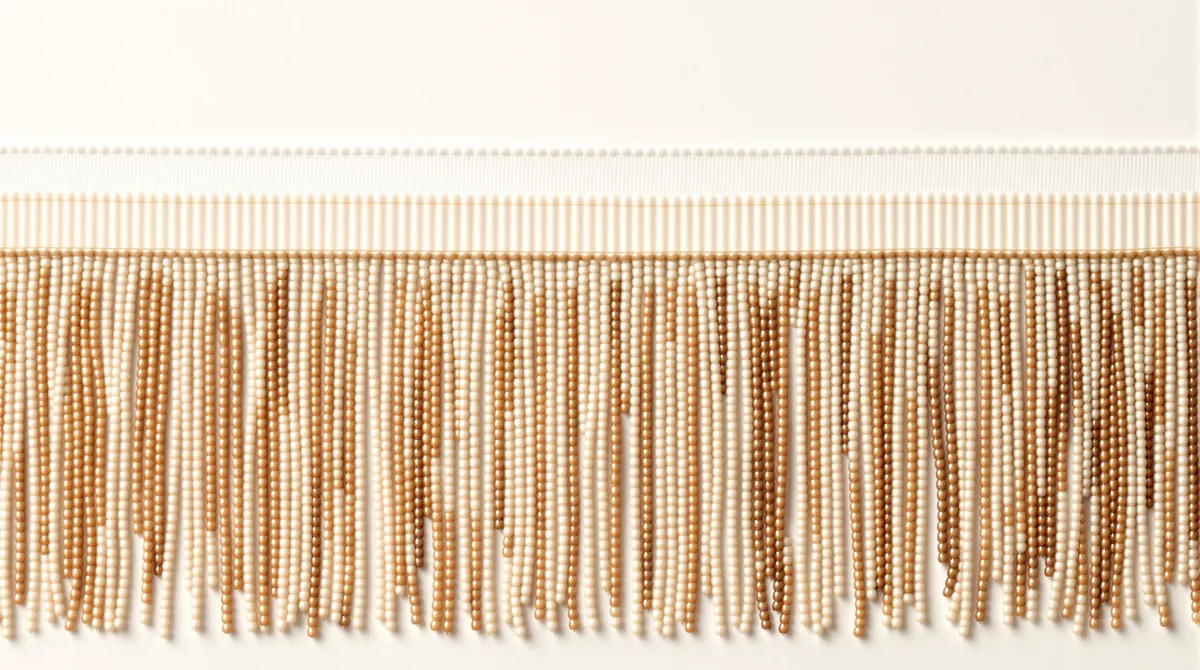
Manufacturing
Beaded trim
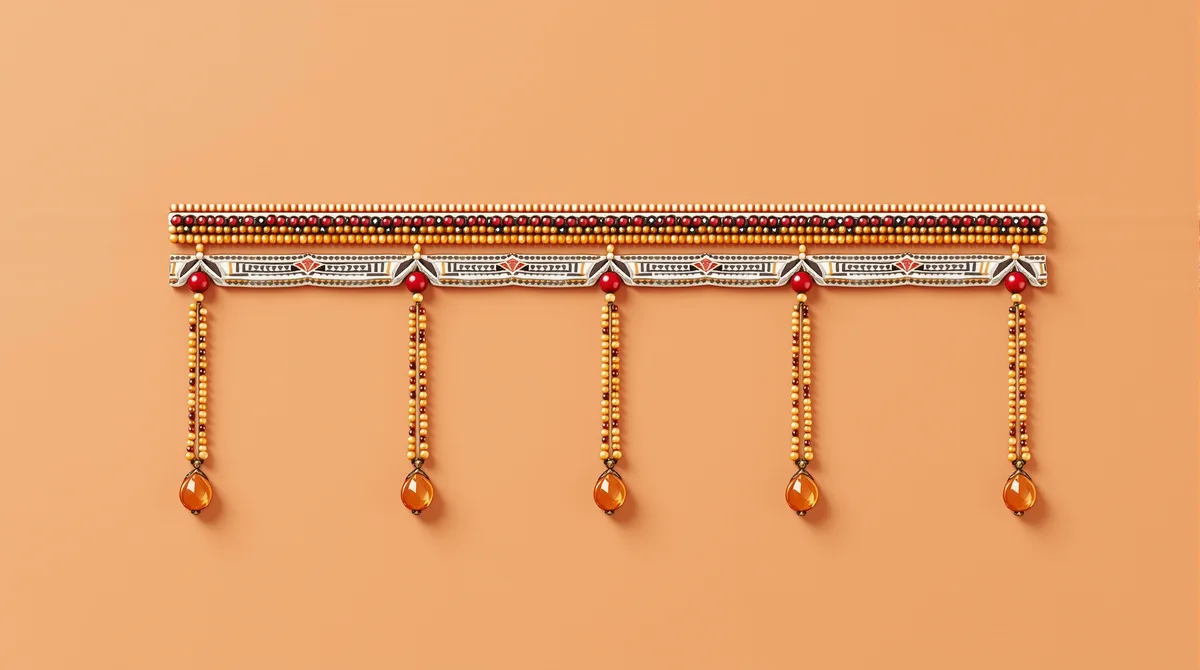
The header tape, the drop, the repeat length and the tolerances — how beaded fringe is built and quoted when it is a component in somebody else's product.
How it is made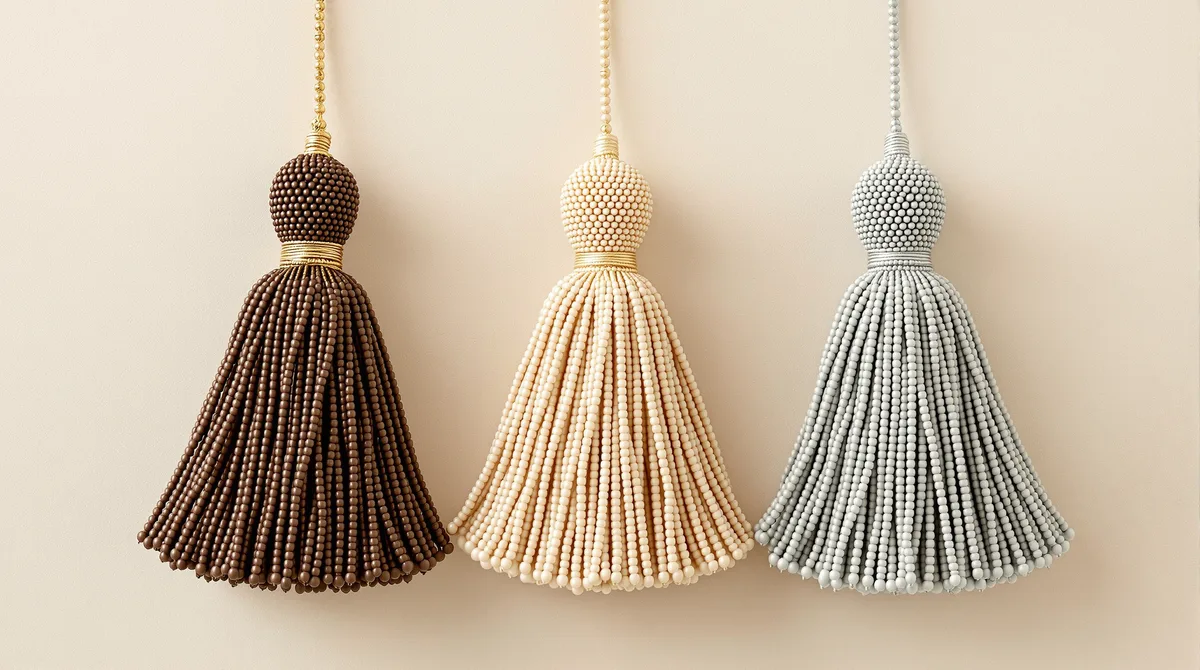
Craft topic
Three parts, one failure point. A tassel is a head, a skirt and a loop, and almost every bad tassel fails at the neck where the skirt is gathered. Tassel geometry exists here as 3-D source files, and the construction is available to develop.
Three beaded tassels hanging in a row, each a bound head of wrapped glass seed beads above a skirt of cords threaded solid with small round glass beads to the tip, in espresso…
A beaded tassel has three parts: a head, which is a bead or a wrapped core; a skirt of bead strands or knotted cord gathered below it; and a loop that carries the whole thing. The neck where the skirt is bound is the part that fails. Gemixx holds tassel geometry as 3-D source files and no tassel production record.

A tassel is a bundle of hanging strands gathered at the top and finished with a head. It is one of the oldest decorative terminals there is, and it survives across almost every textile tradition because it answers a practical question: how do you finish a cord without leaving a raw end?
In beadwork the strands become bead strands, which changes the physics. A thread skirt flows; a bead skirt swings. That difference is why a beaded tassel reads as an object rather than as a flourish, and why it needs more thought at the neck than a thread one does.
The head. Either a single large bead — wood, glass, moulded resin, metal — seated over the top of the skirt, or a core wrapped with thread, cord or beadwork. The head's real job is to cover the binding.
The skirt. Strands of beads, each strung on cord and ended with a stopper, or a fringe of knotted cord with bead accents worked into it. Strand count and length set the whole proportion of the object.
The loop. A doubled cord or wire passed up through the head and secured, carrying the full weight of the tassel.
The neck. Not a part so much as a joint: the point where the skirt is gathered, bound and covered. Everything that goes wrong with tassels goes wrong here.
Because it is the only place where the whole load passes through a friction joint. The loop carries the head, the head sits over the binding, and the binding is the only thing holding the skirt strands together.
Bound correctly — wrapped tightly with thread or fine wire, finished off under itself, then covered — it will outlast the beads. Glued, which is the standard shortcut, it fails as one piece: the adhesive lets go and the entire skirt comes away, usually when someone pulls on it, which is the one thing a tassel exists to be subjected to.
The second neck error is seating the head too high, which leaves a visible gap between head and skirt. It looks like a gap because it is one, and it cannot be fixed after the fact.
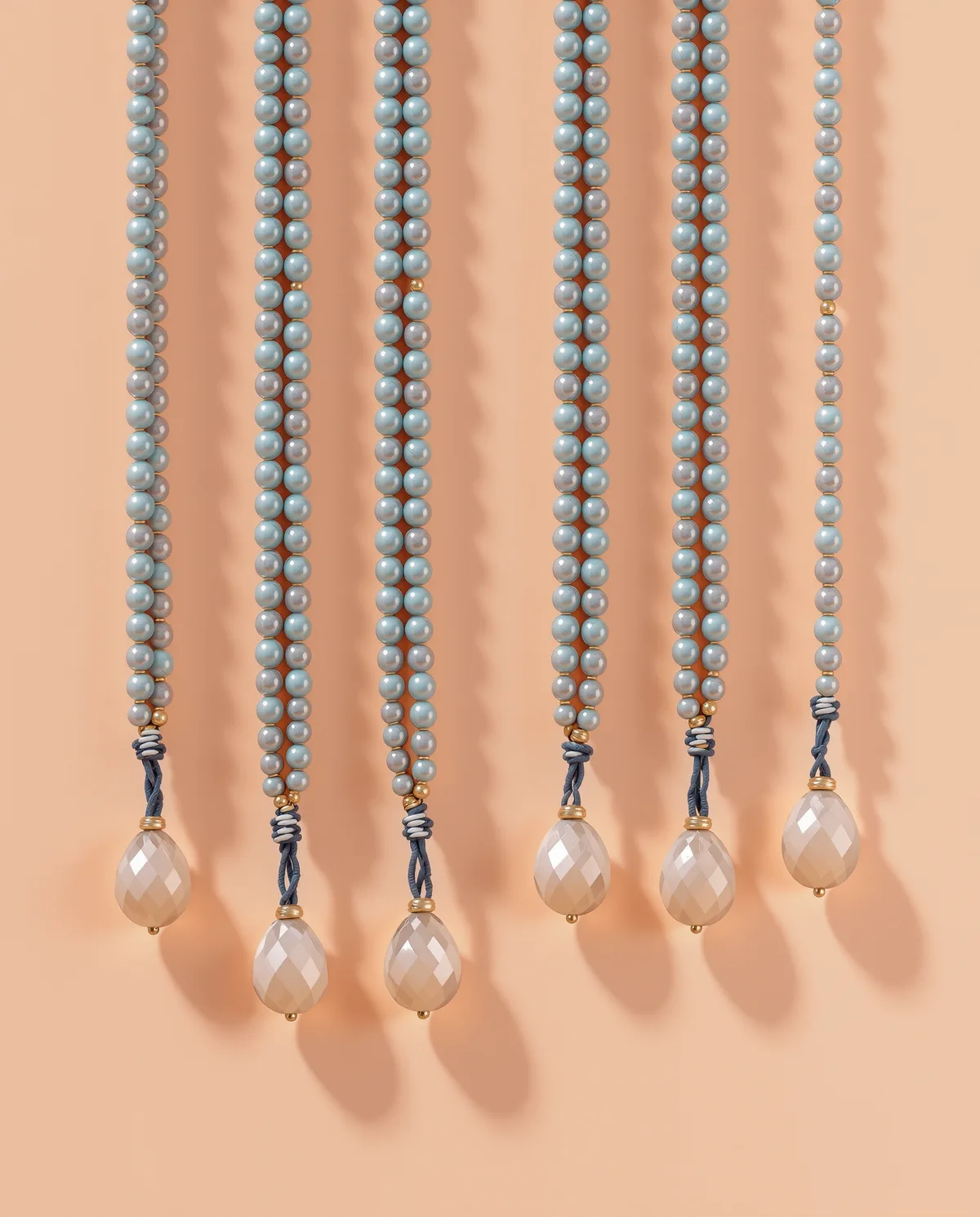
Always as a terminal. A curtain tieback. A key tassel on a drawer or a cupboard. A cushion corner, one at each point. A lamp pull or a shade pull. A zip pull on a beaded pouch. The finial at the bottom of an ornament or a garland. The weight at the end of a cord.
It is never a free-standing piece, which is worth saying because it changes how it is specified: the anchor point, the cord it hangs from, and the weight that cord has to carry all belong in the brief alongside the tassel itself.
For the skirt: glass seed beads and bugle beads, pressed glass drops, cotton cord at three to five millimetres, silk and rayon thread, and raffia or jute for a natural version. For the head: a turned wood bead, a resin bead or an acrylic bead, a metal bead, or a wrapped and beaded core. For the binding: strong thread or fine brass wire.
The techniques are hand-strung stringing, hand-knotting, wire wrapped beadwork and binding. Each of those is a standing craft family in our own studios — the knotting in particular, where the same square and half-hitch work that builds a macramé panel scales right down to a few inches.
We do not make tassels today. Five tassel models exist as drawn geometry, and the stringing, wrapping and finishing a tassel needs are all techniques we run — so it is available to develop rather than a line to order.
Two things exist and neither is a product. The first is a capability statement: our knotting work scales down to tassels, ornaments and charms a few inches long. The second is geometry — five tassel models held as owned three-dimensional source files, which is design data and not evidence of manufacture. We are stating both plainly because the gap between "we could" and "we do" is exactly where this category misleads people.
A tassel is radial and our strung work is planar. Thirty strands on a dowel hang in a plane and have to agree with each other across a width; a tassel's strands hang in a cone from one point and have to agree with each other all the way round. That is a different bench problem and a different inspection.
The nearest thing we genuinely build is the end of a strand: fringe and drops, where an end bead finishes each strand and weights it. Same logic, one bead deep.
Squeeze and pull the neck. Look for a gap under the head. Look along the skirt ends for an uneven level. Check the loop is anchored into the head rather than hooked over it. Then, for a bead skirt, check that the strand ends all carry a stopper — an unstopped bead strand sheds, and it sheds from the bottom where nobody is looking.
Trimmings workshops supplying the furnishing trade, bead and craft workshops making tassels as components for purses and ornaments, and a very large volume of machine-assisted production for low-cost retail. The hand-made end of the market is small, slow and almost entirely business-to-business: a tassel is usually bought by somebody who is making something else.
Because a tassel is a component rather than a line here, and the useful page is the one about how it is built. The craft is adjacent, the geometry exists as owned 3-D source, and the construction is available to develop — so what this page can settle is the neck, the head and the skirt, which is what anybody specifying one actually needs.
Good to know
A skirt is cut to length, gathered and bound tightly at the top with thread or fine wire, then the binding is covered — wrapped with the same material, or hidden inside a head bead seated down over it. A loop is passed up through the head and knotted or crimped. The skirt is trimmed level only after the binding is finished.
Tassel across most of the trade. A key tassel is the small one on a cord; a tieback tassel is the large one on a curtain; a bullion is a tassel with a twisted-cord skirt. In beadwork specifically, a tassel of bead strands is sometimes just called a drop, which is confusing because a drop is also the single terminal bead on a strand.
The neck. Squeeze it and pull gently: a bound neck holds and a glued one gives. Then look for a gap between the head and the top of the skirt, which means the head was seated too high. Then look along the skirt ends — levelled after binding they sit flat, levelled before they fan unevenly. Then check the loop is anchored into the head rather than looped over it.
A tassel is a terminal rather than an object in its own right. It hangs from something: a curtain tieback, a key or a drawer handle, the corner of a cushion, a lamp pull, a zip, the bottom of an ornament or a garland. Anything that gives it a single anchor point and lets it hang free will show it properly.
Comb the skirt with your fingers rather than brushing it, dust the head, and never wet a tassel: a bound neck holds by friction and water swells the fibres and then dries them loose. Hang it rather than storing it flat, because a tassel stored crushed keeps the crease in its skirt indefinitely.
No. There is no tassel in our production record. What exists is a stated capability — the same knotting that builds our macramé pieces scales down to tassels, ornaments and charms a few inches long — and five tassel models held as owned three-dimensional source files. A capability and a set of models are not a product, and we are not going to present them as one.
A head specification, a skirt specification, a binding method and a size set, then a sample. The head would come from the bead library or be moulded to our own die; the skirt from bead strands drawn in our own glass works or from cotton cord. The craft is all present. The design, the sample and the quality standard are not.
Keep exploring
Manufacturing
The header tape, the drop, the repeat length and the tolerances — how beaded fringe is built and quoted when it is a component in somebody else's product.
How it is madeIndex
Seventeen beaded objects documented from inside the craft — what each one is, how the tradition builds it, and what it would take to develop one.
Open the referenceCraft topic
Wire instead of thread, crimps instead of knots, and bead choices that survive keys — plus the wire-wrapped family behind the page.
Specs and sizesCraft topic
Beaded flat, then made up: why the seam allowance has to stay bead-free, why the lining carries the load, and the hardware decisions that go with it.
Compare the optionsCraft topic
The threshold hanging of Indian homes — its meaning, its materials from mango leaf to zari, and why it is not the same object as a door curtain.
Read the guideTechnique
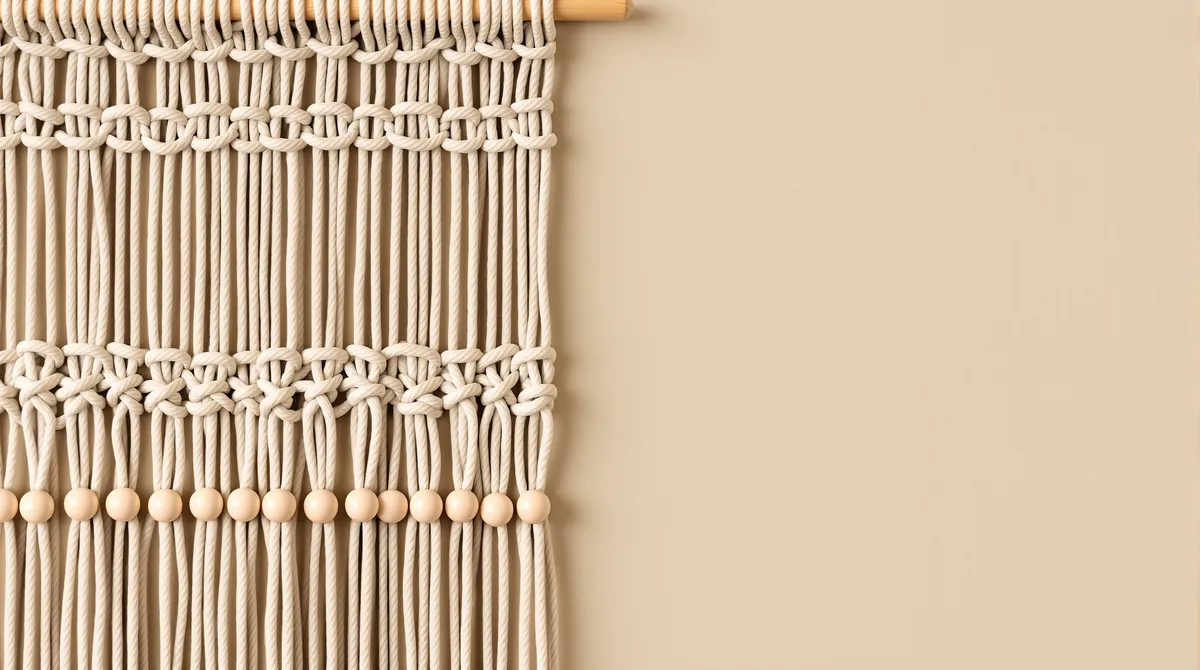
Square and half-hitch knotting on a dowel or hoop, combed fringe, the documented knotted formats, and why the knotting sets the date for a whole order.
See the detail
Start a conversation
Send a reference, a colour chip or a sketch. Minimums are set per design and confirmed per quote; sampling is quoted separately and usually runs 16 to 20 days from an agreed brief.