Technique
Macramé knotting, and why it runs 60 to 90 days
Square and half-hitch knotting on a dowel or hoop, combed fringe, the documented knotted formats, and why the knotting sets the date for a whole order.
Read the guide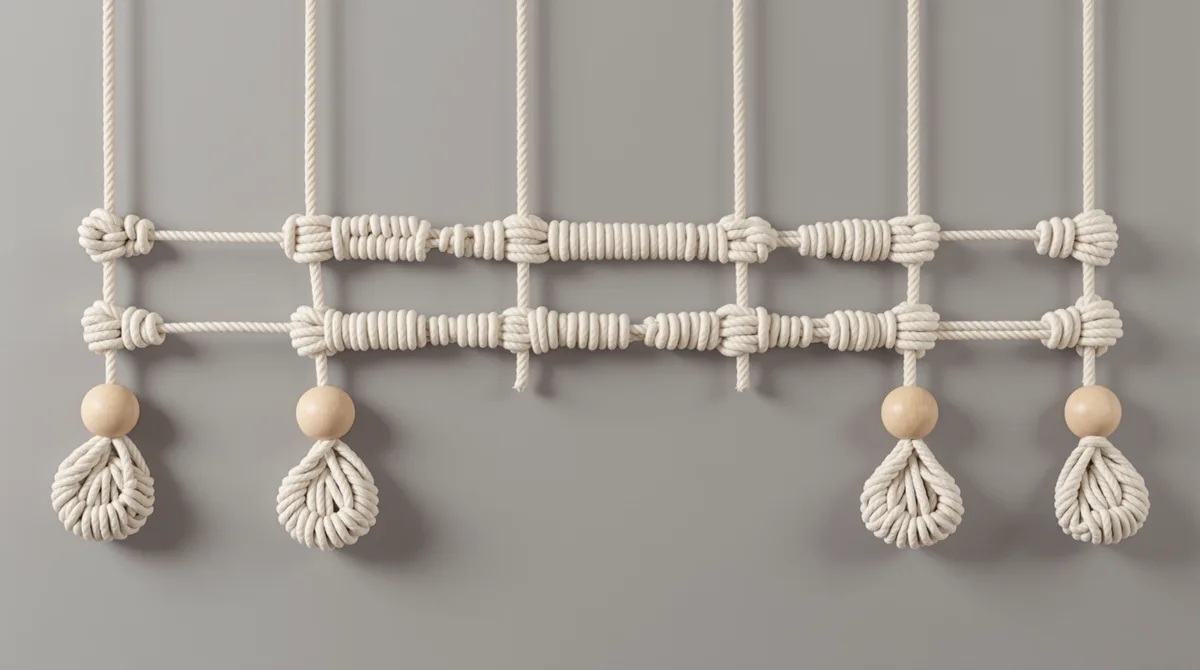
Craft topic
In a knotted curtain the bead is not strung, it is trapped. A knot above and a knot below hold it, which means the knot spacing decides where a bead is allowed to go — and the bead hole has to swallow a cord five times its usual size.
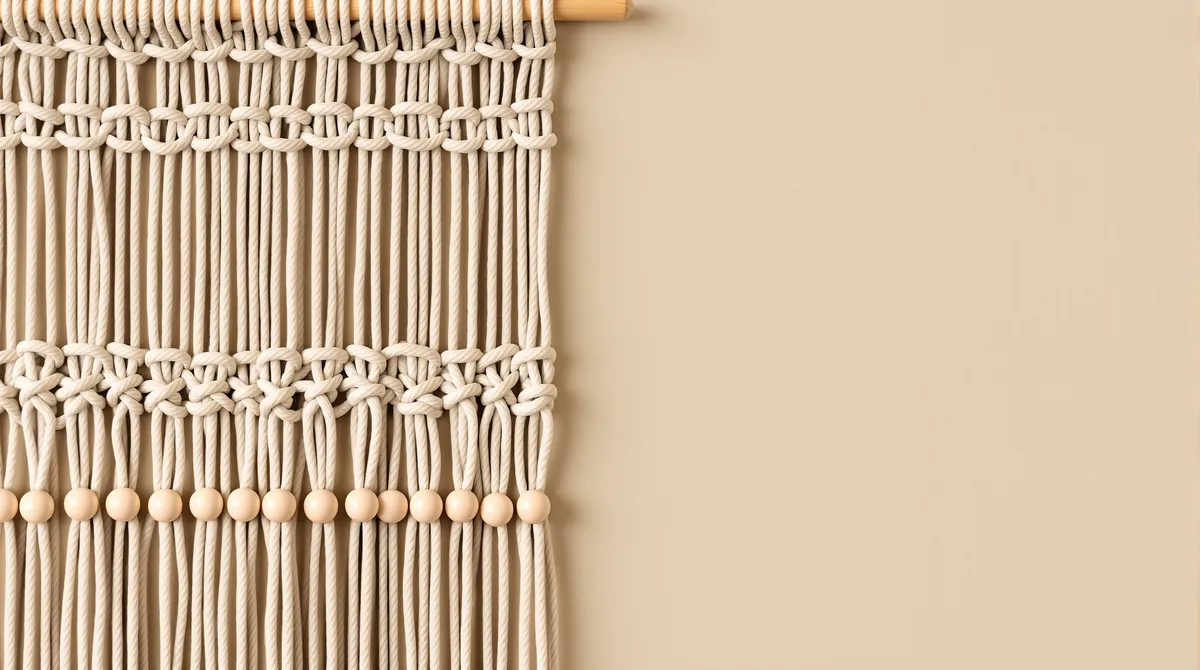
Rows of hand-tied macrame square knots in natural cotton cord with round turned wooden beads threaded on the working cords between them.
In a macramé door curtain the bead is threaded onto the working cords and trapped between a knot above and a knot below, not strung on a thread. That makes knot spacing the thing that decides where a bead can sit, and it makes the bead hole a hard constraint, because it has to pass cord of three to five millimetres.
A macramé door curtain is a knotted cord panel hung in a doorway, usually with beads worked into it. Macramé is knotting: square knots and half hitches worked in cotton cord, mounted on a dowel or a metal hoop, with a fringe left below the last row of knots.
It occupies the same doorway as a beaded curtain and belongs to a different craft. The crossover object — knotted cord with beads in it — is where most of the search interest sits, and it is also where the two crafts constrain each other hardest.
Not strung. Trapped.
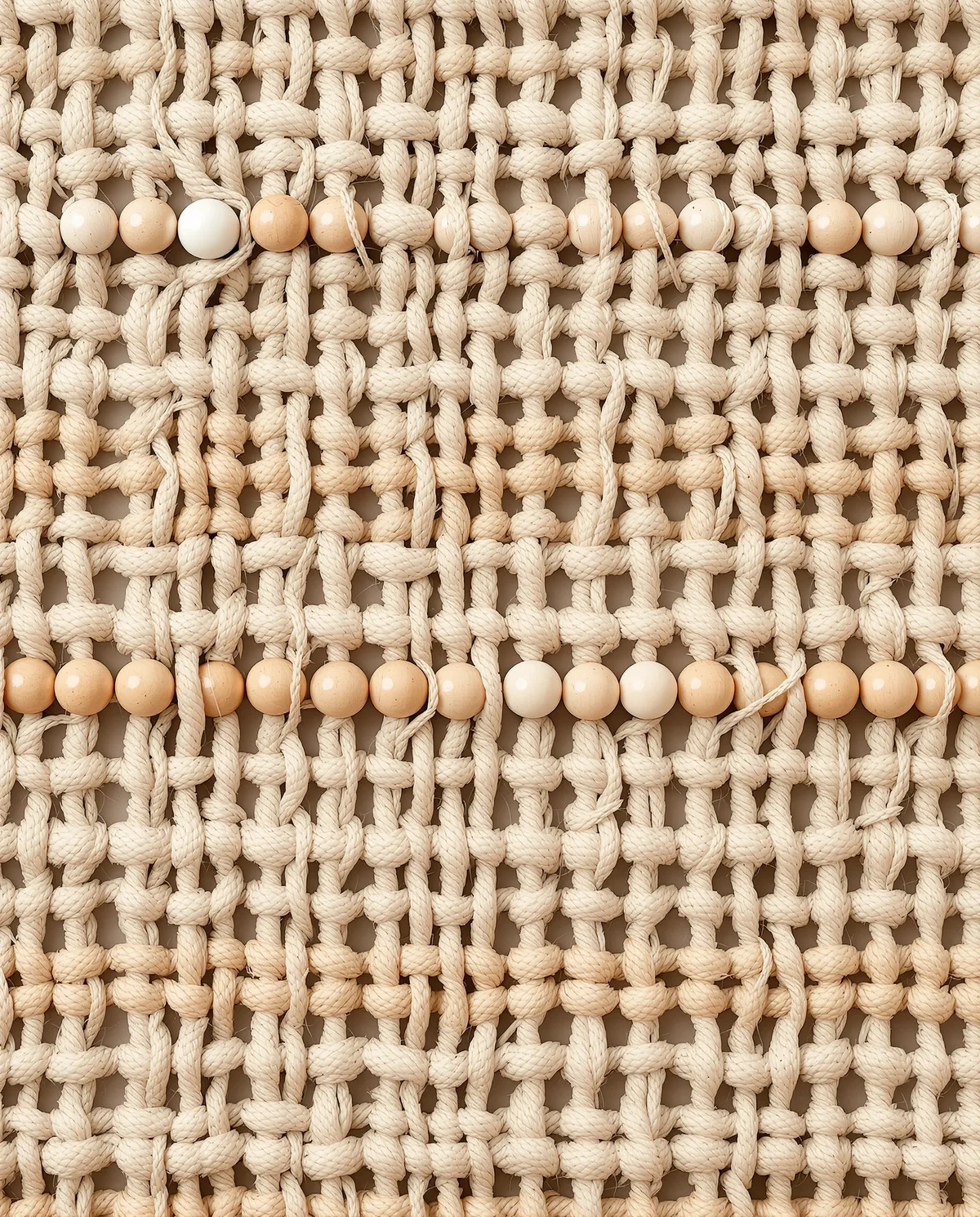
In strung work a bead is threaded onto cord and the whole strand hangs from a header, with the beads sitting on each other under their own weight. In knotted work the bead is threaded onto the working cords partway down the panel, and the next row of knots is tied immediately below it. A knot above and a knot below hold the bead in place. Nothing else does.
That is a better fixing in one respect — there is no stopper to fail and no strand to shed — and a much tighter constraint in another, because the bead can only sit where the knot pattern allows a gap.
Because the hole has to swallow the cord, and sometimes several cords at once.
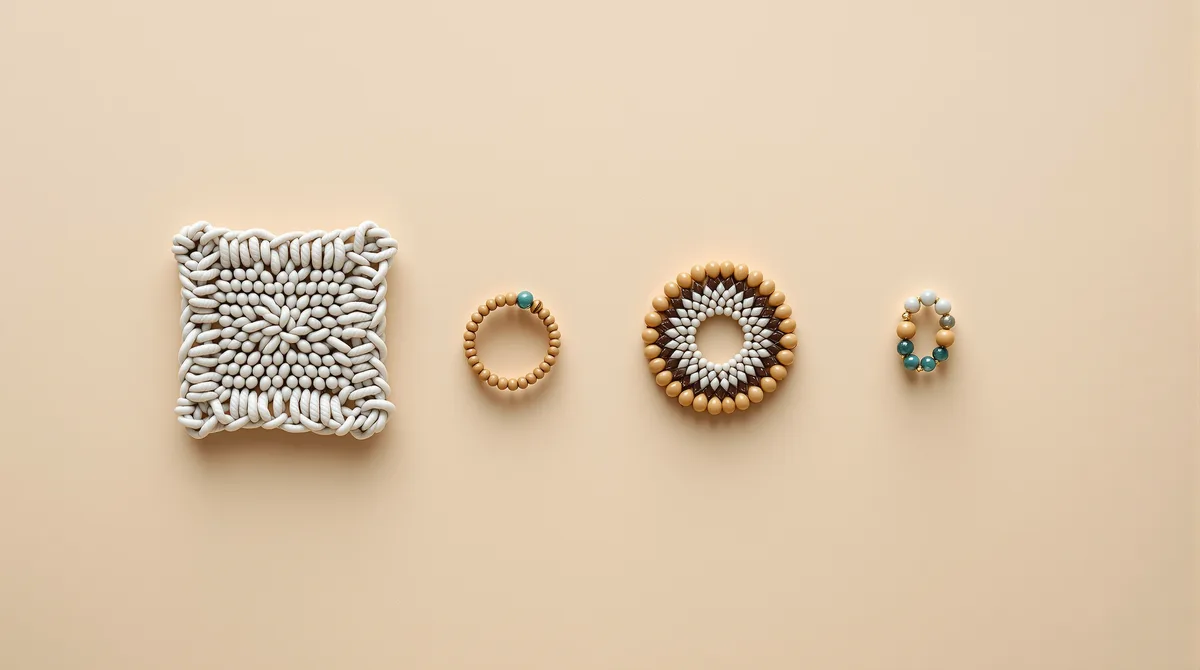
Macramé cord runs three to five millimetres. A bead threaded onto a single cord therefore needs a bore comfortably above five millimetres, and a bead threaded onto two working cords needs far more than that. For comparison, the drill hole in our own strung development work is specified down around four to five millimetres, and the smallest beads are drilled for thread alone.
The practical consequence is that a knotted curtain uses large beads — turned wood beads, big ceramic beads, chunky resin beads — and cannot use the glass seed beads that carry pattern in a strung panel. That is not a design preference. It is a hole diameter.
By drawing them together, before anything is tied. The knot pattern and the bead plan are one document, not two: each bead position has to coincide with a point in the pattern where the working cords are free and the next row of knots will close below it.
Designing the bead placement first and the knotting afterwards produces a pattern full of forced knots. Designing the knotting first and dropping beads in afterwards produces beads in the wrong places. Our own macramé work is drawn to a full tech pack before the first knot for exactly this reason.
Macramé is a real capability here, added in 2026. A knotted butterfly wall hanging was completed as a sample at 36 inches overall on a 22 by 14.5 inch wire frame. A second knotted wall hanging was sampled. A knotted dog series at roughly 18 to 35 inches is in development, drawn to a full tech pack before the first knot. Twenty-two knotted pieces sit in our technique and material reference catalogue, with trees at 12 to 18 cm and wall panels at 25 to 45 cm drop.
A macramé door curtain is not in that record. The craft is here, at wall-hanging scale, and the doorway format has not been built.
Because the published lead times differ, and they differ for a reason. Beaded décor runs 40 to 60 days after sample approval. Bohemian and macramé work runs 60 to 90.
Knotting is sequential in a way stringing is not. A strung strand can be loaded quickly and consistently; a knot has to be tied, tensioned and dressed, and the next knot depends on the last one being right. Tension is also cumulative — an error two rows up cannot be corrected without untying — so there is less tolerance for speed. On a mixed piece, the knotting sets the date for the whole order.
Look across the knot rows, not down them: inconsistent tension shows as rows that wander out of line. Push a bead with a fingertip — it should not slide, and if it does the knots below it were tied loose. Look at the fringe ends for a level cut, which should be done after knotting rather than before. Then the dowel or hoop mount, which carries the entire weight.
Cord quality is the quiet one. A soft, loosely twisted cord fluffs at every knot and the panel looks tired within a season.
Cotton cord at three to five millimetres, square knots and half hitches, a turned wood dowel from our own wood turning, or a metal hoop, and a combed or knotted fringe. For the beads: large turned wood, glazed ceramic, moulded resin or acrylic, and occasionally horn or bone — anything with a bore big enough for the cord.
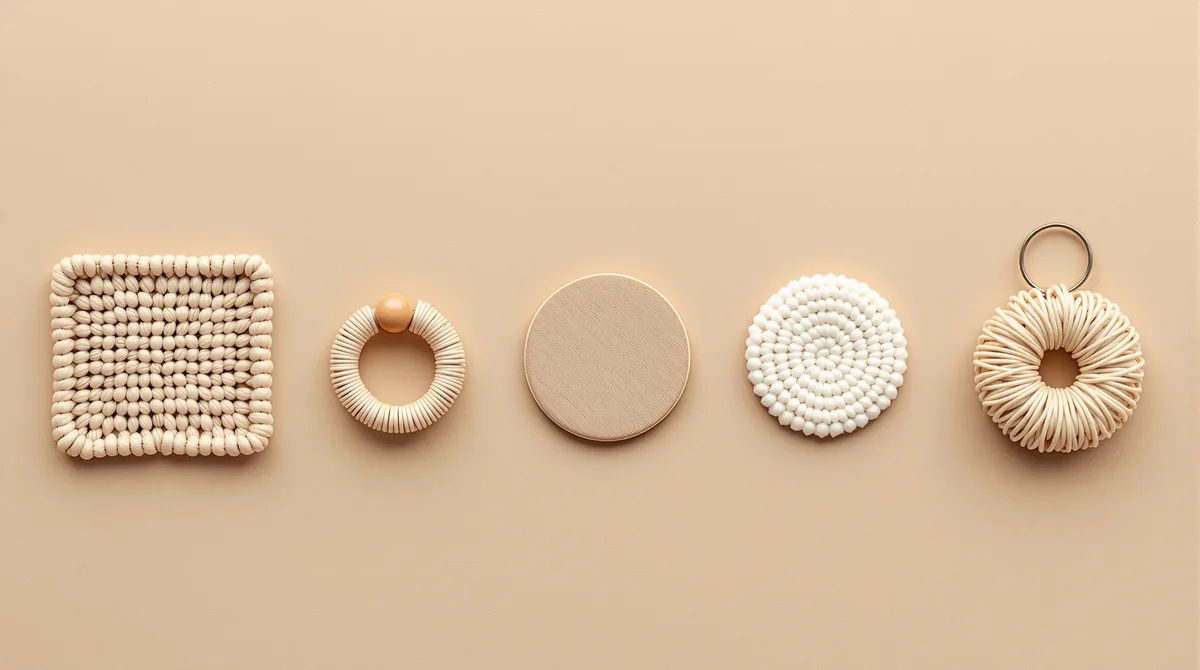
Natural fibre sits adjacent: raffia, jute and cotton rope wrapped and coiled over a wire ring, and hand crochet sits beside it — different families in the same reference catalogue, often appearing in the same ranges.
From its dowel or hoop, on cup hooks or a rod inside the door frame. Knotted cotton is much lighter than glass, so the fixing is less demanding than for a strung glass panel — but it is far more absorbent, so it should not hang anywhere it will be rained on or steamed. A knotted curtain also moves more in a draught than a weighted bead panel does, which is either the charm or the problem depending on the doorway.
Dust, and comb the fringe with your fingers. Spot-clean the cord with a barely damp cloth and let it dry fully while hanging. Do not wash it: cotton cord shrinks unevenly, which pulls the knot pattern permanently out of shape, and a wet knot dries tighter than it was tied.
Because the answer is split. The knotting is ours and is documented. The door curtain is not. Publishing a knotted-curtain range page would borrow the credibility of the sampled wall hangings for a format we have never built, and the whole value of a reference like this one depends on not doing that.
Good to know
Macramé bead curtain, knotted door curtain, boho door curtain and hippie door curtain all name the same thing. Macramé itself describes the knotting, not the beads — a macramé curtain with no beads in it at all is still a macramé curtain, which is why the bead content has to be specified rather than assumed.
Knot tension, by looking across the rows rather than down them: inconsistent tension shows as rows that wander. Then whether the beads sit snug between their knots or slide, which means the knots were tied loose. Then the fringe, which should be combed or cut level after the knotting is finished. Then the dowel attachment, where the whole weight hangs.
From the dowel or hoop it is mounted on, on cup hooks or a rod inside the door frame. Knotted cotton is far lighter than a glass bead curtain, so the fixing is simpler — but it is also much more absorbent, so it should not hang where it will be rained on or steamed.
Dust and comb the fringe with your fingers. Spot-clean cotton cord with a barely damp cloth and let it dry fully while hanging. Never wash a knotted curtain: cotton cord shrinks unevenly, which pulls the knot pattern out of shape permanently, and a wet knot dries tighter than it was tied.
A knot pattern and a bead plan drawn together, a cord specification, a bead with a hole sized to that cord, a dowel or hoop mount, and a sample. Our macramé bench has gone from tech pack to finished sample in about five weeks on a wall hanging, so the route is proven at that scale. A full door curtain in knotted work is available to develop from that base.
Macramé yes, a macramé door curtain no. Macramé is a capability we added in 2026, with a butterfly wall hanging completed as a sample at 36 inches on a 22 by 14.5 inch frame, a second wall hanging sampled, a knotted dog series in development, and a documented knotted range running from trees at 12 to 18 cm to wall panels at 25 to 45 cm drop. A knotted door curtain is available to develop on that base.
Cords are mounted onto a dowel or a hoop, then knotted downwards in square knots and half hitches, row by row, with the pattern emerging from which cords are used as knotting cords and which as fillers. Beads are threaded onto the working cords as the work descends and locked in by the next row of knots. Below the last row the cords are left as fringe, combed or cut.
Keep exploring
Technique
Square and half-hitch knotting on a dowel or hoop, combed fringe, the documented knotted formats, and why the knotting sets the date for a whole order.
Read the guideIndex
Seventeen beaded objects documented from inside the craft — what each one is, how the tradition builds it, and what it would take to develop one.
Specs and sizesCraft topic
Pinned beads over a foam form, the kit era that made it, what collectors check, and the one thing we make that is genuinely adjacent to it.
Read the guideCraft topic
Four elements — form, ground, couched beads, hanging loop — at seven to eleven centimetres, and why the poles of a sphere are where ornaments fail.
Compare the optionsCraft topic
Eggs, flowers and birds at ornament scale, why a moving date tightens the calendar further, and the pastel palette problem nobody plans for.
Read the guidePillar
Door curtains, portals, café lengths and valances: the standard sizes, the strand counts and the one question each format answers.
Specs and sizes
Start a conversation
Send a reference, a colour chip or a sketch. Minimums are set per design and confirmed per quote; sampling is quoted separately and usually runs 16 to 20 days from an agreed brief.