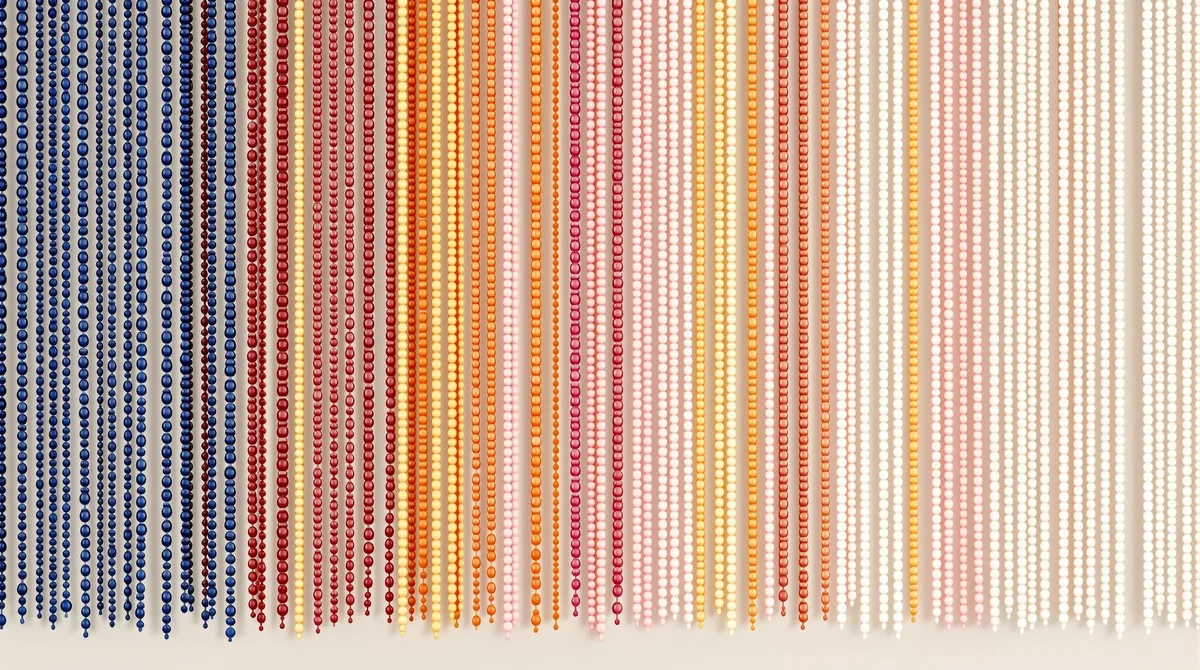
Colour story
Laser-cut blossoms
Five-petal faux capiz blossoms cut to shape, each held by a spacer bead dyed to match, in a sampled and approved build.
How it is made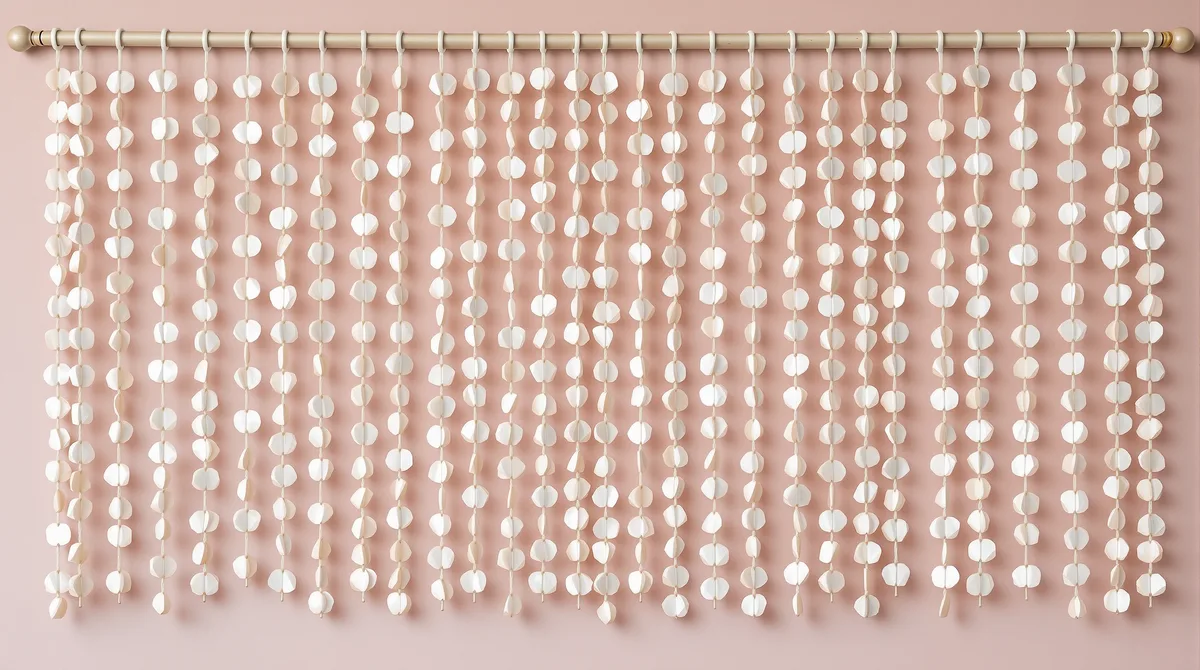
Design · Cherry Blossom Wall Hanging
One small bead at the centre of each blossom is the only thing stopping the whole pattern sliding to the bottom of its cord.
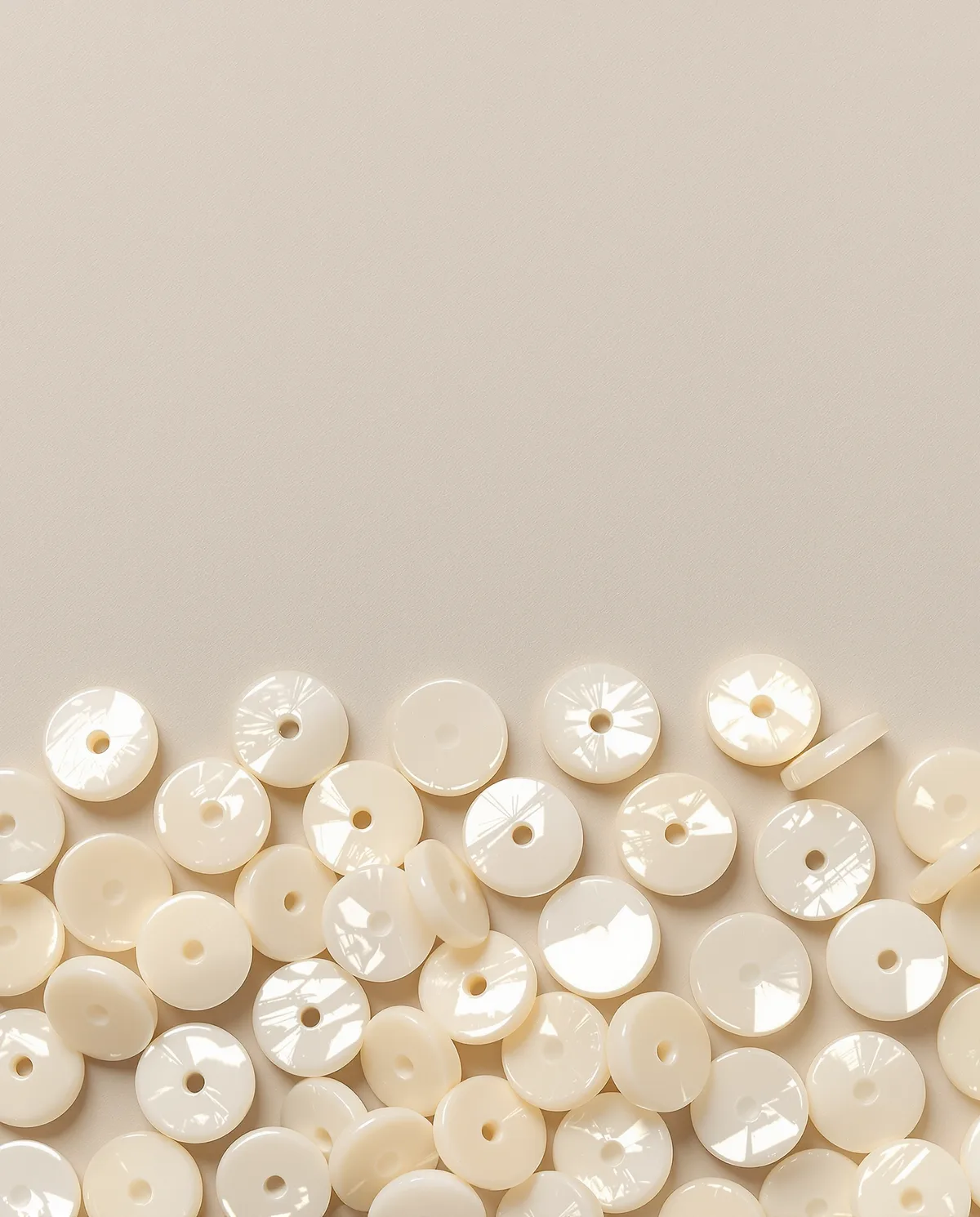
A hanging of flat round discs cast in pearlised resin and dyed acrylic in blossom pink and cream, each disc linked to the next in continuous vertical chains below a slim rail.
The Cherry Blossom wall hanging is an 18 × 30 in piece carrying five-petal blossoms cut to shape in faux capiz. The dowel version holds 155 to 170 blossoms; a rod-pocket version of the same design holds 130, because a fabric header eats height that would otherwise carry blossoms. A spacer bead dyed to match each petal stops the blossom sliding down its cord.
The Cherry Blossom wall hanging is an 18 × 30 in piece carrying five-petal blossoms cut to shape in faux capiz — cast resin or dyed cut acrylic, finished to imitate capiz shell.
It was adopted in August 2026 and approved in September 2026, which makes it the only wall design in the library with a complete production record behind it.
Not as strands in the usual sense. Blossoms are hung on cords, and the only bead in the piece is a small spacer at the centre of each blossom.
That spacer is the construction. A cut blossom is a flat shape with a hole in its middle, and nothing about its own geometry keeps it where it was placed — without a stop it slides down the cord and the pattern collects at the bottom. The spacer is dyed to the petal colour so it disappears visually while doing all of the structural work.
A cut-shape design is specified by count rather than by sequence. The blossom count, the holding method and the mount are the three entries that matter, and the mount changes the count by about a quarter. The carton is settled on this design too — a master carton at 85 by 32 by 25 cm, ten pieces to it — so a shipment can be planned off the design rather than off an estimate.
| Specification | Value |
|---|---|
| Finished size | 18 × 30 in |
| Main element | Five-petal blossoms cut to shape in faux capiz |
| Material | Cast resin or dyed cut acrylic, finished to imitate capiz shell |
| Blossom count, dowel version | 155 to 170 |
| Blossom count, rod-pocket version | 130 |
| Holding method | One spacer bead per blossom, dyed to the petal colour |
| Palette | Blossom pink, with spacer beads dyed to match |
| Carton option | Master carton 85 × 32 × 25 cm, ten pieces |
| Production | 40 to 60 days after sample approval |
Recoloured entirely, because every element is dyed. There is no stock colour anywhere in the piece.
The approval has to be done as a pair, though: a spacer approved on its own against a reference can match the reference perfectly and still read as a visible bead at the centre of every flower. What is approved is the blossom and the spacer together, on the sample, and production is held to that.
Resizing recalculates the blossom count rather than the blossom. A five-petal blossom has a minimum size below which the petals stop reading as petals.
Retailers and own-label brands, broadly — this is the most immediately likeable piece in the library and it sells to people who would not otherwise buy beadwork. It needs no explanation from across a shop.
It also has a bridal and event use, and it suits interior specifiers working on small residential and hospitality spaces where a wall piece has to be decorative rather than architectural.
Three things, each worth carrying into another design.
The spacer bead. Without it the construction fails, and it took an iteration to establish — two versions of the blossom were made, one with the centre spacer and one without.
The mount arithmetic. The dowel version carries 155 to 170 blossoms and the rod-pocket version 130, because a fabric header consumes height. Same design, same width, two bills of materials — which is why the mount is a cost decision as much as a look decision, and belongs in the brief rather than in the sampling loop.
The material naming. Faux capiz is cast resin or dyed cut acrylic. It is an engineered imitation of capiz shell, and that is the advantage: consistent colour batch to batch, no shell-import exposure, and better durability than the shell it imitates.
Protected against knocking and packed to the client's carton, label and packaging specification. One master carton option on this design is 85 × 32 × 25 cm holding ten pieces, which is the figure to build a shipment plan around.
Thin cut shapes can tangle in handling, so disc and petal weight is chosen on the sample so the cords hang straight, and interleaving keeps blossom faces off each other in transit.
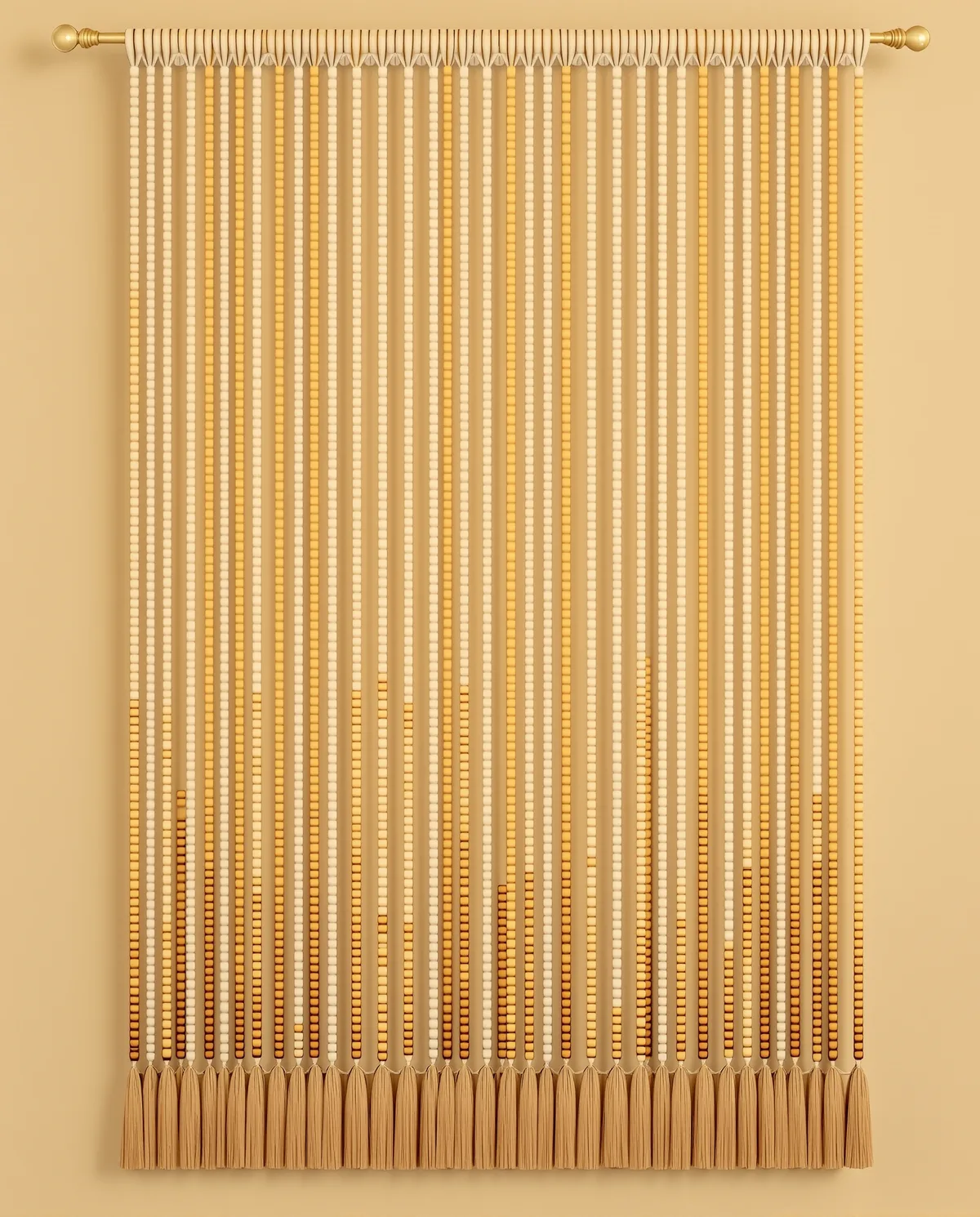
The imagery here is editorial and shows the blossom construction: a cut shape, a spacer bead at its centre, and the way the cords hang. Where a slot calls for a record photograph of that construction, it ships marked as a gap rather than filled with something approximate.
What a buyer receives is the approved sample, matched in production and inspected against it before packing.
The Cherry Blossom story carries a genuine naming collision. This sampled piece is cut faux-capiz blossoms at 18 × 30 in. There is also a 76 × 46 cm design in the 2027 render library under the same name, built at 40 strands with an uneven hem from frosted pink hearts and ivory blossom ends — strung beads, not cut shapes.
A buyer asking for Cherry Blossom should be asked which one. The construction, the bill of materials and the cost are unrelated.
Almost none of it, which is the unusual answer. The blossoms are cut shapes and the only bead is the spacer, and the spacer is invisible by design.
That makes the material question a resin and acrylic question rather than a bead question. Both routes take dye uniformly because the colour runs through the material, which is why this is the most freely recolourable design on the property.
The blossoms themselves end the piece, so the hem is set by where the cords stop rather than by a profile. The published build has an uneven lower edge created by the blossom spacing rather than by strand-length mapping.
A turned wooden dowel in the published version, or a sewn rod pocket in the alternative. A cut resin or acrylic blossom is light, so this is among the lightest pieces in the library per unit of area — one of the reasons the design works on plasterboard without a specified fixing.
Good to know
Protected against knocking and packed to your carton, label and packaging specification. One master carton option on this design is 85 × 32 × 25 cm holding ten pieces, which gives a real figure to plan a shipment against rather than an estimate.
Yes. Send artwork with the size, the material, the colours and the quantity. A cut-shape design is specified by the shape, the count and the holding method, which is a different document from a bead sequence and is quoted differently.
Entirely, because every element is dyed. Change the petal colour and the spacer follows it, and the pair is approved together on the sample rather than separately. The one tonal constraint is that a dark blossom loses the semi-translucency the material is imitating.
Yes, with the blossom count recalculated rather than the blossom resized. A five-petal blossom has a minimum size below which the petals stop reading as petals, so a smaller piece carries fewer blossoms at the same scale.
One bead, and it is doing structural work: a small spacer bead at the centre of each blossom, dyed to match the petal. Everything else in the piece is a cut shape rather than a bead.
Exclusivity is a commercial decision taken per programme rather than a property of the design. Name it in the brief and it is quoted alongside the piece.
The imagery on this page is editorial and the record slot for the real blossom construction ships marked as pending rather than filled with an approximation. Nothing here is captioned as the specific piece a buyer receives.
Keep exploring
Colour story
Five-petal faux capiz blossoms cut to shape, each held by a spacer bead dyed to match, in a sampled and approved build.
How it is madeMaterial
Cast resin or dyed cut acrylic, finished to imitate capiz shell: what it gives that real shell cannot, and why thin discs tangle.
How it is madeDesign
Strung wall pieces from 50 × 90 to 60 × 100 cm at 20 to 40 strands, documented by hem shape and bead list.
View the rangeDesign
60 × 100 cm on 33 strands of jet and garnet glass with plated gold rounds, to a V-point hem.
Specs and sizesDesign
60 × 90 cm on 30 strands, with wood rondelles as the body, honey glass as the accent and dotted drops at the ends.
Specs and sizesGlossary
Dyeing one bead to another bead's colour rather than to a swatch — why it is used, and what it does not promise.
How it is made
Start a conversation
Send a reference, a colour chip or a sketch. Minimums are set per design and confirmed per quote; sampling is quoted separately and usually runs 16 to 20 days from an agreed brief.