Design
The design library: colour stories, by construction
Colour stories documented by how they are built, not by how they look in a mood board.
Open the referenceDesign library · Index
Short formats, where the hem shape carries the whole design because there is no drop to grade across.
The short formats run as valances at 120 × 30 to 40 cm on 56 to 60 strands, and as café curtains around 76 × 76 cm. Bead counts land between roughly 900 and 2,000, against 3,100 and up for a doorway. Height is the largest cost lever in beadwork, so a valance tests a colour story at a fraction of a full curtain's bead count.
Design by design
Each page gives the finished size, the hem shape, the longest and shortest drop where the edge is shaped, and says whether it is a shipped design or one available to develop.
Design
Six-inch daisies assembled from custom moulded almond beads, on a cotton header with a three-inch rod pocket and a scalloped chevron hem.
Design
A 76 × 76 cm square at about 1,800 beads, which is the clearest bead-count-against-format comparison in the library.
Design
Irregular frosted beads of 4 to 5 mm strung with seed beads into a scalloped arch, from a 24 in longest drop to a 10 in shortest.
Design
Dyed glass seed beads embroidered onto a sheer ground at 30 inches square, with a three-inch rod pocket.
Design
120 × 35 cm with a radiating hem, in glossy orange, canary, chocolate and cream soda.
Design
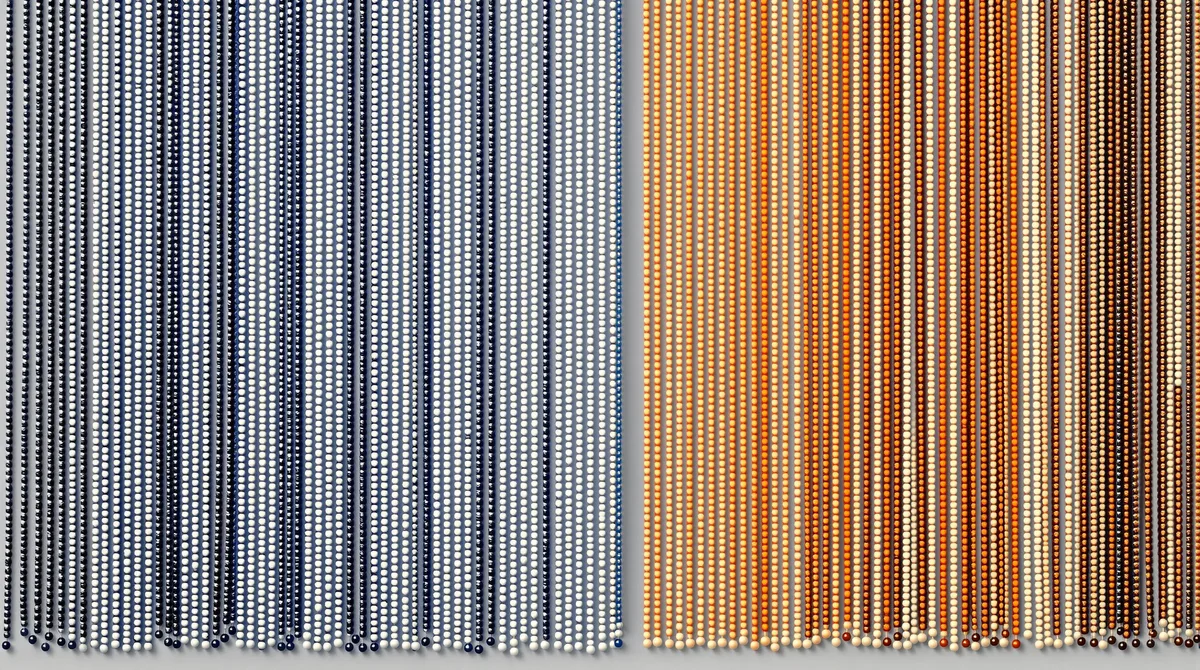
The deep blue story at valance drop — 120 × 30 to 40 cm, where the same palette runs a fraction of the doorway bead count.
Design
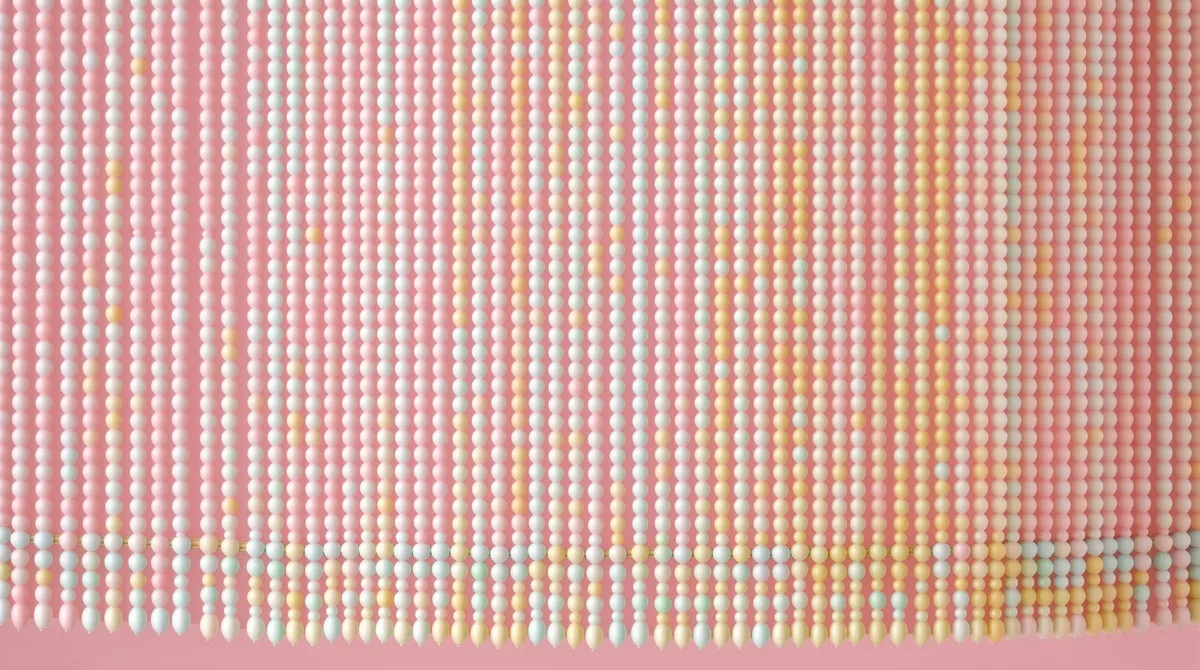
A scalloped awning profile over a pastel scatter at the 120 cm width, so the short drop reads as deliberate.
Design
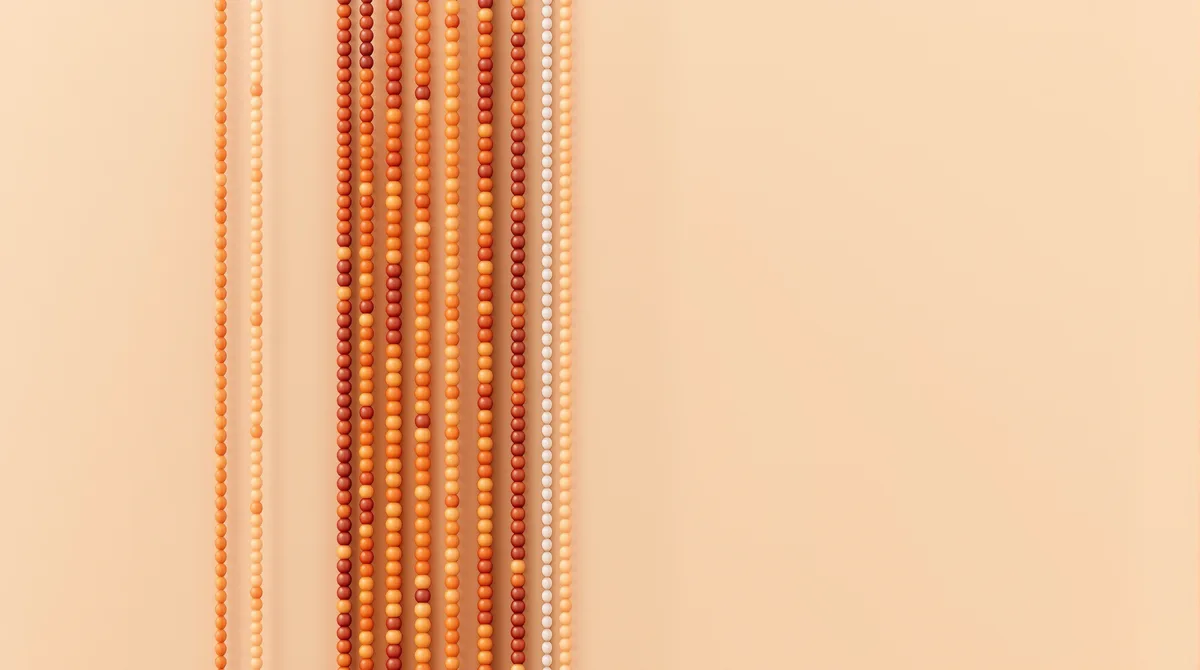
The espresso and crema palette at valance drop, with one cherry-red note placed for the light.
Valances and café curtains, each documented by finished size, header type, strand count, bead list and hem shape.
Short formats are not small versions of doorway curtains. They are a different design problem. A doorway drop of 200 cm has room for a size grade, a scattered accent and a shaped hem all at once. A 30 cm valance has room for exactly one idea, and in practice that idea is almost always the hem.
By hem family, because at this height the hem is the design. Scalloped and chevron hems first, because a shaped edge at 30 cm reads instantly and a straight fringe at 30 cm reads as trim. Then arch and awning shapes. Then the straight-hemmed café curtains, where the interest moves up into the header band instead.
Strand counts run higher than the format suggests: 56 to 60 strands across 120 cm, which is a pitch near 2 cm. Short pieces are dense because a sparse short piece has nothing to hold it visually.
With the Daisy café curtain. It is the one design in the group where the header is doing real work: a 100 per cent cotton header band with a three-inch rod pocket, a beaded top trim above the strands, custom moulded daisy connector beads, oval drop beads, and a scalloped chevron hem at the bottom. Three construction families in a piece 24 inches tall.
The Daisy café curtain is a live style in current production. The sea-glass crystal valance was sampled, corrected and re-engineered. The organza seed-bead café curtain was sampled and shipped in September 2025, and its most useful detail is why it became a café curtain at all: it began as a full curtain and was converted because flat bead embroidery is worked on a frame, and the frame sets the practical maximum — above that size the format is a strung one.
The remaining five are drawn designs, available to develop at the sizes shown.
The sampled pages, because they record what moved. The sea-glass valance page documents the single clearest example of a height-driven cost lever on the whole property: the drop was cut from 30 inches to 26 to reduce the bead count, with the hem shape kept intact.
Every page carries a specification table with the finished width, the longest drop, the shortest drop where the edge is shaped, the strand count and the header. For a shaped hem, the longest and shortest drop together are the specification — a single height does not describe a scalloped arch.
Behind these pages, bead sizes and stringing specifications holds the spec-sheet shape, and hand-strung strands covers how strand lengths are mapped so a shaped hem repeats across a production run instead of being judged at the bench.
Fan Arch, Olive Press Grove, Sunny Side Up, Pearl Scallop and Wiggle, each drawn at true size against real beads. Developing one starts where it starts for every other piece here: a strand-length map and a bead list, then a cost sheet, then a sample in 16 to 20 days from an agreed brief.
The beaded piece on a turned dowel, or with a rod pocket sewn to a fabric header, packed to your carton and label specification. The dowel and the header are ours — turned in our own wood factory, sewn in our own studios — and rods, brackets and tension fittings are the installer's. The care guide covers what happens after it is up, and why the cord rather than the glass sets the service interval.
Good to know
Plants we own. Glass is drawn and hand-strung in our own Firozabad glass works, the moulded connector beads are made and dyed to our own dies, and the cotton header bands are cut and sewn to the rod-pocket pattern in our own studios. Minimums are set per design and confirmed with your quote, because a plain fringe and a daisy-connector header consume very different stringing time at the same finished size.
The Daisy café curtain, because it is the only design on this index that combines three construction families in one piece — a cotton header band with a three-inch rod pocket, a beaded top trim, moulded connector beads, and strands falling to a scalloped chevron hem.
The Daisy café curtain is a live style. The sea-glass valance and the organza seed-bead café curtain were sampled, corrected and re-engineered. The Polka Dot café curtain, the Sunburst valance, the Lapis Hour valance, the Sorbet Parade awning and the Café Society valance are drawn at true size and available to develop, with every figure confirmed on the approved sample.
The longest and the shortest drop together, with the finished width and the strand count. A single height does not describe a scalloped arch or a chevron, and the two drops are what let a hem repeat across a production run instead of being judged at the bench. Every page in the group carries both.
By what the short format has to solve. A valance dresses the top of an opening and its hem shape is the whole design, so the pages are ordered by hem family: chevron and scalloped first, then arched and awning, then straight. Café curtains sit alongside because they share the header problem.
Keep exploring
Design
Colour stories documented by how they are built, not by how they look in a mood board.
Open the referencePillar
Door curtains, portals, café lengths and valances: the standard sizes, the strand counts and the one question each format answers.
Open the referenceDesign
Strung wall pieces from 50 × 90 to 60 × 100 cm at 20 to 40 strands, documented by hem shape and bead list.
How it is madeDesign
Linked faux-capiz disc hangings at 70 × 130 to 90 × 200 cm, and beaded shade designs from a 15 cm sconce to a 50 cm pendant.
Read moreDesign
The full-length doorway designs, 90 × 200 to 120 × 210 cm, documented by strand count, hem shape and bead count.
How it is madeSpecification
Diameters, drill holes, cord selection, strand counts and format dimensions — the sheet to copy into a tech pack.
Compare the options
Start a conversation
Send a reference, a colour chip or a sketch. Minimums are set per design and confirmed per quote; sampling is quoted separately and usually runs 16 to 20 days from an agreed brief.