Design
Colour stories, by construction
Colour stories documented by how they are built, not by how they look in a mood board.
Read the guide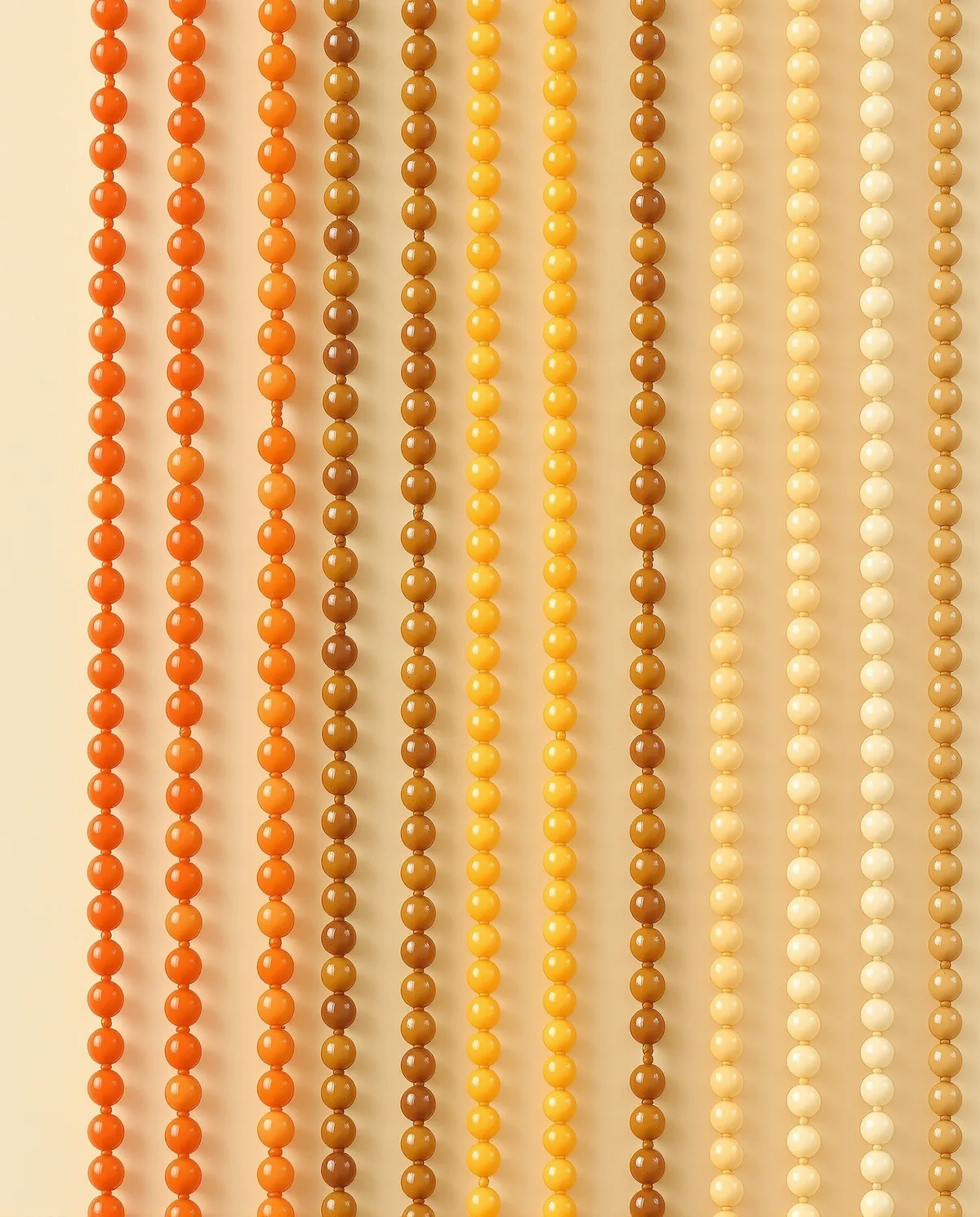
Colour story
The one 2027 collection that is beaded throughout, and the only colour story in the library released as three matched formats at once.
Six bead strands in the Seventies Sunroom palette — glossy orange, canary, chocolate brown and cream soda — hung parallel against a cream-soda ground.
Seventies Sunroom is the warm 2027 story — glossy orange and canary glass with chocolate brown and cream soda, specified as a sun-faded record sleeve. It is the beaded collection of the 2027 announcement, and it was released as a matched set: a door curtain at 120 × 200 cm, a sunburst valance at 120 × 35 cm and a wall hanging at 60 × 100 cm.
Seventies Sunroom is collection 10 in the Gemixx Design Studio, announced in October 2026, and the only beaded collection among the three announced for 2027. The other two in that release are tabletop.
Its own notes describe it as glossy orange and canary glass with chocolate brown and cream soda, and reach for a sun-faded record sleeve as the reference. The commercial note attached to it is just as specific: beaded door curtains rising fast, and buyers asking for statement pieces in warm, dotted and amber looks.
Glass, and glossy glass specifically. The palette specifies glossy orange rather than orange, which is a finish instruction as much as a colour one — on a glass bead, gloss is decided at the works alongside colouring, frosting and ribbing, and a glossy orange reads several steps more saturated than the same colour matte.
The wall-hanging design carries avocado, tangerine and chocolate glass, which is a slightly different cut of the same family. That is normal within a collection: a story is a palette family, and each format uses the part of it the format can carry.
By specifying finish and colour together, then holding production to the approved sample. The oranges, canaries and browns are stock glass families, so batch-to-batch variation is small — this is one of the more economical palettes to reorder.
Cream soda is the note that moves. It sits between a warm white and a pale yellow, which is exactly the region where two people describe the same bead differently, so it is the line to sample before any of the others.
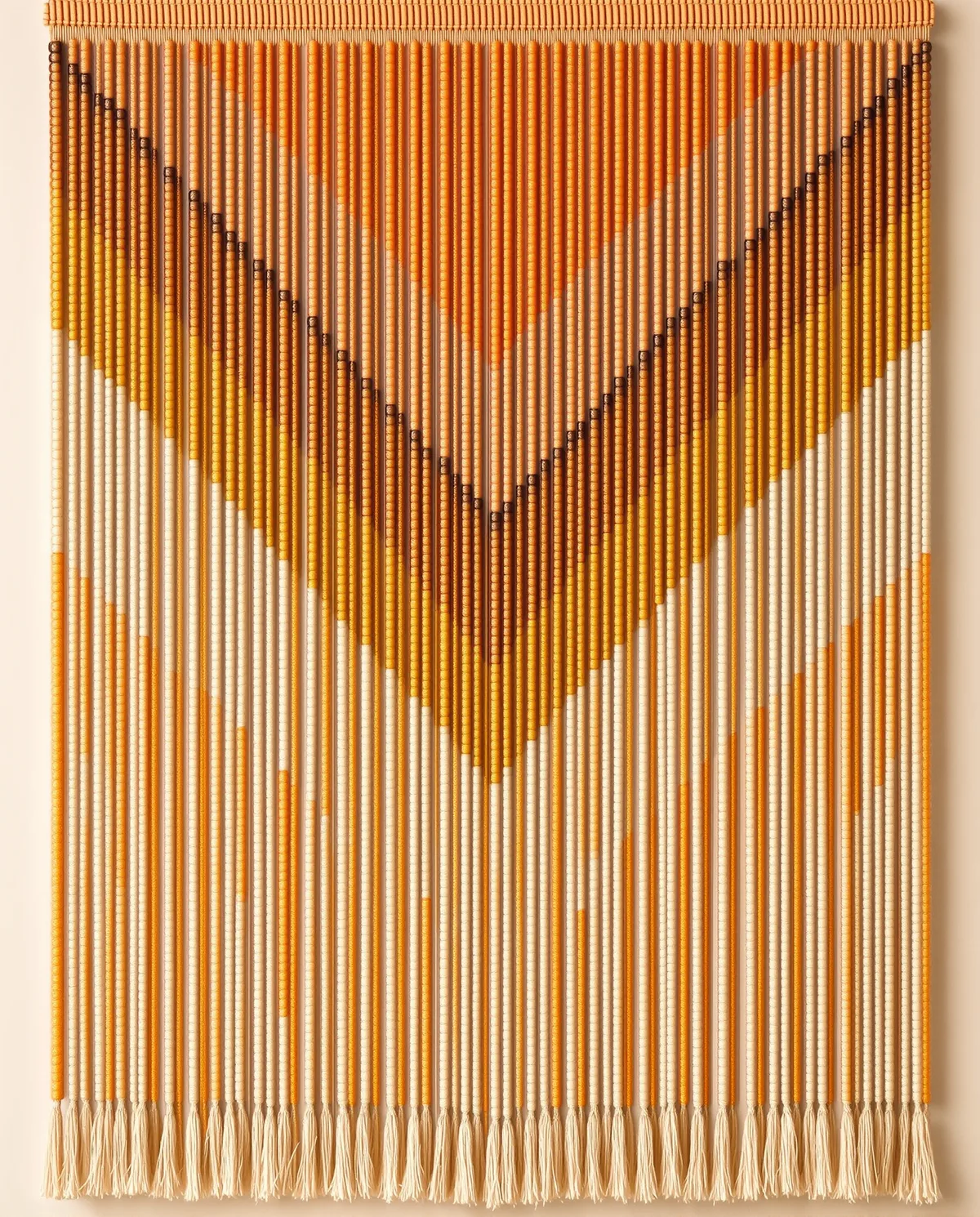
The palette specifies glossy orange, not orange. On a glass bead, gloss is a finish decision taken at the works, and it changes the colour's apparent saturation more than a shade shift would.
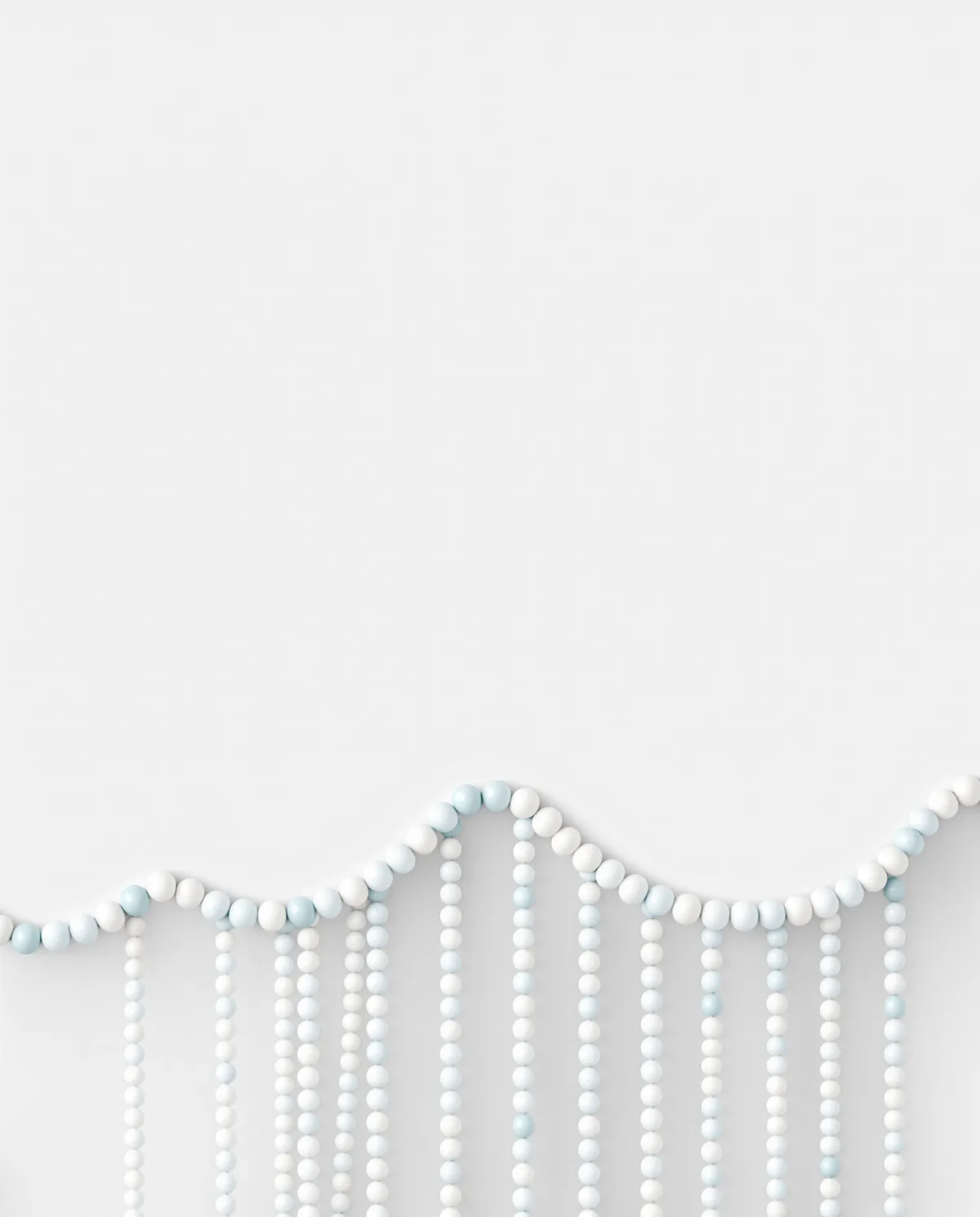
Inverted-V on the curtain, sunburst on the valance, scalloped on the wall piece. The palette is constant; the hem does the differentiating.
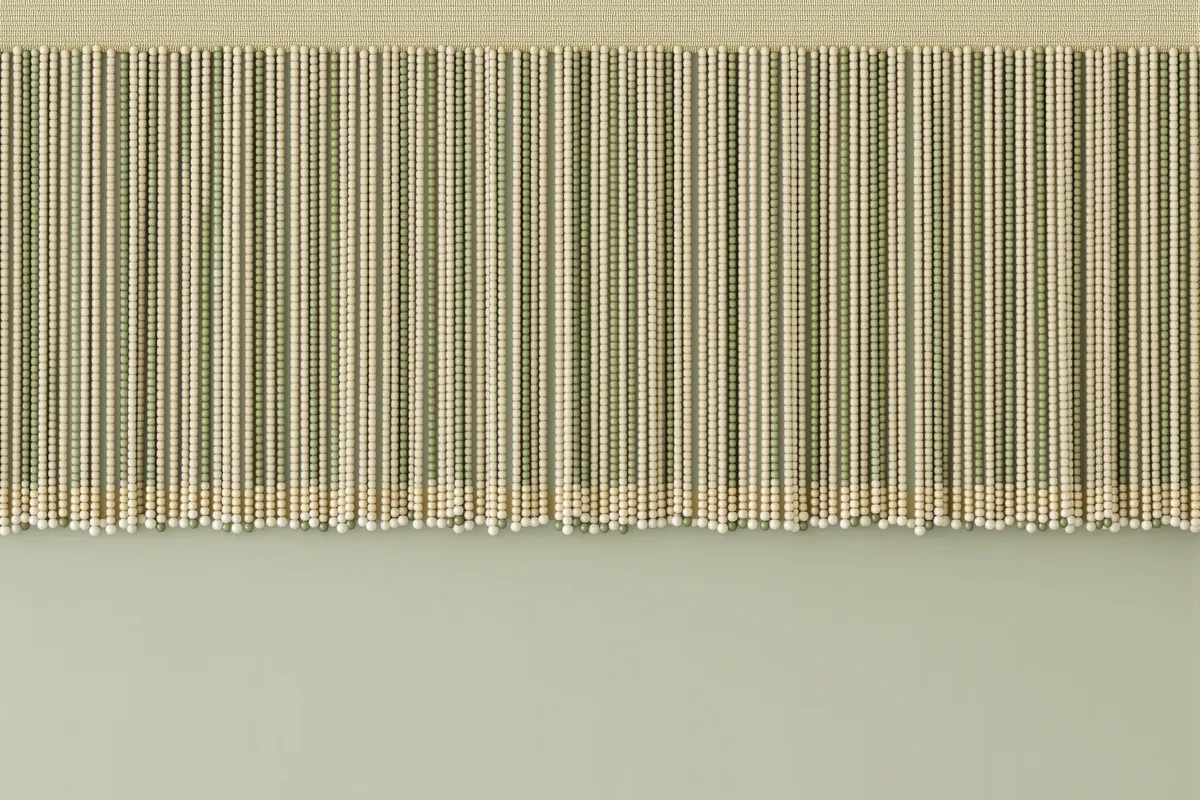
At 120 × 35 cm the valance carries the full width and the full palette at a fraction of the bead count, which is why a short format is the cheapest way into any colour story.
Three, released together, which is unique in the library. A door curtain at 120 × 200 cm drawn at 60 strands with an inverted-V hem. A sunburst valance at 120 × 35 cm. A wall hanging at 60 × 100 cm drawn at 30 strands with a scalloped hem.
All three are drawn designs, available to develop at the drawn size.
It is the most daylight-dependent story in the library, and the name admits it. Backlit, glossy orange and canary glass are brilliant and the browns go almost black, so the piece reads as a lit pattern on a dark ground.
In lamplight the browns come forward and the oranges warm towards rust, which is a handsome but much quieter object. A sunroom gets the first version; a hallway gets the second. The brief should say which.
Glass, straightforwardly and best. Acrylic moulded and dyed to the colour is the lighter route and gets close on the brights, slightly short on the gloss.
Wood turned in our own Saharanpur wood factory carries the chocolate note convincingly and cannot reach the canary at all. Ceramic glazed and fired in our own Khurja plant is the interesting third option — a reactive or speckle glaze in tangerine gives a period-correct surface that glass cannot imitate.
Stock for the brights and the browns. Cream soda is the usual dyed-to-match line. Where a design needs a bead shape that does not exist — a dotted oval, a particular drop — acrylic is moulded and dyed to the colour, to our own dies if the shape is new.
All three it was built as, which is the point of releasing them together. A retailer can take the valance at low entry cost, the wall hanging as a mid-price piece and the door curtain as the statement, with one palette and one approved colour set behind all three.
Nothing, if the warm register is what is wanted — this is one of the few stories where the published palette is already commercially tuned. If a change is needed, change the neutral rather than the bright: cream soda to a cooler off-white turns the whole story from seventies to contemporary without losing the orange.
As the loudest and the most immediately legible. It is the story customers name without being told what it is, which is worth something on a shelf where most beadwork has to be explained.
The three-format release is also the strongest merchandising argument in the library: one palette, three formats, one approved colour set. The Design Studio deep link for this collection is confirmed — app.gemixx.com/?c=seventies-sunroom — so a design can be opened, recoloured as your own copy and sent back for costing, with sampling usually running 16 to 20 days from an agreed brief and quoted separately.
Close to a plain strand on the curtain and the wall hanging, because both are mapped sequences of stock glass with no custom bead in them. Shaped hems add strand-length mapping but not bead cost.
The valance is the outlier in the right direction. At 120 × 35 cm it carries the full width and the full palette on roughly a fifth of the door curtain's bead count, because height is the cost lever that moves most and a valance removes most of it.
Extractable data
| Specification | Value |
|---|---|
| Palette | Glossy orange, canary glass, chocolate brown, cream soda |
| Collection | Design Studio collection 10, announced October 2026 |
| Door curtain | 120 × 200 cm, 60 strands, inverted-V hem |
| Sunburst valance | 120 × 35 cm, 56 to 60 strands |
| Wall hanging | 60 × 100 cm, 30 strands, scalloped hem |
| Wall hanging beads | Avocado, tangerine and chocolate glass |
| Strand pitch at 120 cm | About 2 cm centre to centre |
| Studio link | Confirmed collection slug — app.gemixx.com/?c=seventies-sunroom |
| Production | 40 to 60 days after sample approval |
Good to know
Yes, and in the Design Studio the design opens as your own copy to change — colours, finish and size. The palette is unusually robust to change because its structure is two warm brights against two neutrals, and that structure survives being moved to any hue family.
Three, released together: a door curtain at 120 × 200 cm, a sunburst valance at 120 × 35 cm and a wall hanging at 60 × 100 cm. All three are drawn designs, available to develop.
The oranges, canaries and browns are stock glass families, which is why a seventies palette is one of the more economical to put into production. Cream soda is the note most often adjusted to a buyer's own reference, and it is the one worth sampling first.
By bead line and by finish. Gloss is specified alongside colour, because the same orange in a matte finish reads several steps duller. Colour is matched to a chip or a reference and confirmed on the sample, and production is held to the approved sample.
Glass, as drawn, and it is the right choice — a glossy orange in glass is one of the most saturated things a bead can be. Acrylic moulded and dyed to the colour is the light-weight route. Wood and ceramic both carry the browns well but cannot reach the canary.
It is the only story in the library that was released with a small format from the start. The 120 × 35 cm sunburst valance carries the whole palette across the full width at roughly a fifth of the bead count of the door curtain, which is what makes it the cheapest entry point.
Keep exploring
Design
Colour stories documented by how they are built, not by how they look in a mood board.
Read the guideIndex
Twenty-four named looks, each described by the material, palette, pitch and hem that actually produce it.
Open the referenceColour story
A pale, reflective palette drawn at 120 × 210 cm, where silver and clear glass read as light rather than as colour.
Read the guideColour story
Jet and garnet glass with gold rounds across 33 strands — the point where an all-glass wall piece reaches its sensible weight.
Specs and sizesColour story
Wood rondelles with honey glass and dotted drops on 30 strands — warmth carried by the wood rather than the glass.
Read the guideDesign
120 × 200 cm on 60 strands with an inverted-V hem, in glossy orange, canary, chocolate and cream soda.
Specs and sizes
Start a conversation
Send a reference, a colour chip or a sketch. Minimums are set per design and confirmed per quote; sampling is quoted separately and usually runs 16 to 20 days from an agreed brief.