Design
The design library: colour stories, by construction
Colour stories documented by how they are built, not by how they look in a mood board.
Open the reference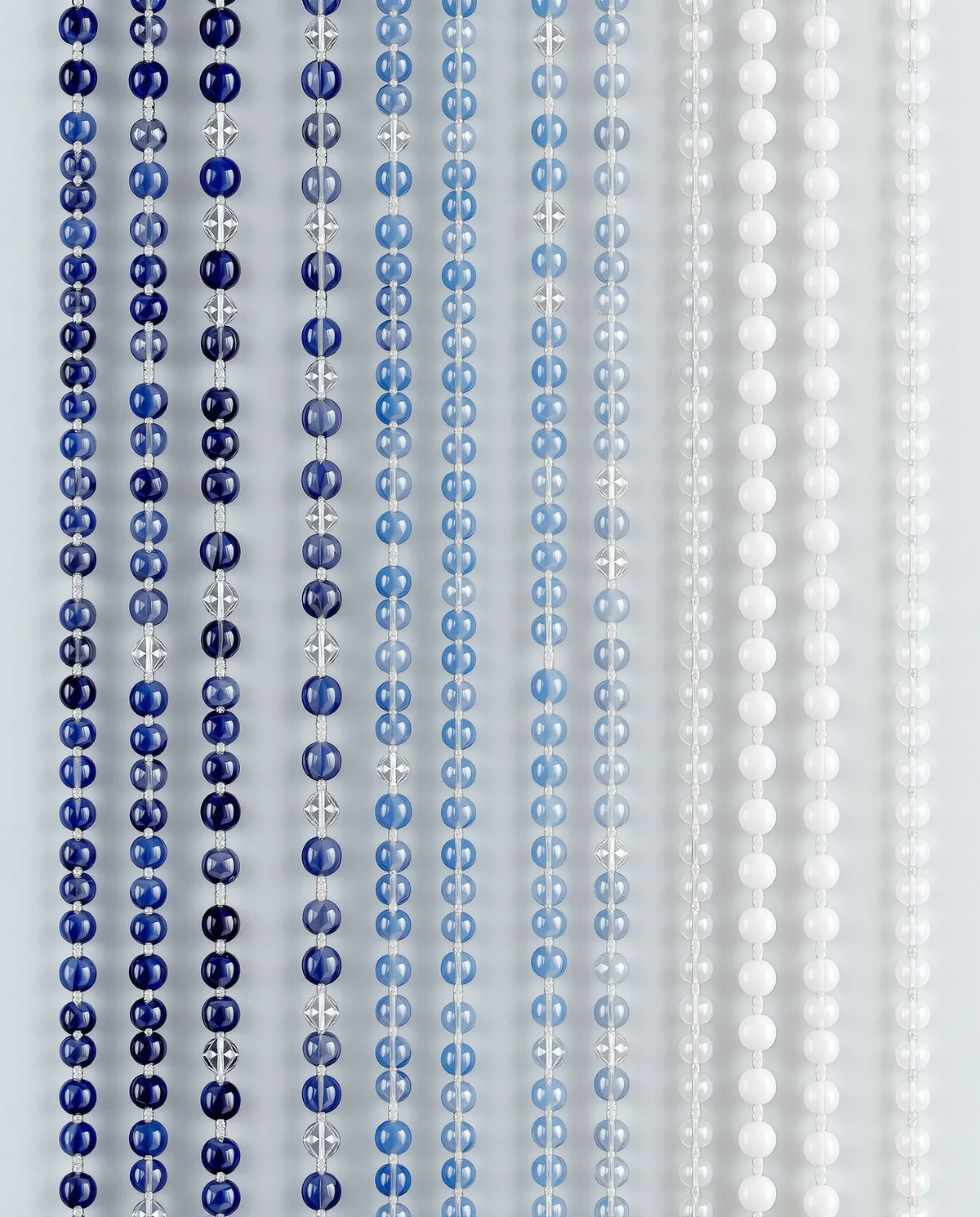
Colour story
A palette with almost no contrast in it, which is why it needs a bead that makes its own light rather than a colour that shouts.
Six bead strands in the Moonwater palette — midnight blue, grey-blue, silver-lined crystal and pearl white — hung parallel against a pale grey-blue ground.
Moonwater is the cool, low-contrast story: foil-lined glass and frosted sea-glass tones with almost no value jump between them. It exists in two unrelated builds — a strung wall hanging at 60 × 100 cm on 22 strands with a straight hem and disc drops, and a linked faux-capiz disc hanging at 90 × 200 cm running to roughly 497 discs.
Moonwater is the coolest of the named colour stories, and the one with the least contrast in it. Cool greys, pale aquas and off-whites, deliberately close together in value.
It is also the only story in the design library drawn in two genuinely different constructions: a strung wall hanging, and a linked faux-capiz disc hanging. Those are not two sizes of the same thing. One is beads on cord; the other has no cord in it at all.
Two finishes carry almost all of it. Foil-lined glass, where a reflective lining inside the bead throws light back out, so a pale bead reads bright rather than chalky. And sea-glass beads — irregular frosted glass around 4 to 5 mm, with a surface that scatters light instead of reflecting it.
Putting those two next to each other is the whole trick. The hues barely differ; the behaviours differ completely. One bead is wet-looking, the next is matte and cloudy, and the eye reads the difference as colour when it is actually finish.
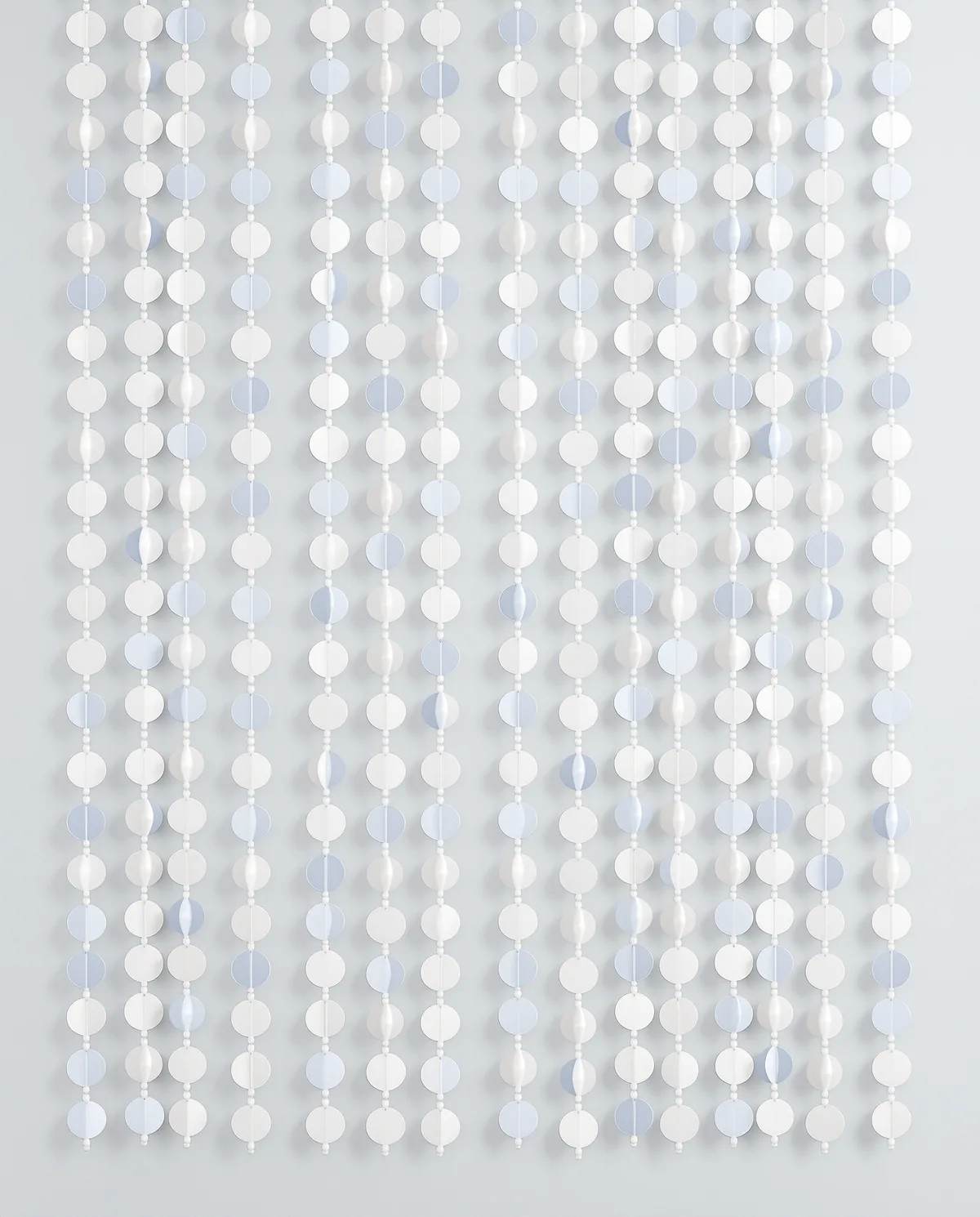
With the hues this close together, the only thing separating one bead from the next is how it handles light. Finish is doing the work a colour contrast would normally do.
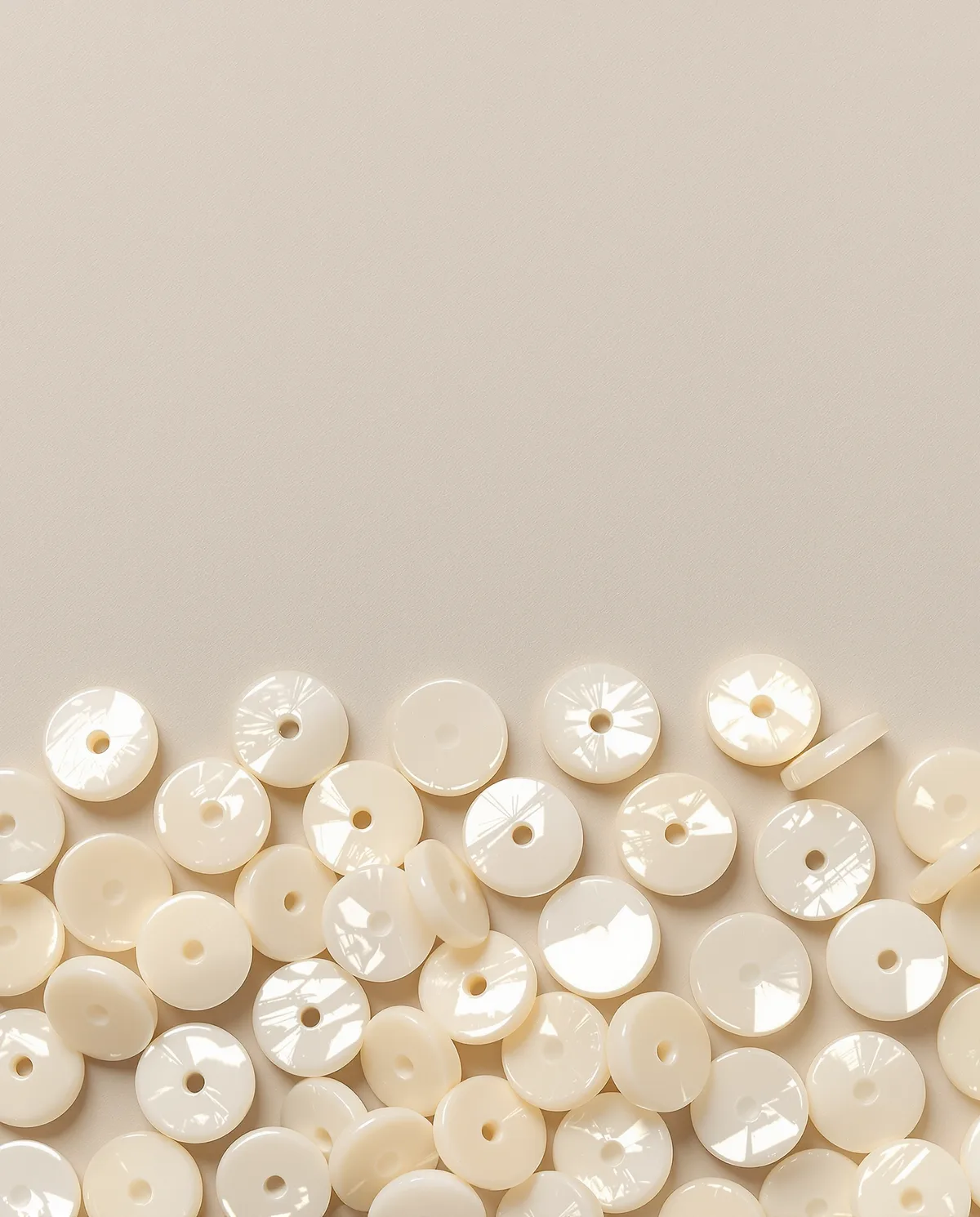
Faux capiz discs linked into columns, not strung on cord. Each disc hangs from the one above it, so the quantity that drives the quote is the disc count.
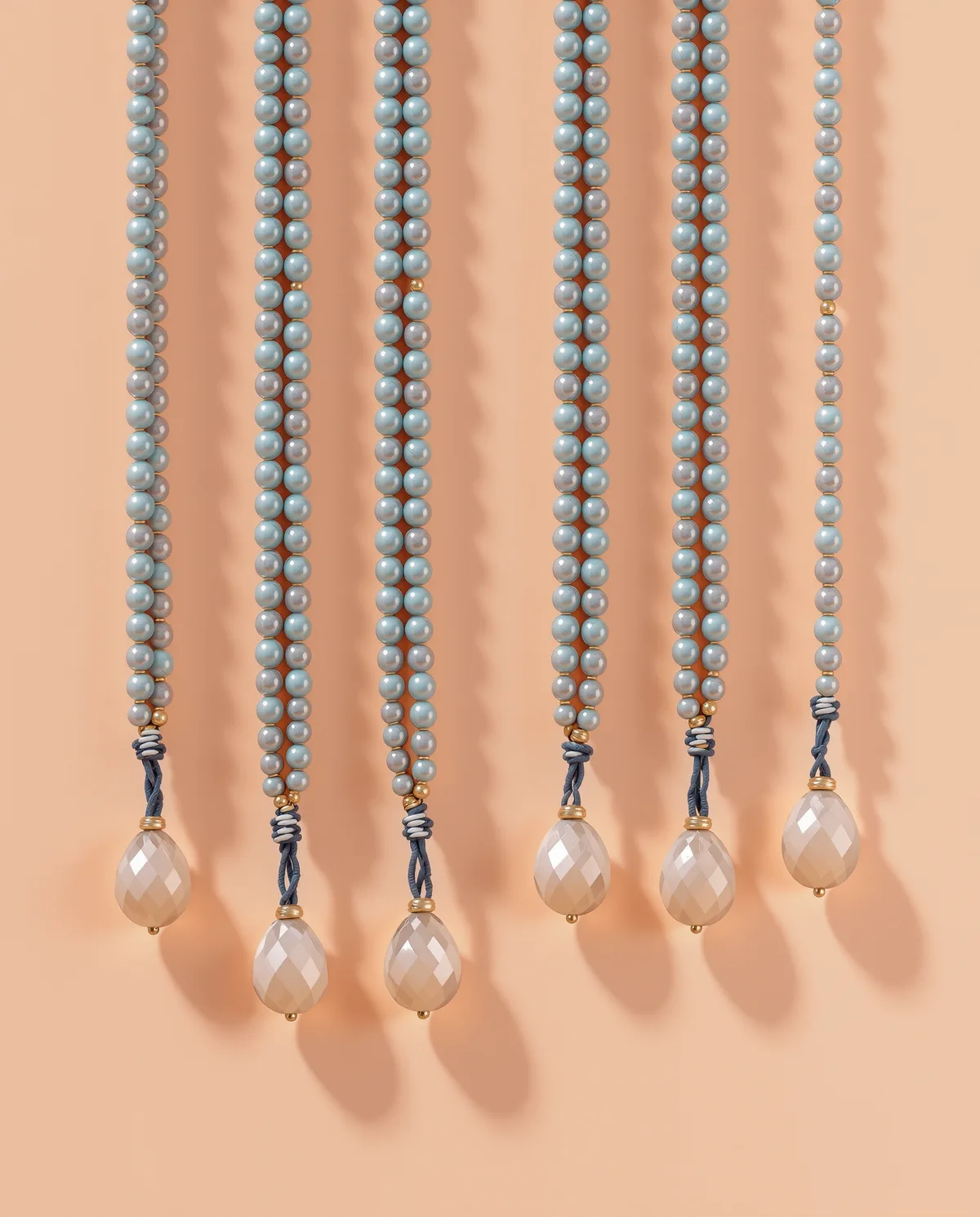
A straight hem on a pale piece has nothing to end on. Disc drops at the strand ends give the hem a line and add the weight a light strand needs to fall straight.
By approving finish as rigorously as colour. A colour chip cannot describe how frosted a frosted bead is, and it cannot describe the brightness of a foil lining, so the approved sample rather than the chip is what production is held to.
The irregular bead needs a second kind of approval. Sea-glass beads are irregular by nature, so the thing being agreed is a tolerance band — how much shape and opacity variation is acceptable within one strand — rather than a single bead. That is agreed on the sample and written onto the count sheet as a range.
As the restful one, and as the one that needs good light to sell. Under warm retail lighting the greys go slightly green and the aquas go grey, so the palette collapses towards one colour. Under cool or daylight-balanced light it opens up.
Beside a saturated story the risk is that it reads as unfinished. The usual merchandising answer is to hang it where it is backlit, because transmitted light is where the foil lining earns its place.
The strung build is close to a plain strand: a repeating sequence, a straight hem, and drops at the strand ends. No scattered accent, no connector, no shaped hem to map.
The linked-disc build is a different cost family altogether. There is no cord and no stringing sequence; there is a disc count, a link operation per disc, and a column count. At around 497 discs it is a quantity-driven build, and the warning is that the drawn 50 mm disc sits outside sampled experience — faux-capiz disc sampling so far covers 10 to 30 mm.
The wall hanging at 60 × 100 cm on 22 strands with a straight hem and disc drops, and the linked disc hanging at 90 × 200 cm in 12 to 16 columns at about 497 discs. Both are available to develop at the drawn size.
Backlit by daylight it is at its best, because the foil linings light up individually and the frosted beads glow dully beside them, which is exactly the contrast the story is built on. In lamplight from the room side the foil linings become small hard highlights and the frosted beads go flat, so the piece reads as texture rather than as colour.
Neither is wrong, but they are different products. A hospitality specification should say which one the fixture position gives.
Glass in frosted and foil-lined finishes. Faux capiz in cast resin or dyed cut acrylic, which is where the disc build lives. Acrylic rounds moulded and dyed to the colour, if the build needs to be light.
Wood cannot take the palette at all, and bone is an interesting near-miss: bone cut, drilled and finished in our own beadwork studios gives a warm off-white that is close to the lightest note but drags the whole story warm.
The glass finishes are stock, because what defines them is a bead-making operation rather than a colour. The discs are the dyed-to-match element, and they take dye well in both the cast-resin and the cut-acrylic route.
That asymmetry is useful. If a buyer needs the story in their own colours, the disc build will get there faster and more exactly than the strung build will.
Wall pieces and linked panels, both of which are read at close range where a finish difference is legible. The format it suits least is a doorway at full height, because at 200 cm the low contrast averages out into a single pale field and the construction stops being visible.
Add one dark note, or do not. That is the only decision that really matters here, and it should be taken before anything else.
With no dark note the story stays as drawn: quiet, close-toned, dependent on finish and on light. With one dark bead per strand it becomes legible at a distance and in bad light, and it stops being Moonwater.
Extractable data
| Specification | Value |
|---|---|
| Palette | Cool grey, pale aqua, off-white, with no strong value jump |
| Beads that carry it | Foil-lined glass rounds and irregular frosted sea-glass beads |
| Sea-glass bead size | About 4 to 5 mm, irregular by nature |
| Strung build | Wall hanging, 60 × 100 cm, 22 strands, straight hem with disc drops |
| Linked build | Disc hanging, 90 × 200 cm, 12 to 16 columns, about 497 discs |
| Disc material | Faux capiz — cast resin or dyed cut acrylic, never shell |
| Disc sizes drawn | 25 mm and 50 mm |
| Colour method | Matched to a physical chip or a colour reference, confirmed on the sample |
| Production | 40 to 60 days after sample approval |
Good to know
Glass, in frosted and foil-lined finishes, and faux capiz discs in cast resin or dyed cut acrylic. The palette is unusually material-dependent: the same greys in a plain gloss bead look chalky, because nothing in the colour itself provides the lift.
Poorly. A low-contrast palette needs area to establish itself — at 30 cm the eye reads one colour, not a family of them. If the story has to go short, the usual fix is to add one darker note, which changes it into a different story with better manners.
Yes, but keep the structure. The story is defined by a narrow value range and two contrasting finishes, not by the particular greys. Move the hue and hold the value range and it still reads as Moonwater; widen the value range and it does not.
A strung wall hanging at 60 × 100 cm on 22 strands, and a linked faux-capiz disc hanging at 90 × 200 cm. Both are available to develop.
The glass finishes are stock lines, because foil-lining and frosting are bead-making operations rather than colour operations. The discs are the dyed-to-match part: cast resin and cut acrylic both take dye well, which is why the disc build is the easier of the two to put into a buyer's own colours.
By approving the finish, not only the colour. A frosted glass bead can be more or less frosted and a foil lining can be brighter or duller, and neither shows on a colour chip. Both are confirmed on the sample, and production is held to the sample rather than to the chip.
Keep exploring
Design
Colour stories documented by how they are built, not by how they look in a mood board.
Open the referenceIndex
Twenty-four named looks, each described by the material, palette, pitch and hem that actually produce it.
Specs and sizesColour story
A graphic check across the strands, which holds only when the pattern is mapped to the bead grid rather than sketched.
Specs and sizesColour story
A pale, reflective palette drawn at 120 × 210 cm, where silver and clear glass read as light rather than as colour.
Specs and sizesColour story
Jet and garnet glass with gold rounds across 33 strands — the point where an all-glass wall piece reaches its sensible weight.
See the detailDesign
60 × 100 cm on 22 strands of foil-lined and frosted sea-glass tones, with disc drops closing a straight hem.
Specs and sizes
Start a conversation
Send a reference, a colour chip or a sketch. Minimums are set per design and confirmed per quote; sampling is quoted separately and usually runs 16 to 20 days from an agreed brief.