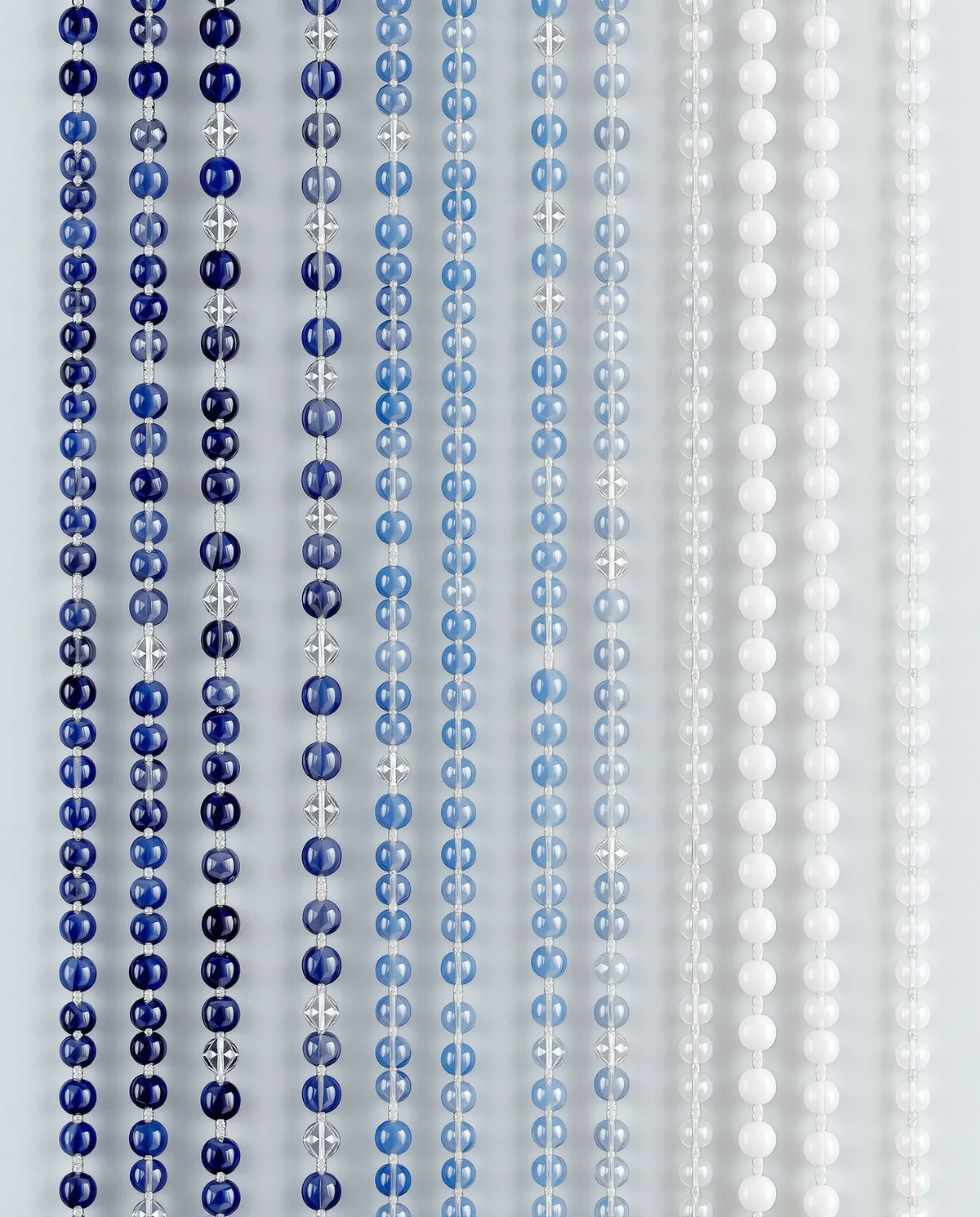
Colour story
The Moonwater story
Cool, low-contrast tones in foil-lined and frosted glass, built as a strung hanging and as a linked disc piece.
Open the reference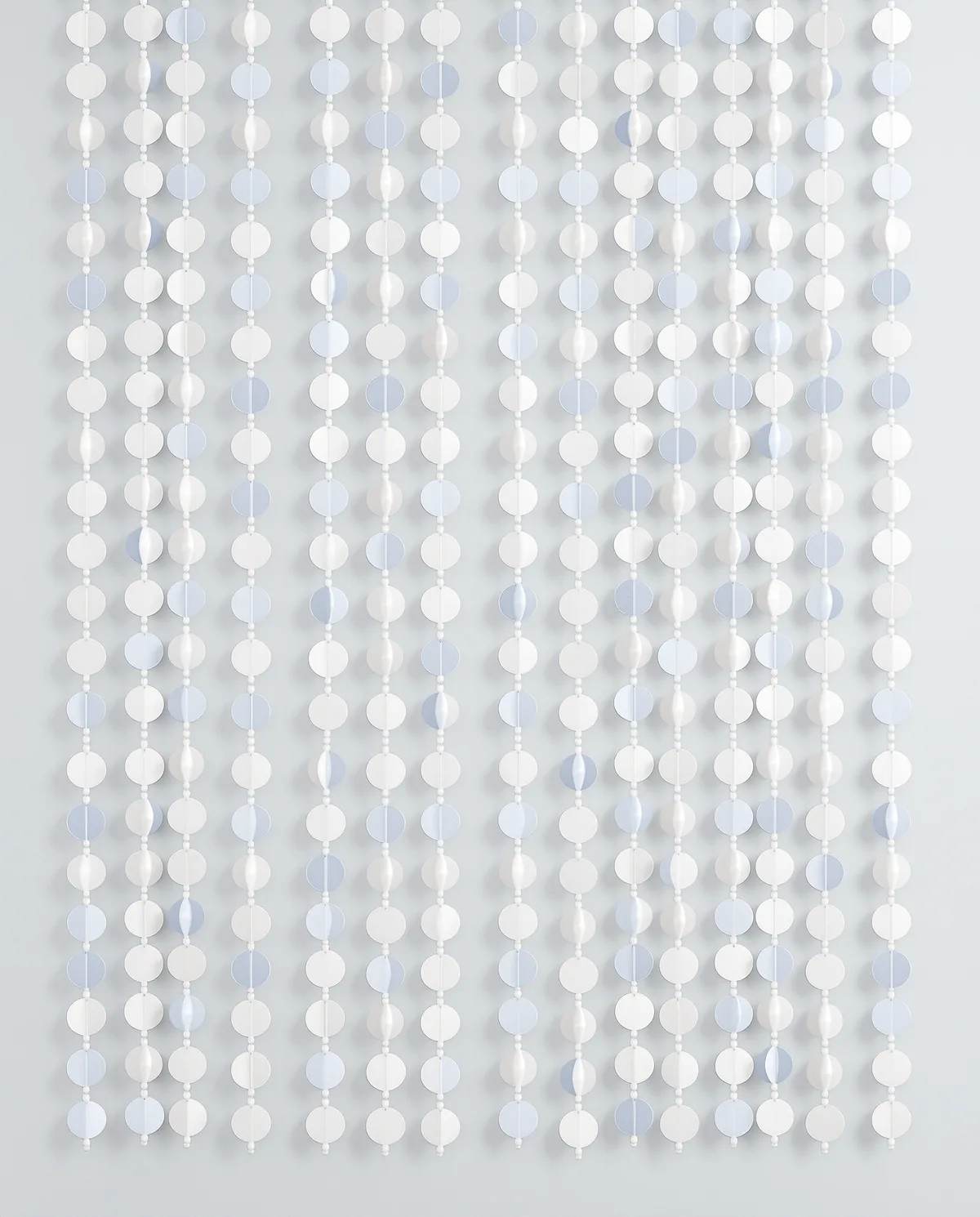
Design · Moonwater Wall Hanging
Twenty-two strands across sixty centimetres is the most open spacing in the group. On a wall, against plaster, that reads as deliberate rather than thin.
A linked disc hanging in pearl and grey-blue, cast discs joined edge to edge with jump rings into an open diamond lattice.
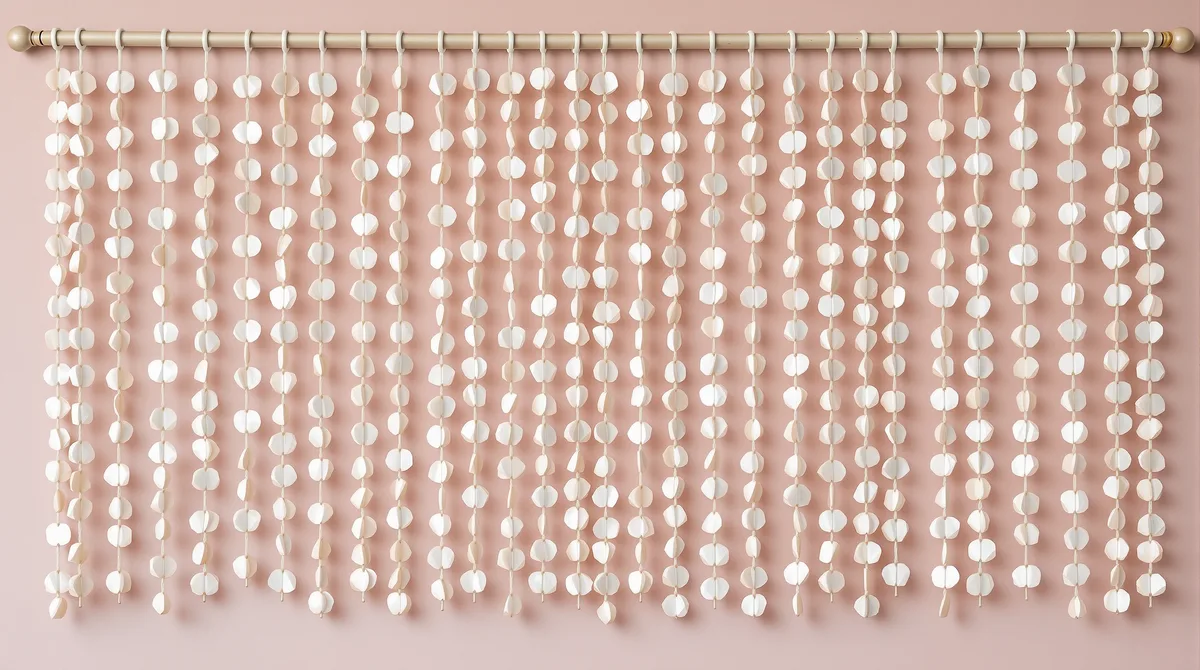
The Moonwater wall hanging is drawn at 60 × 100 cm on 22 strands with a straight hem closed by disc drops, in foil-lined glass and frosted sea-glass tones. At 22 strands across 60 cm the pitch is about 2.7 cm, which is the most open spacing in the wall group — appropriate for a piece read against a wall rather than against daylight.
The Moonwater wall hanging is drawn at 60 × 100 cm on 22 strands with a straight hem closed by disc drops, in foil-lined glass and frosted sea-glass tones. Available to develop at that size.
Twenty-two strands across 60 cm gives a pitch of about 2.7 cm, which is the most open spacing anywhere in the wall group. That is correct for the subject: a wall piece is read against plaster rather than against daylight, so a pitch that would look sparse in a doorway looks considered on a wall.
A written sequence alternating two finishes rather than two colours. Foil-lined glass, where a reflective lining inside the bead throws light back out, against irregular frosted sea-glass beads of about 4 to 5 mm, which scatter it.
The hues barely differ. The behaviours differ completely, and the eye reads that difference as colour. It is the most economical trick in the library, because it produces strong visual separation from a narrow and inexpensive palette.
An open panel density is the defining figure. At 22 strands across 60 cm the strand pitch is the widest in the group, which makes the open area and the view through a panel genuinely visible rather than incidental. An end bead at each strand tip is specified, because a fine strand without one will not hang true.
| Specification | Value |
|---|---|
| Finished size | 60 × 100 cm |
| Strand count | 22 |
| Strand pitch | About 2.7 cm centre to centre |
| Beads | Foil-lined glass rounds and irregular frosted sea-glass beads |
| Sea-glass bead size | About 4 to 5 mm, irregular by nature |
| Strand ends | Disc drops |
| Hem shape | Straight |
| Header | Turned wooden dowel |
| Status | A design available to develop at the drawn size |
The cool low-contrast story, which is the only story in the library drawn in two genuinely different constructions. This is the strung version; there is also a linked faux-capiz disc hanging at 90 × 200 cm and about 497 discs.
Those are not two sizes of one thing. One is beads on cord; the other has no cord in it at all, and its quote is built on a disc count rather than a strand count.
The two finishes equally. Remove the foil lining and the piece goes chalky, because nothing in the colour itself provides lift. Remove the frosted bead and the piece becomes a straightforward pale glass hanging with no texture in it.
Frosting is a glass operation — colouring, frosting and ribbing are all done at our own glass works — rather than a surface dye, so the finish is durable and the behaviour is stable across a run.
Straight, closed by a disc drop at each strand end. Those drops do two jobs. They give a straight hem a visible line, which a pale piece otherwise lacks. And they add the weight a fine strand needs to hang straight rather than drift.
A light strand without an end bead will not fall true, and on a wall piece read at close range a drifting strand is the first thing a viewer notices.
A turned wooden dowel, made in our own Saharanpur wood factory. At 22 strands with 4 to 5 mm beads this is among the lighter builds in the wall group, which is one of the practical reasons it suits an open pitch — there is not enough mass to need a heavy header.
Recoloured by moving the hue while holding the value range and the two finishes. That is the structure of the story and it is what survives a recolour.
Resized with a caution. A low-contrast palette needs area, and below roughly 60 × 70 cm the greys and aquas average into a single pale colour. A smaller version usually wants a darker note added, at which point it stops being this story.
Interior and hospitality specifiers, and retailers with a coastal or calm-interior range. It is the quietest piece in the library and that is its market — a wall piece that does not compete with the room it is in.
The merchandising caution is real, though. Under warm retail lighting the greys go slightly green and the palette collapses towards one colour, so it needs to be displayed where it is backlit or under neutral light.
Not sampled, so the applicable lessons come from the sea-glass valance that uses the same irregular frosted bead. There, the thing that had to be agreed on the sample was a tolerance band — how much shape and opacity variation is acceptable within one strand — rather than a single bead, and that band went onto the count sheet as a range.
The second borrowed lesson is that finish cannot be approved on a chip. A frosted bead can be more or less frosted and a foil lining can be brighter or duller, and neither shows on a colour reading. Both are approved physically.
An open-pitch piece packs more compactly than a dense one of the same area, which is a small freight advantage. The disc drops are the element to protect — a disc at the end of a strand is the part most likely to be struck in transit.
The limitation is specific to this design: an irregular frosted bead renders smoother and more uniform than the real bead is. The render understates exactly the quality — irregularity — that makes the material worth using.
Good to know
Yes, with a palette caution. A low-contrast palette needs area, and below about 60 × 70 cm the greys and aquas average into a single pale colour. If a smaller piece is wanted, add a darker note so the piece has some contrast of its own.
Foil-lined glass rounds, irregular frosted sea-glass beads of about 4 to 5 mm, and disc drops at the strand ends. Glass is drawn, frosted and hand-strung in our own Firozabad glass works, and the frosting is a glass operation rather than a surface dye.
Exclusivity is a commercial decision taken per programme rather than a property of the design. Name it in the brief and it is quoted alongside the piece.
It shows the size, strand count and hem as drawn, built from named beads so the design converts into a colour-count sheet. A drawn frosted bead reads smoother than the real one, which is why the bead line is approved on the sample.
Strands are kept in order and protected against knocking in transit, then packed to your carton, label and packaging specification. An open-pitch piece packs more compactly than a dense one of the same area.
Yes. A sketch, photo or artwork with size, materials, colours and quantity becomes a colour-count sheet. For a finish-driven design, send a physical sample of the finish rather than a colour reference — a chip cannot record how frosted a frosted bead is.
Yes, keeping the structure rather than the hues. The story is a narrow value range plus two contrasting finishes. Move the hue and hold the value range and it still reads as Moonwater; widen the value range and it does not.
Keep exploring
Colour story
Cool, low-contrast tones in foil-lined and frosted glass, built as a strung hanging and as a linked disc piece.
Open the referenceManufacturing
Widths from 50 to 76 cm on a turned dowel, in glass, wood and cast faux capiz — hem shapes, strand counts and what is a shipped format against a concept.
See the detailDesign
Strung wall pieces from 50 × 90 to 60 × 100 cm at 20 to 40 strands, documented by hem shape and bead list.
See the detailDesign
155 to 170 cut faux-capiz blossoms at 18 × 30 in, each held in place by a spacer bead dyed to match the petal.
Specs and sizesDesign
60 × 90 cm on 27 strands of cream, lagoon and jade glass ovals, where bead geometry carries the optical read.
Read the guideDesign
90 × 200 cm at about 497 linked faux-capiz discs in 12 to 16 columns — the largest disc piece in the library.
Compare the options
Start a conversation
Send a reference, a colour chip or a sketch. Minimums are set per design and confirmed per quote; sampling is quoted separately and usually runs 16 to 20 days from an agreed brief.