Design
Colour stories, by construction
Colour stories documented by how they are built, not by how they look in a mood board.
How it is made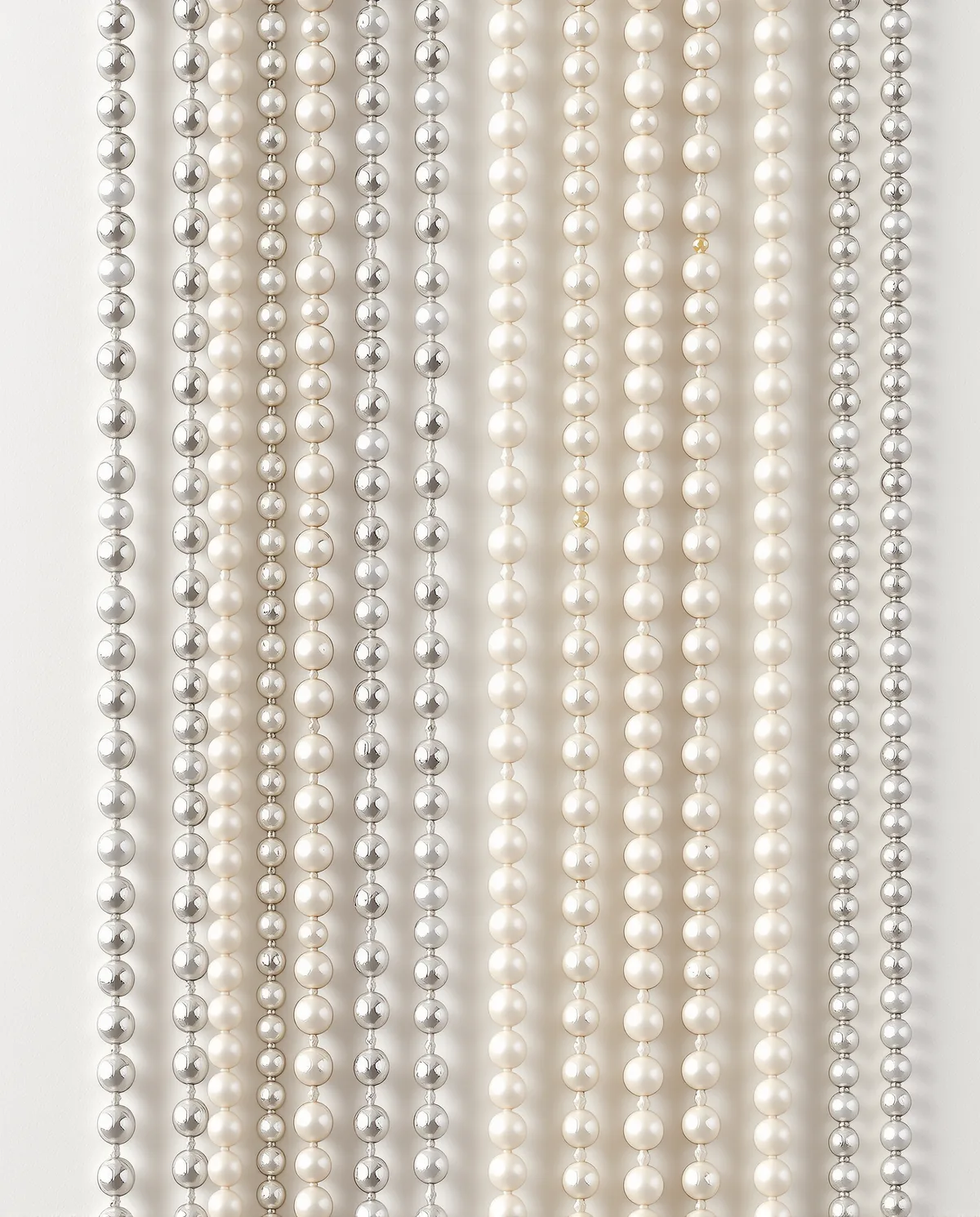
Colour story
The tallest drop in the library, and the palette with the least colour in it. Those two facts are related.
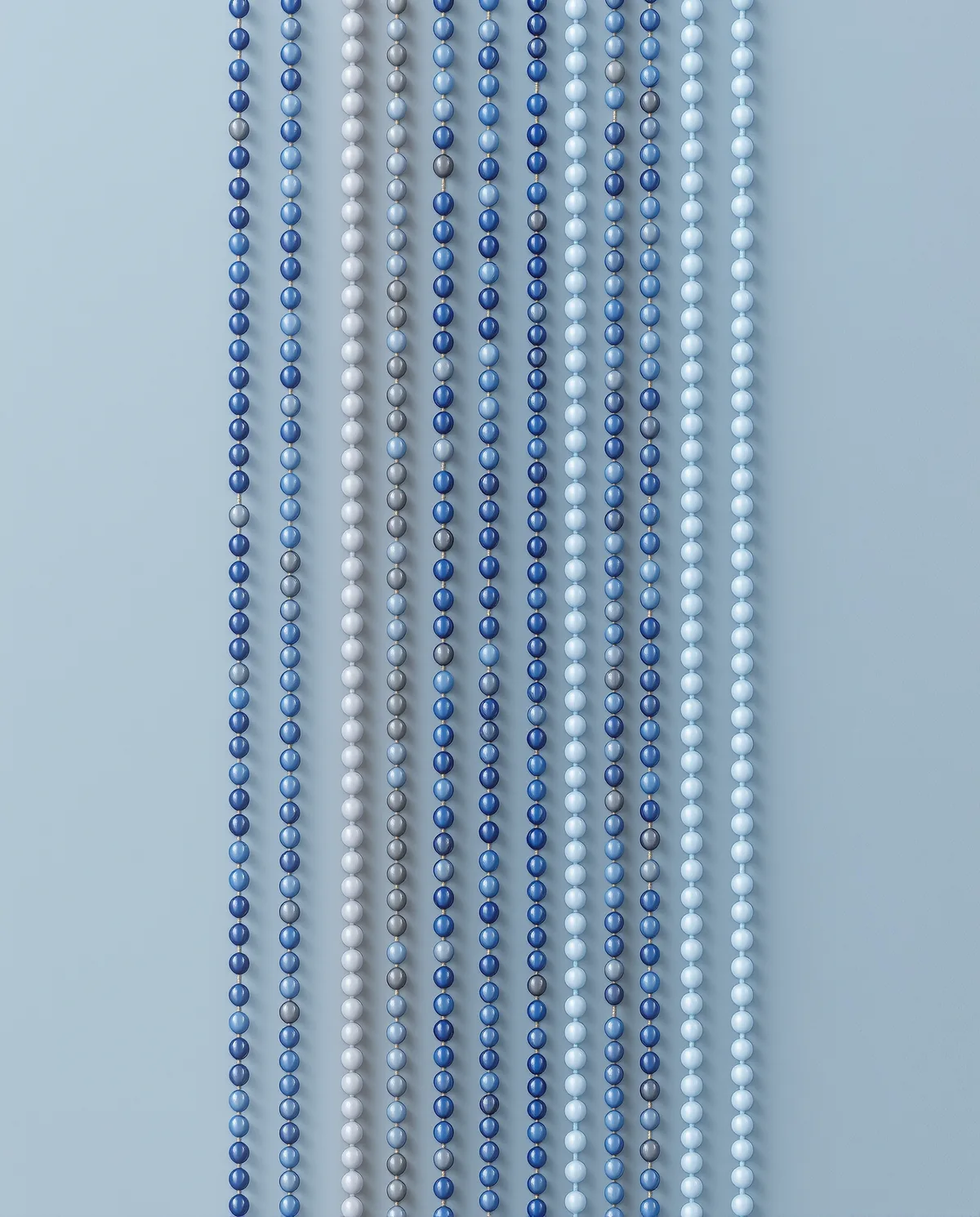
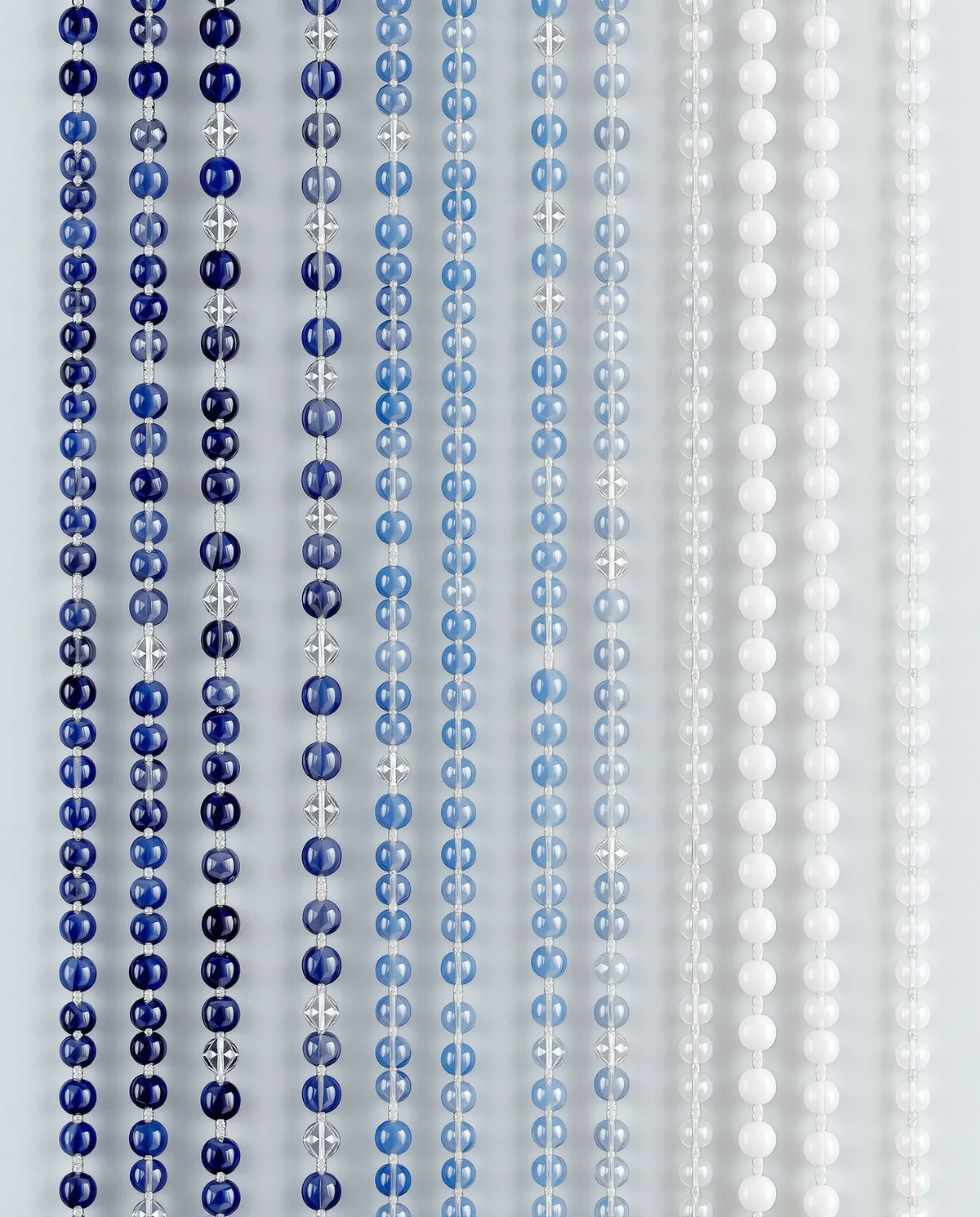
Six bead strands in the Sterling Swan palette, mirrored silver with pearl and chalk white, the mirrored beads throwing small hard glints.
Sterling Swan is the pale, reflective story: silver, clear and off-white glass with faceted beads doing most of the work. It is drawn as a backdrop curtain at 120 × 210 cm, the tallest format in the library, because a palette with almost no colour in it needs area and transmitted light before it reads as anything at all.
Sterling Swan is the pale, reflective story among the fourteen named in the 2027 design library: silver, clear and off-white, with a cool grey shadow note.
It is drawn at 120 × 210 cm as a backdrop curtain, which is the tallest and one of the widest formats in the whole library. That is the most informative fact about it. A palette with this little hue in it has nothing to say at small scale, so the design was given area to work in.
Cut and faceted glass, with plain clear rounds doing the spacing. The faceting is not ornament; it is the mechanism. A faceted bead returns a dozen small specular highlights where a round bead returns one, and in a palette with no colour contrast those highlights are the only visual event.
There is a naming point to settle here, because it comes up on every quote. Buyers ask for a crystal beaded curtain and are delivered cut or faceted glass beads. We describe them as glass, deliberately, because calling them crystal implies a material that is not what we are making.
By approving the cut. Colour is barely a variable in this story; facet geometry and polish are, and a batch with softer facets will look dull against an approved sample even though every colour reading matches.
So the approval is a physical one. The sample is the reference, the count sheet records the bead line and the size, and the first-article inspection compares facets rather than readings.
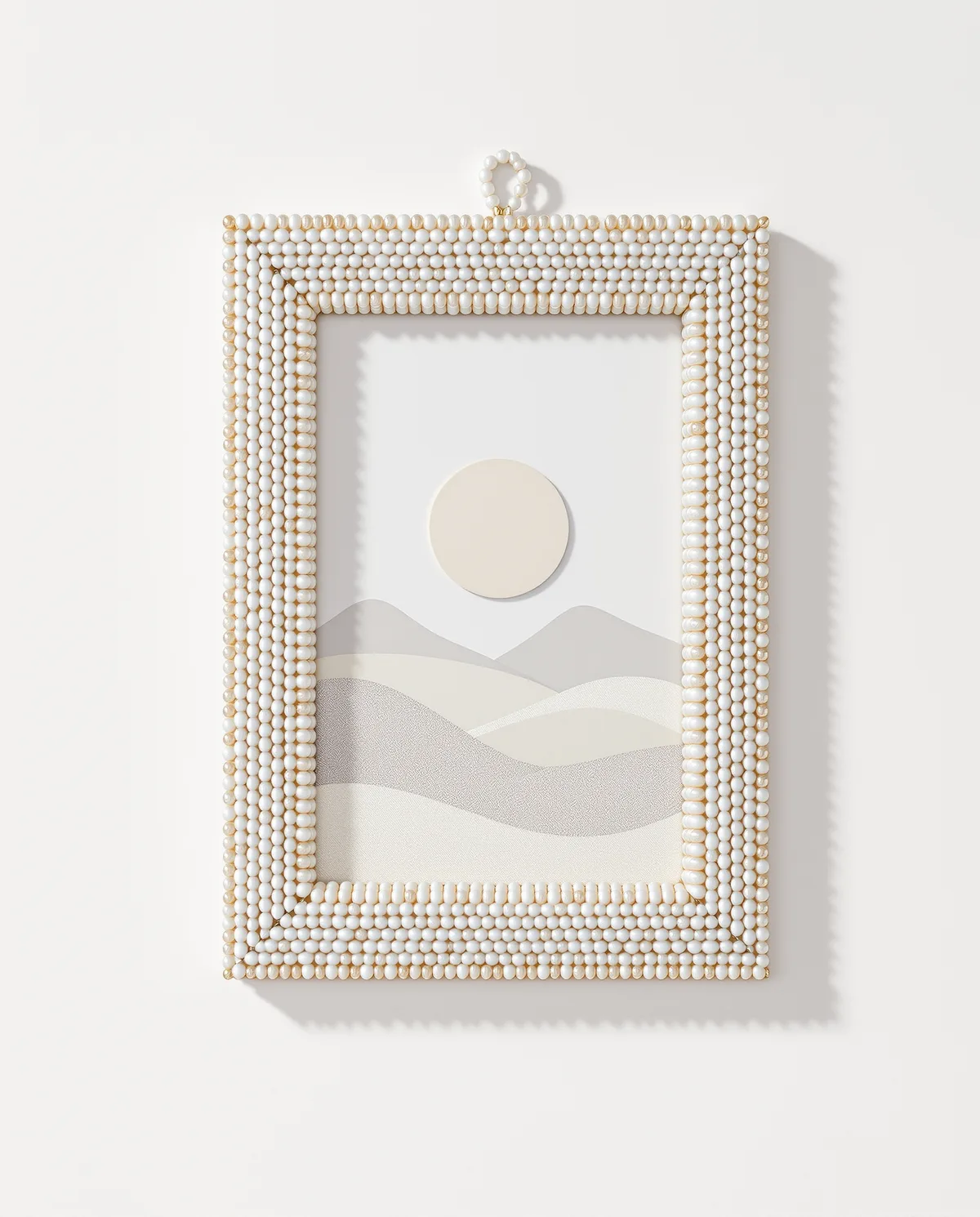
Strip the hue out of a palette and what is left is how each bead bends light. Faceting stops being decoration and becomes the only variable.
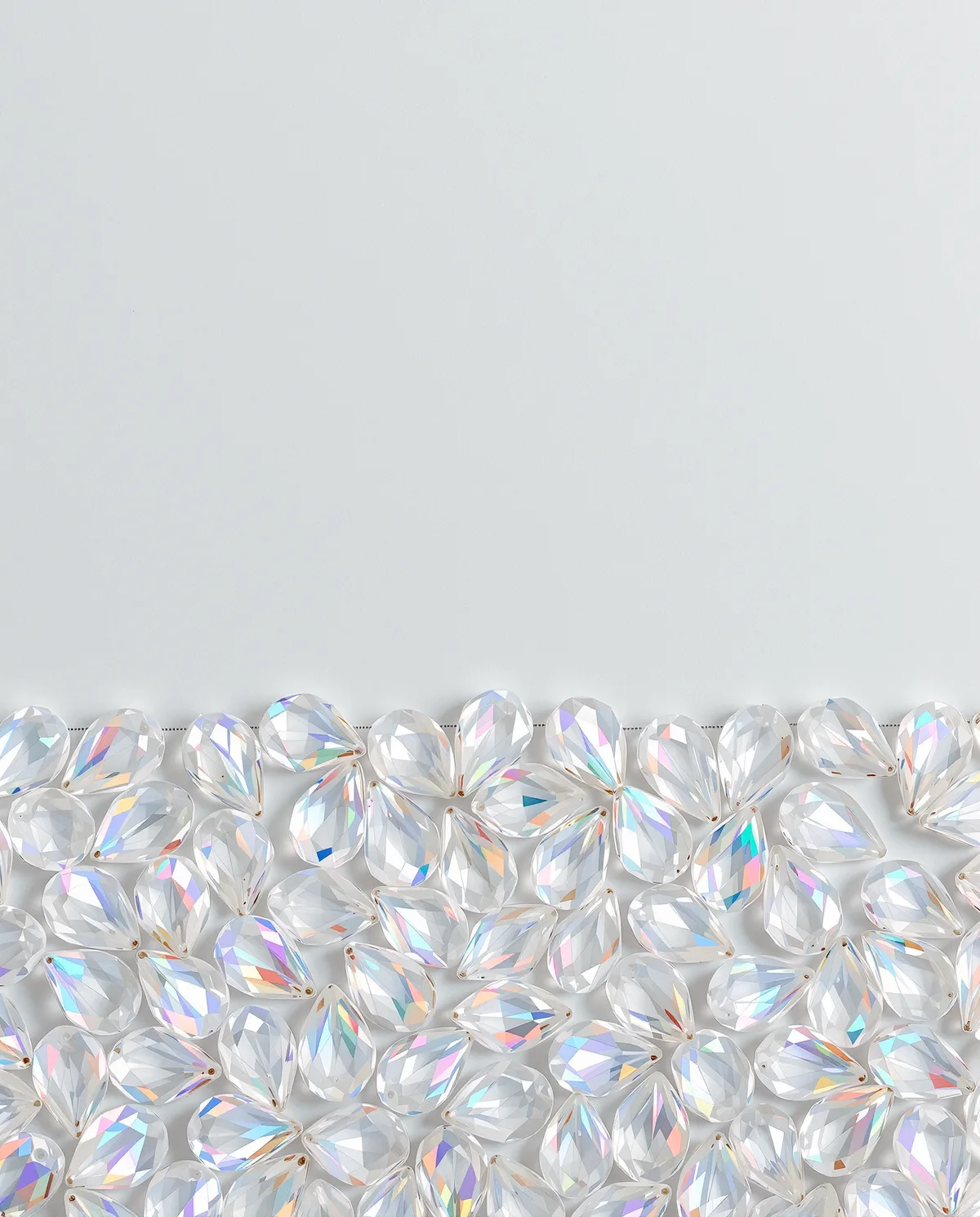
Buyers ask for crystal and receive cut or faceted glass. We describe it as glass on purpose, because the word crystal implies a material we are not supplying.

A pale palette at small scale reads as white. Across 120 by 210 cm the same beads accumulate enough reflections to read as silver.
Stock, almost entirely. Clear and silvered glass are standard lines, and dyeing a clear bead defeats the point of it. Where a build introduces a tint — champagne, smoke, pale blue — that accent is the dyed-to-match element and the one worth sampling before anything else.
That makes Sterling Swan one of the cheapest stories to put into production in its published form, and one of the more expensive to customise, which is the reverse of the usual pattern.
The large ones. Backdrop, room-height curtain, a wide window. Anything where the piece is seen against light and across a distance, so the highlights accumulate into a surface.
The formats that defeat it are a valance and a small wall hanging. Both are read against an opaque ground at close range, where a clear bead has nothing behind it to refract and reads as an empty bead.
Add a value, not a colour. The structural weakness of the published palette is that everything in it sits in the top third of the value range, so the piece has no shadow. One graphite or smoke line per strand gives it one, and makes the piece legible in a room that is not backlit.
If a warmer register is wanted, champagne is the efficient change — it reads as metal rather than as beige, and it keeps the reflective behaviour the story depends on.
As the premium one, and as the one that is hardest to photograph on a shelf. A clear and silver piece against a warm retail wall loses nearly all of its effect, because it is designed to be seen with light behind it.
Where it does work in-store is as a backdrop behind other product, which is what the drawn format suggests it was designed for in the first place.
Above a plain strand, for one reason: faceted glass is a more expensive bead than a plain round of the same size, and this story is mostly faceted bead. Bead size and material is the largest single cost driver on any beaded piece, and here it is almost the only one.
Against that, the build itself is simple. Sixty strands at a 2 cm pitch, a repeating sequence, no scattered accent and no shaped hem drive the stringing time towards the floor for the format. The expense is in the bill of materials, not in the bench.
One: the backdrop curtain at 120 × 210 cm. There is no short format, no wall piece and no portal drawn in this palette.
What the record gives for Sterling Swan is the name, the palette direction and the format, and the strand build on this page follows the library's own 120 cm convention of 60 strands at roughly 2 cm pitch. Both are confirmed on the sample when the design is developed, which is where a backdrop at this width is settled anyway.
Daylight through the strands is what it was designed for: each facet catches separately and the piece reads as moving light. Low warm lamplight turns the clear beads amber and the silver beads dull, so the story warms by several steps and loses its coolness.
A cool-temperature downlight in front of the piece is the one lighting condition to avoid, because it produces hard white highlights with no gradation and the piece reads as plastic.
Glass first and by a distance. Clear acrylic, moulded and dyed to a pale tint, is the light-weight route and the sensible one for a very large piece or a public space, with the caveat that it reads softer because it refracts less.
Faux capiz discs in cast resin or dyed cut acrylic give a pearl-white version of the palette that is genuinely attractive and completely different in behaviour — reflective rather than transmissive.
Extractable data
| Specification | Value |
|---|---|
| Palette | Silver, clear, off-white, with a cool grey shadow note |
| Beads that carry it | Cut and faceted glass, plus plain clear rounds for spacing |
| Format drawn | Backdrop curtain, 120 × 210 cm |
| Strand count | 60 at roughly 2 cm pitch, on the library's 120 cm convention |
| Material correction | Faceted clear beads are glass; we do not describe them as crystal |
| Colour method | Matched to a physical chip or a colour reference, confirmed on the sample |
| Where it is made | Glass drawn and hand-strung in our own Firozabad glass works |
| Production | 40 to 60 days after sample approval |
Good to know
By controlling the cut rather than the colour. There is very little colour to hold; what varies between batches of a faceted clear bead is facet crispness and polish, and those are agreed on the sample. Production is held to the approved sample, not to a chip.
Glass, principally, because faceted glass is the only common bead that throws light the way this story needs. Clear acrylic can be moulded and dyed to a smoke or pearl note and is the lighter route, but it does not refract in the same way and reads softer.
It is the weakest of the fourteen at small scale. Without area, a silver and clear palette simply reads as white, and a white valance is a different product with different appeal. If a short version is wanted, add a smoke or graphite note so the piece has a shadow to work against.
Yes, and a small change goes a long way here. One tinted bead line in a clear field shifts the whole story — champagne makes it warm, smoke makes it architectural, pale blue makes it cold. Because the ground is clear, the accent does not have to fight anything.
One at present: a backdrop curtain drawn at 120 × 210 cm. It is available to develop at that size.
Mostly stock, because clear and silvered glass are standard lines. Any tinted accent introduced into the field is the part that is dyed or tinted to a given reference, and it is the part worth sampling first.
Keep exploring
Design
Colour stories documented by how they are built, not by how they look in a mood board.
How it is madeIndex
Twenty-four named looks, each described by the material, palette, pitch and hem that actually produce it.
Read moreColour story
Cobalt and ink glass spaced across 40 strands at about 3,100 beads, where the gaps are as designed as the beads.
Compare the optionsColour story
Cool, low-contrast tones in foil-lined and frosted glass, built as a strung hanging and as a linked disc piece.
Compare the optionsColour story
Wood, bone and amber glass mixed on one strand — warmth at a lower weight and cost than an all-glass build.
Compare the optionsDesign
120 × 210 cm, the largest drop in the library, in silver, clear and off-white faceted glass.
Compare the options
Start a conversation
Send a reference, a colour chip or a sketch. Minimums are set per design and confirmed per quote; sampling is quoted separately and usually runs 16 to 20 days from an agreed brief.