Manufacturing
Event beadwork
Repeatable backdrop panels, rigging that survives a van, fast reorder of one colourway, and real set-up times.
How it is made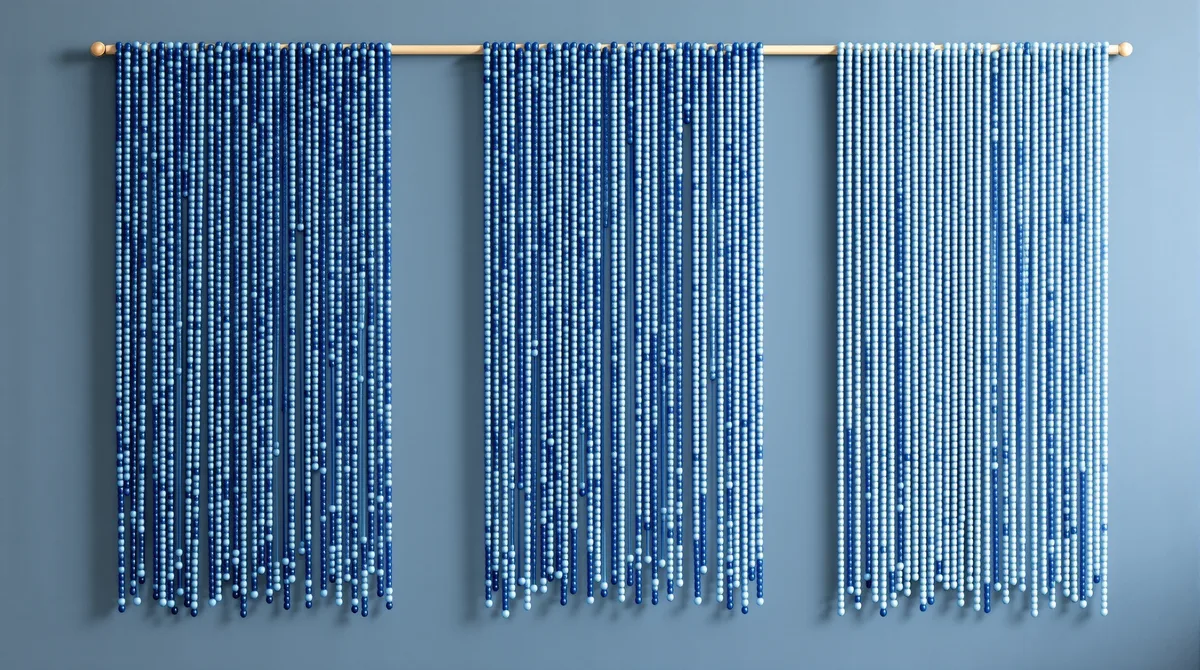
Guide · Buying
Two things change when one panel becomes six: the colour has to match across all of them, and the date stops being negotiable.
Three identical hand-strung panels hung side by side in deep lapis, cobalt and pale sky glass, the bead repeat matching exactly across all three so the set reads as one run.
Order the whole batch in one production run so every panel shares a bead lot and a bead map, and work back from the event date: sampling is usually 16 to 20 days from an agreed brief, and beaded décor runs 40 to 60 days after sample approval. Hold back one spare panel and a spare bead bag for the day itself.
Two things change and nothing else does.
First, the colour has to match across every panel, which means one production run on one bead map rather than separate orders placed as the budget allows. Second, the date becomes a constraint rather than a preference, and the published timetable is longer than most event planners assume.
Everything else — construction, materials, hem shapes, fixings — is the same as it would be for one panel.
A brief first: size, material, colours, quantity and destination.
Then a rough cost sheet, before any sample is made, showing where the cost sits and which lever moves the price. That is the stage at which a design is made affordable, by opening the pitch or cutting the height rather than by changing what the room sees.
Then the colour match: beads matched to a Pantone reference or a physical chip for each colour in the design. Then a sample, usually 16 to 20 days from an agreed brief, with photographs approved before it ships. Then written approval, and production — 40 to 60 days for beaded décor.
Then packing to your carton, label and packaging specification, and shipping to the port or warehouse you name.
Nine items, and they are the same nine every time.
The product type. The finished size — width and the longest drop, plus the shortest drop if the hem is shaped. The strand count or pitch, or a reference photograph showing the density. The bead material, shape and size for the main bead and any accents. The colours, as Pantone references or physical chips. The pattern, as artwork or a reference image. The top fixing — dowel, rod, rod pocket or fabric header — and its length. The edge shape and any end beads. And the quantity per colourway with the destination.
A specification with those nine settled gets a formal quote within 48 hours. One without them gets questions.
Sampling, usually 16 to 20 days from an agreed brief. Production, 40 to 60 days after sample approval for beaded décor; 60 to 90 days for bohemian and macramé categories.
Added together with approval time in between, an event order started from scratch needs the better part of three months before anything ships, and that is before freight. Enquiries are answered within one business day and formal quotes delivered within 48 hours of a specification, so the front of the process is fast; the middle is not.
Minimums are set per design and confirmed with the quote. On event work the useful move is to pool the order: one design in one colourway across every booking in a season reaches a workable quantity where six separate briefs do not.
What actually decides the number on an event job is usually how many colourways sit inside it. Six panels in one colourway is a straightforward run; the same six spread across a colour each is six colour matches, six bead lots and six sets of spares, and it will be quoted as such.
Three places, consistently.
Ordering in instalments. Panels made in two separate runs can be a tone apart, which is invisible on their own and obvious hung side by side. Surface-dyed seed beads are the usual culprit, because dye is a batch property and lots shift between runs.
Starting the clock late. The timetable is published and it does not compress, so an event eight weeks out is a library-design job at best.
No spares on the day. An installation crew that breaks a strand at a venue with no spare beads has a visibly damaged panel in the photographs.
Everything from the specification list, plus four things specific to a batch.
That all panels are to be produced in one run from one bead map. That the bead lot is to be common across the batch. That one spare panel and one spare bead bag are included and packed separately, labelled for the install kit rather than the warehouse. And the carton specification, because a venue delivery has different handling from a distribution centre.
A brief, from you. A rough cost sheet, from us, before any sample is made. A colour reference — a Pantone chip or a physical chip — from you. Sample photographs for approval, from us. A written sample approval, from you. Then a formal quote, the order, and the packing and labelling specification.
The document that matters most and gets the least attention is the bead map: the bead-by-bead plan for every strand, which is what makes a pattern repeat exactly across a run and keeps strand lengths identical. It is also what a repair works from two years later, so it is worth knowing it exists and that it is held.
In two respects that bear directly on an event order.
There is no stock. We do not run a retail stock programme; every beaded door curtain we ship is made to order, in the colours, size and packing approved. So there is no shortcut through a warehouse.
And the unit of work is a bead rather than a metre. A densely patterned 90 × 200 cm panel holds about 11,800 beads on our 2027 design-render basis; a spaced one of the same size about 3,100. On average sixteen artisans contribute to a finished Gemixx product, each applying one craft discipline. That is why the production window is what it is, and why it does not shorten under pressure.
Compressible: the front end. Starting from a library design rather than a new one removes the development loop. Approving sample photographs rather than waiting for the physical sample to land can save days. A single colourway instead of several removes colour matches.
Not compressible: the stringing. Every bead on every strand is placed by hand to the bead map, and no amount of commercial pressure changes how long that takes.
That the published figures are the real ones and that the fast work is at the front.
Beaded décor runs 40 to 60 days after sample approval; sampling is usually 16 to 20 days from an agreed brief, with photographs approved before the sample ships. On the macramé side, one butterfly wall hanging on a 22 × 14.5 in wire frame went from tech pack to finished sample in about five weeks, which is a good illustration of how much of the timetable is development rather than production.
Scale is also relevant to an event planner weighing whether a batch is routine: our beaded programme has been in continuous production on dated ship schedules, and reordered season after season. A batch of six panels is not a stretch; a batch of six panels in eight weeks is.
"What can you make from the library in my timeframe, and what will it cost at two densities?"
That single question gets you a rough cost sheet, a realistic date and a choice between a dense panel and an open one, which between them resolve most event briefs. If the answer is that nothing in the library fits, the follow-up question is whether the event can take a different format — a valance or a café-length panel instead of full-length panels — because height is a major cost and schedule lever and a shorter piece is a faster one.
Extractable data
| Stage | Published timing | What the buyer supplies |
|---|---|---|
| Brief | — | Size, material, colours, quantity, destination |
| Rough cost sheet | Before any sample is made | The look to be priced, and a target |
| Colour match | — | A Pantone reference or a physical chip per bead colour |
| Sampling | Usually 16–20 days from an agreed brief | Approval of photographs before the sample ships |
| Sample approval | — | A written approval against the sample |
| Production, beaded décor | 40–60 days after sample approval | Carton, label and packing specification |
| Production, bohemian and macramé | 60–90 days after sample approval | As above |
| Quote turnaround | Within 48 hours of a specification | The specification |
| Enquiry response | Within one business day | — |
| Spares to hold back | — | One panel and one bead bag, kept with the install kit |
Good to know
Sampling is usually 16 to 20 days from an agreed brief, and you approve photographs before the sample ships. Production for beaded décor is 40 to 60 days after sample approval; bohemian and macramé categories run 60 to 90 days. Formal quotes are delivered within 48 hours of receiving a specification, and enquiries are answered within one business day.
The finished size of each panel, the longest and shortest drop if the hem is shaped, the bead material and size, a Pantone reference or a physical chip for each colour, the quantity per colourway, the top fixing, and the destination port or warehouse. With those settled a quote is a short conversation; without them it is a guess.
Yes. Sampling is quoted separately from production, and before any sample is made we show a rough cost sheet so you can see where the cost sits and which lever moves the price. Minimums are set per design and confirmed per quote rather than fixed across the range.
The timetable does. Macramé and bohemian categories run 60 to 90 days after sample approval against 40 to 60 for beaded décor, so a mixed event order should be planned against the longer figure. Macramé also moves fast at the front: one butterfly wall hanging went from tech pack to finished sample in about five weeks.
Sampling can sometimes be shortened by approving photographs rather than waiting for a physical sample to arrive, and by starting from a library design rather than a new one. Production cannot be meaningfully compressed, because a densely patterned 90 × 200 cm panel holds about 11,800 beads on our design-render basis and every one is placed by hand.
Minimums and price. Minimums are set per design and confirmed per quote, because a plain-strand panel and a fully patterned one use very different amounts of material and stringing time. Quotes are built from bead size and material, construction, strand count and spacing, height, the dowel and the packing.
It depends which part. A colour change before production starts is a new colour match and a new sample approval. A size change after production has begun is a new run. The one change that is usually absorbable is packing, because cartons and labels are the last stage — but tell us before the consolidation, not after.
Keep exploring
Manufacturing
Repeatable backdrop panels, rigging that survives a van, fast reorder of one colourway, and real set-up times.
How it is madePillar
Brief, rough cost sheet, colour match, sample, production, packing — the six stages with the real published timings.
How it is madeGuides
One guide per question that arrives often enough to be worth answering properly.
Compare the optionsGuide
Knot finish, strand length consistency, bead alignment, drill quality, header fixing, dye evenness, spares and packing.
See the detailGuide
Width at three heights, the floor gap, the header depth — and the two decisions that come before any of them.
Specs and sizes
Start a conversation
Send a reference, a colour chip or a sketch. Minimums are set per design and confirmed per quote; sampling is quoted separately and usually runs 16 to 20 days from an agreed brief.