Reference
Inspection and AQL
The beadwork defect taxonomy, how each defect is detected, and which are rejects rather than repairs.
Read the guide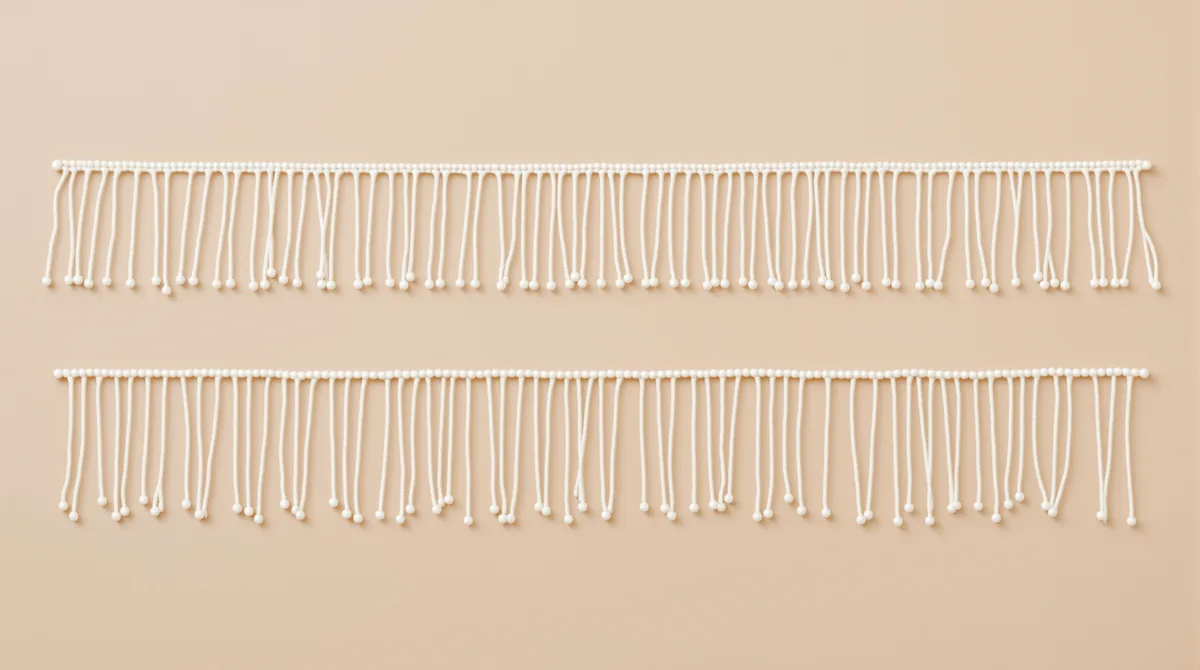
Guide · Buying
Quality in beadwork is almost entirely invisible from a metre away and obvious from twenty centimetres. Here is what to look at, in the order it tells you most.
Two beaded hems laid one above the other: the upper with every cord finished level, the lower with slack looped tails of obviously uneven length.
Look at eight things, close up: the knot or crimp at each strand end, strand length consistency along the hem, bead alignment in the pattern, the drill holes, how the strands are fixed to the header, dye evenness across the panel, whether the maker will supply spares from the same run, and how it was packed. Seven of the eight are workmanship rather than materials.
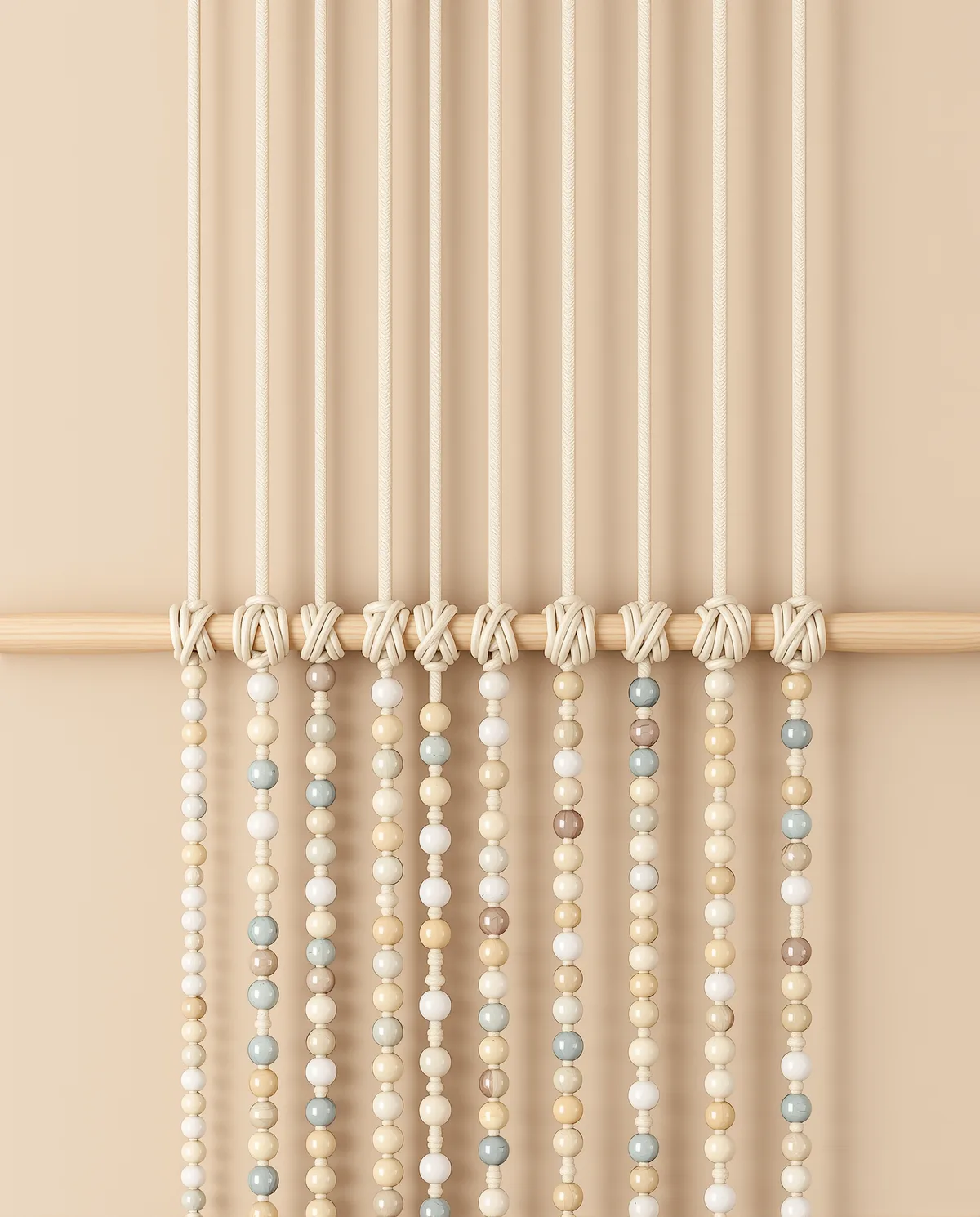
End finishes, strand lengths, bead alignment, drill holes, header fixing, dye evenness, spares, packing. In that order, because that is the order in which they predict how the panel will behave.
Seven of the eight are workmanship. Only drill-hole quality is a property of the bead, which is why an expensive-looking panel can be a badly made one and a modest bead can be in a beautifully made piece.
| Inspect | Good | Poor | Defect name |
|---|---|---|---|
| Strand end finish | Knot or crimp larger than the drill hole | Loose knot; bead rides over it | Knot slip |
| Strand length | Hem reads as one continuous line | Strands wander by several beads | Strand drift |
| Bead alignment | Pattern rows meet across strands | Motif steps unevenly | Pattern misregistration |
| Drill holes | Smooth, consistent, centred | Rough edges; off-centre; varying size | Hole inconsistency |
| Header fixing | Even pitch; knots seated; dowel cannot roll | Uneven pitch; proud knots | Pitch variance |
| Dye evenness | One tone across the panel | Visible batch change mid-panel | Colour variance |
| Bead integrity | No chips at the hole or the rim | Chipping where beads knock | Bead chipping |
| Spares and packing | Spares offered from the same run; strands held in order | No spares offered; strands loose | — |
| Network defect rate | A fraction of a percent | — | Published figure |
Because they are where a panel empties. The bottom of every strand is closed with a knot, a crimp or a deliberately larger stopper bead, and the single requirement is that the finish be larger than the last bead's drill hole.
A loose knot, a badly set crimp or a missing stopper lets the last bead ride over the finish, and then the whole strand runs out. It is the clearest workmanship signal available and it takes five seconds to check: hold a strand end, look at it, tug it gently.
Sight along the hem from one end, at eye level, with the panel hanging and settled. On a straight hem the bottom edge should read as one continuous line; on a shaped hem the shape should be symmetrical about the panel's centre and smooth rather than stepped.
Strands that wander by several beads are what our own inspection vocabulary calls strand drift, and it comes from measuring each strand against the previous one rather than against a fixed reference. In production, strand lengths are held to the bead-by-bead sheet, which is exactly why thirty strands come out identical.
Give a new panel a day first. Unsettled strands look drifted and are not.
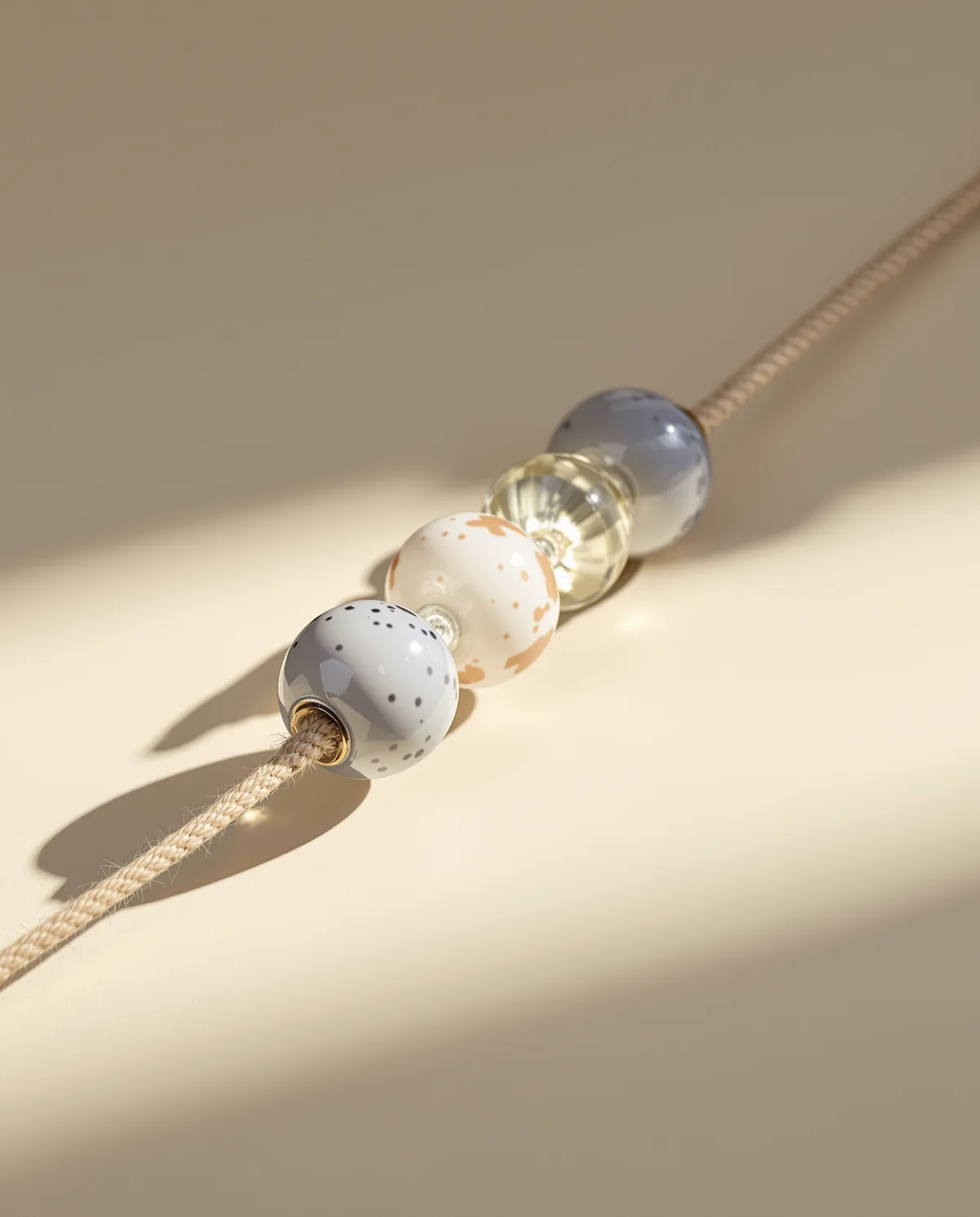
More than anything else about the bead. A hole should be smooth, consistent in diameter and centred. A rough or sharp-edged hole abrades cord from the day the bead is strung, which means the panel has a shorter life regardless of how well it was assembled. An off-centre hole makes the bead sit crooked, which on a plain strand is visible.
Hole size is a real specification, not an afterthought: one current bead development is specified at a 4 to 5 mm hole because the build requires it. A maker who can tell you the hole size is a maker who has thought about the cord.
Even pitch, knots seated flush, and a dowel that cannot roll. Look along the header line: strands should be at consistent centres, and no knot should stand proud of its neighbours.
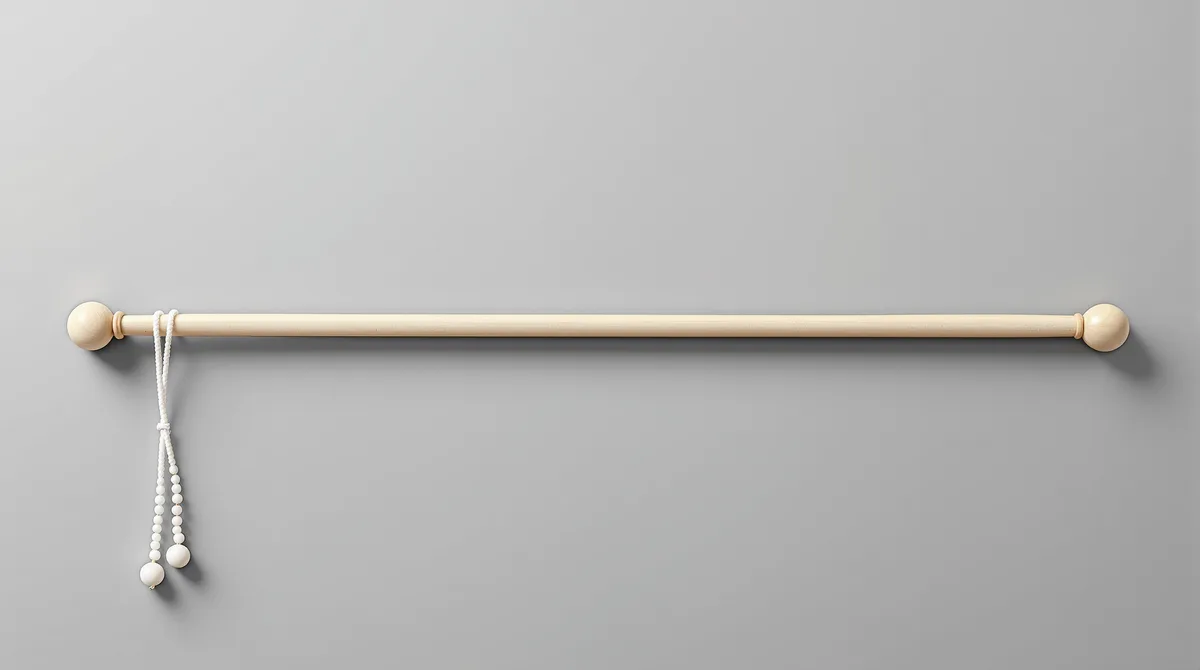
The construction itself is also information. The real options are a stained wooden header rail, a single turned dowel, end suspension loops knotted at the top of each strand for a level mount on an imperfect opening, and a stitched cotton header band with a rod pocket — three inches deep on the café builds. A panel whose header was chosen for the mounting situation is a panel that was specified rather than assembled.
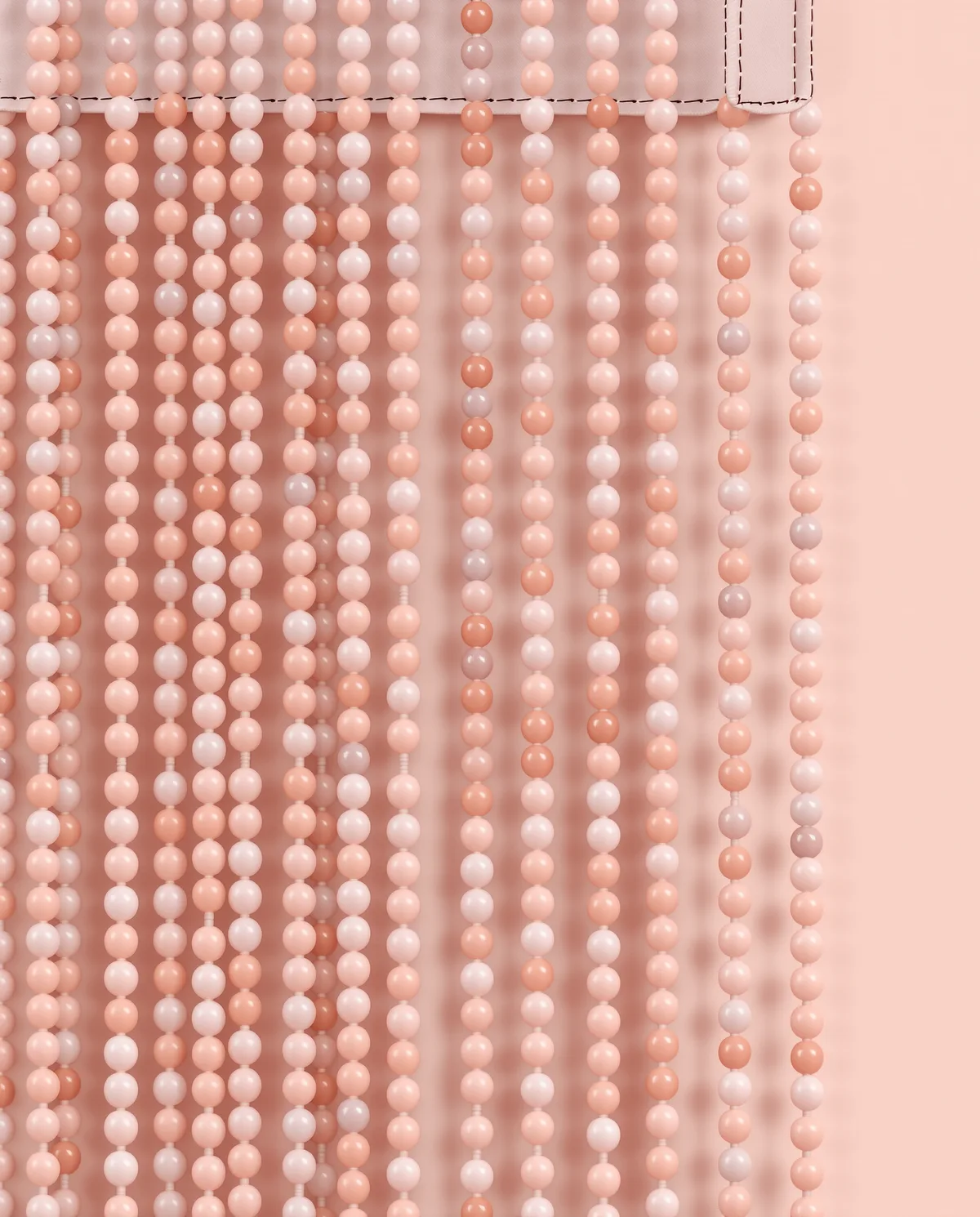
Look across the panel, not at one strand. Surface dye is a batch property and dye lots shift between runs, so a visible tonal change part-way across a panel means two batches went into one piece.
This is why production is held to the approved sample rather than to a reference chip: colour is matched to a Pantone reference or a physical chip, confirmed on the sample, and the sample is then the standard. Colour variance is one of the defects our own inspection looks for, alongside bead chipping, strand drift and knot slip.
Whether the maker understands the product. A panel packed with the strands held in their order arrives as a panel; a panel folded into a box arrives as a problem, with a set in every strand at the same height.
Whether spares can be had at all is the other signal, and the stronger one. Spares are not automatic anywhere in this category — they are a packing-specification item agreed per order — so the question to ask is whether the maker will string spare beads, and ideally a pre-made replacement strand, into the same production run as the panel.
A maker who will expects a strand to be re-strung rather than a panel to be replaced, which is only a reasonable expectation if the construction is documented well enough to support it.
Cord first, then knots, then the dowel, then the finish. Cost is cut where it is invisible, and the invisible components are the structural ones.
The useful consequence for an inspection: the things that fail first are the things on this list, which is not a coincidence. End finishes, drill holes and knot seating are both the cheapest things to skimp on and the first things to fail.
Hand-strung to a document. A bead-by-bead sheet sets the colour sequence and the length for every strand, which is what makes a pattern repeat exactly across a production run and keeps strand lengths identical. Beads are matched to a colour reference and confirmed on the sample. Glass is drawn and hand-strung in our own glass works at Firozabad; dowels are turned in our own wood factory at Saharanpur.
Then it is checked. Finished panels pass first-article and lot inspection on an AQL plan at our quality control and packaging house at Greater Noida before export packing, and across the network product issue rates run at a fraction of a percent. On average sixteen artisans contribute to each finished product, each applying one craft discipline.
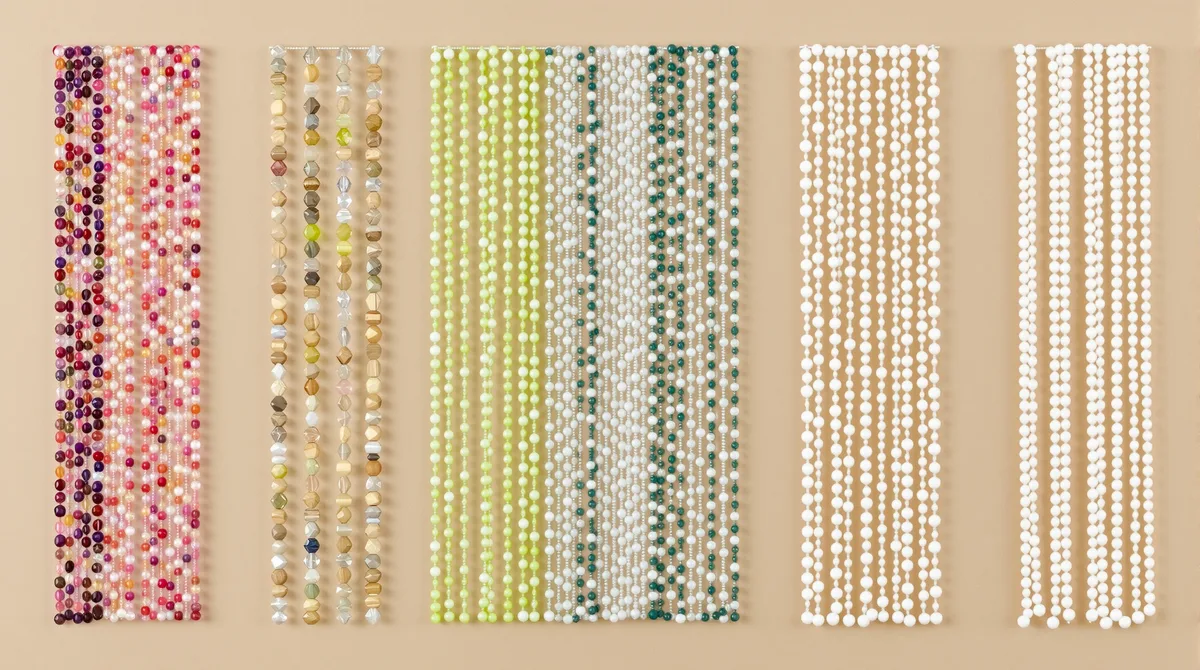
The five things that make the eight inspection points come out right. The end finish by name. The strand count. The bead size and the drill-hole size. How the colour is held — body colour or surface dye. And the header construction.
With those five settled, the sample is a short conversation. Sampling is usually 16 to 20 days from an agreed brief, with photographs approved before the sample ships, and production runs 40 to 60 days after sample approval. The sample is the moment to apply this whole list, because after approval the sample is the standard the run is held to.
Good to know
Less than people assume. Glass is not automatically better made than acrylic, and an expensive bead badly strung is a bad panel. Seven of the eight inspection points on this page are about workmanship — knots, lengths, alignment, pitch — and only drill-hole quality is a property of the bead itself.
Yes, because nothing is held in stock: width, drop and strand count are set per order and every beaded door curtain is made to order. A non-standard width changes the strand count on the bead-by-bead sheet rather than changing the construction, so it is inspected to the same points.
Usually it indicates handling, not making. Tangles mostly happen in the first five minutes, when a panel is lifted by its strands or shaken out of the carton. The making question behind tangling is whether strand weight and spacing were designed for the material — a very light strand with no weighted end bead will drift into its neighbour.
A tension rod inside the reveal, for light panels only. It affects installation rather than quality, but it interacts with one inspection point: a stitched header with a rod pocket needs a rod sized to the pocket, and a rod too thin for it makes a well-made header look slack.
It is better than a badly made one, and that is as far as the claim goes. Good end finishes and well-seated knots mean beads stay attached, which is the whole safety-relevant property. The age grade is assigned by the buyer for its own market.
The construction answer is the useful one: the beads outlast the room and the cord is the service item, which is why end finishes and drill-hole quality matter more than anything else on this list.
Yes, and well-made beadwork is more tolerant because the cord is doing its job and the knots are seated. The method is the same either way: dry brushing downwards, strand by strand, and a barely damp cloth on the beads only. Good making does not make a panel washable.
Keep exploring
Reference
The beadwork defect taxonomy, how each defect is detected, and which are rejects rather than repairs.
Read the guideGuides
One guide per question that arrives often enough to be worth answering properly.
Compare the optionsGuide
The header, a care card and packing that held the strands in order — plus the spare beads you have to specify yourself.
Open the referenceGuide
Where it hangs, which material, how dense, how long, which hem, how it fixes — and why colour is the last decision, not the first.
Compare the optionsGuide
Width at three heights, the floor gap, the header depth — and the two decisions that come before any of them.
How it is madeGuide
Cord first, then knots, then the dowel, then the finish — and why none of it is about the beads themselves.
Read the guideGuide
Which four numbers decide the product, which words mean less than they appear to, and what a missing strand count tells you.
Compare the options
Start a conversation
Send a reference, a colour chip or a sketch. Minimums are set per design and confirmed per quote; sampling is quoted separately and usually runs 16 to 20 days from an agreed brief.