Compliance
The 100 ppm limit
The children’s-product determination for décor, the four factors it rests on, and what the 100 ppm limit actually covers.
Specs and sizes
Guide · Safety
A toddler will pull on a beaded curtain. That is not a question. The question is what happens when they do, and that is decided on the stringing sheet long before the panel is hung.
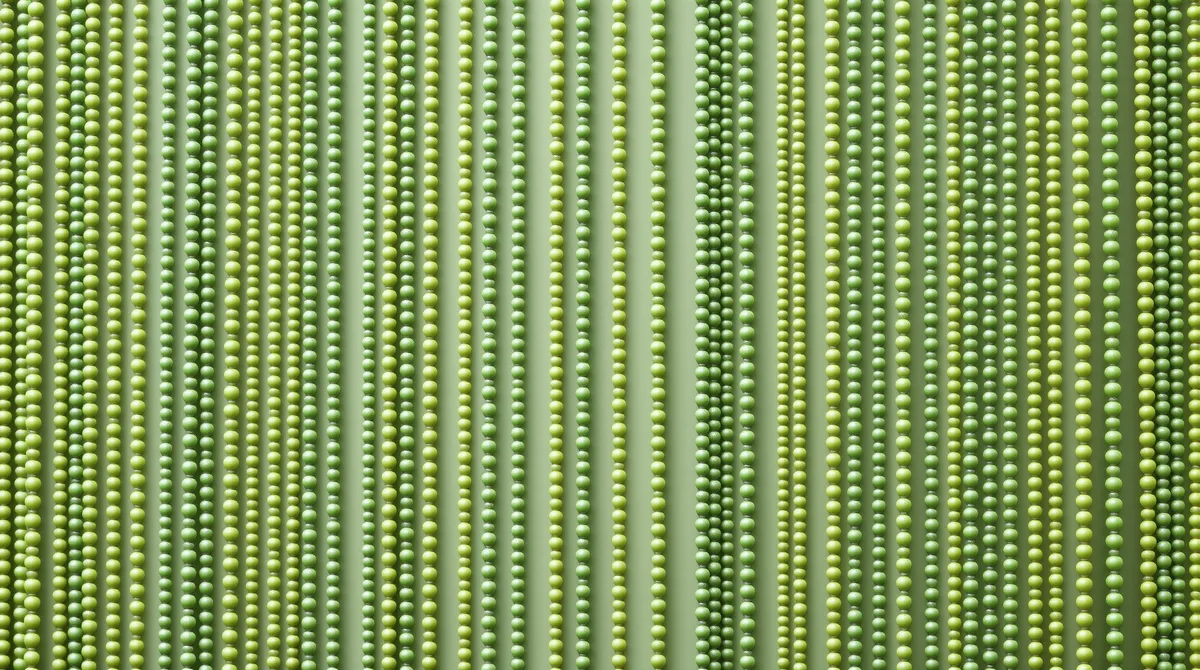
Close hand-strung strands of canary and chalk-white glass beads, every cord finishing on one dead level hem with a wide band of clear ground below it.
There are three risks around a toddler: the whole panel being pulled down, a cord loop at a child's height, and a small loose bead. The second and third are design choices — specify no loops below the header and larger beads rather than seed beads. The first is a fixing decision: mount into solid timber, never on a tension rod.

A beaded curtain in a home with a toddler is safe if three decisions are made deliberately and unsafe if they are left to chance. The decisions are the fixing, the loops, and the bead size. None of them is about the beadwork being good or bad — they are specification choices, and all three can be settled before a sample is made.
What follows is written as the three decisions rather than as reassurance, because reassurance is not useful to anyone standing in a doorway with a one-year-old attached to the hem.
The load goes straight to the fixing. A strung panel weighs what it weighs, but a child leaning on the hem can apply several times that in a sudden, downward, off-centre pull — and friction fixings fail under exactly that kind of load.
On hooks or brackets screwed into the door frame or into solid wall, the panel stays where it is. The worst case becomes a parted strand, which is a repair. On a tension rod or an adhesive fitting, the whole panel and the rod come down together, which is a different category of event.
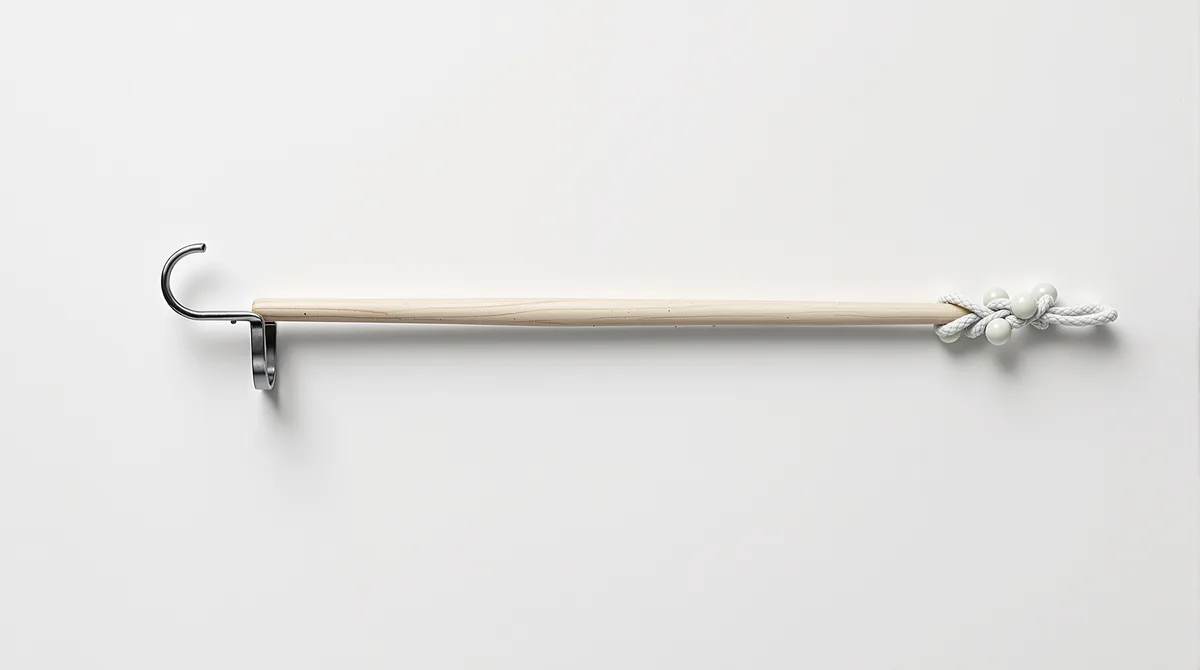
Screwed, into timber. Cup hooks or screw hooks through the frame carry the dowel or its suspension loops simply and strongly; a rod on brackets is better for a heavier glass panel or a wide opening.
Tension rods are genuinely useful in rentals and student rooms and they are the wrong answer here. If drilling is impossible and a small child is in the house, the right compromise is a shorter panel — a valance or a café length, hung high — rather than a full-length panel on a friction fitting.
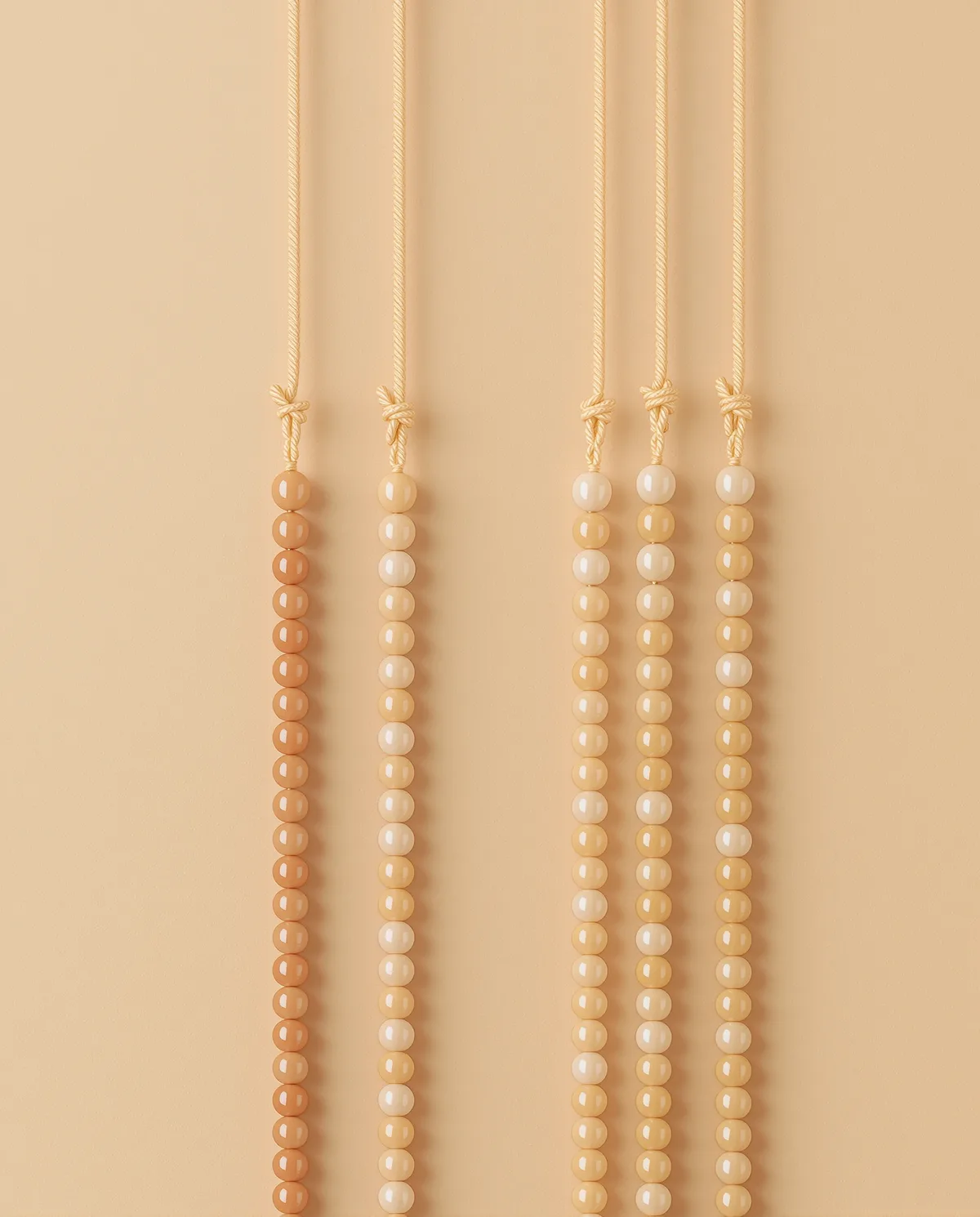
This is the risk that gets least attention and is easiest to eliminate. Specify a build in which every strand finishes individually — a knot, a crimp, or a stopper bead — with no return loop below the header that a head, an arm or a leg could pass through.
Suspension loops are a legitimate part of the construction, and they sit at the top of the panel: on our Mushroom portal, end suspension loops at the strand tops are what let one panel hang level from either a door fixing or a wall mount. A panel designed that way has nothing loop-shaped anywhere a child can reach.
Larger than you would otherwise choose. The relevant question is not whether the bead is attractive but whether it is swallowable if a strand parts.
A 20 mm turned wood round, a 13 × 22 mm dotted glass oval, a 25 mm faux-capiz disc: none of these is a realistic choking hazard. A 2 mm glass seed bead is, and a seed-bead panel puts hundreds of them on the floor if a strand goes.
Larger beads also cost less to string for the same drop, so this is one safety decision that does not fight the budget.
Acrylic first, for a nursery or a toddler's doorway: nothing in the panel can shatter, the strands are light, and the colour range is the widest available because the beads are moulded and dyed to a named colour. Wood second — matte, quiet, warm, and unswallowable in larger rounds.
Glass is a considered choice rather than a bad one. It is the material that actually throws light, and in a doorway above a small child's reach it is fine. At hem height, a chipped glass bead is sharp, and that is reason enough to put the glass somewhere else in the house.
Lead-content testing to California Proposition 65 is run as standard on the beaded curtain programme. Beyond that, the children's-product certificate is obtained against the approved sample: flammability, mechanical and small-parts testing are scoped against a specific build, because bead, cord, header and finish all matter, and quoted with the programme.
Anyone offering you a blanket children's safety rating for a beaded curtain without naming the test and the build is guessing. That is worth knowing whoever you buy from.
Largely, yes, and it is under-used. A valance drop or a café length hung high in a child's doorway keeps the movement, the colour and the light while putting the hem out of reach altogether. Bead count drops with the height, so it is also the cheapest version of the idea.
The full-length panel is the one that invites pulling, because the hem is at exactly toddler height and it rewards a tug with motion and sound.
It becomes the most looked-at object in the room, which is the reason to hang one. A bead panel moves on its own in any air current, catches light at every hour differently, and makes a sound when it is touched — and a child will touch it for weeks.
That is also the case for specifying it properly rather than talking anyone out of it. The failure modes here are all designed-out at the brief stage; the appeal is not something you can add later.
Start with choosing a bead size, because a 20 mm bead and a 2 mm bead are a different object in a room with a toddler in it. Beadwork with pets reaches the same conclusion by a different route and is worth reading alongside. Panel headers covers the fixing options properly, which is the decision that stops a panel coming down. A short bead panel is the underrated answer: hung high, it keeps the hem out of reach entirely. And acrylic beaded curtains is the material page we would point any nursery brief at, because nothing in that build can shatter.
Good to know
Yes, if it is hung on a tension rod or an adhesive fitting. A child hanging off the hem applies far more load than the panel weighs, and a friction fixing lets go. On hooks or brackets screwed into the frame or solid wall, the panel stays up and the worst outcome is a parted strand.
A loose small bead is, which is why bead size is the specification that matters most in a child's room. A 20 mm wood round or a 13 by 22 mm glass oval is not a realistic choking risk; a 2 mm glass seed bead is. If a strand parts, pick the beads up before the child does.
No. Specify a build where every strand finishes individually in a knot, a crimp or a stopper bead, with no return loops below the header. A panel with no loops cannot present a loop hazard, which is a design answer rather than a warning label. End suspension loops belong at the top of the panel.
Acrylic, because nothing in the panel can shatter and the strands are light enough that contact carries little force. Wood is the next choice. Glass is fine in a doorway a small child does not reach, but at hem height a chipped glass bead is sharp and that is reason enough to specify something else.
No blanket certification exists for these panels and we will not imply one. Lead-content testing for California Proposition 65 is run as standard on the beaded curtain programme, and any further children's-product testing is scoped against the specific build — bead, cord, header and finish together — and quoted separately.
Clear of the floor, so the strands swing free and nothing can be trodden on or hooked under. A shorter panel is also worth considering: a café-length or valance drop in a child's doorway removes the hem from reach entirely while keeping the effect.
It is a safer alternative in one specific way — there is nothing to trap fingers, and nothing that can swing shut on a child. It is not a substitute for a door where a closing barrier is the point, and it gives no sound or temperature separation at all.
Keep exploring
Compliance
The children’s-product determination for décor, the four factors it rests on, and what the 100 ppm limit actually covers.
Specs and sizesGuide
Where a loop can form on a strung panel, why strands are finished individually, and what to check on an older piece.
See the detailPillar
Door curtains, portals, café lengths and valances: the standard sizes, the strand counts and the one question each format answers.
View the rangeGuide
Cats climb, dogs push through: which builds survive it, which beads are a swallowing risk, and how to hang in a pet home.
See the detailGuide
Three ways to hang beadwork in an arch: a straight rod inside the opening, a hem cut to the curve, or a shaped top rail.
See the detailGuide
The lightest panel you can hang, the widest colour range, a light click rather than a chime, and no shatter risk.
See the detailGuide
Tension rods inside the frame, the real limits of adhesive fixings, and how to match the panel's weight to what the fixing will take.
See the detailGuide
Resolution, weight, hang and hours — the four things one number decides, and how to trade between them.
See the detail
Start a conversation
Send a reference, a colour chip or a sketch. Minimums are set per design and confirmed per quote; sampling is quoted separately and usually runs 16 to 20 days from an agreed brief.