Specification
Beaded wall panels
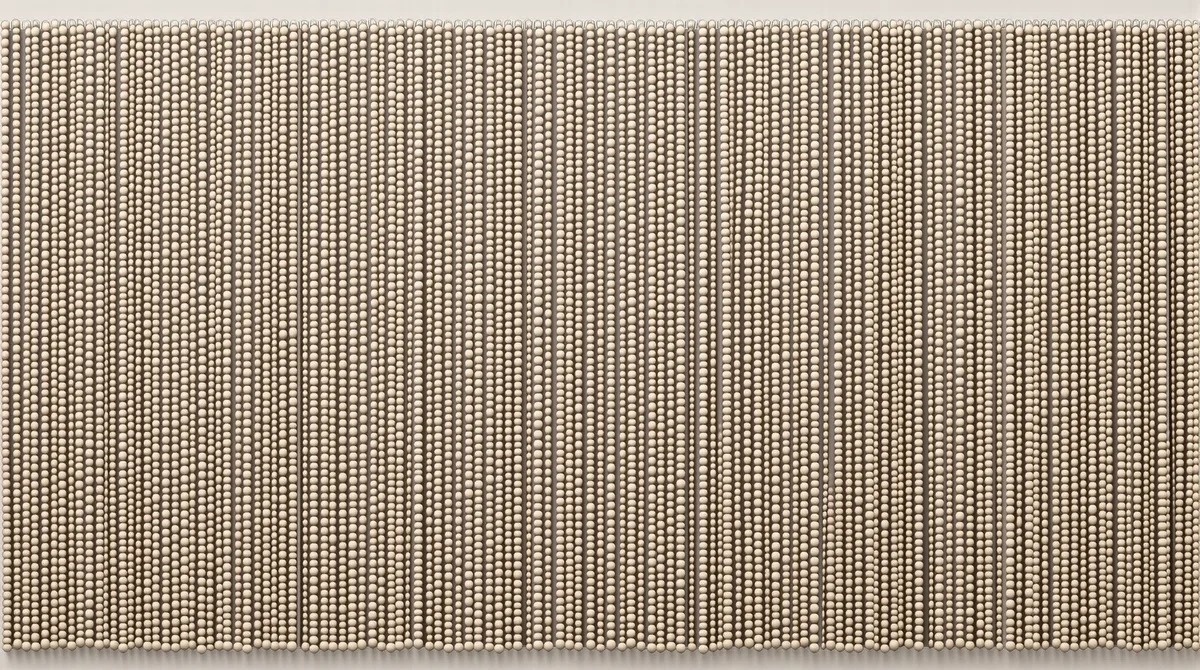
Modularisation, substrate fixing, tolerance between modules, cleaning access and a repair plan that does not mean replacing the wall.
Specs and sizes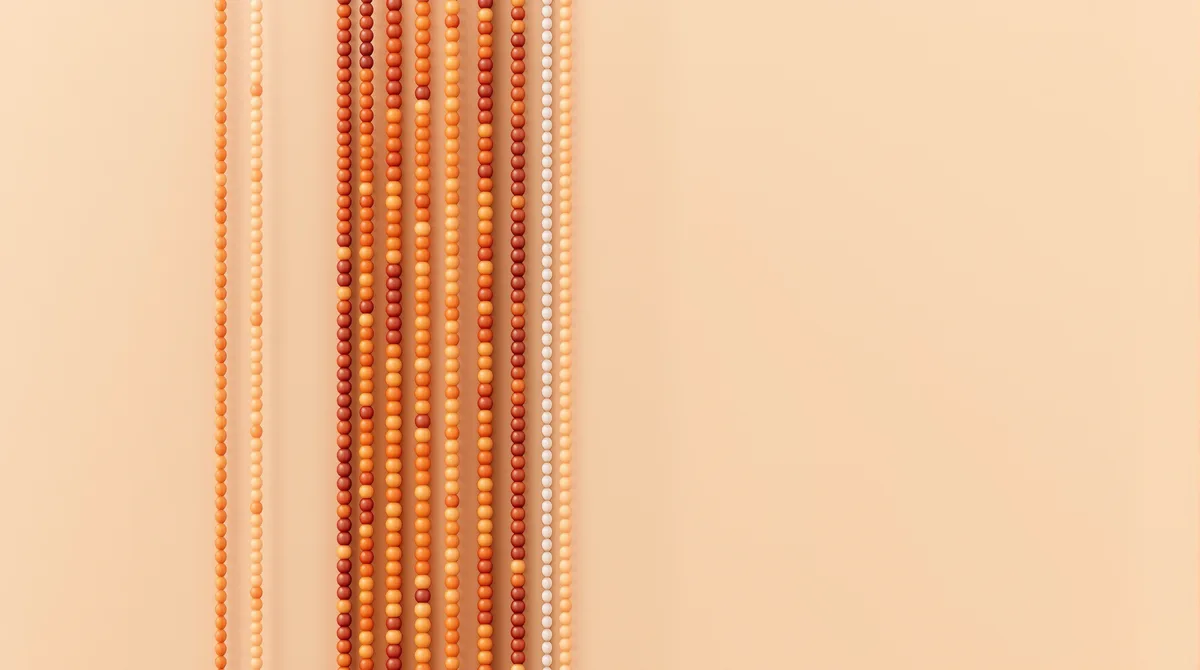
Guide · Format
A panel is a module. Once you stop thinking of beadwork as one curtain for one door, the geometry opens up — and so does the question of where the joins fall.
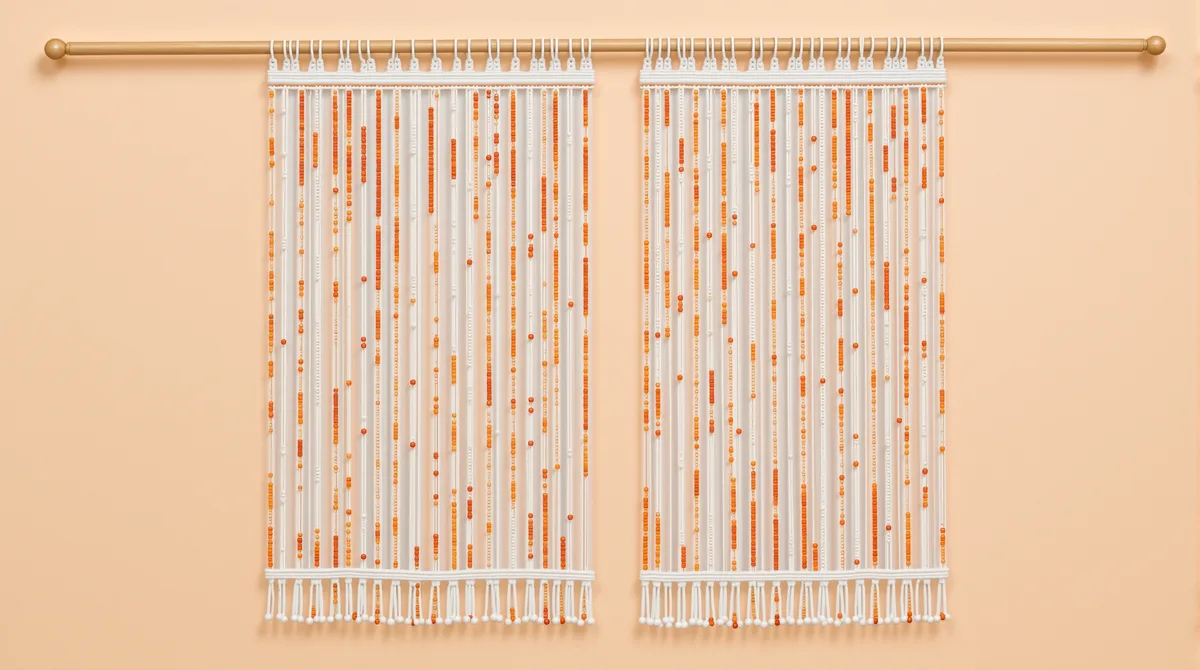
Close hand-strung strands of rust, burnt orange and amber glass beads filling one side of the frame against clear ground.
A beaded panel is a module rather than a finished curtain: one width of strands on one header, sized so that several can be hung side by side. Panels in the design library run from roughly 50 cm wide panels to 120 cm curtains, with 90 cm the commonest single width. The join between panels is a design decision, not an accident.
The same object, described with a different intention. A curtain is specified to an opening: you measure a door and the panel is made to fit it. A panel is specified to a module width, on the understanding that one, two or five of them will be hung side by side.
That shift changes three decisions. The width becomes a standard rather than a measurement. The join becomes a design element. And the set-out — where the modules land across the available width — becomes a drawing exercise rather than an installation detail.
Width is set per order, because every piece of beaded décor is made to order against an approved sample and there is no stock range to choose from. But the design library clusters around a familiar set of widths, which is what makes them useful as modules:
Strand pitch follows from the width. Forty strands across 90 cm is a pitch of roughly 2.25 cm; sixty strands across 120 cm is roughly 2 cm. That arithmetic is how a module width becomes a strand count on the stringing sheet.
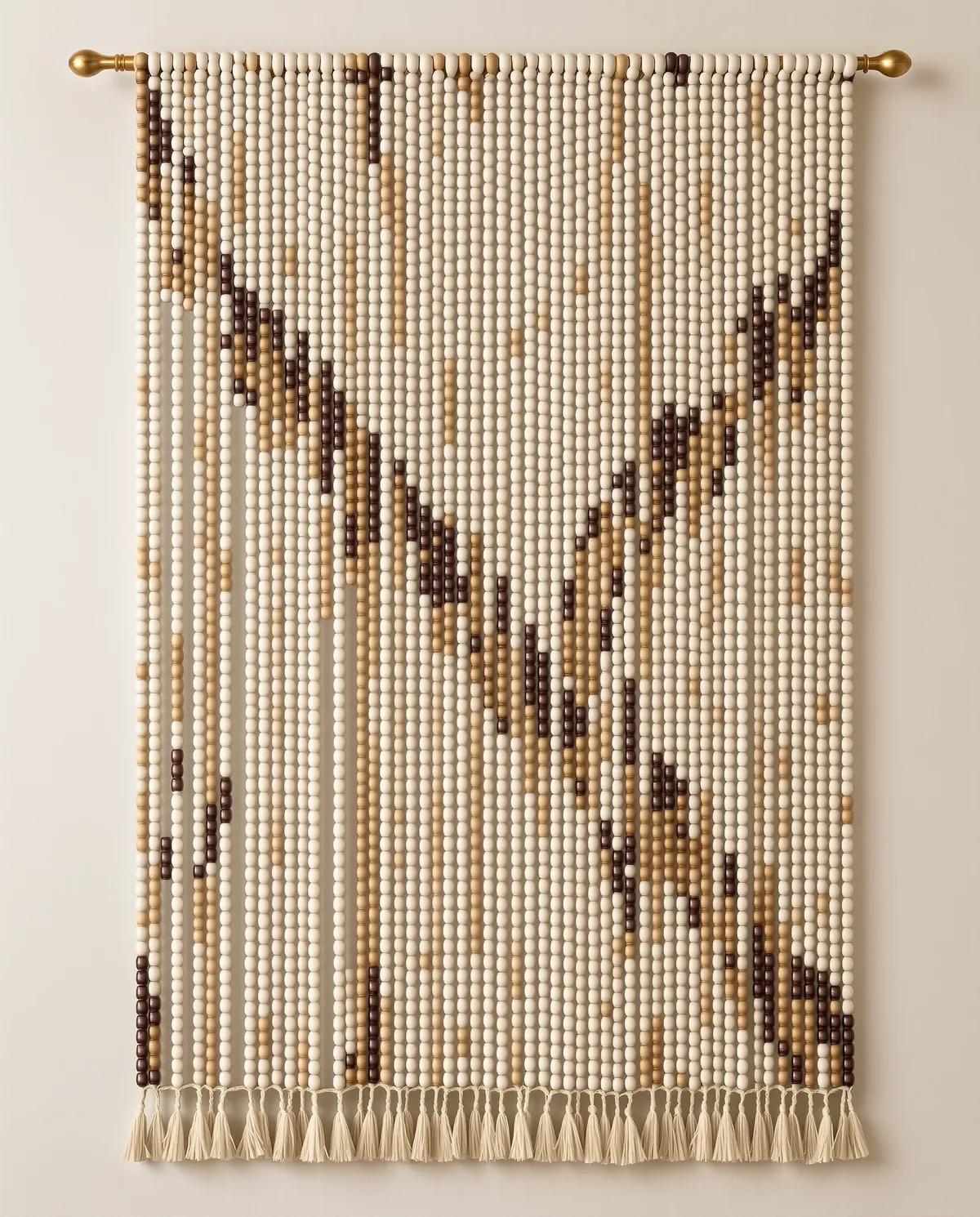
Deliberately. There are two good answers and one bad one.
Overlap by about one strand pitch. The strands of each panel interleave visually, no daylight shows between them, and the join disappears. This is the right answer in a doorway, where the gap is also the route through.
Separate by a visible gap. Twenty centimetres of clear wall between two panels reads as rhythm. This is the right answer on a wall, where panels are a composition rather than a covering.
The bad answer is the accidental one: a one-centimetre sliver of light between panels hung as close as the brackets allowed. It looks like a mistake, because it is one.
From the centre outwards. Divide the wall width by the module width, and put the part-width panel — there is almost always one — at the ends.
Setting out from one end does the opposite: it lands the odd module at the far end, which on a long wall is right in the middle of the visible field. Nobody notices a narrow panel at a corner. Everybody notices one two thirds of the way along.

Consistency becomes the governing property, which pushes you towards materials whose colour is a specification rather than a discovery. Acrylic, moulded and dyed to a named colour, is the most repeatable. Glass is repeatable within a dye lot and should be run as one lot across a whole run for this reason.
Wood is the material that argues for a run rather than against it: natural grain varies, so five wood panels side by side read as a natural surface. Trying to match five wood panels exactly is the mistake; letting them vary is the point.
The beadwork is close to a wash, because bead count is set by the area covered rather than by how it is divided. What changes is everything around the beads.
A run needs more headers and more fixings. In exchange it removes the single worst problem with a very wide panel — a long dowel deflecting under load in the middle of its span — and it makes damage survivable: one module can be re-strung or replaced without taking the whole installation down.
For anything over about 1.5 m, modules are the better engineering answer as well as the better commercial one.
The design library runs door panels to 200 cm and up to 210 cm drops. Beyond that you are into cumulative strand weight, which loads the header progressively and puts real tension on the cord at the topmost drill holes.
A run of modules does not solve a long drop — each strand still carries its own full length — so length and width are separate problems. Width divides neatly into modules; height does not divide at all.
One header per module: a single turned wooden dowel, a stained header rail, or a sewn rod pocket on a fabric band. End suspension loops are the detail that makes modules flexible, because a panel with loops at the strand tops can hang from a dowel in one installation and a rod in the next without being rebuilt.
On a wall run, a continuous rail with modules hung along it works too, and gives the cleanest top line. It is also the arrangement where a deflecting rail will show most, so the rail has to be sized for the full load rather than for one panel.
Yes, and it is the most interesting thing about the format. Panels developed from a single colour-count sheet can change bead, density or colour weighting while staying visibly related — the same approach that lets a valance and a full-length curtain in one design sell as a pair.
Three related panels in a row read as a composition. Three identical ones read as wallpaper. The format gives you the choice, which a single wide curtain does not.
An extra-wide bead curtain explains why the header rather than the beadwork sets the limit on a single module, and a wide doorway covers the set-out when the opening is a route. Panel weight matters once there are several modules on one rail, and panel headers covers the rail itself. For a run on a wall rather than across an opening, where beadwork is specified is the page that sets out the settings it suits. And if the modules have to match each other across more than one season, reordering a bead design is the one to read.
Good to know
Commercially, nothing — a panel is a curtain. Practically, calling it a panel signals that it is one module of a larger arrangement: sized to be combined, with the join treated as part of the design. A curtain is specified to an opening; a panel is specified to a module width.
Width is set per order, because there is no stock programme behind beaded décor. The design library works around a familiar set: roughly 50 to 76 cm for wall pieces, 90 cm for a single door panel, 120 cm for a wide one. Those are starting points for a specification rather than a catalogue.
Either overlapping by about one strand pitch, so there is no visible line of daylight, or separated by a deliberate gap wide enough to read as a gap. The worst outcome is the accidental middle case: a one-centimetre sliver of light that looks like a mistake rather than a decision.
The beadwork costs roughly the same, because bead count is set by the area you cover. What changes is the hardware and the risk: more headers to fix, but no long dowel to deflect in the middle, and a damaged module can be replaced on its own rather than taking the whole piece out.
From the centre outwards, so any part-width module falls at the ends where the eye forgives it. Setting out from one end puts the odd panel at the other end, in the middle of the wall's visible field, which is where it will annoy you.
Yes, and it is a good use of the format. Panels developed from one colour-count sheet can vary in bead or density while staying obviously related, which lets a run of three or five read as a composition rather than as repetition.
No. The same construction hung on a wall with nothing behind it is a beaded wall hanging, and the design library runs them from roughly 50 × 90 cm up to 60 × 100 cm, plus a 90 × 67 cm format that works as either a wall piece or a short door portal.
Keep exploring
Specification
Modularisation, substrate fixing, tolerance between modules, cleaning access and a repair plan that does not mean replacing the wall.
Specs and sizesPillar
Door curtains, portals, café lengths and valances: the standard sizes, the strand counts and the one question each format answers.
How it is madeGuide
Cumulative strand weight, cord creep and header load: what changes when a bead panel goes past two metres.
Specs and sizesGuide
Dowel deflection, mid-span support and the case for modules: why a very wide opening is a header problem first.
See the detailGuide
Valance, café length and half drop: three short formats, what each one does, and how bead count falls with height.
Read the guideGuide
One panel or a pair, where the join falls, and why the walk-through gap should be designed rather than left to chance.
Read the guide
Start a conversation
Send a reference, a colour chip or a sketch. Minimums are set per design and confirmed per quote; sampling is quoted separately and usually runs 16 to 20 days from an agreed brief.