Glossary
The beadwork glossary
The words a bead tech pack uses, defined one term to a page so a specification can cite them.
Specs and sizesGlossary
An old word that still describes exactly the right thing, and the one piece of vocabulary that tells a maker you mean a doorway rather than a window.
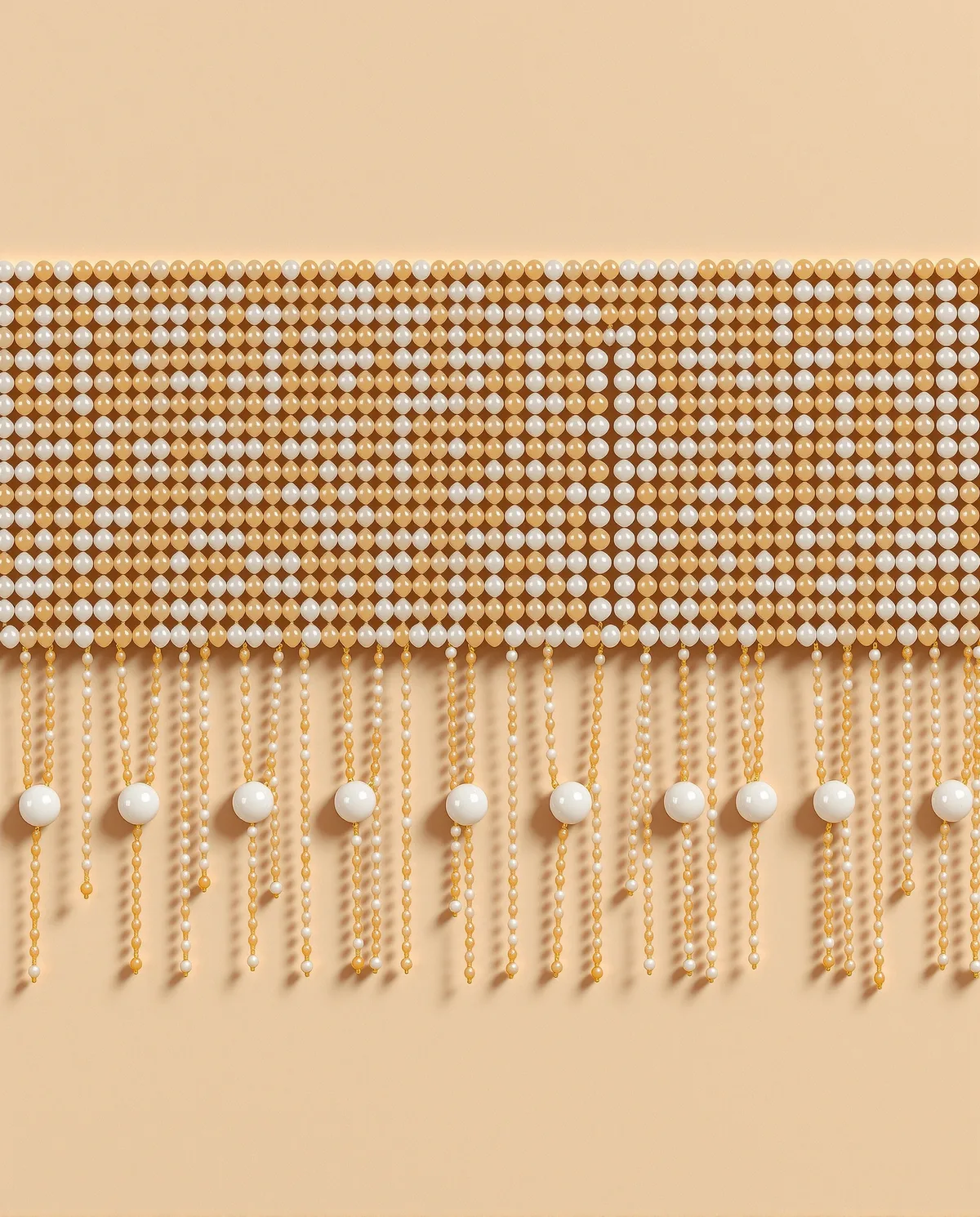
A portiere is a curtain hung in a doorway rather than at a window, used historically to cut draughts and screen one room from another. It is the correct historical term for what is now sold as a beaded door curtain or portal. We define the word and build to that format; we do not run a range labelled portiere.
A portiere is a curtain for a doorway. The French portière, from porte, a door. Historically it hung across an internal opening to cut draughts between rooms and to give a degree of privacy where a door was absent or deliberately left open.
The word is precise in a way the modern vocabulary is not. "Curtain" covers both windows and doors; portiere covers only one, and that is exactly the distinction a bead specification needs.
Rarely, and that is correct. The word belongs in the design notes, where it tells the reader what kind of opening is in play. The production block uses the format and the dimensions, because the bench strings to a drop and a pitch, not to a historical category.
Where buyer-facing copy is written from the tech pack, portiere is a useful word for a product description and a poor one for a specification line.
Because a doorway and a window ask different things of the same panel. A doorway panel is walked through, so the end beads are handled daily, the hem has to clear the floor by a deliberate gap, and the strands have to return to their pitch after being pushed aside. A window panel is not touched and can be lighter and denser.
Naming the opening as a doorway changes the end-bead weight, the floor gap and the cord choice. Those are three real decisions riding on one word.
The buyer, because only the buyer knows what the opening is. It is the kind of context that gets lost when a brief arrives as a width, a drop and a mood board with no statement of where the panel is going.
The maker's contribution is to ask. A panel specified without its opening is a panel specified without half its performance requirements.
From nineteenth-century interiors, where heavy fabric portieres were standard in European and North American houses. They were practical before they were decorative: draught control in buildings heated by fireplaces.
Beaded portieres belong to the same lineage. The beaded door curtain of the 1960s and 70s is a portiere in a different material, and the current revival inherits the format wholesale.
The standard formats sheet, which carries the door-panel dimensions the word points at, and the drop entry, because the floor gap in a walked-through opening is a drop decision.
The toran entry sits beside this one for a related reason: both are vocabulary pages for formats that buyers search by name, and both state what the record actually holds.
A door curtain. If the sentence needs to be unambiguous: a beaded panel hung in a doorway, not at a window.
A portal, most of all. A portal frames a doorway and leaves a clear opening in the middle — beads down both sides and often across the top, with the centre open to walk through. A portiere fills the opening, and you part it to pass.
Also confused with a valance, which dresses the top of an opening only, and with a room divider, which screens part of a room. Room dividers are worth flagging separately: our design library carries divider formats, but no beaded room divider has been made, sampled or shipped, so it is not a current product and should not be specified as one.
The door-panel format in our record is around 90 by 200 cm, about 35 by 79 inches, hung from a wooden dowel or rod. Common interior doors in North America run 28 to 36 inches wide, so the 90 cm panel covers most openings and a 120 cm panel handles a 36 inch door and wider.
A thirty-strand build on a single dowel is the common construction at that size. The 2027 design library also carries a 76 by 140 cm portal format and a 90 by 67 cm wall-hanging and portal dual format.
Not by name. The inspection reads the panel against the colour-count sheet and the sealed sample, measures the drops and the pitch, and checks the header. Whether the piece is called a portiere, a door curtain or a portal does not appear in that process.
What inspection does check, on a doorway panel, is the end-bead fixing — because that is the part a walked-through panel loads every day.
A buyer who omits the word loses nothing, provided they have said doorway. A buyer who writes portiere and nothing else has specified the opening but not the panel, which is the reverse problem and equally common.
Both halves are needed: what the opening is, and the dimensions and construction that fill it.
No. The term describes a position in a building, not a material. A portiere can be fabric, beads, linked discs or chain; the word says only where it hangs.
That material-independence is why it survives as useful vocabulary. It is one of the few words in beaded décor that means the same thing to a textile specifier, an interior designer and a bead maker.
Extractable data
| Field | Value |
|---|---|
| Term | Portiere |
| Also written | Portière; door curtain; door hanging |
| One-line definition | A curtain hung in a doorway rather than at a window |
| Where it appears | Design and historical notes on a brief, rarely on a production document |
| Confused with | Portal, valance, room divider, window panel |
| Gemixx record | No range is sold under this name; the door-panel format is real and in production |
Good to know
A curtain hung in a doorway rather than at a window.
Almost never. It belongs in the design and historical notes on a brief, where it is useful shorthand for the intent. The production document uses the format name and the dimensions — door panel, around 90 by 200 cm, on a turned wooden dowel — because that is what the bench builds against.
A portal, which frames a doorway and leaves a clear opening in the middle; a valance, which dresses the top of an opening only; and a room divider, which screens part of a room rather than filling a door. All four hang from a header and all four are specified differently.
The door-panel format in our own record is around 90 by 200 cm, about 35 by 79 inches, on a wooden dowel or rod. North American interior doors commonly run 28 to 36 inches wide, so a 90 cm panel covers most of them, and a 120 cm panel is the answer for a 36 inch door or a wider opening.
Nothing, because the word is not load-bearing on a production document. What matters is whether the brief has said doorway or window, because the two take different drops, different floor gaps and different end-bead weights even at the same width.
Keep exploring
Glossary
The words a bead tech pack uses, defined one term to a page so a specification can cite them.
Specs and sizesSpecification
Diameters, drill holes, cord selection, strand counts and format dimensions — the sheet to copy into a tech pack.
Specs and sizesGlossary
The Indian decorative door hanging placed above a threshold — defined, with no product claim behind it.
Read the guideGlossary
The flat translucent shell of the windowpane oyster — the natural material faux capiz discs imitate, and why we make the imitation.
Specs and sizesGlossary
Heat-treated to relieve internal stress — the specification that keeps a large glass feature bead from cracking in service.
See the detail
Start a conversation
Send a reference, a colour chip or a sketch. Minimums are set per design and confirmed per quote; sampling is quoted separately and usually runs 16 to 20 days from an agreed brief.