Reference
Cost levers, in the order that they bite
The five levers that move a bead price, in order of effect, and why cost per square foot does not describe this product.
View the rangeSpecification · Budget
Beadwork is not costed by the metre or by the square metre. The opening is the unit, and five levers move the number inside it.
Beadwork is budgeted per opening because two panels of identical dimensions can differ in content by a factor of several. The five levers, in the order they bite, are bead size and material, construction, strand spacing, the dowel and packing, and height. A rough cost sheet is issued before any sample is made.
How much content goes into each opening. Not how many metres of product to buy — a bead panel is not sold by length and cannot usefully be budgeted that way.

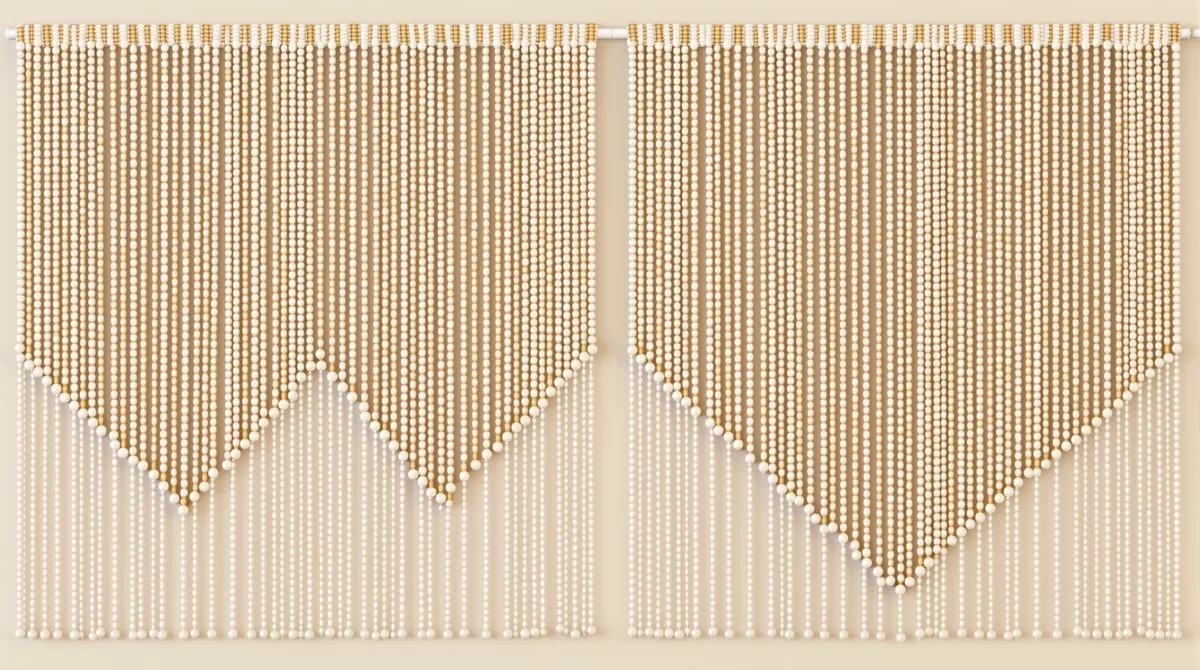
The reason is in the record: a densely patterned 90 by 200 cm curtain can hold about 11,800 beads, while a spaced panel at the same dimensions holds roughly 3,100. Same opening, same format, nearly four times the content.
| Lever | What moves it | Effect on the look |
|---|---|---|
| 1. Bead size and material | Glass against acrylic against wood; small against large | The largest single driver, and the most visible |
| 2. Construction | Strand count and how tightly each strand is filled | Changes density and weight together |
| 3. Strand spacing | Pitch at the header | Changes view-through; invisible on a cost sheet, obvious in the room |
| 4. Dowel and packing | Header type, carton size, pieces per master | Invisible in the room, real in the landed cost |
| 5. Height | Finished drop | Multiplies directly into bead count and stringing hours |
| De-densifying | Planned bare cord within each strand | Keeps the format and the pitch; reduces the fill |
| Repeating pattern instead of a gradient | Fewer distinct bead colours to hold and sequence | Reads as pattern rather than as a graded wash |
| Rough cost sheet | Issued before any sample is made | Shows where cost sits and which lever moves it |
| Minimum order quantity | Set per design, confirmed with your quote | Against the construction you specify |
The five levers, settled. Bead material and size. Construction. Pitch. Header and packing. Drop. Those five are what a cost sheet reads, and a drawing that leaves any of them open can only be costed to a range.
What does not go on the drawing is a price or a minimum. Both are set against a specific design: minimums and pricing are confirmed with your quote.
Fix the format and the drop from the opening. Then choose the bead material, which is the largest single driver. Then set the pitch for the density the design needs. Then check whether the result is affordable.
If it is not, work back down the lever list rather than shrinking the panel. De-densify the fill within each strand, or change a graded wash to a repeating pattern, both of which reduce content while keeping the format and the pitch.
A design contingency rather than a cost tolerance, sized against the density decision. Density is the lever most likely to move between concept and tender, and it has the largest effect of any of them.
The practical approach is to budget the look as drawn and a de-densified version, and carry the difference.
By separating the panel from everything around it. The budget needs three lines, not one: the panel, the fixing hardware, and the installation labour. No rods, brackets, hooks or tracks are supplied with a panel, so a single-line budget is short by the whole hardware and labour amount.
On a specified installation the hardware and labour can be a material fraction of the opening cost, particularly on a ceiling fixing.
The schedule carries quantity by colourway and destination, and the per-opening dimensions. The specification carries the construction common to all of them.
Quantity by colourway affects the cost as well as the programme: the same total split across several colourways is a different run from the same total in one, and it is worth asking what the split costs before committing to it.
Where a budget was set from a reference image of a dense panel and a specification was written for a sparse one, or the other way round. The image and the specification part company and nobody notices until the sample.
The second failure is a budget with no hardware or installation line, discovered at tender.
The de-densified option alongside the full one, if budget is tight. Two hung sections side by side settle the question in minutes, and it is a far better conversation than an argument over a cost plan line.
It belongs in the budget as a recurring line, and it is driven by the same decisions. A dense glass panel at high level is cleaned by a contractor from a tower. A light acrylic panel at door height is dusted by housekeeping.
Over ten years those are very different numbers, and neither of them appears anywhere in a capital cost plan.
A concept budget for beadwork cannot be accurate until density is decided, and concept design leaves density open longest of all. That is a real limitation of budgeting this product early, and pretending otherwise produces a figure that moves.
What is available early is a rough cost sheet: before any sample is made, we show where the cost sits so look can be traded against price. That is the right instrument at concept stage, and it is more useful than a number with no specification behind it.
That the levers work, individually and measurably. A valance height was reduced from 30 inches to 26 specifically to cut bead consumption. An assembly was simplified to take cost out. A pillow design hit its target through de-densified infills. A wall-art design used a repeating pattern instead of a gradient to reduce cost. A canvas background was introduced on another piece specifically to reduce the bead count.
Those are five real cost-engineering moves from the record, and all five kept the design recognisable.
The final specification and the colour-count sheet. Those two are what a second phase gets costed from, and a phase-two budget built from a phase-one price with no specification behind it is not a budget.
Good to know
It belongs in the budget as a recurring line. A dense panel in glass at high level will be cleaned by a contractor from a tower; a light acrylic panel at door height will be dusted by housekeeping. Those are different numbers over ten years and neither appears in the capital cost.
A concept budget for beadwork cannot be accurate without a density decision, and density is the thing concept design leaves open longest. The approach is to budget two versions — the look as drawn and a de-densified version — and carry the difference as a design contingency.
The budget has to carry the fixing and the installation separately, because neither is supplied with the panel. No rods, brackets, hooks or tracks come with a bead panel, and a budget that assumes they do is short by the whole hardware and labour line.
The final specification and the colour-count sheet, which together are what a second phase will be costed from. A phase-two budget built from a phase-one price with no specification behind it is a guess.
The five levers, settled: bead material and size, construction, pitch, header, and drop. Those five are what a cost sheet reads. A drawing that leaves any of them open is a drawing that cannot be costed to better than a range.
Carry a design contingency rather than a cost tolerance, and size it against the density decision. Density is the lever most likely to move after a concept budget is set, and it is the one with the largest effect.
The de-densified option alongside the full one, if budget is tight. Seeing both hung is the only reliable way to judge whether the saving is acceptable, and it is a much better conversation than a line on a cost plan.
Keep exploring
Reference
The five levers that move a bead price, in order of effect, and why cost per square foot does not describe this product.
View the rangeSpecification
The dimensions, strand values, fixings and performance limits a drawing and schedule have to carry.
Read the guideSpecification
Straight, scalloped, V-point, inverted-V, swag, diagonal and staggered — each with its longest and shortest drop.
Read the guideSpecification
What hand-strung beadwork can hold on length, pitch, colour and count — and why a drawing has to say.
See the detailSpecification
The colourway, one full strand, the header detail and the hem at full drop — the four things to see first.
See the detail
Start a conversation
Send a reference, a colour chip or a sketch. Minimums are set per design and confirmed per quote; sampling is quoted separately and usually runs 16 to 20 days from an agreed brief.