Style
Boho beaded curtains
Four rules that make a loose look cohere, and the one that briefs almost always miss.
See the detail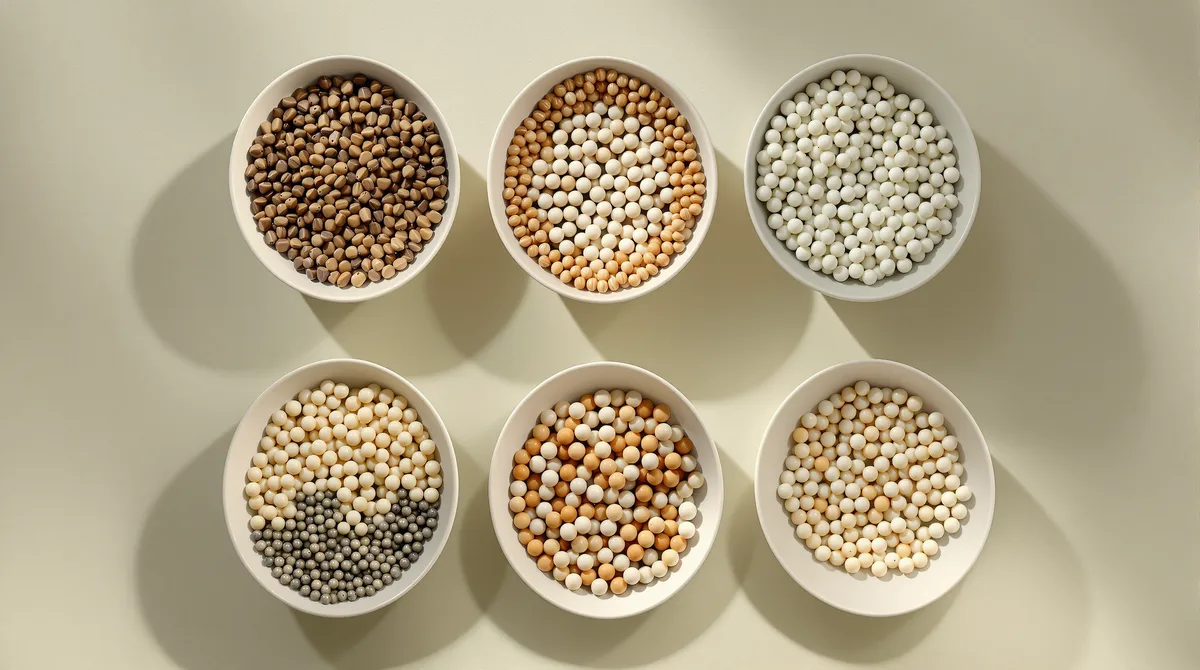
Style · Era
Nothing matched, because nothing was specified. That is the whole look — and it is the reason a hippie panel is harder to manufacture than a graphic one.
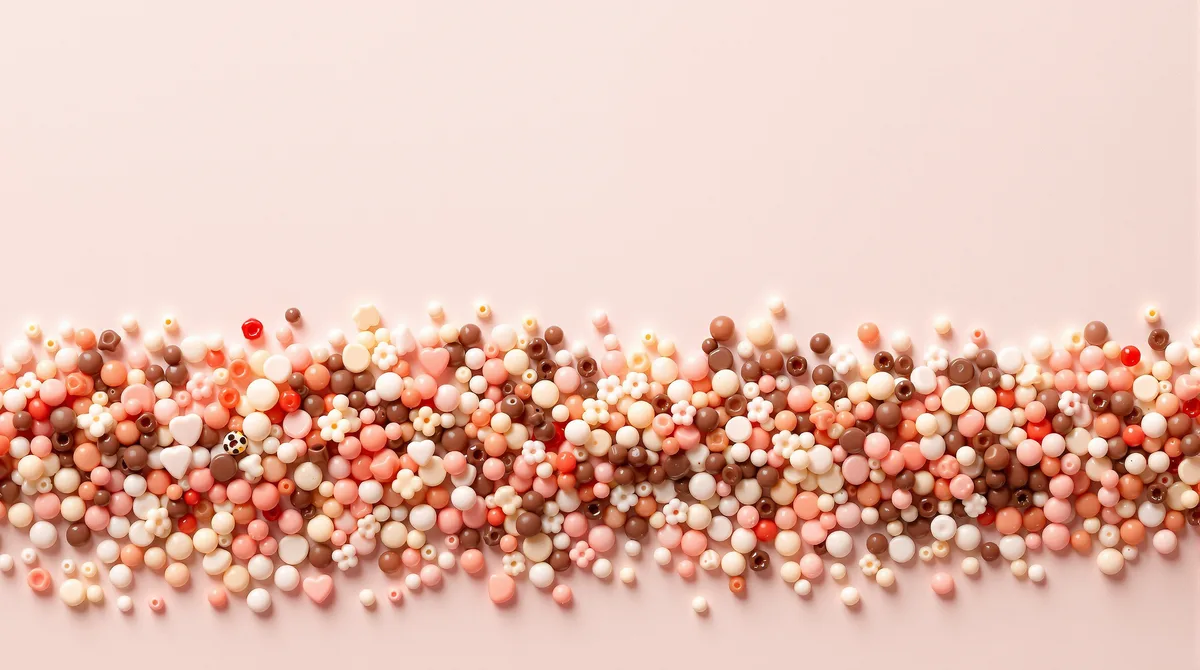
Trays of loose beads laid out by material: glass seed beads, pressed glass dots, wood discs, cast resin blossoms and metal spacers.
The hippie bead curtain came out of the late 1960s counterculture and was assembled from whatever beads were available — imported glass, wood and trade beads on different cords at different lengths. Its signature is that nothing matches: mixed sizes, mixed materials, uneven drops and no palette discipline at all.
From trade routes rather than from a designer. The bead curtains that appeared in American and British doorways in the late 1960s were assembled from beads arriving through the import shops of the period — Indian glass and turned wood, North African and West African trade beads, Central American seed and nut beads — strung by whoever bought them, often at home. The visual signature is the signature of an unspecified object: mixed origins, mixed sizes, mixed materials on a single cord, and no two strands the same length.
Mismatch in every dimension at once. Boho varies bead size while holding the palette; the hippie look varies size, material, finish and colour simultaneously. Add uneven drops — strands that end where the beads ran out rather than where a hem was drawn — and the panel reads as made by a person with a box of beads rather than by a factory with a count sheet. That is a specific effect and it is not the same thing as carelessness.
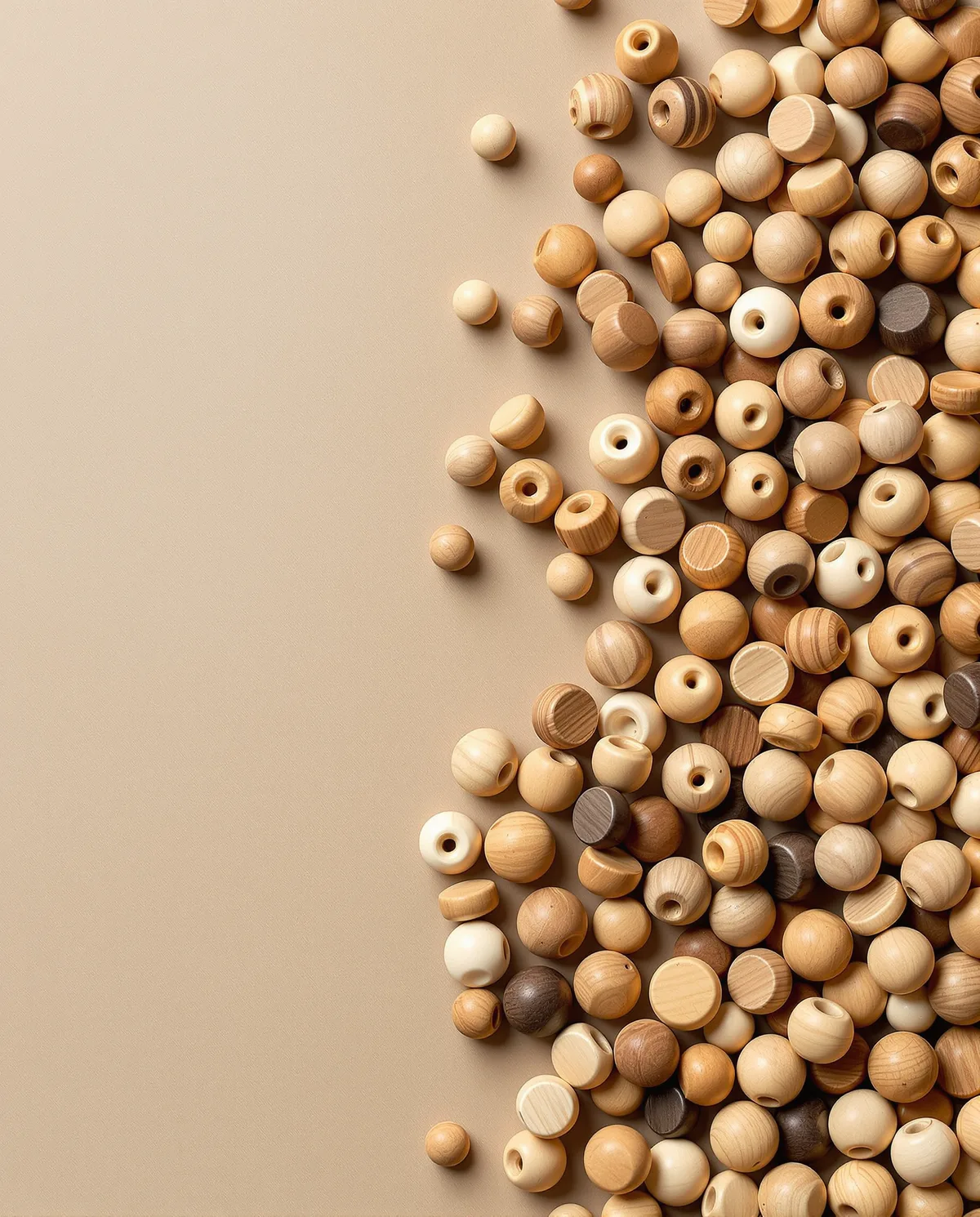
Wood, glass, bone, horn and seed beads together, with no size discipline. Earth tones plus saturated glass is the historically accurate palette; a rainbow reading is equally true to the period and sells better. The hem is uneven or staggered by design. One practical constraint governs the whole mix: the cord has to pass through the smallest drill hole in the build, so hole diameter, not look, sets the shortlist.
A single bead in eight bright colours, strung evenly. It fails because it has the colour of the look and none of the structure: uniform size, uniform pitch, straight hem. The result reads as a party decoration rather than as a doorway. The cheap version of this look is the one most commonly sold, which is also why the real thing stands out so sharply next to it.
This is the hardest production problem in the style library. You cannot instruct a stringer to improvise, because improvisation does not repeat and a reorder arrives as a different product. So the randomness is engineered. We define a bead pool with a fixed proportion of each type, a permitted-position rule so no two adjacent strands share a sequence, and a strand-length band rather than a strand length — which is a hand-work tolerance decision as much as a design one, written onto the stringing sheet. It is the same mechanism as the scatter rule on a dotted panel, applied to the whole build rather than to one accent.
Clearly above it. Six to eight bead lines open at the bench, a sequence that changes strand to strand, and a hem that has to be checked against a band rather than a dimension. The beads themselves are among the cheapest in the catalogue, so the cost levers here are the number of bead lines rather than the bead. The cost conversation here is about how many distinct beads the look really needs — in our experience the effect holds at five and collapses at three.
Student rooms, first flats, festival and event dressing, independent cafés and record shops, and gift retail. It is also the register most often asked for by film and photography sets dressing a period interior, where the panel has to read as 1969 in a single frame.
Keep the structure and narrow the materials. The contemporary version uses two materials rather than five, keeps the uneven drop and the size mix, and drops the saturated multi-colour in favour of one tonal family. What you get is recognisably the same object with a 2027 palette, which is what a buyer can actually sell alongside the rest of a range.
A fixture with no growth. It has not gone away since 1968 and it has not grown either. Treat it as a permanent small line rather than as a seasonal bet, and expect it to sell on nostalgia and on price rather than on design news.
The original was unrepeatable by definition — each panel was a different object. The revival has to repeat, which means every piece of apparent spontaneity in it was decided by someone. That is not a betrayal of the look; it is the only way to manufacture it. What a revival should not do is clean the irregularity up, which is the usual failure: a tidy hippie panel is just a mixed-bead curtain.
None of the fourteen directly, because every one of them is a controlled palette and this look is the absence of one. The nearest are Ember and Honey for the earth-tone reading and Sorbet Parade for the confetti reading, where candy pink, lemon, mint and lilac are mixed so each strand reads as scattered colour. Both work as a starting point, provided the size mix is added back.
It photographs badly flat and well in situ, which is the opposite of most of the style library. A hippie panel on a studio ground looks like a mistake; the same panel hung in a doorway with light behind it looks like the thing people remember. It sells on that single in-situ frame and on nothing else.
Good to know
Steadily rather than fashionably, and mostly into student, festival and gift channels. That is a dependable base rather than a seasonal spike, and it rewards a range that stays available.
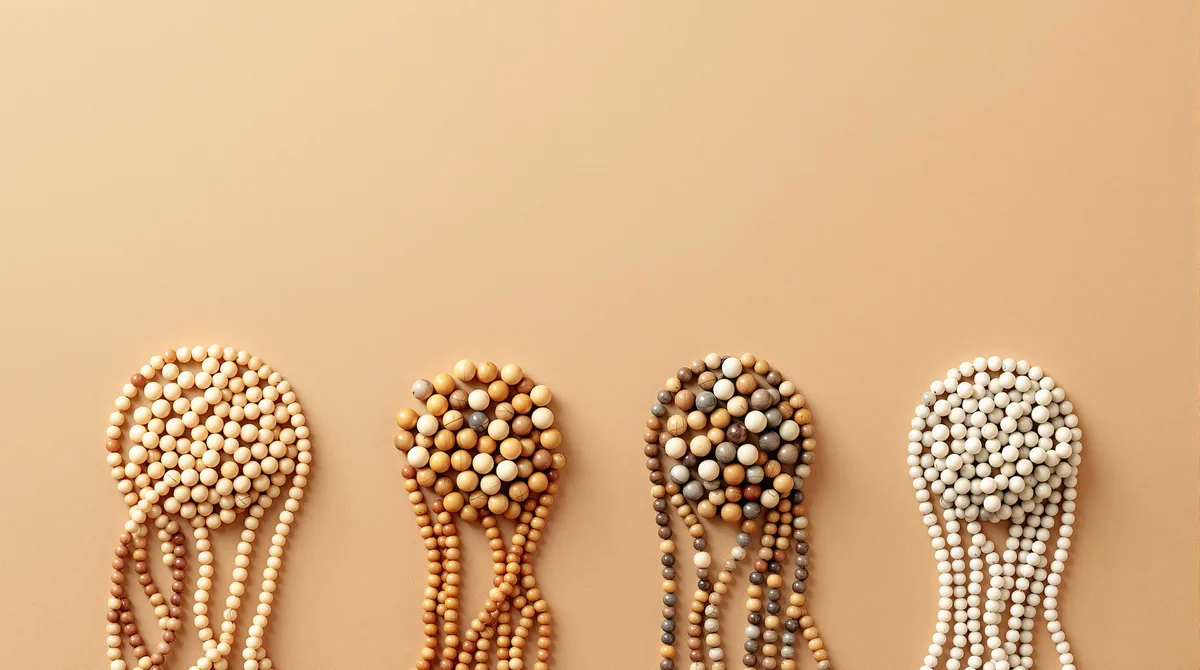
A deliberately mismatched set: turned wood rounds and discs, amber and bottle-green glass, bone and horn tubes, and a run of plain seed beads to fill. The mix is the point, and the practical limit is that one cord has to pass through every drill hole in it.
We match a reference's look, colours and bead sizes in new materials as a vintage-inspired design, and we do not reproduce another brand's protected design. With a genuine 1960s panel the useful information is the proportion of each bead type, which is what you have to specify to make randomness repeat.
All of them, which is the difficulty. There is no palette; there is a tendency — warm earth tones plus saturated glass accents, because that is what was being imported. A rainbow reading is equally authentic and much easier to sell.
More than you would expect. A panel that looks improvised needs more bead lines open at the stringing bench than any other build, and the sequence changes constantly, so nothing can be batched. The beads are cheap and the picking is not.
Full-length door curtains above all. This is the one register that genuinely wants the longest drop available, because the original object was a doorway you walked through and the length is part of the memory. Short formats lose the reference.
Keep exploring
Style
Four rules that make a loose look cohere, and the one that briefs almost always miss.
See the detailIndex
Twenty-four named looks, each described by the material, palette, pitch and hem that actually produce it.
Read moreStyle
The scatter rule from a design in production, and why one aligned row ruins the whole panel.
Specs and sizesStyle
Colour across the strands or down each one — two very different panels, two very different cost sheets.
See the detailStyle
Counted and placed to a rule — about 120 mushroom beads to a thirty-strand portal, up to four a strand, never level across the panel.
See the detail
Start a conversation
Send a reference, a colour chip or a sketch. Minimums are set per design and confirmed per quote; sampling is quoted separately and usually runs 16 to 20 days from an agreed brief.