Guide
Choosing a colourway
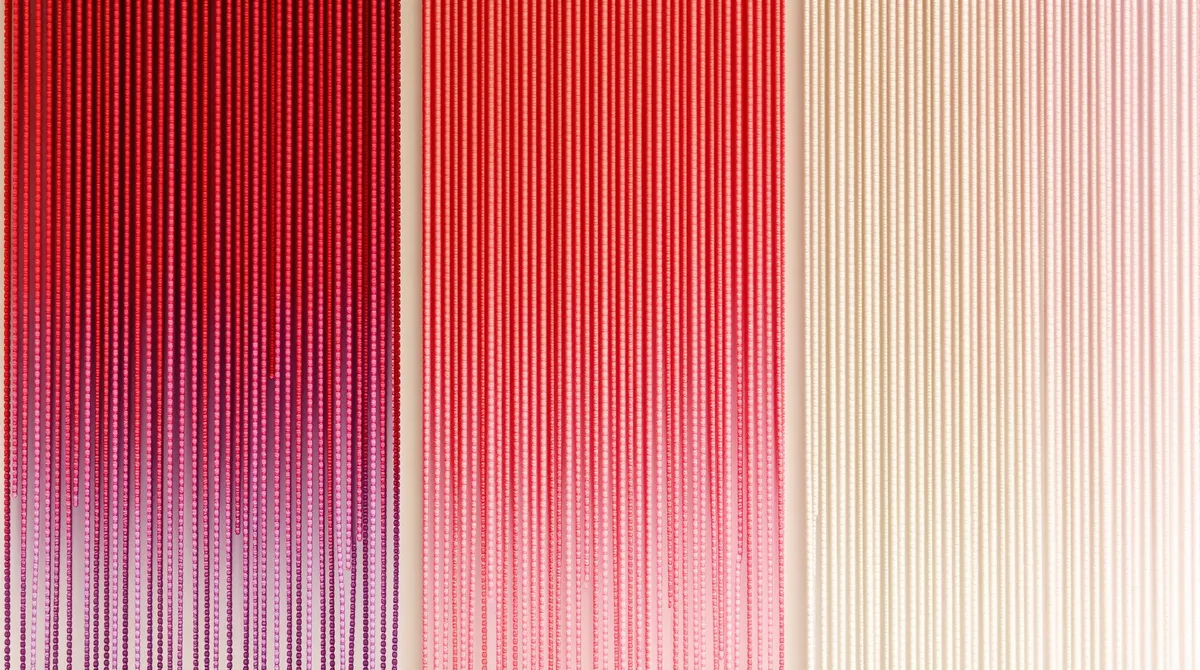
Across the strands or down each one: the distribution decision that matters more than the palette, plus grading by bead size.
How it is made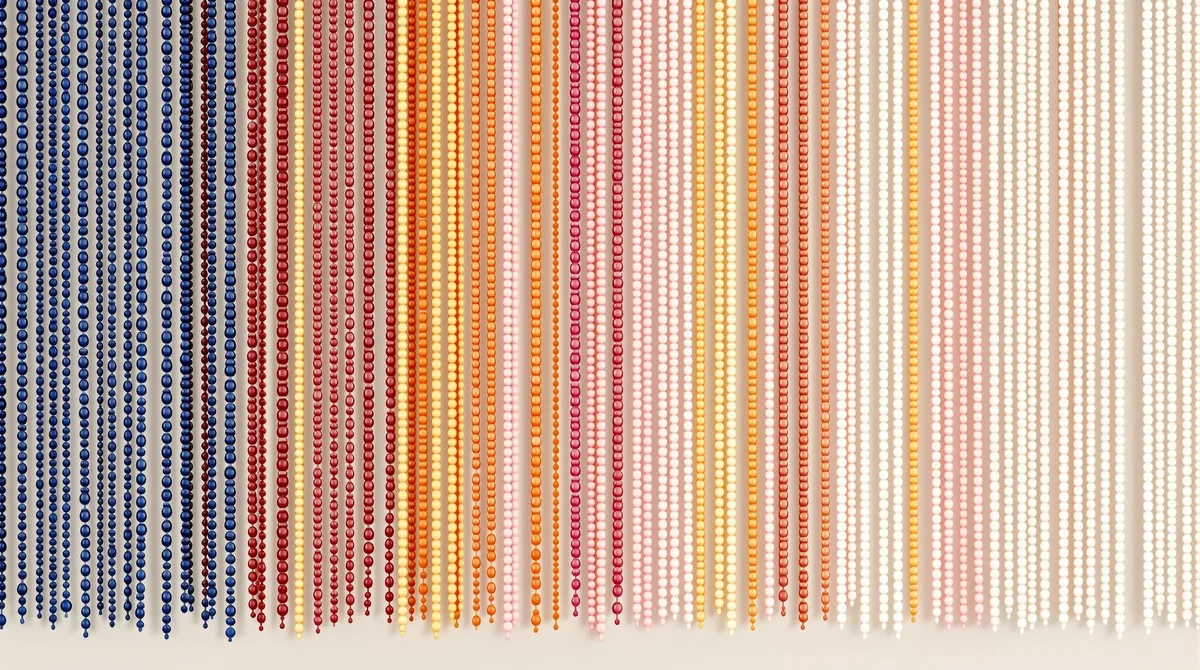
Style · Era
There are two ways to put a rainbow on a bead panel and they produce two unrelated objects. Deciding which one you mean is the first and most consequential line in the brief.
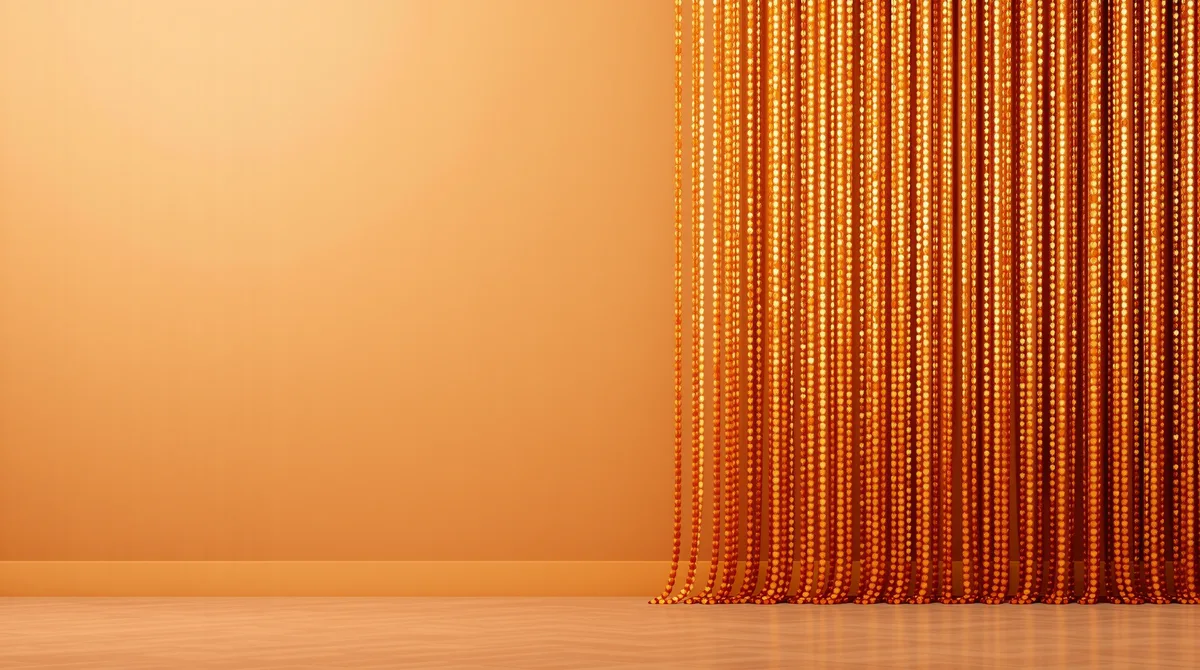
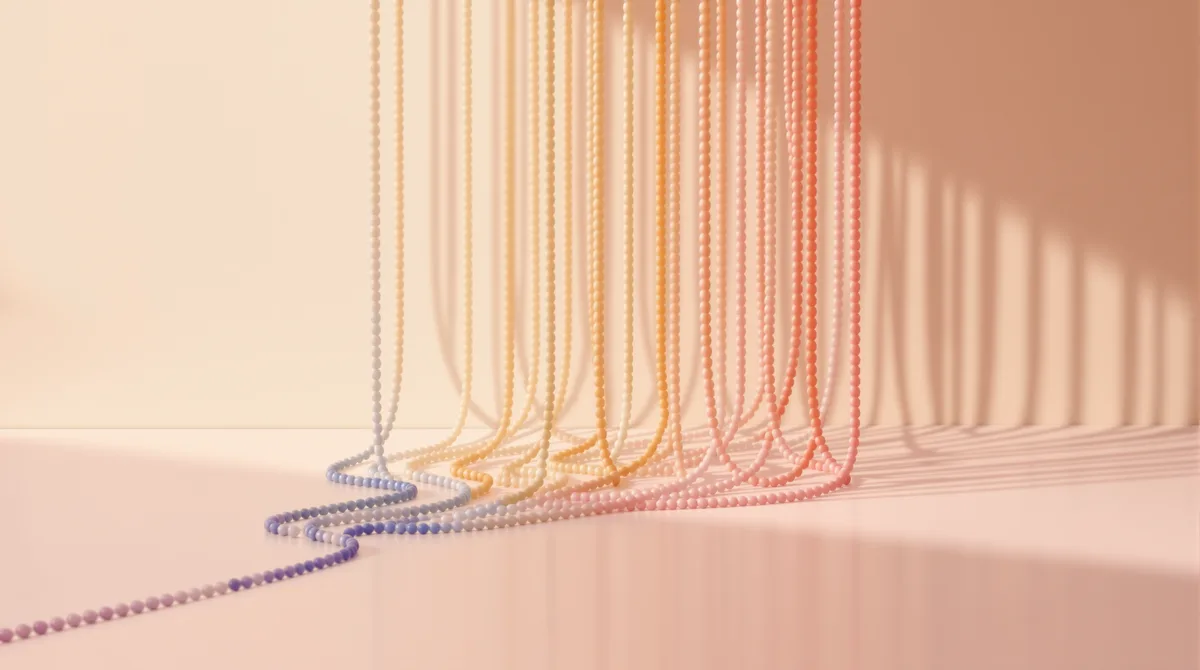
Fourteen bead strands hung side by side, running in order from deep lapis and cobalt through rust and honey amber to sorbet pink and chalk white.
Across the strands means each strand is one colour and the colours run in sequence left to right, which reads as a vertical spectrum and is cheap to pick. Down each strand means every strand carries the full sequence, which reads as horizontal bands across the whole panel and costs considerably more in picking.
From the simplest thing you can do with coloured beads, which is put them in order. Spectrum arrangement needs no design vocabulary and no period reference, which is why it appears independently in children's craft, festival décor, Pride merchandise and high-end gradient glass. In beadwork it has an additional advantage: a panel of strands is already a set of parallel lines, so a spectrum laid across them reads immediately and from any distance.
A legible ordered sequence. The eye has to be able to see that the colours are in order rather than mixed, which means the steps need to be distinct and the sequence needs to be unbroken. Scatter the same colours randomly and the panel reads as confetti, which is a different and perfectly good look, but it is not a rainbow. Order is the whole thing.
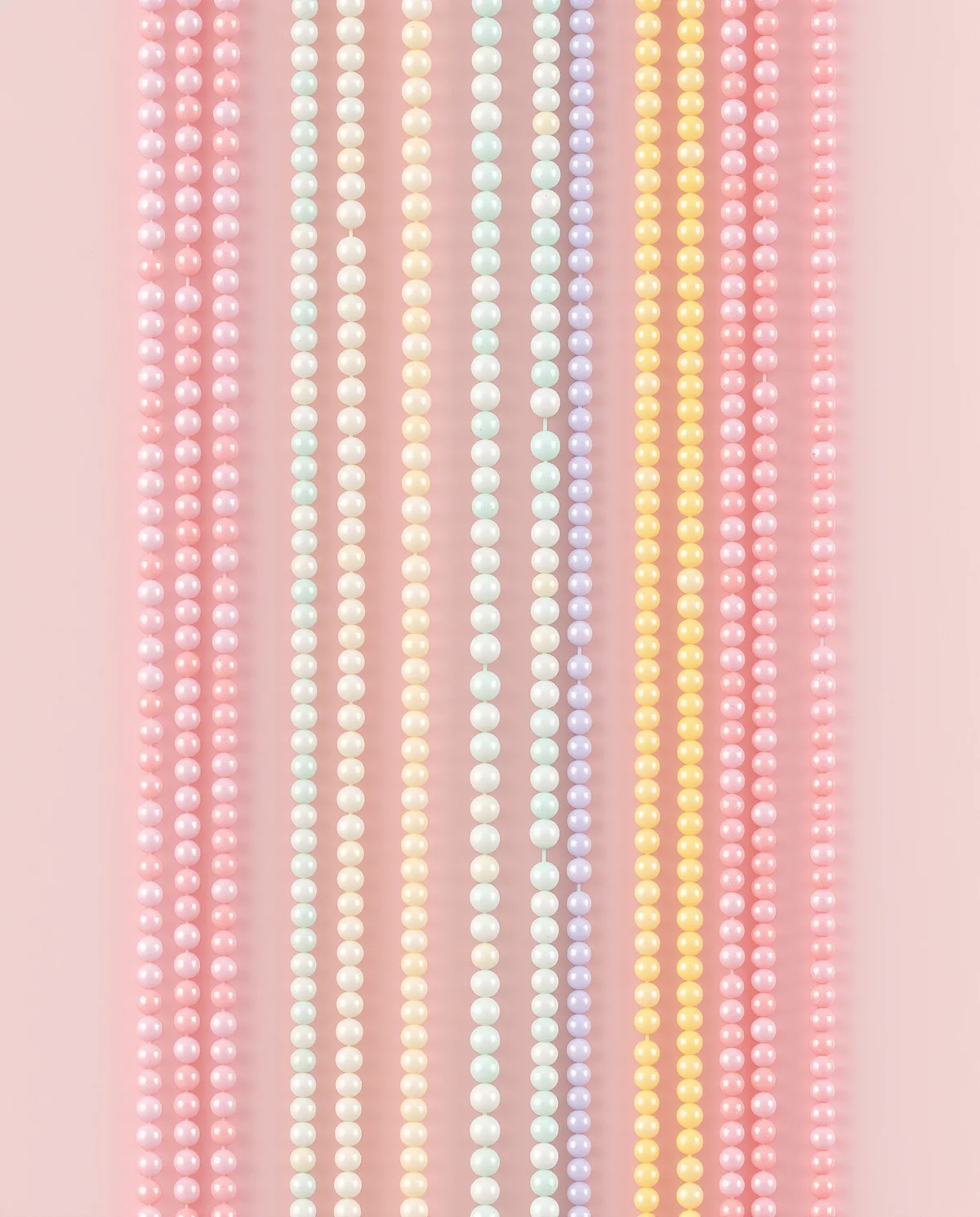
Translucent glass or moulded acrylic dyed to colour. Glass is the better light transmitter; acrylic gives the widest colour range, because the colour is moulded into the body and matched to a Pantone reference or a physical chip. Hems are straight, which is almost always right here: a shaped hem cuts across the colour sequence and confuses it.
A fixture with no fashion cycle at all. Rainbow sells in children's, dorm, gift and festival channels permanently and is almost immune to décor fashion, because the people buying it are not buying a décor look. Treat it as a steady line and expect it to be priced accordingly.
There is nothing to revive — this look has been continuously available since bead curtains have been sold. What has changed is the available precision. A modern panel can have each colour matched to a chip and the sequence written into the count sheet, where an older one took whatever colours came out of the run. That precision is also why a modern rainbow panel can be a design rather than a toy: controlled saturation is a decision now.
Sorbet Parade for the confetti reading — candy pink, lemon, mint and lilac mixed per strand. Honey Hour for the tonal reading, where each strand steps one shade deeper than the last from cornsilk through honey to deep autumn amber. And the honey ombre colour story for the case where what is wanted is a tonal fall rather than a spectrum, because that one is graded by bead size and the colour change lands on the size change.
It photographs flat and head on, backlit, and it is the single most thumbnail-legible register in this library. It sells on the image alone and almost never needs explaining, which makes it a reliable entry product in a range. The construction decision described on this page is invisible in a photograph, which is why it has to be made in the brief rather than discovered at sampling.
Children's and teen home retailers, dorm and student ranges, gift and festival retail, and event companies. It is also a frequent request for photography and display, where a legible colour sequence does a lot of work in one frame.
Seven fully saturated colours in opaque acrylic at a wide pitch. Every element of that is wrong: saturation at full strength reads as plastic, opacity removes the light transmission that makes colour worth having in beads, and a wide pitch breaks the sequence into separate stripes. The cheap version is not cheap material; it is a full-saturation palette.
With a colour-count sheet that names the sequence explicitly. Across-the-strands panels are simple — one colour per strand, in order, and the sheet is a list. Down-the-strand panels need the full sequence written per strand with the step lengths specified, because a gradient that drifts by two beads per strand produces a visibly crooked band across the panel. Dye lots are the other control: a surface-dyed bead shifts between lots, so a reorder of a spectrum panel is approved against the retained sample rather than against the original chip.
Across the strands, barely above it: one pick per strand, several bead lines open. Down each strand, substantially above it: six or seven picks per strand, multiplied by forty or sixty strands, and nothing batchable. The third option — a pooled confetti mix drawn from one hopper — is the cheapest of all three and has been the right answer on more than one brief. One further lever from our own record: on a rainbow seed-bead wall piece, substituting a repeating pattern for a continuous gradient was what brought the cost down without changing the register.
Children's and teenagers' rooms, playrooms, nurseries, dorms, classrooms, and retail or event spaces that want a single cheerful object. In a specified adult interior the register works only in its desaturated form, and at that point it is better described as a tonal panel than as a rainbow one.
Decide by what the panel is for. If it will be seen whole, from a distance, as a single object — a shop window, a display, a wide doorway — run the colour across the strands: the spectrum resolves instantly and the cost barely moves. If it will be walked through, so a viewer is close and sees only part of it at a time, run the colour down each strand: every part of the panel then contains the whole sequence, and the piece reads correctly from six inches away as well as from six feet. Most briefs that go wrong went wrong by choosing on cost and then being surprised by the result.
Good to know
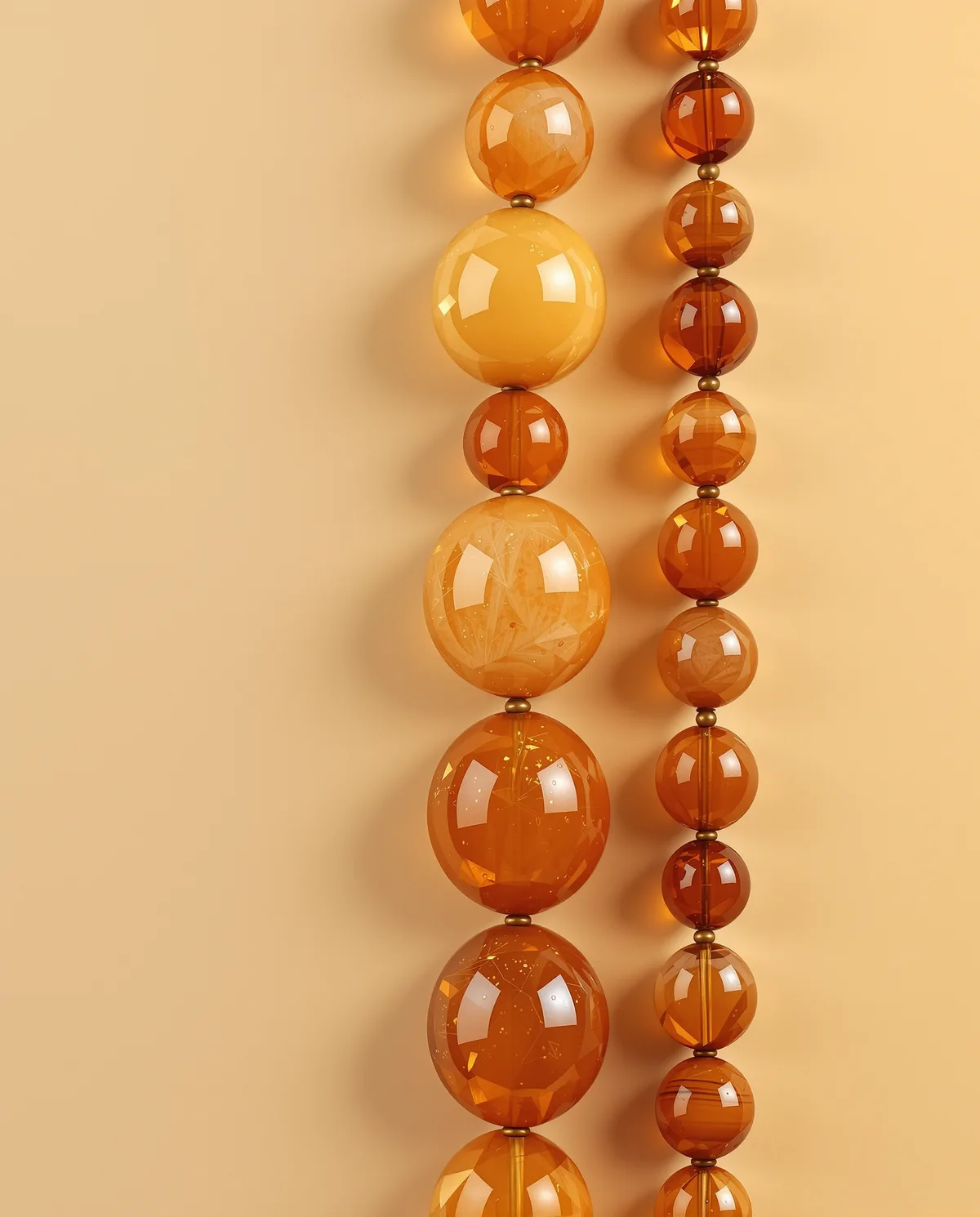
Translucent glass, because a rainbow is a statement about light and an opaque bead stops it. Moulded acrylic dyed to colour is the economical alternative and gives the widest colour range of any material, since the colour is set in the body rather than applied to it.
We match a reference's look, colours and bead sizes in new materials as an inspired design, and we do not reproduce another brand's protected design. With a rainbow reference the critical measurement is how many distinct colours are actually in it — most look like seven and turn out to be four.
Fewer than the brief usually says. A spectrum reads convincingly at five or six steps and gains nothing above that, while each extra colour is another bead line and another pick. If the panel is a doorway rather than a display, five is the practical number.
The across-the-strands version barely does — it is one pick per strand, the same as a plain panel, with more bead lines open at the bench. The down-the-strand version costs considerably more, because every strand needs the full sequence selected in order.
Across-the-strands suits anything wide, because the spectrum needs width to resolve. Down-the-strand suits anything tall, because the bands need drop. Pick the orientation to the format rather than the other way round, and a lot of briefs resolve themselves.
Cut the saturation or cut the count. A full-saturation seven-colour panel is a party decoration. The same construction in five desaturated tones, or in a tight analogous range rather than the full spectrum, is a design. The structure is identical; only the palette moves.
Steadily rather than fashionably: it is a dependable seller in children's, dorm and gift channels rather than a seasonal spike. That makes it a range to keep available rather than a trend to time.
Keep exploring
Guide
Across the strands or down each one: the distribution decision that matters more than the palette, plus grading by bead size.
How it is madeColour story
Cornsilk to deep amber down the drop, with the colour change landing on a change of bead size rather than on a dyed gradient.
Read moreIndex
Twenty-four named looks, each described by the material, palette, pitch and hem that actually produce it.
Read the guideStyle
Turned wood in walnut tones, consistent sizes and straight hems — the quiet register, and why it is quieter than retro.
Compare the optionsStyle
Frosted sea-glass tones, chalk whites and cast capiz discs — and the motif list to leave out.
See the detail
Start a conversation
Send a reference, a colour chip or a sketch. Minimums are set per design and confirmed per quote; sampling is quoted separately and usually runs 16 to 20 days from an agreed brief.