Specification
What hand work holds
What hand-strung beadwork can hold on length, pitch, colour and count — and why a drawing has to say.
Compare the options
Style · Era
Take out the pattern and the palette and what is left is tolerance. This is the cheapest build in the medium to specify and the hardest one to pass.
A beaded panel half in shadow, with a colour chip and a steel rule laid across the lower strands.
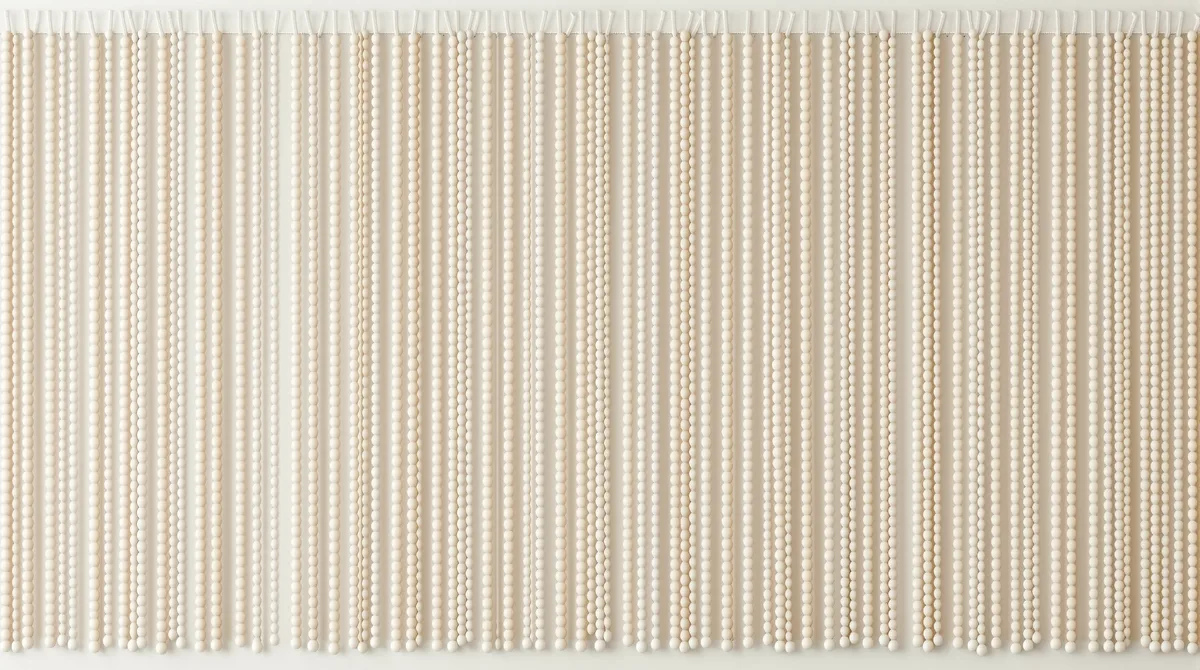
Beadwork can be minimal, and when it is, uniformity becomes the entire design. One bead size in one colour at an even pitch with a straight hem leaves nothing to hide behind: bead diameter variance, hole alignment and strand length drift all read immediately. The quality bar rises as the specification simplifies.
Not from beadwork's own history, which is almost entirely decorative. It arrives from architecture and from product design — the reductive tradition that runs from the Bauhaus through post-war Scandinavian and Japanese interiors to contemporary minimal retail. What that tradition asks of a material is that it do one thing exactly. Beadwork is rarely asked that, and when it is, the result is unlike anything else on this part of the site: a vertical plane of identical units, and nothing happening on it at all.
Repetition without incident. One bead, one size, one colour, one pitch, a straight hem, a plain header. The eye finds no focal point, so it reads the panel as a surface or a screen rather than as an object. Two things reliably break the effect: a gloss finish, which scatters specular highlights across the field and turns uniformity into sparkle, and any variation in strand length, which turns a straight hem into a wavering one.
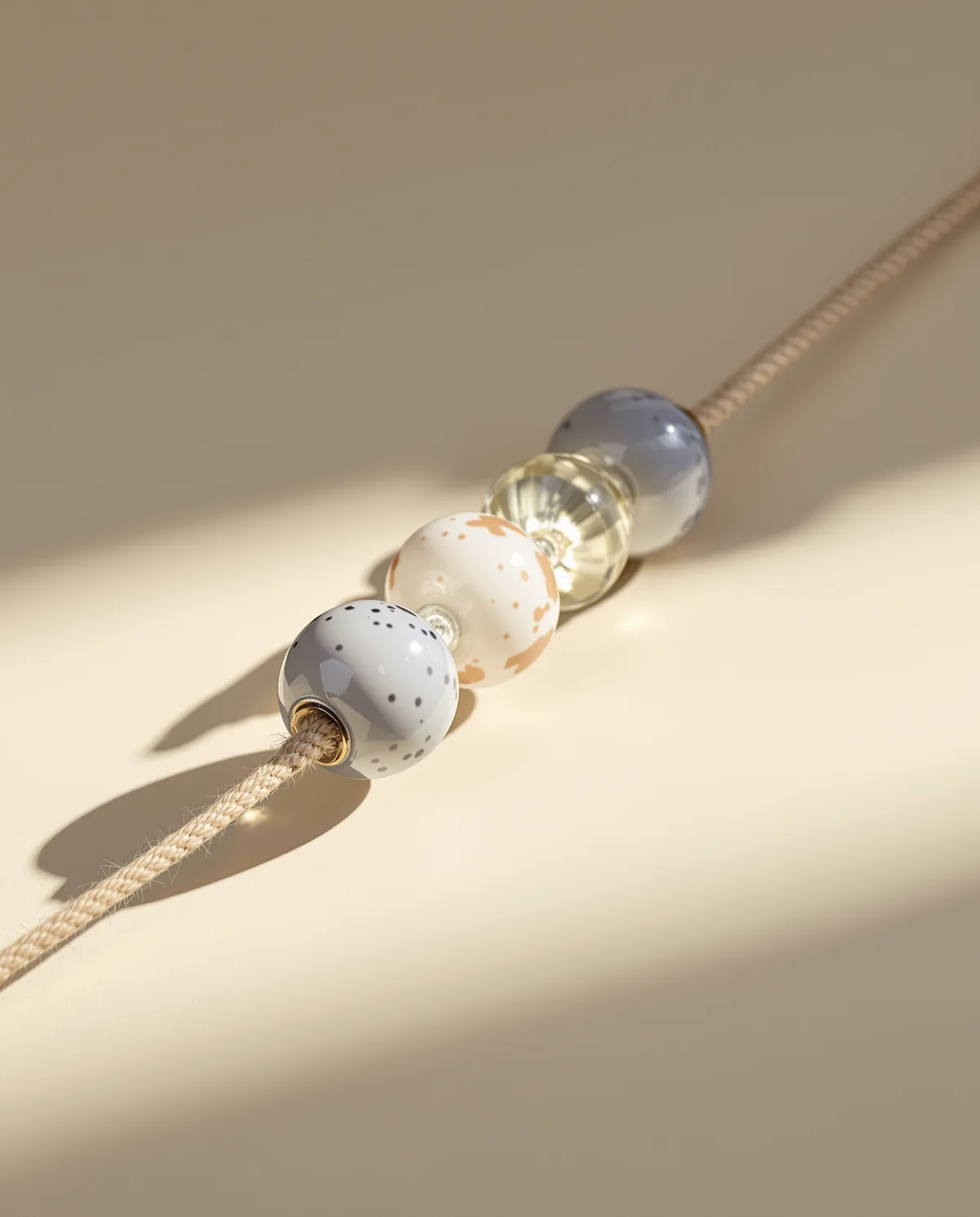
Matte or frosted glass at one bead size, or pale turned wood. One colour, or one colour and a single tonal step of it. Straight hem. The specification that actually decides the result is not in the look at all: it is the bead diameter tolerance, the drill hole alignment and the strand length band, which is why a minimal brief should be written on a stringing specification rather than on a mood board.
There is no original to revive, which makes this the one page in the style library with no period to be faithful to. What exists instead is a lineage of adjacent registers — Japanese threshold curtains, Scandinavian pale interiors, mid-century wood screens — each of which arrives at a similar answer from a different direction. Minimal beadwork is best understood as the construction those three registers share, described without the cultural reference attached.
Only the quietest expressions of two. Sterling Swan in its pearl and chalk-white half, without the mirrored beads, and Moonwater in its palest half, without the midnight blue. Otherwise the library's colour stories are the wrong tool: every one of them is a colour relationship, and this register is the absence of one. The bead materials reference is the better starting point.
It photographs as a plane and sells on the detail crop. A full view of a minimal panel is an almost empty image, which is commercially unhelpful; a macro of a single bead with the cord visible at the drill hole is persuasive, because it shows that the plainness is a quality decision. It sells into specification and almost never into browsing.
Architects and interior designers on residential and small hospitality work, retail interiors, and spa and wellness projects. It is also the register most often arrived at by accident: a buyer asks for a Japanese or a Scandinavian panel, and what they want built is this.
A single glossy acrylic bead at an uneven pitch with a machine-cut hem. All three failures compound. Gloss introduces highlights the design cannot absorb; uneven pitch destroys the only rhythm present; and a hem cut to a nominal length rather than to a checked one wavers across the width. A cheap minimal panel does not look cheap in the way a cheap boho panel does — it looks like an error.
By controlling three dimensions and nothing else. Bead diameter is matched before stringing so the rows sit level. Drill hole alignment is checked, because a bead that sits at an angle on the cord is visible in a uniform field. Strand length is held to a narrow band rather than a nominal figure. Our own Greater Noida house runs first-article and lot inspection against the approved sample, which is the point at which a plain panel either passes or does not.
Material cost is at the floor: one bead line, one colour match, no accent, no shaped hem, and a pitch that can be widened to cut strand count directly. Inspection cost is above average, for the reasons above. The net is cheaper than any patterned build and not as cheap as the bead count suggests, and a buyer who budgets on bead count alone will be surprised by the inspection line.
Thresholds in specified interiors, retail changing areas, treatment-room entrances, stair voids, and anywhere a sight line needs breaking without a visual event. It suits even, diffuse light. It does badly in a room with strong directional sun, which throws bead shadows across the floor and introduces exactly the incident the register removes — although that same effect is the whole argument on the texture-wall pages.
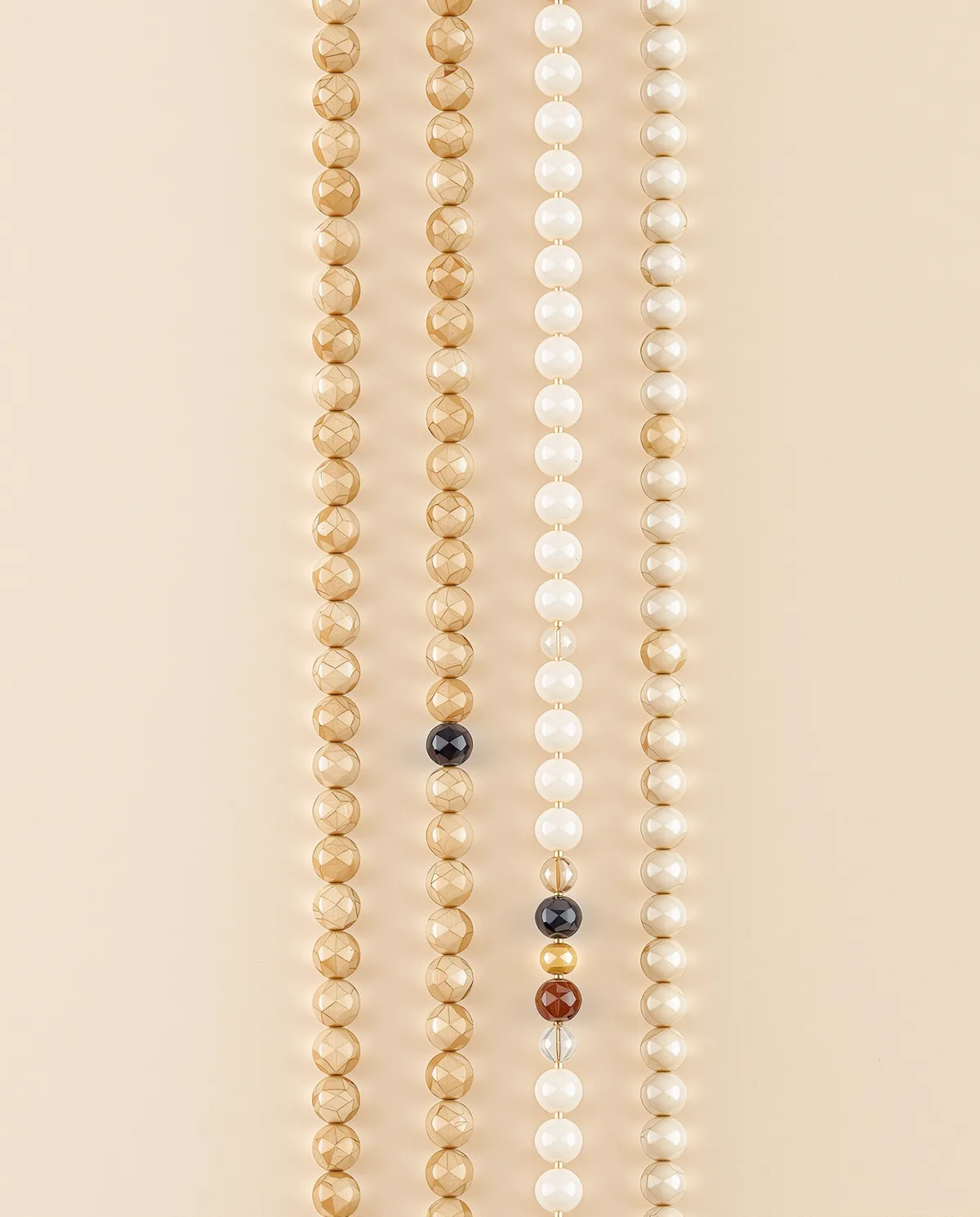
Push the pitch much wider than convention. Standard practice is around two centimetres between strands; at three or four the panel stops being a surface and becomes a set of lines in space, with the room visible between them. That is the single most effective move available in this register, it costs less rather than more because the strand count falls, and it is the version a specifier almost always prefers once they have seen it.
Good to know
There is no costume risk in this register and a different risk instead: looking unfinished. The fix is to make one decision visible — a precisely wide pitch, a single deliberate hem curve, or a header finished like joinery — so a viewer can see that the plainness was chosen.
It arrives through interiors and architecture briefs rather than through retail search, and most briefs that describe a Japanese or a Scandinavian look are asking for this register under a different name.
A single matte or frosted glass bead at one size, or a pale turned wood bead. What matters more than the material is the consistency of the bead: matched diameters and aligned drill holes, because nothing else in the design distracts from them.
We match a reference's look, bead size and finish in new materials as an inspired design, and we do not reproduce another brand's protected design. Minimal references are the simplest to match and the hardest to improve, because there is nothing to adjust except dimensions.
One. Chalk white, oyster, charcoal, indigo or a single pale wood tone. The register tolerates a second colour only as a tonal step of the first, and the moment a third appears the panel has moved into a different style.
It is the plain strand, so material cost sits at the floor. Inspection cost does not: a uniform panel has to be checked more carefully than a patterned one, because a patterned panel hides small variance and a plain one broadcasts it. Expect the saving to be in beads rather than in total.
Keep exploring
Specification
What hand-strung beadwork can hold on length, pitch, colour and count — and why a drawing has to say.
Compare the optionsIndex
Twenty-four named looks, each described by the material, palette, pitch and hem that actually produce it.
Open the referenceStyle
Lantern and zellige geometry, jewel tones and metal accents — and why the influence is named rather than the country claimed.
See the detailStyle
Zardozi bead embroidery, wire-wrapped beadwork and glass-bead drawing — the techniques behind the phrase, and where each is made.
See the detailStyle
Pale wood and chalk glass at a wide strand pitch — the register where spacing matters more than colour.
Read the guide
Start a conversation
Send a reference, a colour chip or a sketch. Minimums are set per design and confirmed per quote; sampling is quoted separately and usually runs 16 to 20 days from an agreed brief.