Specification
Bead sizes and stringing specs
Diameters, drill holes, cord selection, strand counts and format dimensions — the sheet to copy into a tech pack.
Read the guide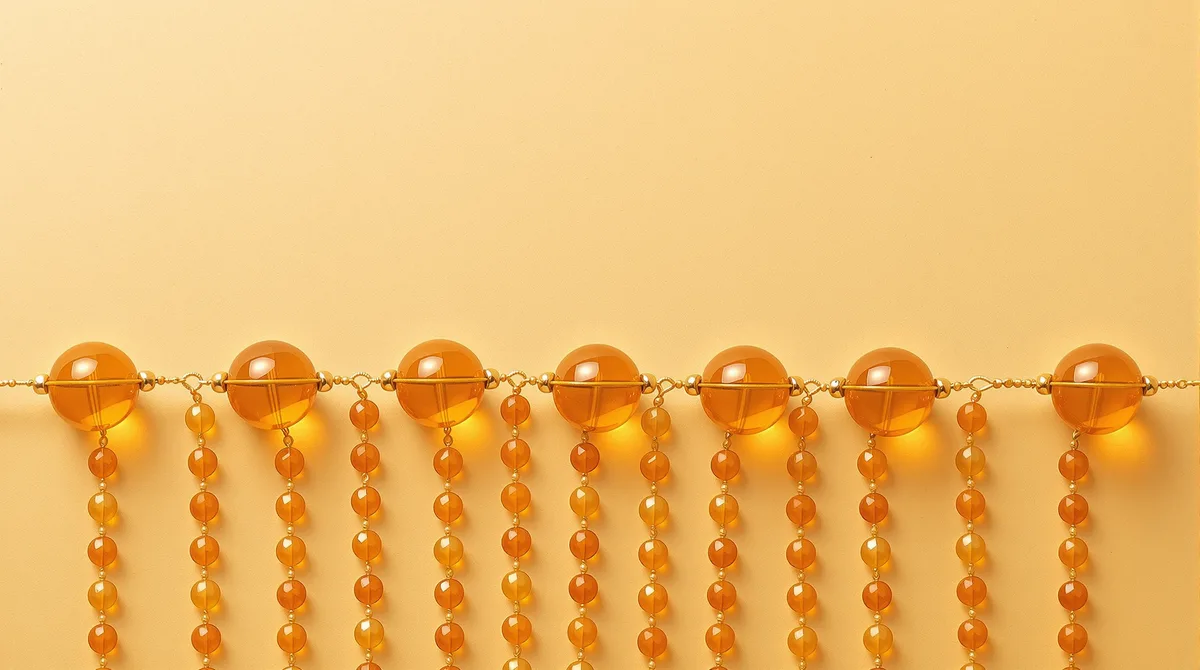
Guide · Choosing
Bead size is the single most consequential number on a bead-curtain brief, and the one most people leave to the maker. It sets the resolution, the weight, the hang and the hours.
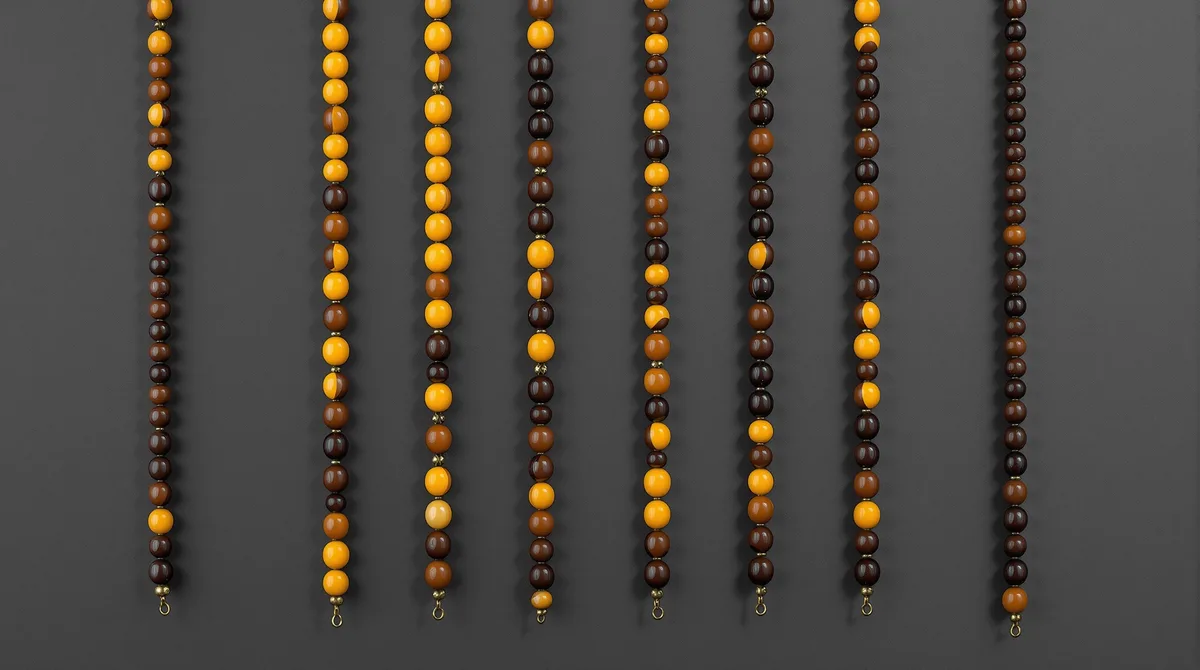
Hand-strung strands in amber glass, every cord running from a large bead at the head down through steadily smaller beads to the hem, so the change of bead diameter reads as a…
Bead size sets four properties at once: how fine a pattern the panel can carry, what it weighs, how straight each strand hangs, and how many hours it takes to string. A larger bead fills the drop with fewer units, so it is lighter work and lower cost; a smaller bead gives finer resolution and far more stringing time.
Four things at once, which is why it is the most consequential single number on a brief.
Resolution — how fine a pattern the panel can carry. Weight — what the fixing has to hold and what the strand needs to hang true. Hang — whether each strand falls straight or drifts. And hours — because stringing time is per bead, so the bead count is the labour.
No other decision touches all four. Material changes weight and sound; colour changes nothing structural; pitch changes coverage and cost. Size changes everything.
Arithmetic, applied twice. Double the bead diameter and roughly half as many beads fill the same drop. And because stringing time is per bead rather than per centimetre, the labour halves with the count.
This is not a theoretical lever. Our 2025 beaded portal development ran through iteration after iteration before it hit its target, and the change that got it there was using two bead sizes in one strand rather than one. A companion design saved real money by simplifying the assembly rather than altering the appearance.
At a metre's viewing distance, a 10 mm and a 14 mm bead of the same colour are close to indistinguishable. The cost difference is not.

Because it is a hard constraint, not a preference. Cord is chosen from the smallest drill hole in the build. If the cord will not pass the smallest bead, the panel cannot be assembled — there is no workaround and no compromise.
Four to five millimetres is the usual hole ask for cord-strung work, and it is what customers developing beads with us specify by name. Below that you are into seed-bead territory with fine cord, which strings beautifully and gives up strength. Above it the hole starts to show at the ends of the bead.
A brief that gives outside diameters and omits holes is incomplete, and it is the most common omission there is.
As fine as the bead is small, and seed beads behave almost like pixels. A motif nine to twelve centimetres across can carry real drawing in seed beads, because there are enough individual units to describe a curve.
In 20 mm rounds the same motif is a handful of blocks. That is not a defect — a large-bead panel is a different kind of image, built from scattered accents rather than from drawn shapes — but it sets a floor on how much detail the design can hold.
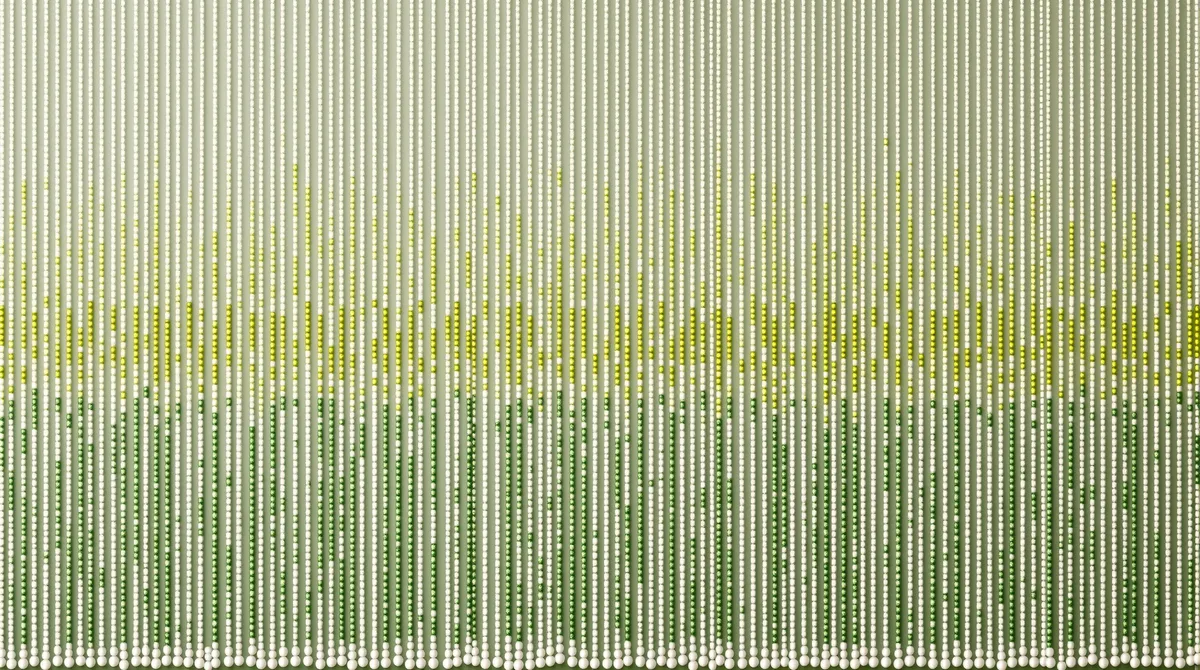
Between the two sits the most common real answer: a seed-bead base carrying large feature beads. Our Naia curtain runs lime glass seed-bead strands with spaced forest-green rounds; the Mushroom portal runs a cream seed-bead base with small amber accents and about 120 glass mushroom beads scattered through it.
Weight per strand is what pulls a strand true, and bead size is half of that figure — the other half is material density. Glass sits near 2.5 g/cm³, acrylic near 1.2, most woods below 1.
So a large glass bead gives the most weight per centimetre of drop and the straightest hang. A small acrylic or bamboo bead gives the least, and a strand built from them will drift in any air movement and settle slowly.
The standard fix is a weighted end bead: a deliberately heavier final bead that pulls the strand down. On light materials it is not an option, it is the specification.
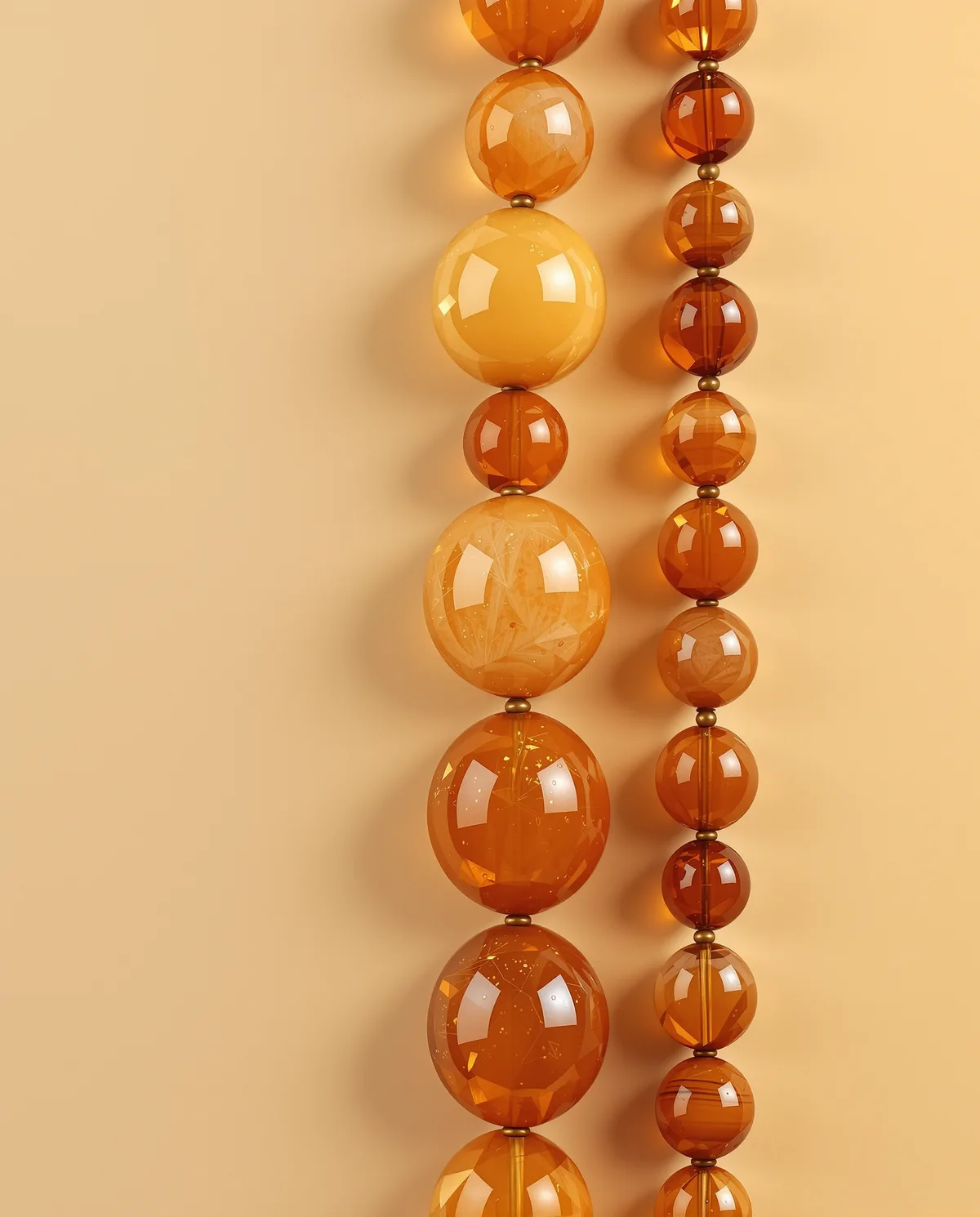
Yes, and it produces the best effect in the category. Our honey ombre colourway grades three bead sizes with three tones: cornsilk on the smallest, honey on the medium, deep autumn amber on the largest. Colour and scale change together.
The eye reads that as depth rather than as a stripe, and no single-size panel can imitate it however carefully the dyes are chosen. It also has a physical benefit: the heaviest beads end up at the hem, where the weight does the most good.
The reference figure is a densely patterned 90 × 200 cm curtain holding about 11,800 beads, each placed by hand. That is a published production figure.
For comparison, the design library's open-pattern 90 × 200 cm panel at 40 strands comes out around 3,100 beads, and a valance at 120 × 30–40 cm around 900 to 2,000 — both from the current design library, and best read as proportions rather than as counts.
The useful takeaway is the ratio. Bead size and pattern density together move the count by a factor of three or four on the same dimensions.
Four lines, per bead type. Outside size. Shape. Drill hole. And whether it is the main bead or an accent, with how many accents per strand if it is the latter.
If a cost target matters, say so and say it early, because bead size is the lever that will be pulled to meet it — and it is much better to agree that trade on a drawing than to discover it on a sample.
A seed bead curtain is the fine end of the scale and the page that shows what resolution actually buys. Mixing bead materials is how most real designs resolve the trade, and bead curtain pricing explains why size is the lever a cost target pulls first. A colourway covers the grading effect that makes colour change on scale. Light and beadwork explains why size changes the character of the light rather than the quantity. For the holes, cords and strand lengths that a size decision constrains, stringing specifications has the figures.
Good to know
There is no single right answer, but the practical band for a full-length door panel runs from about 8 mm up to 20 mm or more for a feature bead. Our dotted oval beads are 13 by 22 mm and work as scattered accents on a seed-bead base; a panel built entirely of 20 mm wood rounds is a different object again.
The hole, because it is a hard constraint rather than a preference. Cord is chosen from the smallest drill hole in the build, so if the cord will not pass the smallest bead the panel cannot be assembled. Four to five millimetres is the usual ask for cord-strung work.
Yes. Double the bead diameter and roughly half as many beads fill the same drop, and stringing time is per bead rather than per centimetre. Our 2025 beaded portal development took six or seven iterations to hit its target, and the change that did it was moving to two bead sizes in one strand.
Routinely, and it is the most useful trick in the book. A large bead carries the drop cheaply, a small bead carries the detail where it shows, and graded sizes produce effects a single size cannot — our honey ombre colourway grades small, medium and large beads so the colour changes on a change of scale.
Seed-bead scale, which is a couple of millimetres. The Naia curtain is built on lime glass seed-bead strands with spaced forest-green rounds. A seed-bead panel gives the finest pattern resolution in the category and carries the longest stringing time by a wide margin.
It changes the character of the light rather than the amount. A large translucent bead acts as a single lens and throws a distinct bright point; a seed-bead strand scatters light into a soft glow. At the same strand pitch, the quantity of light reaching the room is broadly similar.
Significantly. Weight per strand is what pulls a strand true, and a light strand drifts. A larger bead in a dense material gives more weight per centimetre of drop, which is why glass panels hang straightest. On light materials, a heavier end bead is specified for exactly this reason.
Keep exploring
Specification
Diameters, drill holes, cord selection, strand counts and format dimensions — the sheet to copy into a tech pack.
Read the guidePillar
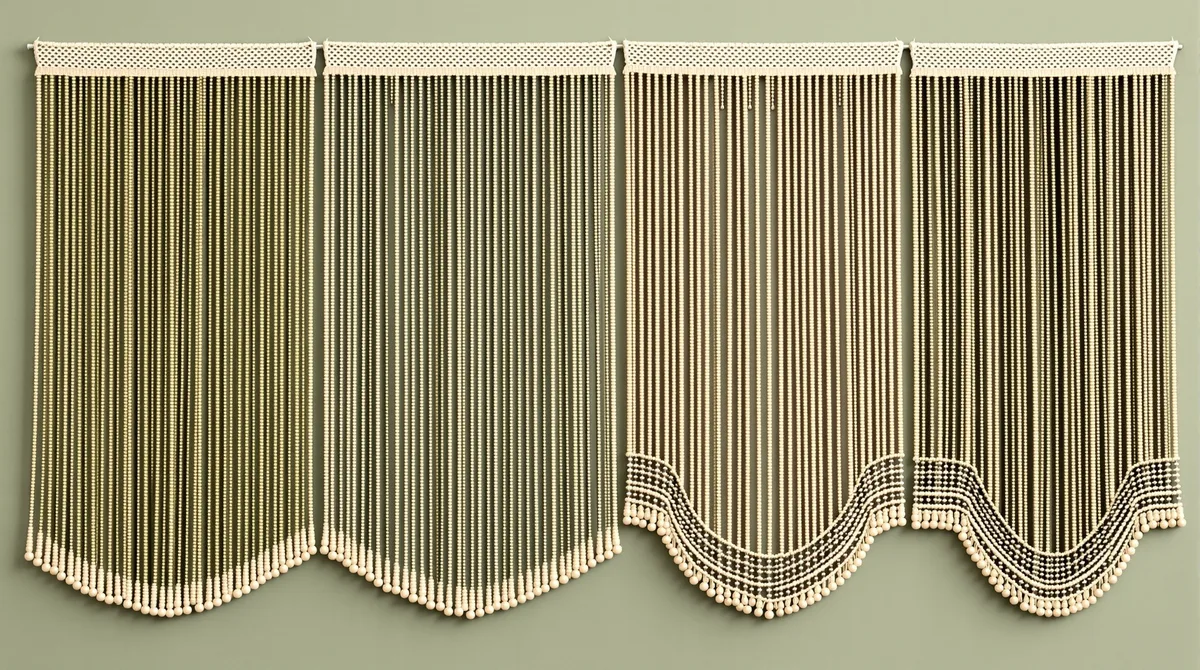
Door curtains, portals, café lengths and valances: the standard sizes, the strand counts and the one question each format answers.
See the detailGuide
Nine profiles, what each one suits, and why a shaped hem costs no more than a straight cut.
Specs and sizesGuide
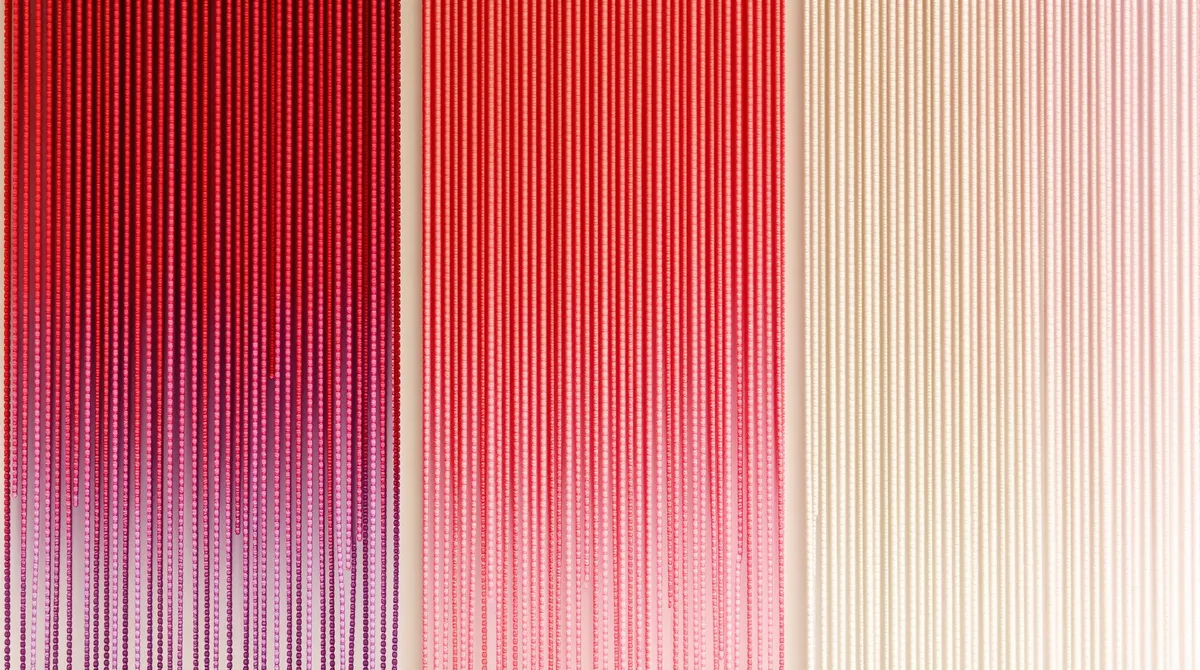
Across the strands or down each one: the distribution decision that matters more than the palette, plus grading by bead size.
Compare the optionsGuide
Breaking light rather than blocking it: what a bead panel does to daylight through the day, and which beads come closest to shade.
How it is madeGuide
Hundreds of beads to a strand: the finest colour resolution in beadwork, and the longest stringing time in the category.
Read the guide
Start a conversation
Send a reference, a colour chip or a sketch. Minimums are set per design and confirmed per quote; sampling is quoted separately and usually runs 16 to 20 days from an agreed brief.