Material
Plated bead accents
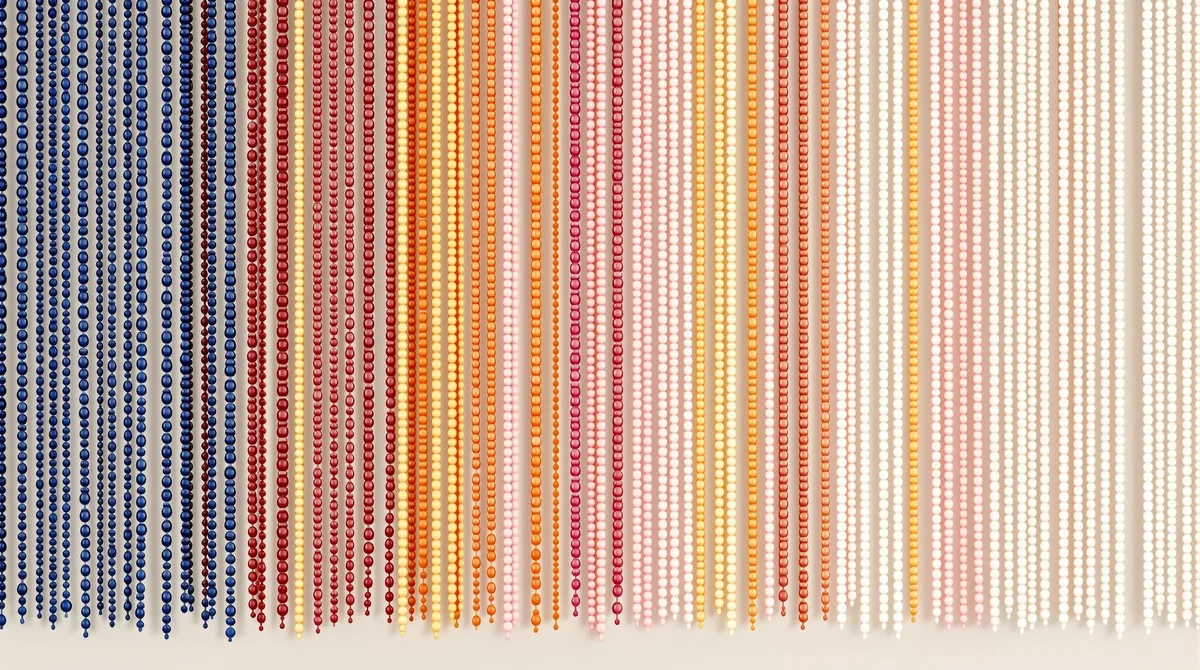
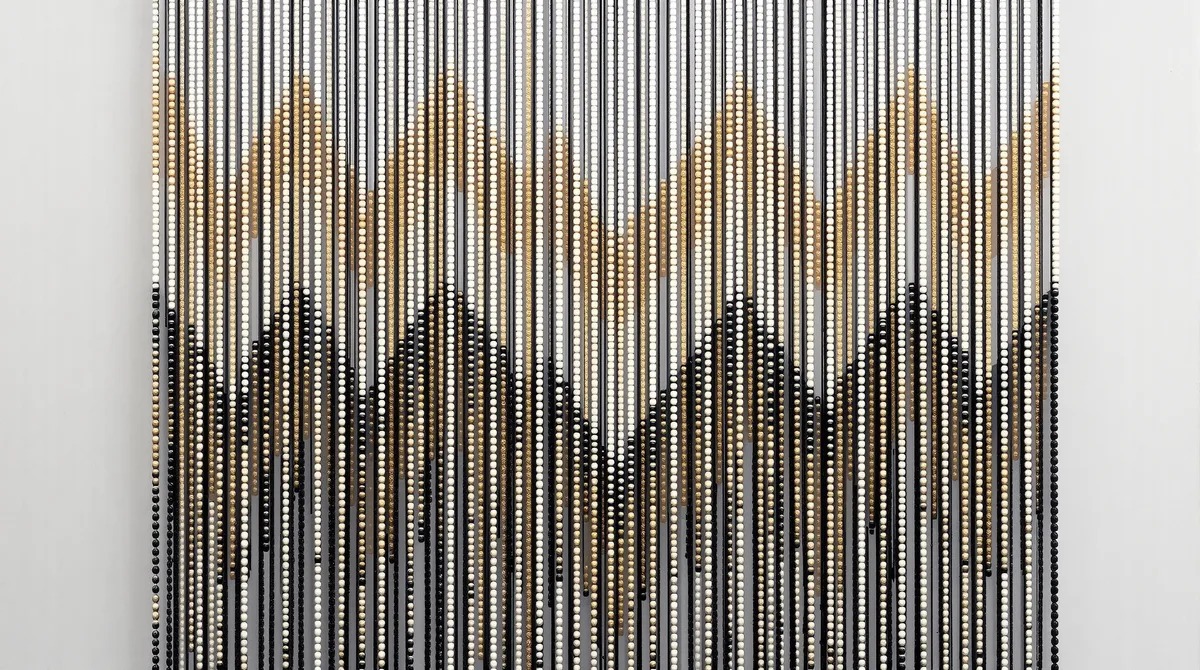
Finished and plated in our own metal plants: eight standard finishes, why metal reads as an accent rather than a field, and what plating does to wear.
Read the guide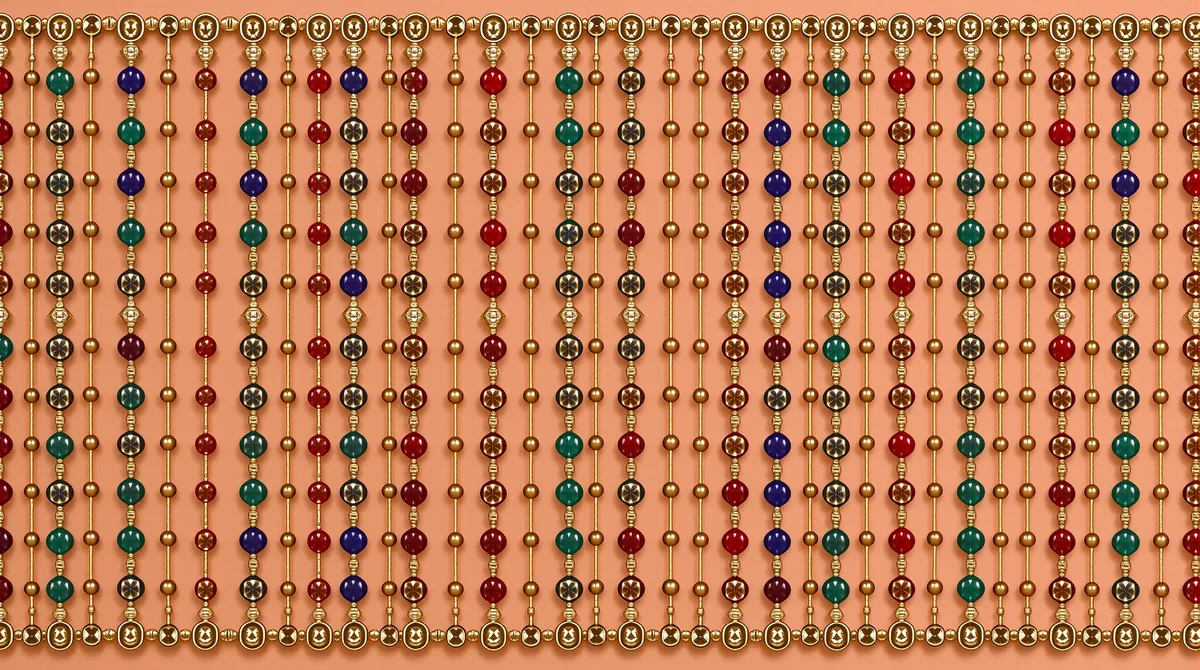
Style · Era
The phrase describes a Western shorthand, not a Moroccan bead tradition. Said plainly, that makes the brief easier to answer and the object more honest.
A beaded panel of small pierced antique-gold metal beads alternating with jewel-toned glass rounds in emerald, ruby and cobalt, the metal lining up into a strict geometric lattice.
Buyers asking for Moroccan beadwork are describing three things: interlaced lantern and tilework geometry, a jewel palette of ruby, cobalt, emerald and amber, and a brushed or antique metal accent. None of those comes from a Moroccan bead tradition, so we name the influence rather than claiming the craft.
From two Moroccan crafts, neither of which is beadwork. The first is pierced and soldered lantern metalwork, which produces the interlaced star and polygon figures and the pattern of light they throw. The second is zellige, the cut-tile geometry of Moroccan and wider Maghrebi architecture, which produces the interlacing itself. A Western décor market compressed both into a shorthand — jewel colour plus a star plus a metal glint — and that shorthand is what arrives in a brief. Being clear about the lineage is not pedantry; it is what lets us answer the brief.
Three signals. An interlaced geometric figure rather than a simple repeat: an eight-point star, an overlapping polygon, a pattern that crosses over itself. A jewel palette in transmitted light. And a metal note — a brushed brass or antique gold spacer — placed often enough to catch light down the panel. A panel with the palette and no geometry reads as generic jewel-tone beadwork; the interlacing is what carries the reference.

Translucent pressed glass in ruby, cobalt, emerald and amber, with plated metal spacers. Eight standard finishes are available — matte gold, matte black, rose gold, brilliant gold, champagne gold, antique silver, brilliant silver and matte silver — and antique or brushed is almost always the right one here, because a brilliant plating reads as costume. Hems are straight or shallow-scalloped; an elaborate hem competes with the geometry.
A panel of bright moulded acrylic jewel beads with gold-coloured plastic spacers and a tasselled hem. It fails on the metal above all: a plated brass bead and a gold-coloured plastic bead are indistinguishable in a photograph and completely distinguishable in a room, because one reflects like metal and the other does not. The geometry usually fails too, because a cheap version resolves it at too low a resolution.
With a patterned strand layout, and a more demanding one than usual. Interlacing means a single strand carries fragments of two different figures, so the sequence on each strand is unique and cannot be batched. The artwork is converted to a grid where every bead position carries a colour, and the stringer works strand by strand against the sheet. A reorder is identical because the sheet is, not because anyone remembers the pattern.
Well above it. The two drivers are the number of colour changes per strand and the metal content. Interlaced geometry maximises the first. The practical lever, as on the geometric designs page, is to enlarge the figure: one big star across a whole panel costs far fewer picks than a repeating field of small ones, and reads better.
Restaurants, bars, shisha and tea rooms, spa and hammam-style treatment spaces, and retail interiors with a strong fit-out concept. Domestically it suits a single feature threshold rather than a whole scheme. It needs plain surrounding surfaces, because it is a loud geometry and a patterned floor will fight it.
Enlarge the figure and remove the metal from the field. The current version of this register is one large interlaced figure at near-architectural scale, in two colours, with the metal reduced to a single line near the header rather than scattered down the panel. That reads as contemporary geometric design with a clear lineage, rather than as a themed interior.
A fixture in hospitality fit-out and a cycle in retail. The restaurant and bar market returns to this vocabulary regularly because it signals a specific hospitality register; home retail picks it up for a season at a time. Build it as a project capability rather than as a range.
There is no bead original, so the comparison is with the source crafts. Moroccan lantern metalwork and zellige are living trades with their own apprenticeships, workshops and standards, practised by people whose work we are not reproducing and would not claim. What we build is a bead panel that borrows a geometry, and the way we describe it says exactly that. A brief asking us to present the work as Moroccan-made is one we decline.
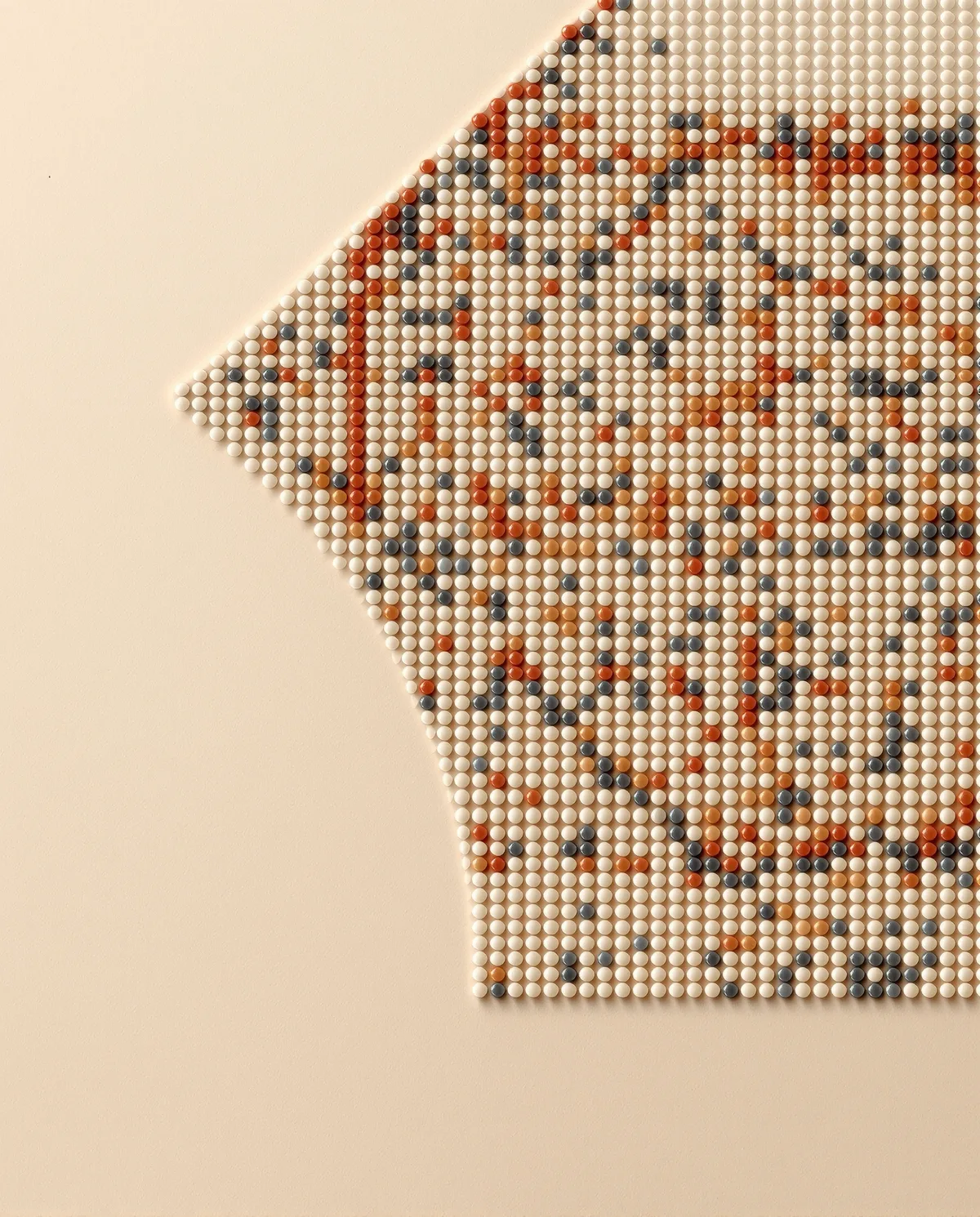
Lapis Hour for a cooler reading — deep lapis and cobalt through slate to pale sky — and After Hours for the darkest one, where jet and smoke crystal sit against antique gold. Neither is a jewel-spectrum palette, which is deliberate: the two-colour-plus-metal version of this register is the one that survives contact with a real interior.
It photographs flat, head on, so the geometry resolves, and it benefits from a raking light that catches the metal. It sells on the geometry at thumbnail scale and on the metal at close range, which means two frames rather than one. Commercially it closes in fit-out conversations and rarely on a shelf.
Hospitality designers and fit-out contractors, independent restaurant and bar operators, and event and display companies. In our own brief flow this vocabulary arrives attached to a venue concept rather than to a product line, which is why the sensible commercial shape is a project capability with a small set of reference geometries rather than a stocked range.
Good to know
Ruby, cobalt, emerald and amber, in translucent glass, with brushed brass or antique gold as the accent. Keep it to two jewel tones plus the metal: the vocabulary is already visually busy and a full jewel spectrum tips it into a themed interior immediately.
Yes, on two counts. Interlaced geometry needs a bead map and a per-strand sequence, which costs in picking operations. And a metal bead is finished and plated in our Moradabad plants rather than drawn as glass, so the accent is a real line in the build rather than a free detail. Where it is engineered is bead size, strand pitch and how much of the panel the metal accent has to cover.
Large flat ones. A whole-panel geometry needs the panel, so a wall hanging or a tall portal works and a valance does not — a short format cuts the geometry off before it resolves. If the brief is short-format, use the palette and the metal and drop the geometry.
Use one geometry at one scale and stop. The failure mode is accumulation: a star pattern, a scalloped hem, tassels, metal coins and five jewel tones on one piece. One large geometric figure, two colours and a single metal finish is the whole discipline.
It reaches us through hospitality and interiors briefs — restaurant and bar fit-outs most often — rather than through retail search, and we treat it as a specification register.
Translucent pressed glass for the field, because jewel tones only read when light passes through them, and plated metal beads for the accent. Our metal beads are finished and plated in our own Moradabad plants, which is where the business started as a family metal-finishing operation.
Keep exploring
Material
Finished and plated in our own metal plants: eight standard finishes, why metal reads as an accent rather than a field, and what plating does to wear.
Read the guideIndex
Twenty-four named looks, each described by the material, palette, pitch and hem that actually produce it.
View the rangeStyle
Colour across the strands or down each one — two very different panels, two very different cost sheets.
Specs and sizesStyle
Counted and placed to a rule — about 120 mushroom beads to a thirty-strand portal, up to four a strand, never level across the panel.
Specs and sizesStyle
The strand grid is anisotropic, which decides which checks, chevrons and waves survive at a given bead size.
Specs and sizes
Start a conversation
Send a reference, a colour chip or a sketch. Minimums are set per design and confirmed per quote; sampling is quoted separately and usually runs 16 to 20 days from an agreed brief.