Manufacturing
Bead and thread embroidery
The couched bead-and-metal-thread technique behind the flat beaded objects: what it is, what it can depict, and the forms built with it.
View the range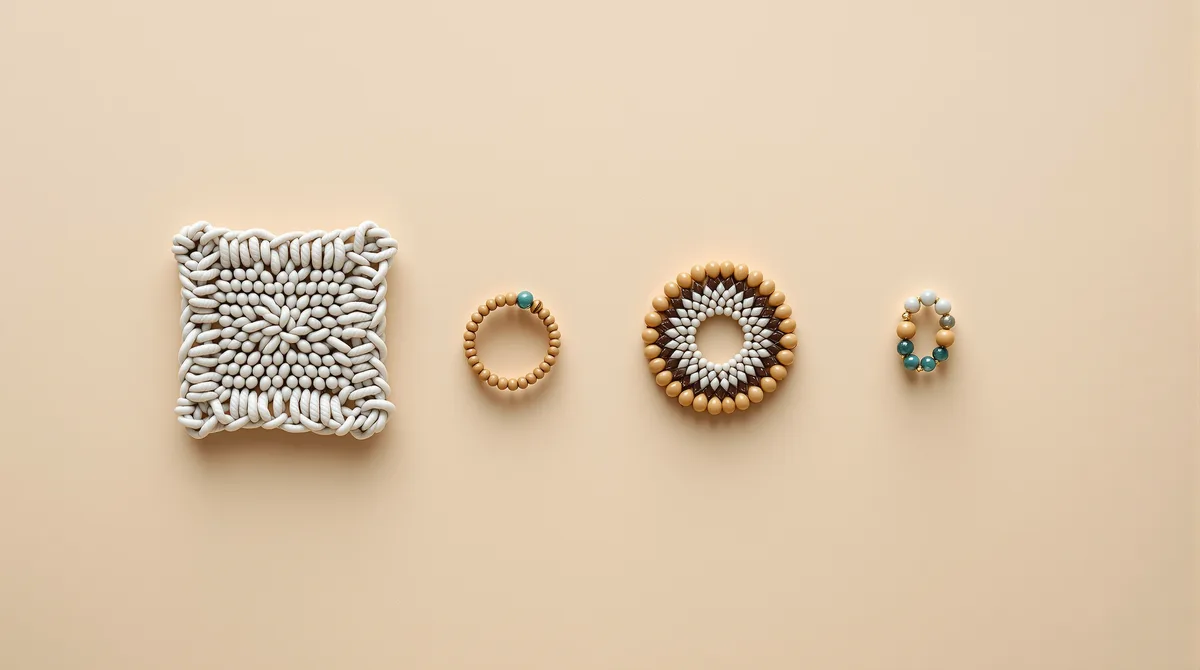
Style · Era
This is not a look. It is a group of named crafts tied to named towns, and the useful version of this page tells you which technique you are actually asking for.
Four small beadwork samples laid out in a row: a knotted macramé square, two wire-wrapped beaded collars and a disc of couched bead embroidery.
The phrase names techniques and places rather than a style. In practice it means bead-and-thread embroidery in the zardozi tradition, wire-wrapped beadwork over a brass armature, and drawn glass beads hand-strung into panels — worked in Firozabad for glass, Moradabad for metal, Khurja for ceramic and Saharanpur for wood.
From several places at once, and the first useful thing this page can do is disambiguate. The phrase means India. It does not mean Native American or First Nations beadwork, which are entirely separate traditions with their own techniques, meanings and protocols, and which we neither work in nor represent. What follows is about the Indian crafts our own studios actually practise, in the towns where they are practised.
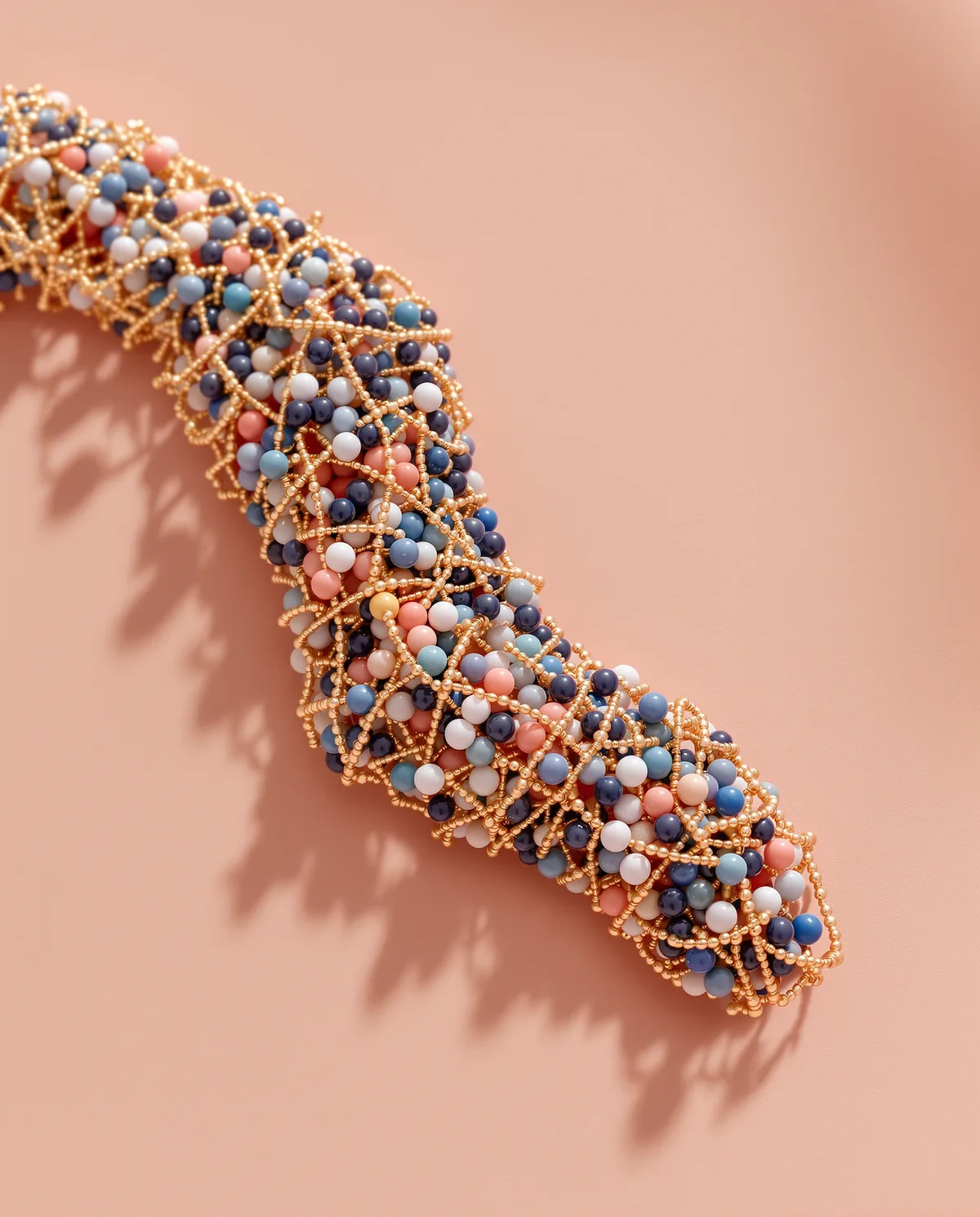
Technique, visible in the surface. Bead-and-thread embroidery leaves a thread crossing between beads at every stitch, which is why a zardozi-tradition surface looks dense and slightly raised rather than flat. Wire-wrapped work leaves brass openwork visible between the beads. Hand-strung work leaves the cord visible at the drill hole. A viewer who knows what to look for identifies the craft from a macro shot, not from a motif.
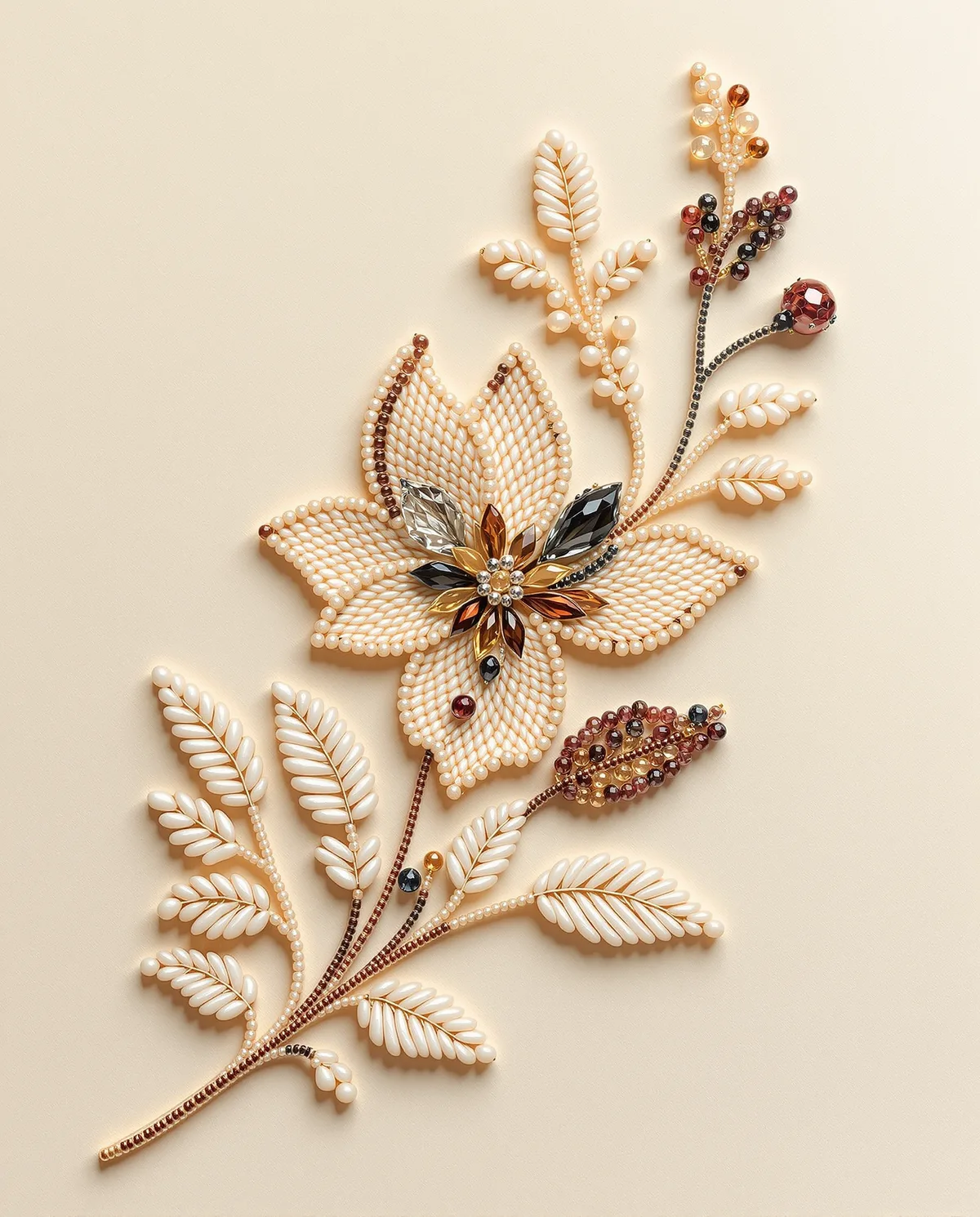
Glass seed and bugle beads with metallic thread for the embroidery routes. Drawn glass beads for strung work — Firozabad is one of our five owned plants and its disciplines include glass-bead drawing and hand-stringing. Metal beads finished and plated in Moradabad, where the business began as a family metal-finishing operation. Ceramic from Khurja, turned wood and dowels from Saharanpur. The towns are the vocabulary.
Differently for each craft. A strung panel holds its pattern through a count sheet. An embroidered piece holds it through a stitched layout drawn onto the stiffened ground before the first bead goes on. A wire-wrapped piece holds it through the armature, which is formed to a jig so the shape repeats before any bead is threaded. Across all three, first-article and lot inspection run through our own Greater Noida house.
Several times more for the hand-embroidered and wire-wrapped routes. These are hour-measured crafts: a bead-embroidered coaster is a field of individually couched beads and there is no lever that makes it fast. The practical cost conversations are de-densifying an infill — a tight outline with an open fill, which reads the same at arm's length — and reducing the piece size. Strung work sits far below both.
The embroidery routes belong on the table and in soft furnishing: beaded coasters, placemats, chargers, cushions, ornaments. The wire-wrapped route belongs in small objects — napkin rings, charms, figural pieces. Strung work belongs at thresholds and on walls. Treating them as one category is the main reason briefs in this area arrive confused.
Strip the motif and keep the technique. The dated version of this vocabulary is a traditional motif executed well; the current version is a contemporary graphic executed in a traditional technique. Our own buyer offers show where that has gone: zodiac purses, city postcard purses, monogram cases and lettering, all built with the same couched bead embroidery that would historically have carried a floral.
A fixture, and the deepest one in this library. These are living craft industries with their own towns, workshops and generational skills, and our stated purpose is to give second and third generation artisans modern manufacturing tools so they can work with ancestral skills. That is a durable position rather than a seasonal one.
There is no revival here, because nothing lapsed. What has changed is the end use. The techniques that once made ceremonial textiles, bridal work and devotional objects now also make coasters, ornaments and purses, and that transfer has to be made carefully. Where a form carries ceremonial or devotional meaning we do not reproduce it as décor, whichever tradition it came from.
Café Society sits closest in practice — espresso and cocoa through crema to dusty cornflower and pistachio, with a single glossy cherry-red note — because its coaster expression is couched bead embroidery on stiffened felt. After Hours, with jet and smoke crystal and a band of antique gold bugle beads, is the other direct one. Both are documented in the design library by construction rather than by mood.
It photographs at macro range and sells there too. These are techniques whose quality is invisible at two metres and obvious at twenty centimetres, so the frame that sells them is a tight crop showing the thread, the wire or the cord. It sells into tabletop, gifting and accessories far more readily than into the threshold formats the rest of this library covers.
Retailers and brands buying tabletop, gifting and small decorative accessories under their own label, plus boutique design retailers — supplied from our own plants, with inspection and export packing through our own Greater Noida house and shipping into the US, the UK, the EU and Canada. The doorway hanging most associated with this vocabulary is the toran, a living Indian tradition documented here as craft and available to develop.
Good to know
The embroidery and wire-wrapped routes cost considerably more, because they are hand operations measured in hours rather than in beads. Hand-strung glass panels are the economical end of this vocabulary. The difference is technique, not origin — everything here is made in plants we own.
Each technique has its own natural formats. Bead embroidery suits flat work: coasters at ten to eleven centimetres, dimensional florals at nine to twelve, appliqué patches and brooches. Wire-wrapped work suits small three-dimensional objects: napkin rings at six to nine centimetres, charms, figural birds and animals at twelve to eighteen. Hand-strung work suits panels.
Name the technique instead of the country. A brief that says Indian gets a cliché; a brief that says zardozi bead embroidery on stiffened felt, in two colours, gets an object. The register problem in this category is entirely a naming problem.
The techniques behind it are selling: bead-embroidered coasters, purses and ornaments carried the large majority of the gift offer we issued in the third quarter of 2026, right across its colour collections.
Glass seed and bugle beads for the embroidery routes, because the technique needs a bead small enough to behave as a field. Drawn glass seed beads from our own furnaces for strung work. Metal beads from our Moradabad plants where a metallic accent is wanted, in any of our eight standard finishes.
We match a reference's look, colours and bead sizes in new materials as an inspired design, and we do not reproduce another brand's protected design. We would also decline a brief to reproduce a ceremonial or devotional object as décor, whichever tradition it came from.
There is no single palette, because there is no single craft. Zardozi work historically pairs metallic thread with jewel tones; Firozabad glass covers the full range; the contemporary buyer offers in this vocabulary run from espresso and crema through to candy brights. Colour is specified per design against a Pantone reference or a physical chip.
Keep exploring
Manufacturing
The couched bead-and-metal-thread technique behind the flat beaded objects: what it is, what it can depict, and the forms built with it.
View the rangeReference
Five craft families — strung, embroidered, wire-wrapped, knotted and wrapped fibre — and what each one is good for.
Compare the optionsIndex
Twenty-four named looks, each described by the material, palette, pitch and hem that actually produce it.
See the detailStyle
Translucent acrylic, frosted pastels and iridescent finishes — a material decade rather than a motif one.
Specs and sizesStyle
Smileys, mushrooms, daisies and cherries on translucent and iridescent grounds, scattered to a rule.
Specs and sizes
Start a conversation
Send a reference, a colour chip or a sketch. Minimums are set per design and confirmed per quote; sampling is quoted separately and usually runs 16 to 20 days from an agreed brief.