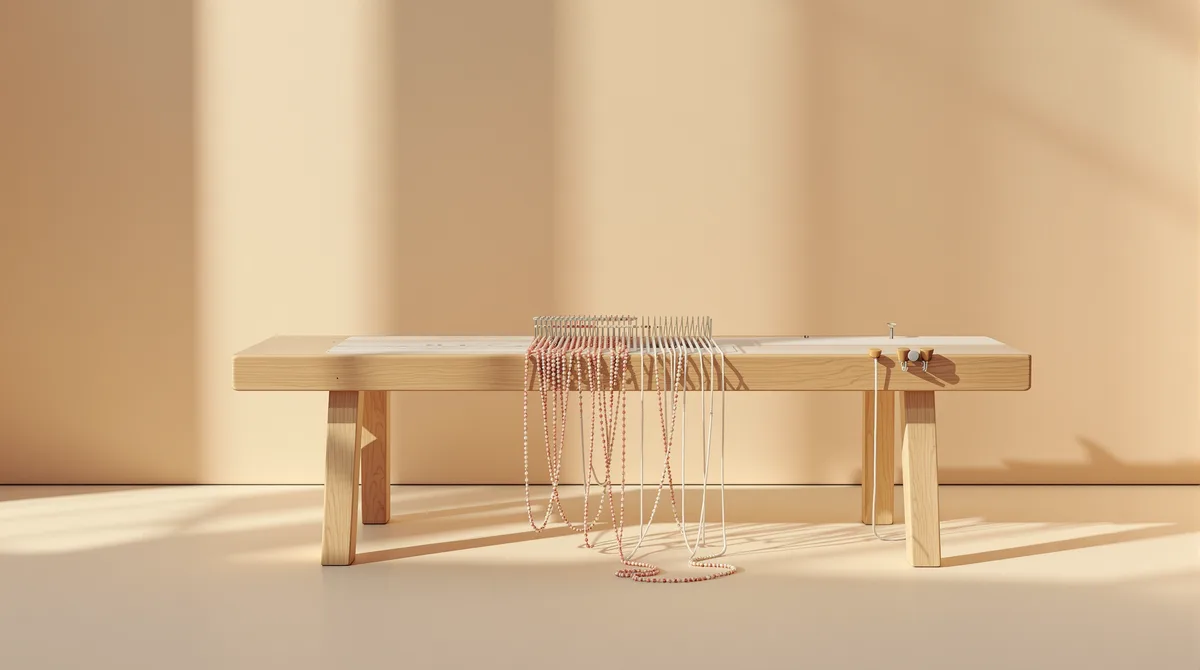
Material
Turned wood beads
Turned and drilled in our own wood factory: grain variation you approve rather than eliminate, the finishes that hold colour, and the dowel from the same plant.
Open the reference
Process · Wood works
The bead and the rod it hangs from come off the same lathes in the same plant. That is why they match — and why the one operation that decides a wood panel's quality is not the turning but the drilling.
Four bead families grouped in a row — turned wood, cut bamboo, polished bone and glazed ceramic — each with a threaded sample strand falling below it.
Wood beads are turned to profile on a lathe, drilled through on centre, then stained, waxed or lacquered. The curtain dowels and header rails come off the same lathes in the same plant — our own Saharanpur wood factory. Drilling on centre is the critical operation, because an off-centre hole makes the bead sit crooked for ever.
Turning is shaping a round object by spinning it and cutting into it. A timber blank is held in a lathe, spun, and a tool is brought against it until the profile matches the drawing. It is a subtractive process on a material that is not uniform, which is the whole reason wood behaves the way it does in a bead library.
A single bead is cut across the grain at its ends and along the grain at its waist. Those two surfaces take a tool differently and they take a stain differently, which is why a wooden bead has a tonal character rather than a colour.
Seven stages, and only one of them is critical in the engineering sense. Turning is mechanical and repeatable. Finishing is a quality question with known answers. Drilling on centre is the operation that either works or ruins the bead, because a hole a fraction off axis tilts the bead on the cord permanently and nothing downstream corrects it.
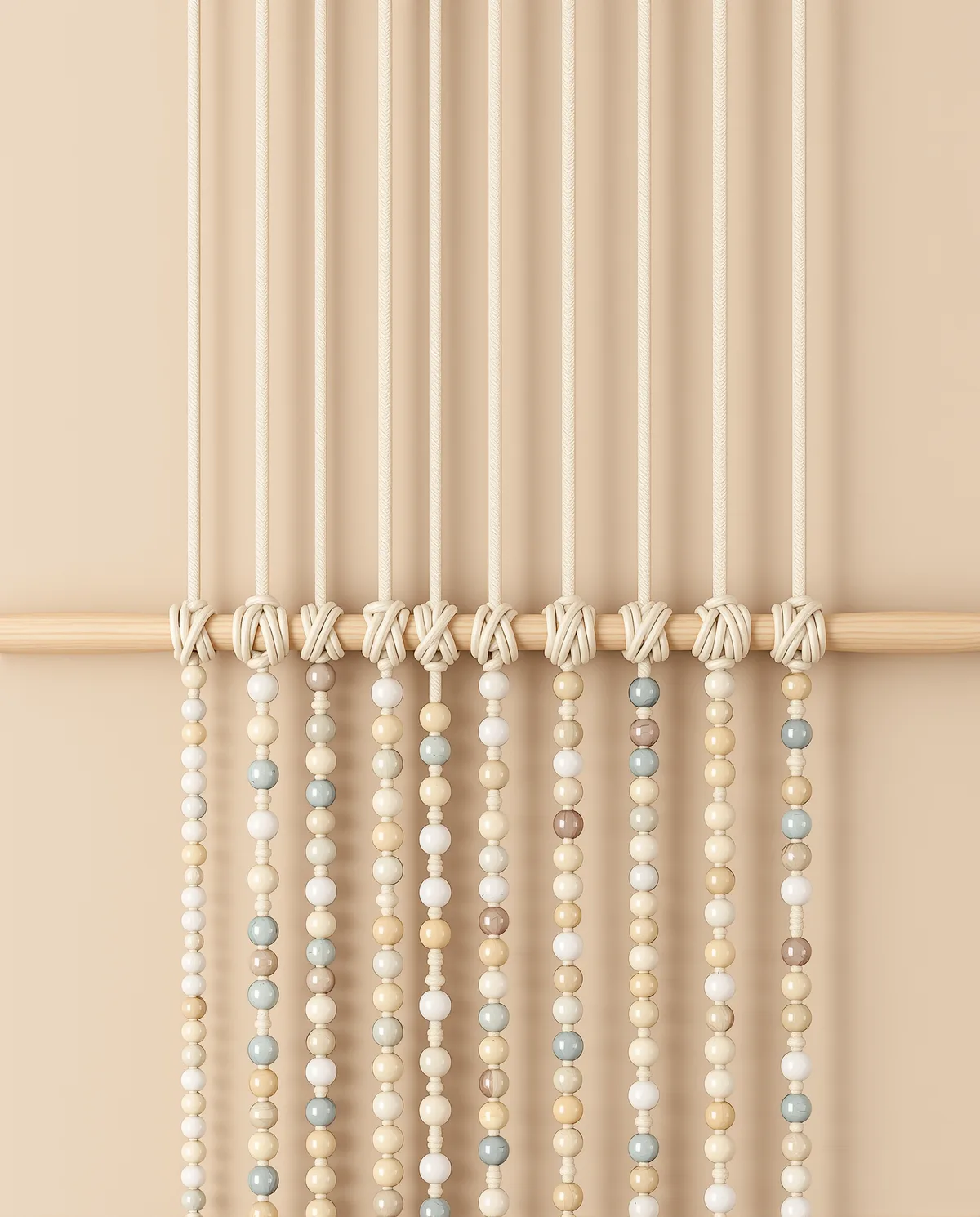
A matched set. The beads and the rod they hang from come off the same lathes, get the same stain and the same lacquer, and are sorted to the same tone range. On a wood panel that is not a detail — the dowel is the most visible single component on the piece, and a dowel finished to a different standard from the beads reads as a mismatch immediately.
It is also the only route to a bead at genuinely large volume with no mould. A 30 mm wooden bead is an ordinary turning; a 30 mm glass bead is a feature bead with an annealing cycle.
The standard entries, plus the tone range. A wood sheet that names "mid walnut" and stops is unusable, because mid walnut is not a thing a bead can be held to. What it needs is a tone range approved on a retained sample, so an inspector can sort against something physical.
Everything else follows the usual structure set out in bead maps and colour-count sheets: bead identity per position, pitch and strand count, cord sized from the smallest drill hole in the build.
Wood, and our own plant's capability list extends the same discipline to carving, joinery and assembly, and bone and resin inlay. That inlay capability is why bone and horn beads are in the library at all.
Bamboo needs one clear sentence rather than a blur: it is offered alongside wood and confirmed per design, and it is not an owned capability. Nothing on this property claims a bamboo facility.
Finishing and sorting, not turning. The lathe work on a bead is seconds. The finish is coats and drying time, and the sort is a person comparing beads against a retained sample and setting aside the ones that fall outside the range.
That makes tone tolerance the hidden cost lever on a wood programme. A wide approved range is cheap; a narrow one means a high reject rate on a naturally variable material, and the rejects are paid for whether they ship or not.
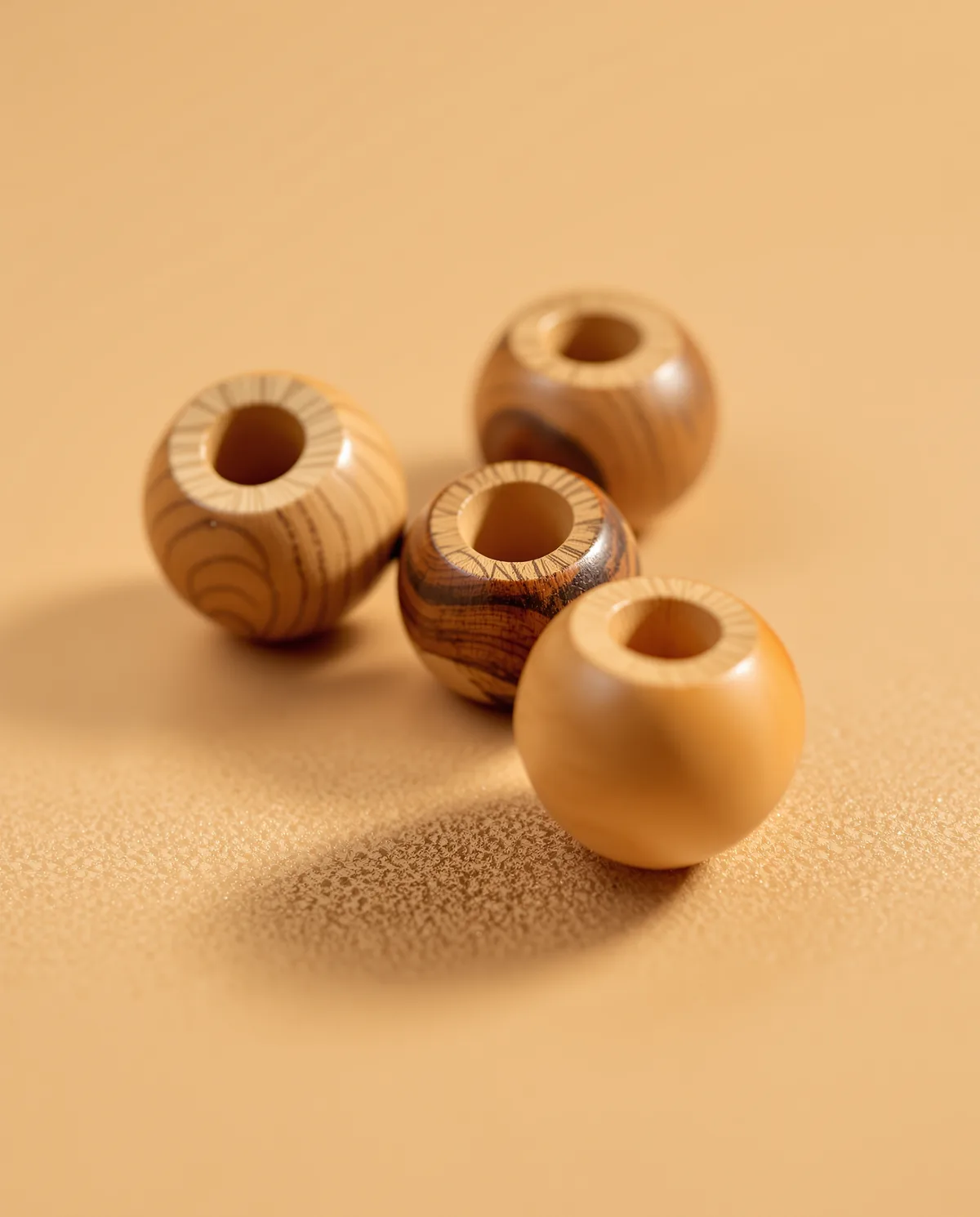
By a tone range on a retained sample, with production sorted into it. This is the same mechanism a reactive ceramic glaze and an antique metal finish use, and it is the only one for a material whose appearance is not under process control.
The alternative, where a buyer genuinely cannot carry variation, is an opaque colour finish. That turns the bead into a coloured object rather than a wooden one, and it should be presented to the buyer as that trade rather than as a solution.
Five. An off-centre hole — unfixable. A blown-out hole exit, where the drill broke through the far face and left a ragged rim that will abrade cord. Torn grain, from a dull tool. Beads outside the approved tone range. And finish faults: runs, bloom, uneven sheen.
On the dowel there is a sixth: bow. A long rod carrying a heavy panel will deflect if its diameter was chosen for the span and not for the load, which is why rod diameter is specified against panel weight rather than against width alone.
Wood is among the cheapest bead materials per unit and the cheapest to freight, so the cost conversation on a wood panel is rarely about the beads. It is about finish coats and sort tolerance.
Two levers actually move it. Widen the tone range, which cuts the reject rate on a variable material. And choose wax over lacquer where the piece will not be handled daily, because wax is fewer coats and less drying — accepting that it does not seal, which changes the care instruction.
In our own Saharanpur wood factory: lathes, a drilling jig, sanding drums and a finishing line. The published capability list for that plant is wood turning and carving, joinery and assembly, bone and resin inlay, and staining, waxing and lacquering. Timber for our wood lines carries Forest Stewardship Council certification, with chain of custody intact.
Saharanpur is a woodworking town, and the dowel is the quiet proof of the claim: the rod on a Gemixx beaded curtain is not a bought component fitted at the end. It is turned in the plant that turned the beads.
On beads, effectively none within the range beadwork uses — turning handles anything from a small round to a large barrel. On dowels and header rails, the limit is deflection under load rather than length as such.
Our own record uses two header profiles: a single turned wooden dowel, which is the default and reads as the cleaner object, and a rectangular beam profile on one portal construction. Both are turned or milled on the same line, and the choice between them is visual rather than structural at the sizes we build.
Beads by sample against the retained tone range, with holes checked for centring and for a clean exit. Dowels checked for straightness, diameter and finish match. Then the assembled panel, hanging, for whether the strands fall straight — which is where an off-centre hole finally reveals itself.
Bead shape and nominal dimensions. Hole diameter. Finish route — stain, wax, lacquer or opaque colour. The approved tone range. The dowel profile, diameter and length, and its finish. And whether the panel hangs from the dowel directly or from end suspension loops.
The dowel entries are the ones buyers skip, and the dowel is the component their customer sees first.
Extractable data
| Stage | What drives the labour | What is rejected here |
|---|---|---|
| Blank selection and conditioning | Moisture stability of the stock | Blanks that will move after finishing |
| Turning | Profile complexity; mechanical and repeatable | Profiles outside tolerance, torn grain |
| Drilling on centre | Jig setup; the critical operation | Off-centre or blown-out holes |
| Sanding | Finish grade; lacquer needs finer than wax | Visible scratch under a gloss finish |
| Stain or colour | Number of coats; sorting to a tone range | Beads outside the approved tone range |
| Wax or lacquer | Coats and drying time | Runs, bloom, uneven sheen |
| Dowel and header rail | Length and profile; same line, same standard | Bow in the rod, mismatched finish |
| Where it is done | Our own Saharanpur wood factory | — |
Good to know
Turning and drilling are fast and mechanical; the time is in conditioning the stock and in finishing, which is coats and drying rather than machine work. Production for beaded décor runs 40 to 60 days after sample approval, and on a wood programme the finishing line is usually what sets the pace.
The same bead-by-bead document used everywhere else, with one addition that matters here: the approved tone range, pointed at a retained sample. A wood sheet that names a colour instead of a range cannot be inspected against, because no two wood beads are the same colour.
Wood, and the plant's capability list also covers carving, joinery and assembly, and bone and resin inlay. Bamboo is offered alongside wood and confirmed per design rather than held as an owned capability, and nothing here should be read as a claim about a bamboo facility.
By approving a tone range on the retained sample and sorting production into it. That sorting is the real labour on a wood programme — the beads that fall outside the range are set aside, and a tighter range means more of them.
An off-centre hole, which is the one that cannot be corrected. A blown-out hole exit, where the drill broke the far face. Torn grain from a dull tool. Beads outside the approved tone range. And finish faults — runs, bloom, uneven sheen — which are the commonest and the easiest to catch.
The beads do not need to be, and the dowel is where scale actually lives. A 90 cm panel and a 120 cm panel need the same beads and a longer rod, and the rod is where a long format shows up as a problem: a long thin dowel can bow under a heavy glass panel, so rod diameter is specified against panel weight.
Yes, and that is the practical reason a Gemixx wood panel matches. Beads, dowels and header rails are turned, sanded and finished on the same line in our own Saharanpur wood factory, to one finish standard. Factories we own, not vendors we book.
Keep exploring
Material
Turned and drilled in our own wood factory: grain variation you approve rather than eliminate, the finishes that hold colour, and the dowel from the same plant.
Open the referenceTechnique
The bead map, the cord, thirty strands on a dowel, hem shapes, suspension loops — and the three levers that move the cost.
Compare the optionsMaterial
Cut, drilled and finished to specification in our own beadwork studios: dense quiet surfaces, natural markings, and the tone range a brief has to allow.
Read the guideGuide
Dry dusting first, spot cleaning the beads, keeping the cord dry, what never to use, and how to handle a broken strand.
Compare the optionsReference
Five craft families — strung, embroidered, wire-wrapped, knotted and wrapped fibre — and what each one is good for.
Read more
Start a conversation
Send a reference, a colour chip or a sketch. Minimums are set per design and confirmed per quote; sampling is quoted separately and usually runs 16 to 20 days from an agreed brief.