Specification
Specifying beadwork for a project
The dimensions, strand values, fixings and performance limits a drawing and schedule have to carry.
Specs and sizes
Trend · 2027
A decorative object arrives with a product name. A detailing material arrives with a dimension and an adjacency. That change in how a brief is written changes almost everything behind it.
Editorial frame. Light through hand-strung glass, not a specific SKU.
Beadwork is increasingly briefed with a dimension and an adjacency rather than with a product name, which is how a material is specified rather than how an object is bought. That changes four things: dye-lot behaviour across a run, fixing into structure, a fire and testing file, and who owns the cleaning.
How the brief is written. A decorative object brief names a product: a beaded curtain, in this colourway, at this size, this many units. A detailing brief gives a dimension and an adjacency: a two-metre run above a bar, finishing against oak, in a colour that holds against the tile behind it. The second kind of brief treats beadwork the way a specifier treats trim, tile or terrazzo, and it carries a completely different set of questions behind it.
As a run rather than as a product. Interiors coverage has started framing beading as the overlooked interior detail, and the briefs reaching our desk have followed: a length, what the beadwork finishes against, a fixing method and a testing question, all in the first message. A specifier writing that way is specifying a material, and the answers come off the floor rather than out of a catalogue.
It means publishing specification rather than only publishing designs. A specifier working this way needs bead sizes and drill-hole diameters, strand pitch, weight per square metre, cord gauge, fixing options by weight, and what a dye lot can and cannot promise. None of those are design decisions and all of them are now the first questions. A range built for this audience is half documentation.
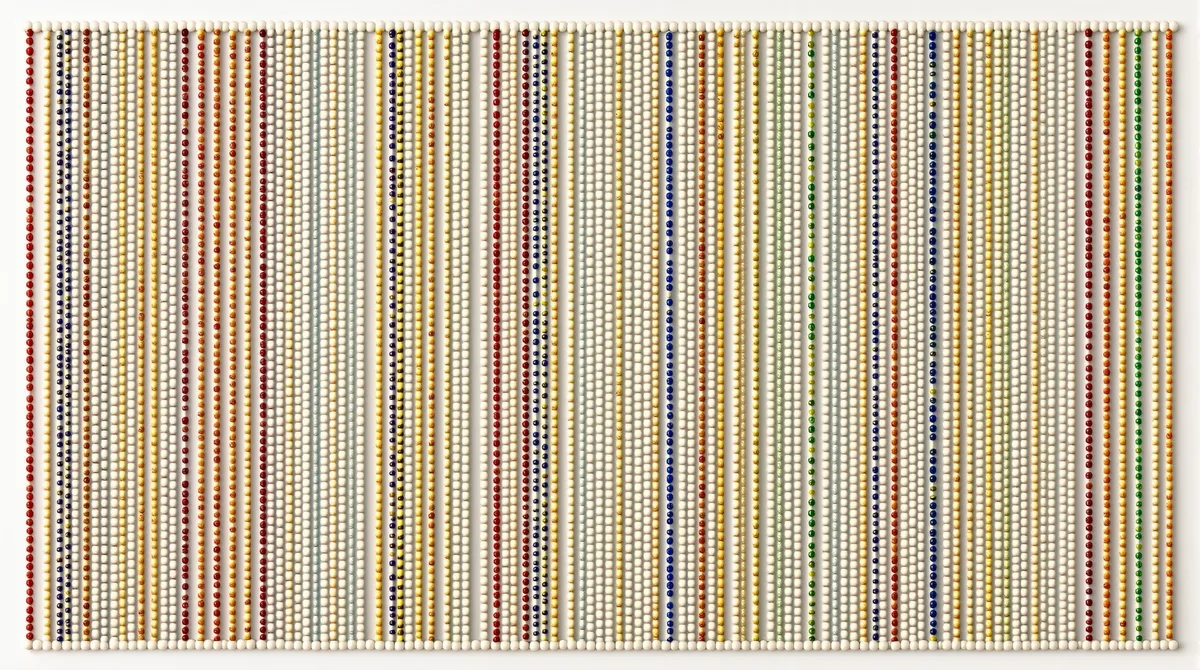
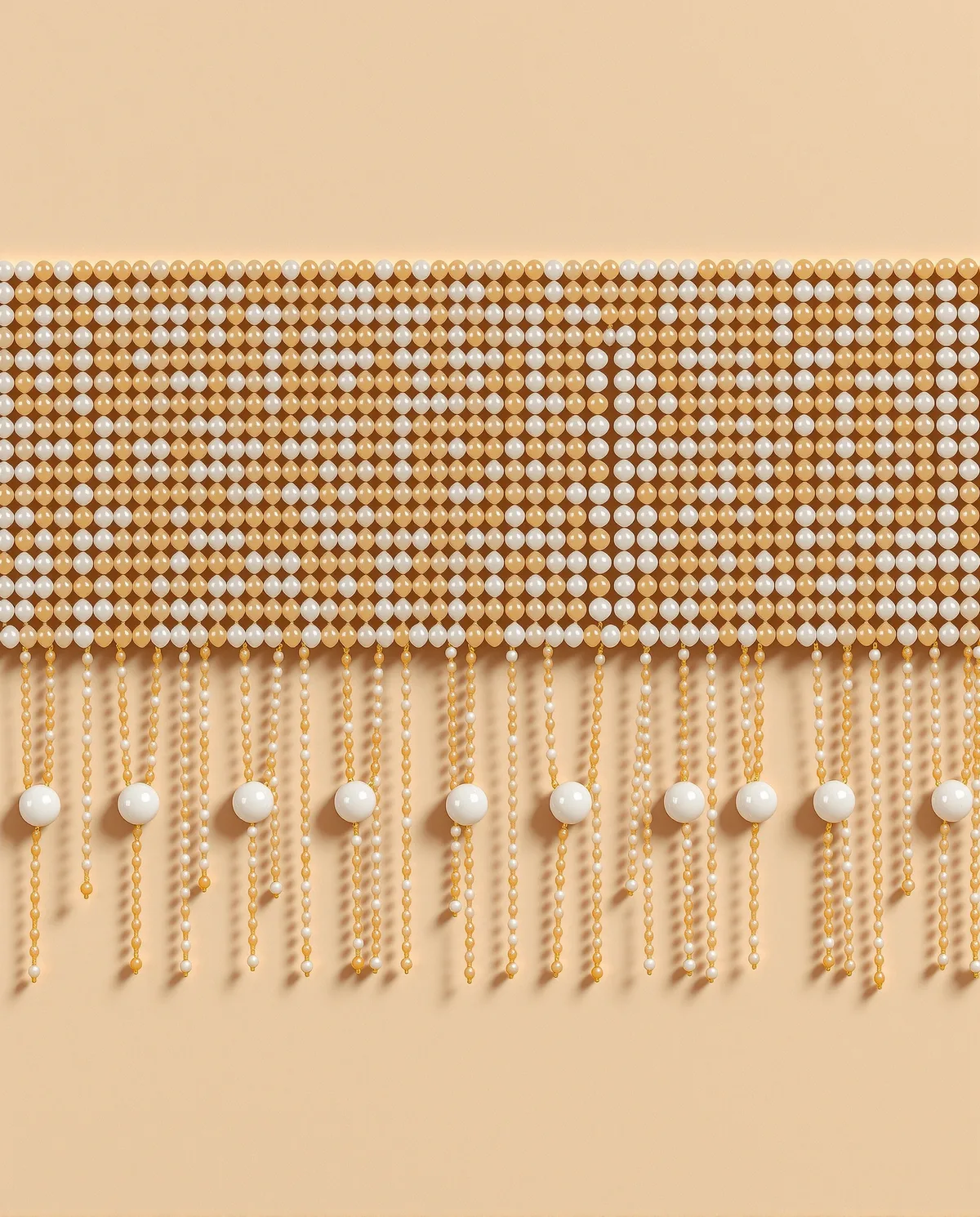
Bands, trims and runs rather than panels. The constructions that answer it are already made: a solid beaded top band worked in close horizontal rows above the point where strands separate, a beaded top trim on a cotton header band with a rod pocket, and linked-disc columns that behave as a modular screen. What a detailing brief usually wants is a length of something, not a piece of something.
Because every question it asks is a floor question. Weight per square metre, strand pitch, cord gauge, fixing by weight and dye-lot behaviour across a long run are answered by the plant that draws the bead and strings the piece. A specifier working this way is specifying a material, and the maker that owns the furnace, the drilling and the stringing bench is the one that can put a figure against each of those and hold it through a run.
Vocabulary changes outlast style changes, which is the structural argument for taking it seriously. Once a category of specifier starts asking for weight per square metre and a fixing schedule, they do not stop.
Posted: beadwork integrated into joinery, cabinetry fronts, ceiling details and architectural trim. Bought: the same panels and portals as before, occasionally with a dimension specified to a wall rather than to a doorway. The gap is the widest in this section, and the lesson is practical: brief the dimension and the adjacency first, and let the construction follow from them.
By documenting one construction thoroughly rather than designing several. A specifier can work with a single band construction if they know its weight, its pitch, its fixing options, its cleaning regime and its colour-repeat behaviour. They cannot work from a sheet of attractive designs with no figures attached. The commercial implication is unusual for this category: the investment is in the specification sheet rather than in the design library.
Lead time stays at 40 to 60 days after sample approval, with sampling usually 16 to 20 days from an agreed brief and quoted separately. Cost changes in character rather than in level. A detailing run is often lower in bead count per piece than a panel and higher in approval overhead, because a first article has to be approved against an adjacency rather than against a chip. Where a run is long, the dominant cost risk becomes dye-lot consistency rather than bead count.
The band and trim constructions above, and the linked-disc hangings, which are the nearest thing in the library to a modular material: cast discs at twenty-five and fifty millimetres linked one below the next into columns hung side by side, documented from 70 by 130 up to 90 by 200 centimetres at roughly 239 to 497 discs. That construction behaves like a screen system rather than like a curtain, which is why detailing briefs keep arriving at it.
Beaded wallpaper, beaded tile, and any beadwork described as a continuous wipeable finish. The last is the specification trap: it holds beadwork to a cleaning standard a tiled or plastered wall passes without thought, and accepting that language guarantees a failure later. A bead panel is a hanging decorative element — not a partition, and not a fire-rated one.
Quiet ones, because a detail is specified against something else. Oat, chalk, clay, olive and espresso read well next to timber, stone and plaster; a saturated palette fights them. Finish follows the same logic: matte and frosted sit into an adjacency, and gloss stands out of it. The practical consequence is that the detailing palette and the statement-piece palette are almost opposites, and a range that serves both needs to say which is which.
Good to know
A vocabulary, and it is changing how the product gets specified. A detailing brief arrives as a dimension and an adjacency, and the constructions that answer it — bands, trims and linked-disc columns — are already made in our own studios. Treat it as the way specifications are now written.
The trim and band constructions rather than the panels: a solid beaded top band worked in close horizontal rows above the point where strands separate, a beaded top trim on a cotton header, and the linked-disc columns that behave as a modular screen rather than as a hanging.
Beaded wallpaper, beaded tile, or beadwork described as a continuous wipeable finish. Beadwork is a hanging decorative element, and a finish-level cleaning standard is the wrong specification to hold it to. Where a brief wants a continuous surface, the answer is a band, a trim or a run of linked discs.
With a dimension and an adjacency rather than a format name, and with fixing and testing questions attached from the first message. Interiors coverage has started framing beading as the overlooked interior detail, and the briefs reaching our desk are written the way a specifier writes a trim schedule.
This is less a trend than a change in vocabulary, and vocabulary changes tend to persist. The page is written as a specification argument rather than as a forecast.
For detailing work, colours that sit next to something rather than stand apart from it. A detail is specified against an adjacency — a timber, a stone, a paint — so the useful palettes are the quiet ones: oat, chalk, clay, olive, espresso. Statement palettes belong to statement pieces.
Keep exploring
Specification
The dimensions, strand values, fixings and performance limits a drawing and schedule have to carry.
Specs and sizesIndex
Eleven trend reads on beaded décor for 2027, from the floor the movements land on first.
Specs and sizesTrend read
Dense pattern multiplies bead count and picking operations — and the version that actually gets ordered is the scattered accent.
Specs and sizesTrend read
Motif-led, iridescent-ground and reordering fast: the one construction that carries a rotating icon set.
Specs and sizesTrend read
One piece per space: easier on dye lots, harder on fixing, fire files and whoever owns the dusting.
See the detail
Start a conversation
Send a reference, a colour chip or a sketch. Minimums are set per design and confirmed per quote; sampling is quoted separately and usually runs 16 to 20 days from an agreed brief.