Specification
Beadwork in a hotel lobby
Large-format panels, fire performance, the maintenance plan and the approvals a lobby specification has to clear before it gets built.
See the detail
Trend · 2027
One large piece per space, rather than a scatter of small ones. For a maker that simplifies the colour risk and complicates almost everything else.
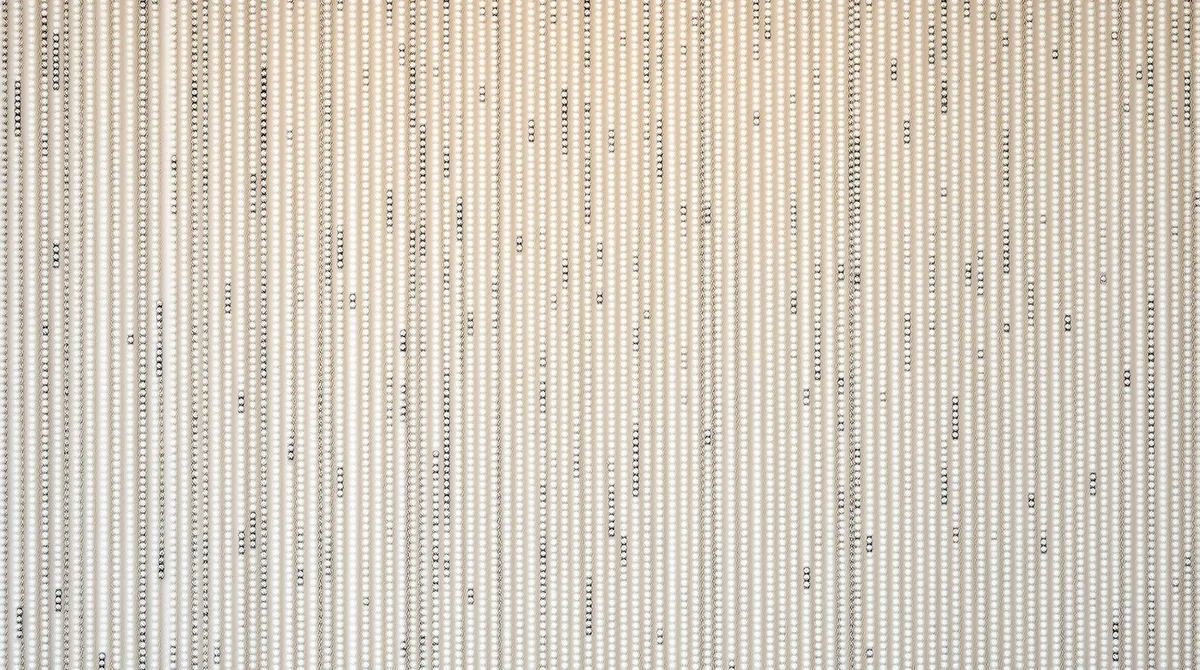
A very large dense field of faceted crystal and cut glass in smoke grey, clear and pewter, the tightest-pitch strands throwing hundreds of small crisp highlights.
Hospitality is concentrating decorative budget into one large piece per space rather than spreading it. That makes colour easier, because a single piece can come from one dye lot, and makes fixing, flammability documentation, cleaning access and spare-strand provision harder, because all of them now sit on one object in a public room.
Decorative budget in hospitality is concentrating. Instead of a scatter of small decorative items through a space, the money goes into one object that carries the identity of the room — a wall, a threshold, a backdrop — and the rest of the scheme is kept plain. For beadwork that is favourable, because beadwork at small scale competes with a crowded field of decorative accessories and at large scale competes with almost nothing.
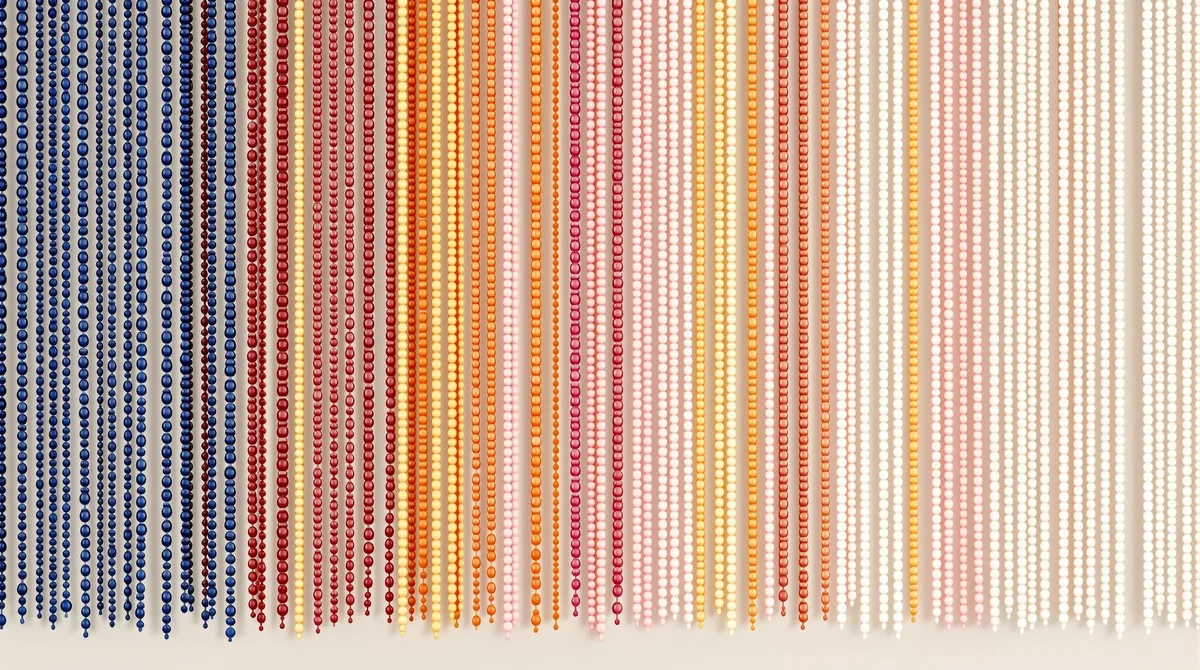
That the format works at venue scale. The beaded décor walls at a US casino resort are large beaded wall panels, and they are our reference project in this category: one surface carrying the decorative identity of a public room, panelised so it could be made, shipped and installed. Alongside that, buyers are asking for statement pieces in warm, dotted and amber looks.
It means building a project capability rather than a product line. A statement piece is specified to a space, so what a hospitality client needs is a construction they can scale, plus the documentation around it: bead sizes and stringing specifications, panel weight and hardware load, wall fixings, a flammability and testing position, a cleaning regime, and a spares arrangement. A catalogue of fixed sizes is close to useless in this conversation.
A beaded room divider as a current product. It is a craft category rather than a Gemixx range, and a division built from door curtains, portals or wall hangings hung side by side is the format with the production record behind it. We would also not claim a fire rating, an acoustic value or a partition function for a bead panel. A bead panel is a decorative element in a public room, and overstating what it does is how a specification fails an approval.
Warm, glossy and translucent. A statement piece in a public room is doing a signalling job, and a jewelled surface with light through it signals occasion where a matte one signals restraint. Buyers name warm, dotted and amber specifically. The matte and mineral palettes that press texture trends favour belong to the detailing register rather than to this one, which is a genuine fork in the road at brief stage.
Wall panels and portals, not curtains. A curtain in a circulation route is touched continuously and ends up tied back within weeks, which destroys the piece as a statement. A wall panel sits out of the path and keeps the installed appearance. Where a threshold genuinely has to be dressed, a portal with an arched-cut opening survives daily use far better than a full panel does.
That one piece is one point of failure. If a single panel carries the identity of a lobby, then a damaged strand, a dusty field or a soiled lower section is not a detail — it is the room looking wrong, in front of guests. In our experience that is a maintenance question rather than a design one, and it has a concrete answer: name the maintenance schedule and its owner in the specification, and supply replacement strands with the piece. A statement piece without either ages visibly inside two years, and the care and cleaning regime belongs in the specification rather than in the housekeeping schedule.
Hospitality demand for one identity-carrying surface per space is structural rather than cyclical, because it comes from how venues differentiate themselves. The palette inside that demand follows fashion; the demand itself does not.

Posted: the beaded room as a complete environment. Bought: one panel or one portal, with the rest of the scheme kept quiet. The commercial consequence for a maker is that the enquiry that converts is a single large piece with a dimension attached, and the enquiry that does not is a request for a whole decorative scheme in beads. Recognising which one is on the table saves a great deal of sampling.
Around one construction that panelises cleanly. Take a documented wall-hanging construction, establish how it tiles across a wall, and settle the panel module, the rail detail and the dye-lot rule before anything is quoted. All panels for one wall come from a single dye lot, because a bead dyed to match shifts between lots and two adjacent panels from different lots read as two colours on a wall — a problem that simply does not arise on two separate hangings sold through retail.

Lead time is 40 to 60 days after sample approval, and a panelised job should allow a first-article approval before the full run. Cost concentrates rather than rises: a single large piece in one dye lot avoids the repeat-colour risk of a long retail programme, and in exchange it carries the approval overhead of a public-space installation. Testing is the line most often forgotten — fire performance wording and third-party testing carry real costs and real timelines, and they belong in the budget rather than in the surprises.
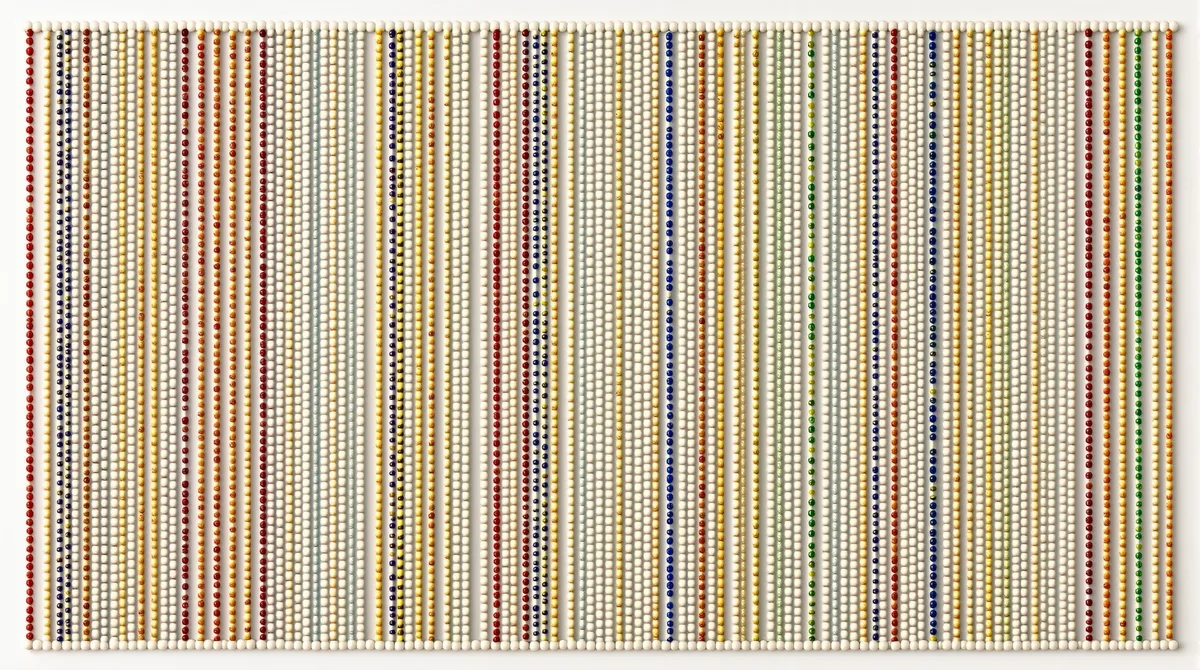
The wall-hanging and portal groups, panelised. Documented wall hangings run 50 by 90 to 60 by 100 centimetres on twenty to forty strands with straight, V-point, inverted-V and scalloped hems; portals run 76 by 140 on twenty-seven to forty strands. Those are drawn to size for the library and confirmed on the sample, and a lobby-scale piece is a panelised build from them rather than a single enormous panel, which would be unmanageable to pack, hang and clean.
Good to know
That a statement piece is a single point of failure in a public space. If one panel is the decorative identity of a lobby, then damage, soiling or a missing strand is not a detail — it is the room looking wrong. That is a maintenance and spares argument rather than a design one, and it is the reason to insist on a named maintenance owner at specification.
The wall-hanging and portal groups, scaled and panelised. Documented wall-hanging formats run 50 by 90 to 60 by 100 centimetres and portals 76 by 140, so anything at lobby scale is a panelised build from those constructions with a single dye lot across the panels.
A beaded room divider as a current product. It is a craft category rather than a Gemixx range, and a division built from door curtains, portals or wall hangings hung side by side is the format with the production record behind it. We would also not claim a fire rating or a partition function for a bead panel, because it has neither.
Built work and current demand. The hospitality application is the beaded décor walls at a US casino resort — large beaded wall panels, and our reference project in the category. Alongside it, buyers are asking for statement pieces in warm, dotted and amber looks.
Hospitality demand for one identity-carrying surface per space is permanent rather than cyclical, because it is driven by how a venue differentiates itself.
Warm, glossy and translucent for the statement register, because a jewelled surface signals occasion. Buyers name warm, dotted and amber specifically. Matte and mineral palettes belong to the detailing register rather than to this one.
Wall panels and portals rather than curtains. A curtain in a public room is touched constantly and gets tied back; a wall panel is out of the circulation path and keeps looking the way it was installed.
Keep exploring
Specification
Large-format panels, fire performance, the maintenance plan and the approvals a lobby specification has to clear before it gets built.
See the detailIndex
Eleven trend reads on beaded décor for 2027, from the floor the movements land on first.
View the rangeTrend read
Where the warm amber family sits, where the blues went, and which colour stories are carrying production.
Specs and sizesTrend read
Where beadwork beats plaster and tile on texture, where it loses on durability, and what a contract specification has to carry.
Read the guideTrend read
Dense pattern multiplies bead count and picking operations — and the version that actually gets ordered is the scattered accent.
Compare the options
Start a conversation
Send a reference, a colour chip or a sketch. Minimums are set per design and confirmed per quote; sampling is quoted separately and usually runs 16 to 20 days from an agreed brief.