Material
Seed beads, in detail
How seed beads are drawn, why dye lots are quoted per run, what the drill hole limits, and where seed-bead work earns its cost.
Read the guide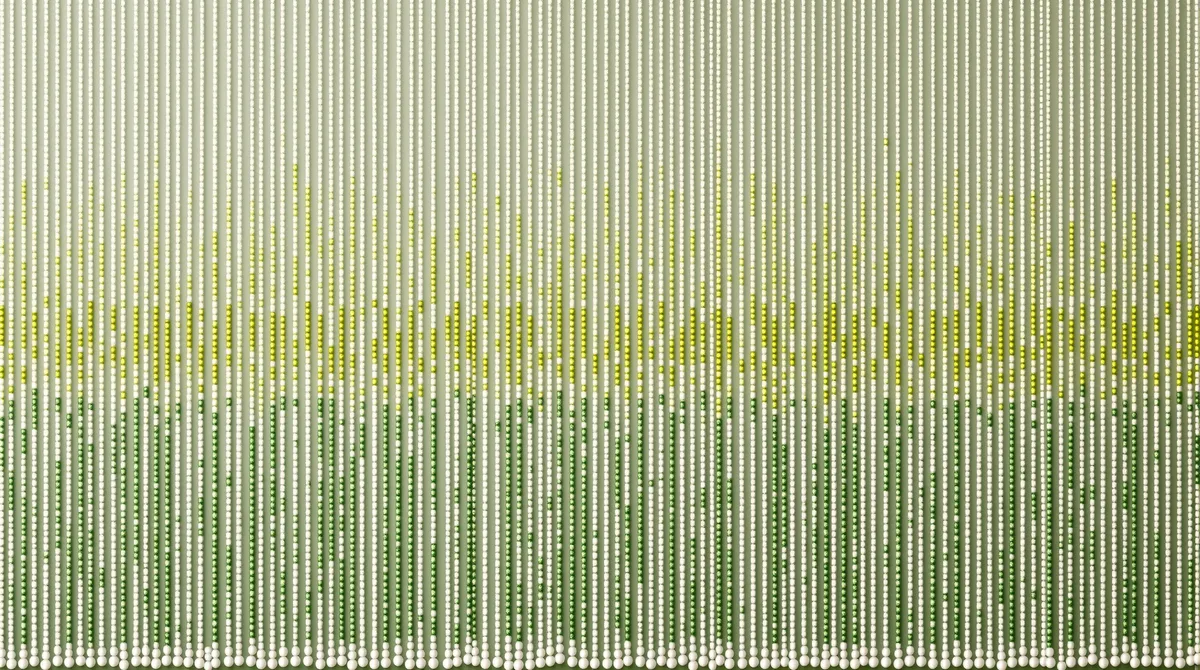
Guide · Material
A seed bead is two or three millimetres across. Put hundreds on a strand and you get something no larger bead can produce: beadwork with the resolution of a drawing.
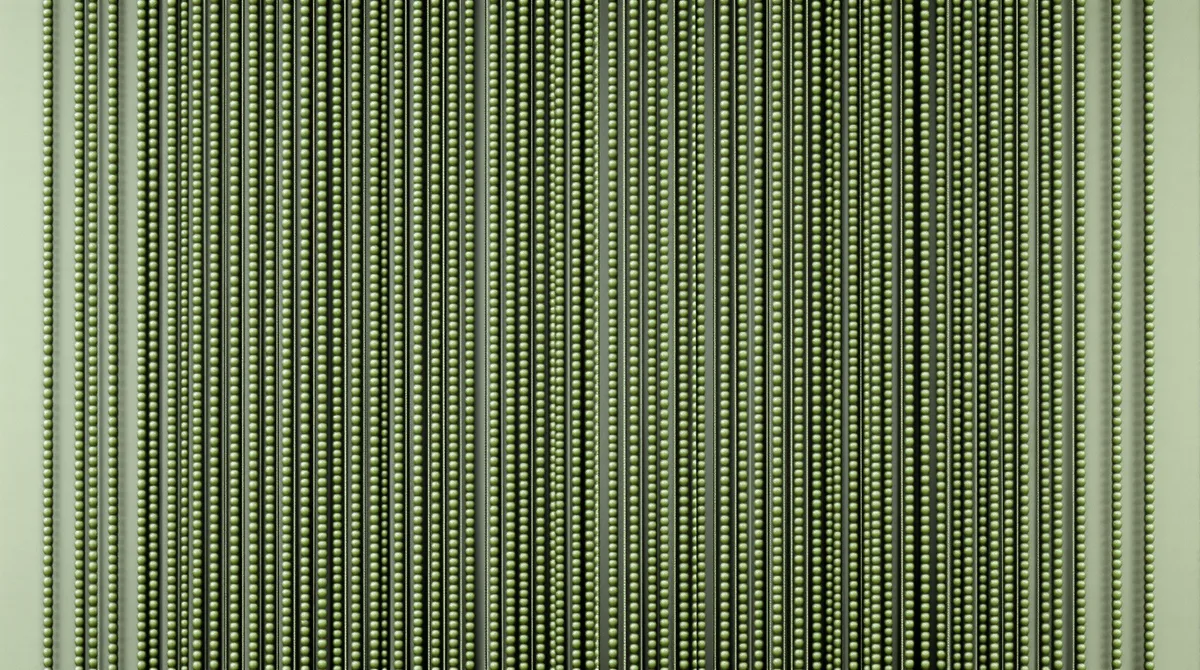
A curtain of tiny two-millimetre glass seed beads, hundreds to a cord and set very close, a sharp graphic motif worked bead by bead across the strands in lime, forest green and…
A seed-bead curtain strings drawn glass beads of two to three millimetres, hundreds to a strand. The payoff is resolution: the beads behave like pixels, so a motif can hold real drawing. The cost is time — stringing is per bead, so a seed-bead panel carries the longest labour in the category. Our seed beads are drawn in our own Firozabad glass works.
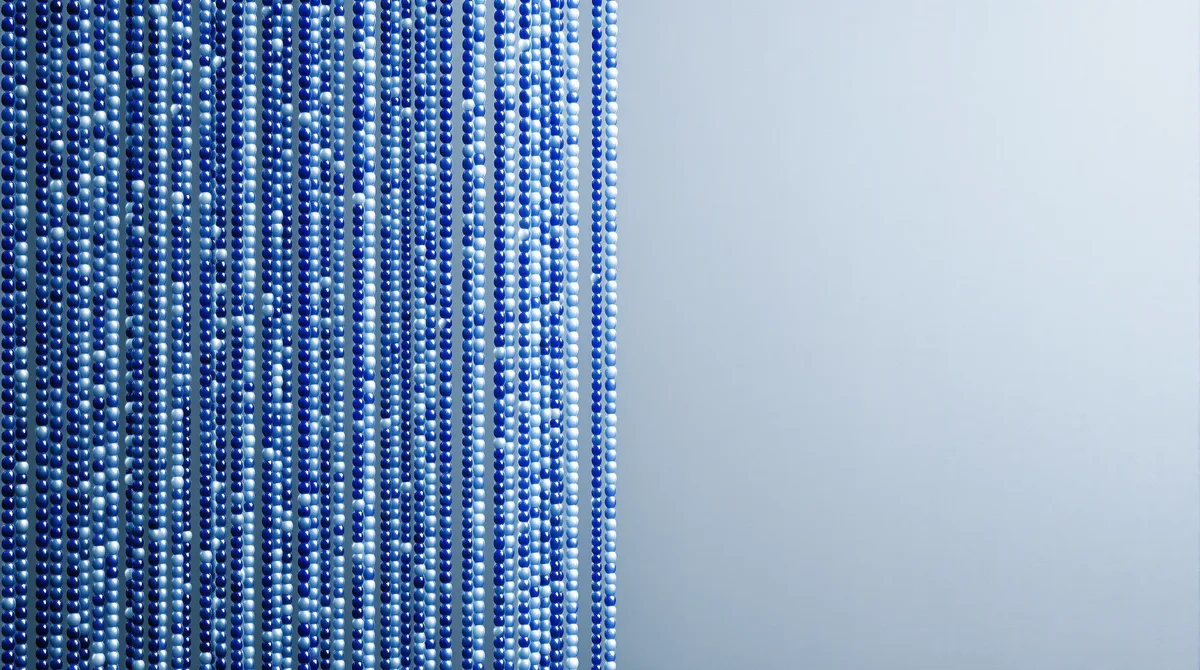
A small drawn glass bead, typically two to three millimetres across. It is made by drawing molten glass out into a long tube and cutting that tube into short lengths — which is why a seed bead has a slightly barrelled profile and a bore that is the tube's own hollow rather than a drilled hole.
Ours are drawn and hand-strung in our own Firozabad glass works, which is also where the colouring and finishing happen. Drawn seed beads are one of three separate glass trades: the other two are pressed glass, which is moulded, and lampwork, which is wound at the torch.
Resolution. This is the whole case for the material.
A seed bead is small enough that a field of them behaves like pixels: there are enough individual units to describe a curve, a gradient or a lettering form. A motif nine to twelve centimetres across can hold real drawing.
Put the same motif in 20 mm rounds and it becomes a handful of blocks. That is not worse — a large-bead panel is a different kind of image, built from scattered accents rather than from drawn shapes — but it has a hard floor on detail that seed beads do not.

Because stringing time is per bead, not per centimetre of drop. A seed-bead strand holds many times more beads than a large-bead strand covering the same distance, so it takes many times longer.
That is why bead size and material is the largest single cost lever in beadwork, and why seed beads sit at the expensive end of it by definition. The published cost hierarchy runs: bead size and material first, then construction, then strand spacing, then the dowel and packing, then height. A seed-bead specification maxes out the first lever before anything else is decided.
The corollary is the useful one. If a seed-bead panel comes back over budget, the fix is almost never the dimensions — it is a larger base bead with the seed beads kept where the detail actually is.
It happens, and the more common and more interesting answer is a seed-bead base carrying feature beads.
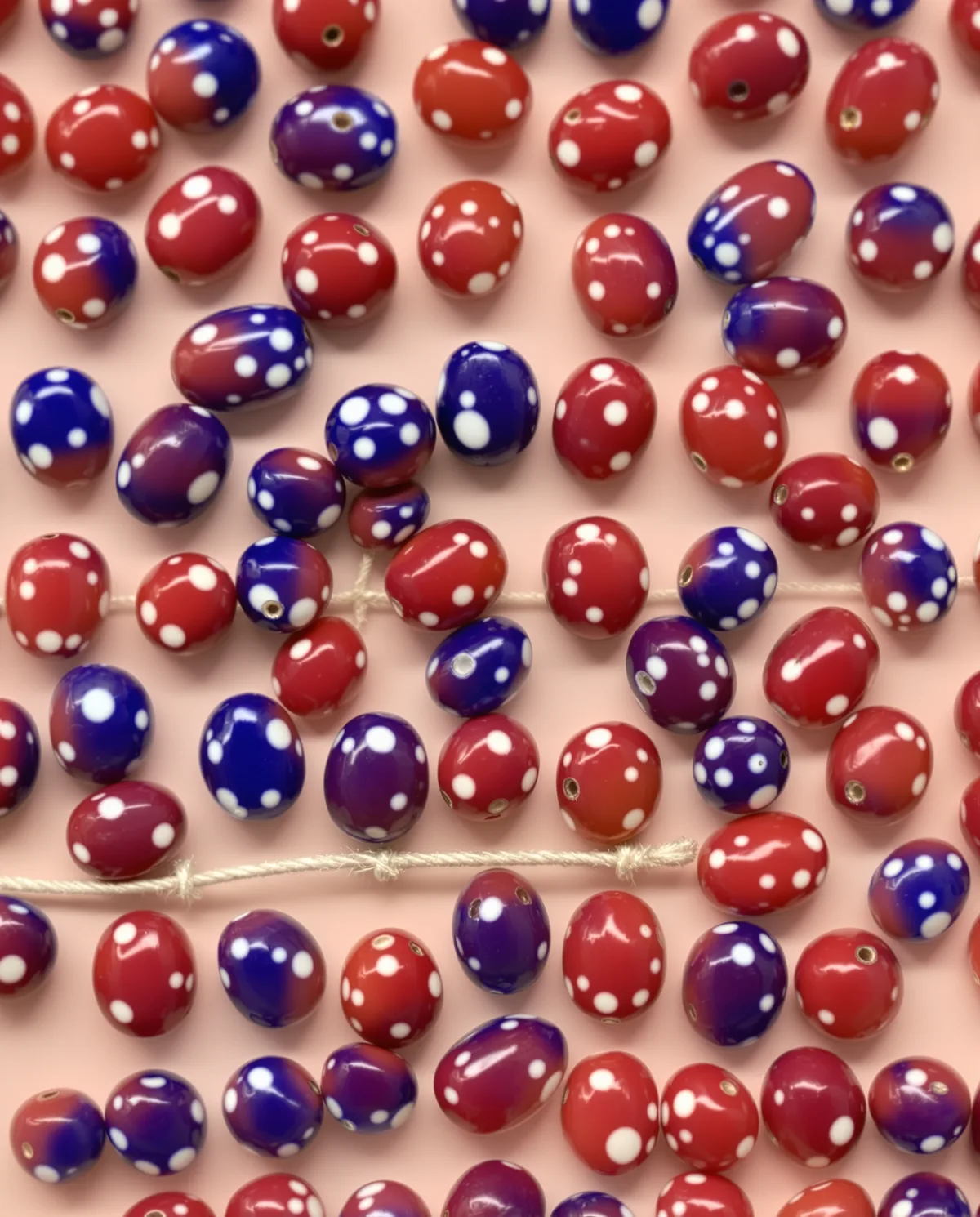
Our Naia curtain is built on lime glass seed-bead strands with spaced deep forest-green rounds, at 76 × 140 cm with an arched-cut drop. The Mushroom portal runs a cream glass seed-bead base with small amber accent beads and about 120 glass mushroom beads scattered through it, up to four per strand, never aligned in a row, across 30 hand-strung strands.
In both, the seed beads supply the fine ground and the feature beads supply the subject. It is a cheaper build than a covered seed-bead field and — at viewing distance — a better-looking one.
The real engineering limit. Cord is sized to the smallest drill hole in the build, so the presence of seed beads dictates a fine cord for the whole strand, including wherever the big feature beads are.
Fine cord strings beautifully and gives up strength. On a short drop that is irrelevant. On a 2 m door panel it matters, because every bead on a strand hangs from one knot at the header and bears against the drill holes of the topmost beads.
Four to five millimetres is the usual hole ask for cord-strung work, and a seed bead is well below that. So a seed-bead panel is a specification where the drop and the hole have to be discussed together rather than separately.

Yes, better than people expect. Glass is dense — near 2.5 g/cm³ — and a strand packed with hundreds of seed beads has plenty of mass per centimetre even though each bead is tiny.
So a glass seed-bead panel hangs true and settles fast, which makes it one of the less tangle-prone builds. The exception is a plastic or acrylic seed bead, which is much lighter: our 2025 seed-bead pillow development used acrylic seed beads in production and glass only for sampling, precisely because the two weigh so differently.
A fine rustle rather than a chime. Point contact between very small beads produces a higher, quieter, more continuous sound than two large beads clacking — closer to rain than to a wind chime. In a bedroom doorway it is the gentlest option in glass.
It also collects less visible dust than a large-bead panel, for the simple reason that there is less flat surface facing upwards. Both are quiet advantages that rarely make it onto a specification and both are real.
Fully, and in two ways.
Body colour — the colour is in the glass. These hold up in daylight indefinitely and are what to specify at a sunny window.
Dyed to match — the seed bead is dyed to the colour of an accent bead so the ground supports the accent rather than competing with it. On our Polka Dot portal the base seed beads were dyed to the dot colours; on a fabric-mounted development the seed beads were dyed to a reference across a whole colour sequence.
Surface dye is the one to watch for longevity: it lifts with solvents and fades in strong daylight, because it is a surface property rather than a body one.
When the design has drawing in it — a motif, a gradient, lettering, anything that needs resolution. When you want the finest, quietest, least dusty panel available. Or when a design needs a ground that recedes so a feature bead can be the subject.
Not when a large bead would do the same job, because the cost difference is the largest in the category and the visual difference at two metres is often small. The question to ask of any seed-bead brief is: does the design actually contain detail that needs this?
Glass seed beads is the material page and the place the drawing process is set out properly. Choosing a bead size explains why seed beads sit at the expensive end of the biggest cost lever there is. A capiz curtain and a plastic bead curtain are the two cheapest ways to cover the same area, for contrast. Graphic bead patterns covers the bead map a drawn motif needs. Stringing specifications holds the cord and hole relationships that a fine bead constrains, and what a beaded curtain sounds like explains the rustle.
Good to know
A small drawn glass bead, typically two to three millimetres, made by drawing glass into a long tube and cutting it into short lengths. The barrel shape and the bored tube are both visible under a lens. Ours are drawn and hand-strung in our own Firozabad glass works.
Resolution. There are enough individual units in a seed-bead field to describe a curve, so a motif nine to twelve centimetres across can hold real drawing. In 20 mm rounds the same motif is a handful of blocks — a different kind of image, built from scattered accents rather than from drawn shapes.
Because stringing time is per bead rather than per centimetre, and a seed-bead strand holds many times more beads than a large-bead strand of the same drop. Bead size and material is the largest single cost lever in beadwork, and seed beads sit at the expensive end of it by definition.
It happens, and more often the design is a seed-bead base carrying a few larger feature beads. Our Naia curtain runs lime glass seed-bead strands with spaced forest-green rounds; the Mushroom portal runs a cream seed-bead base with amber accents and about 120 glass mushrooms scattered through it.
Yes, and it is the real engineering constraint. Cord is sized to the smallest drill hole in the build, so a seed bead dictates a fine cord for the whole strand. Fine cord strings beautifully and gives up strength, which matters on a long drop where every bead hangs from one knot at the header.
Less than a large-bead panel, for the straightforward reason that there is less flat surface facing upwards. It is one of the quiet advantages of the material, alongside the softer sound — a seed-bead strand gives a fine rustle rather than a chime.
Yes, and they are routinely dyed to match an accent bead so the accent reads as the subject. On our Polka Dot portal the base seed beads were dyed to the dot colours; glass seed beads also come in a wide range of body colours, which hold far better in daylight than surface dye does.
Keep exploring
Material
How seed beads are drawn, why dye lots are quoted per run, what the drill hole limits, and where seed-bead work earns its cost.
Read the guidePillar
Door curtains, portals, café lengths and valances: the standard sizes, the strand counts and the one question each format answers.
How it is madeGuide
Flat translucent discs in linked columns: a different construction, a different sound, and an engineered imitation of shell rather than shell.
Compare the optionsGuide
Acrylic or PVC: the distinction that decides colour depth, smell, chemical compliance and lifespan.
Read the guideDesign
Lime glass seed-bead strands with spaced deep forest rounds at 76 × 140 cm, cut to an arched drop.
See the detailGuide
Resolution, weight, repeatability, cost per covered area and breakage risk, with the working figures from production.
Specs and sizes
Start a conversation
Send a reference, a colour chip or a sketch. Minimums are set per design and confirmed per quote; sampling is quoted separately and usually runs 16 to 20 days from an agreed brief.