Reference
What drives the price
The five levers that move a bead price, in order of effect, and why cost per square foot does not describe this product.
See the detail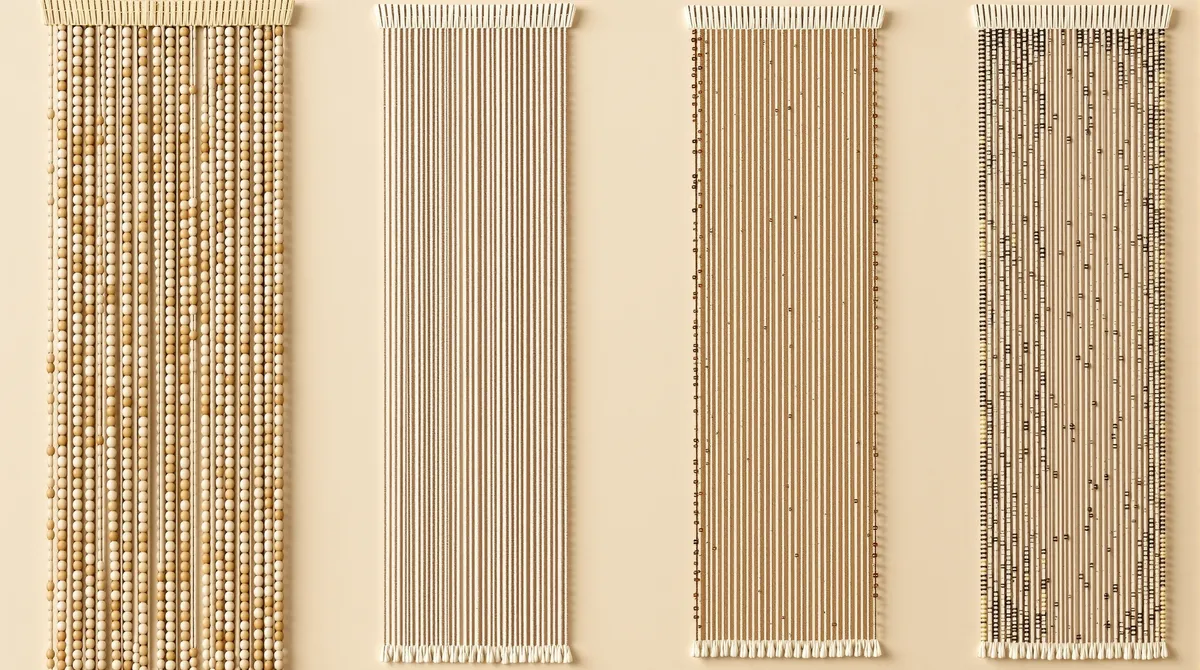
Guide · Buying
Two panels of identical dimensions can differ in cost by a multiple, and the dimension is never the reason. The reason is how many beads are in them and how long it took to place each one.
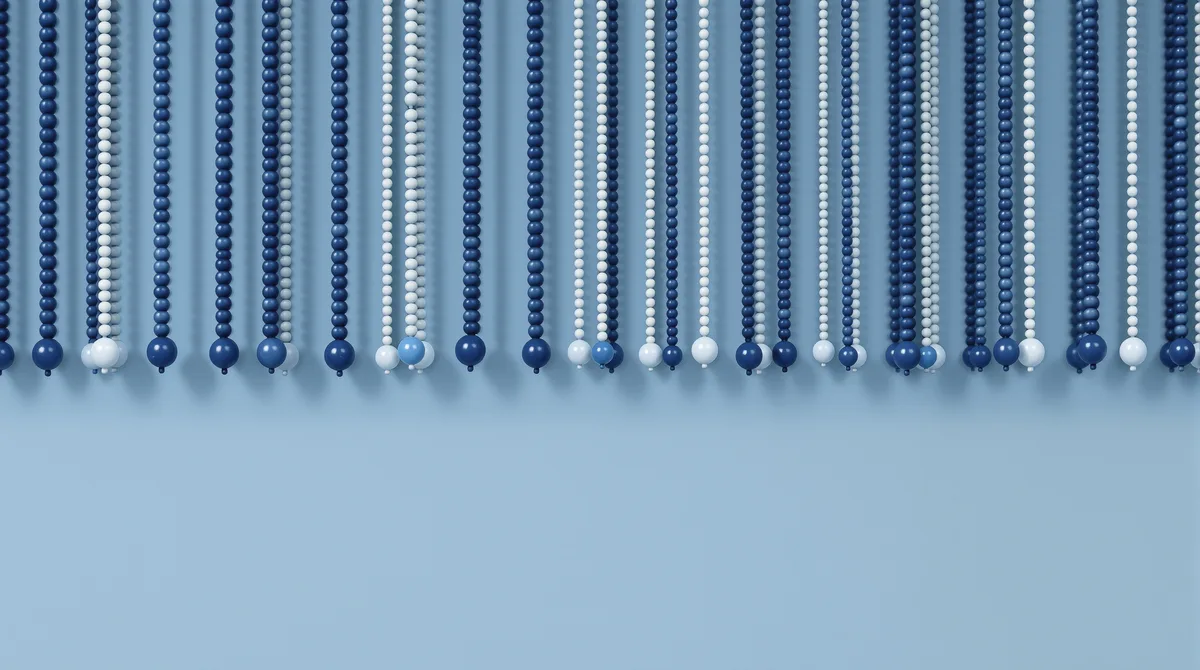
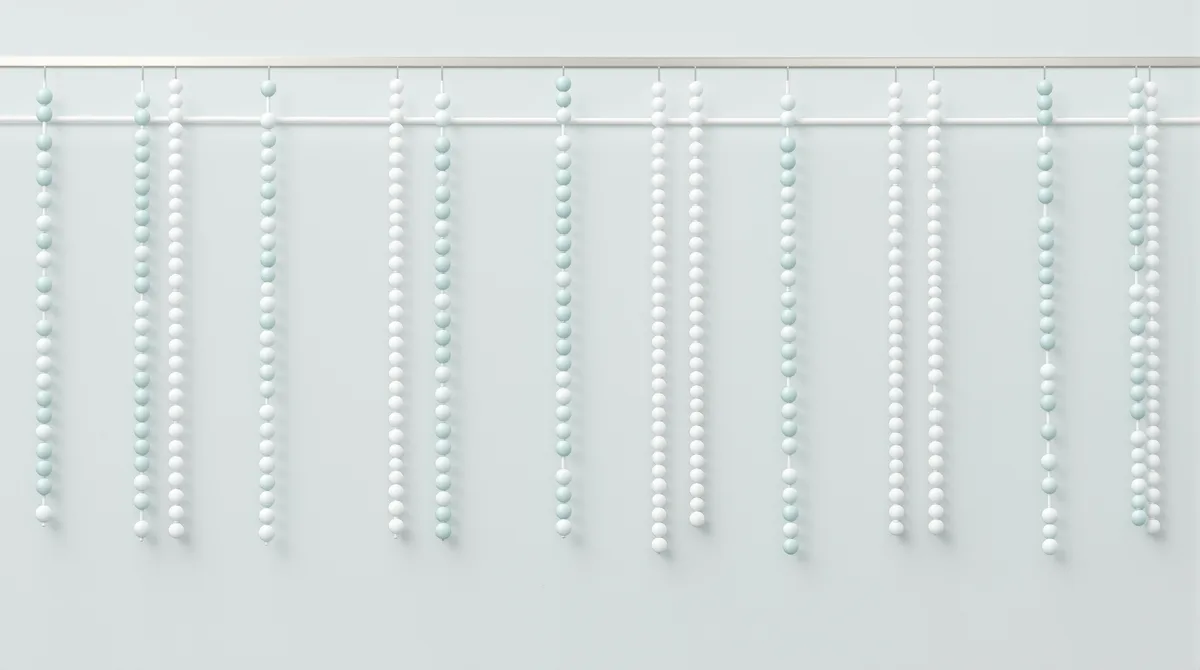
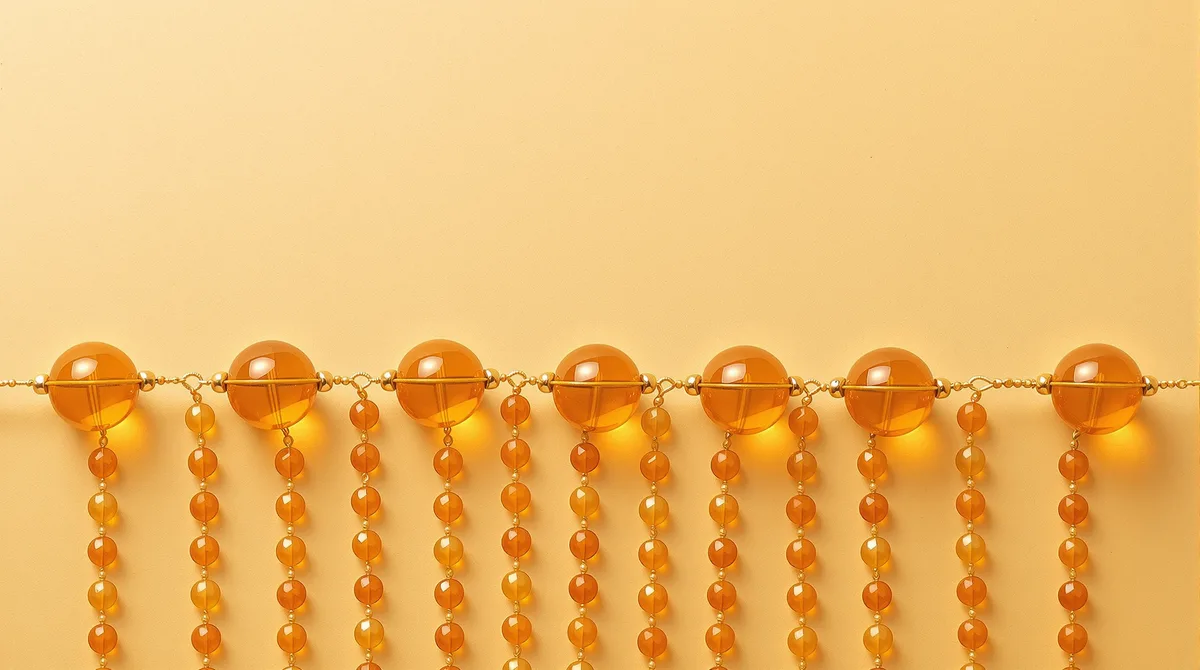
Four narrow sample panels at one length and four builds: wide-pitch large turned wood, medium-pitch pressed glass, close-pitch glass seed bead, and seed bead with scattered…
A beaded curtain costs what its bead count and stringing hours cost. A densely patterned 90 by 200 cm panel can hold about 11,800 beads, every one placed by hand; an open design the same size may hold a third of that. The five levers, in order of effect, are bead size and material, construction, strand spacing, the dowel and packing, and height.

Bead count, and the hours that count implies. Everything else on this page is a way of changing one of those two numbers.
The figure worth holding onto: a densely patterned 90 × 200 cm curtain can hold about 11,800 beads, and every one of them is placed by hand. An open-pattern panel of exactly the same dimensions may hold a third of that. Same size, same dowel, same packing — three times the beadwork.
That is why dimensions are a poor guide to cost in this category, and why anyone quoting a bead curtain by the square metre is not quoting beadwork.
A specification that is loose on levers one to three and precise on level five is specifying the wrong things.
Bead count, and it is the only cost driver here that moves in whole multiples rather than percentages. A larger bead does not shave a margin off a price; it halves a number.
The second lever is assembly rather than material. A companion design in the same 2025 development reached its cost by simplifying how the strand was put together, with the appearance unchanged — which is the cheapest kind of saving to find and the easiest to miss, because nothing on the drawing moves.
At normal viewing distance — a metre or more — a 10 mm bead and a 14 mm bead in the same colour are nearly indistinguishable. The cost difference is not.
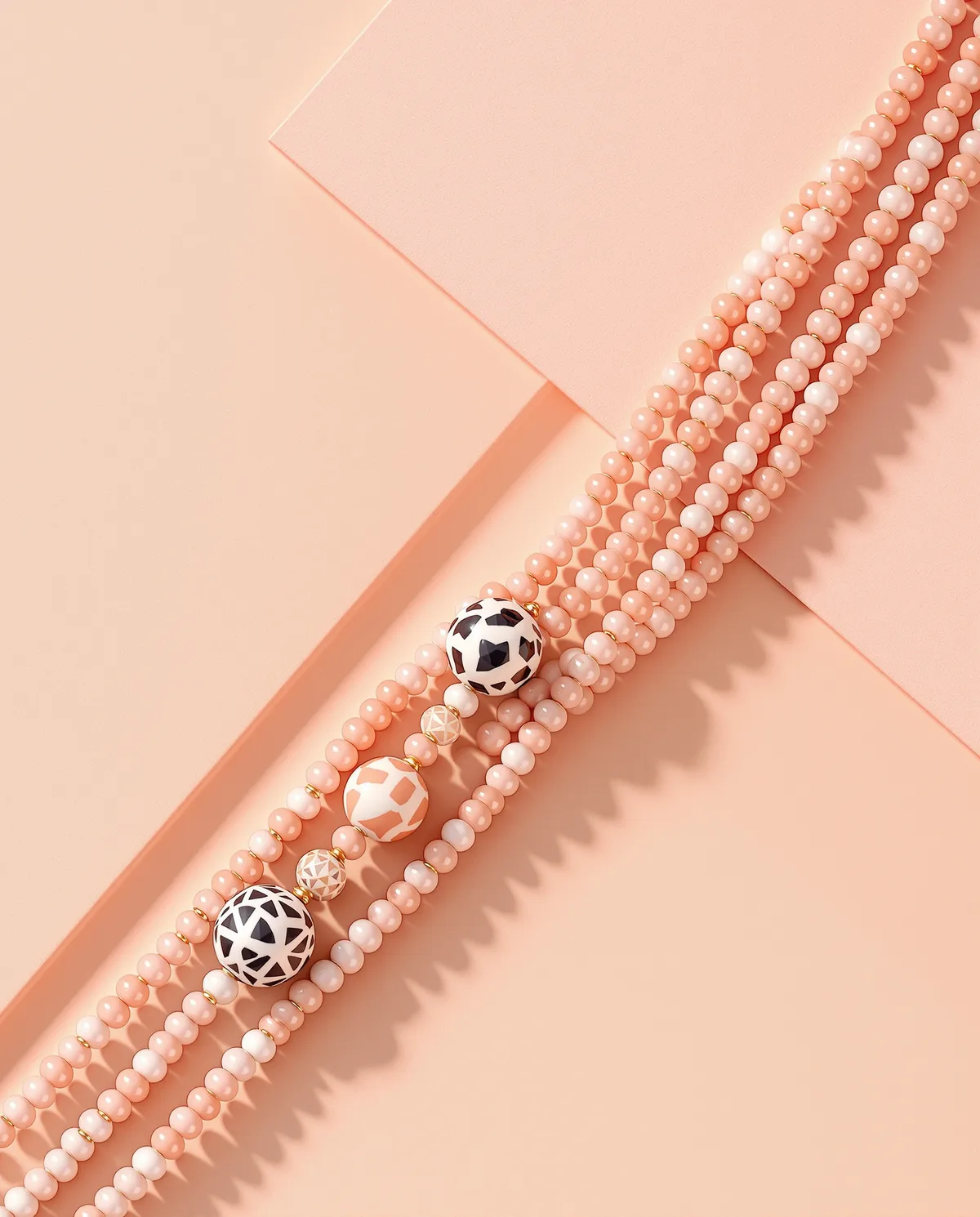
More than colour does, and this is the most useful thing on the page. There are two ways to put a motif on a panel.
A fully covered strand makes every bead part of the picture. That is what produces an 11,800-bead panel, and it is also what produces the highest-cost pieces in the category: one design was costed at the top of its range precisely because the pattern had to be mapped and assembled by hand from a reference image with no artwork file to work from.
A scattered accent keeps the strand plain and places a handful of feature beads on it. Our Polka Dot portal carries roughly 90 to 120 dotted oval beads across the whole curtain, three or four per strand, deliberately never aligned in a row. The Mushroom portal carries about 120 glass mushrooms the same way. Both read as patterned from across a room and cost a fraction of a covered build.
De-densifying an infill — keeping an outline tight and opening the fill — is the same trick applied to a motif, and it has repeatedly brought a piece to target without changing what the buyer actually looks at.

Pitch sets the strand count, and strand count multiplies everything else. A 90 cm panel at roughly 2.25 cm pitch takes 40 strands; a 120 cm panel at roughly 2 cm pitch takes 60. Open the pitch and you remove whole strands rather than individual beads, which is the fastest structural saving available.
What you lose is coverage. A wide pitch is more see-through, lets more light past, and screens less. So pitch is a cost lever that is also an appearance lever, which makes it the one to decide on the sample rather than on paper.
Yes, and it is the line item people are most surprised by. The top fixing is a turned timber component with a real cost. The packing is worse: a beaded panel is heavy, awkward, and must arrive with its strands in order and unknocked, which means inner packing and a carton specified for the job.
One of our 2025 developments was an oversize, non-collapsible wall piece whose packaging was a design constraint in its own right. On a strung panel, packing is not an afterthought — it is the difference between a piece that arrives sellable and one that arrives tangled.
Because it is linear and the others are not. Add 20% to the drop and you add roughly 20% to the bead count. Change bead size, pattern density or pitch and you can halve the count.
Height does have a hard commercial edge on short formats, where the ceiling on price is lower. A frosted sea-glass valance we developed in 2026 had its height cut from 30 in to 26 in specifically to reduce the bead count, because on a short format height is the lever closest to hand.
A brief is costable once it pins the five fields that move the price: the bead, by material, shape and size; the strand count or pitch; the longest drop; the header; and the packing. Quantity per colourway sets the rest.
Everything else can be settled later. Those five cannot — without them a cost sheet is a guess with a decimal point on it. Two omissions are fatal rather than merely expensive: leave out the strand count and the bead count cannot be derived at all, and leave out the drill hole and the panel cannot be assembled at any price.
A price list, because none exists for beaded décor. A range-wide minimum order quantity, because minimums are set per design and confirmed per quote — a plain-strand curtain and a fully patterned one use different amounts of everything.
What does exist is the rough cost sheet: before any sample is made, we show where the cost sits so you can trade look against price while the design is still a drawing. That is a more useful document than a price list would be, because it tells you which lever to pull.
Choosing a bead size is where most of the saving actually lives, so read it next. A mixed-material strand is the usual professional answer to a budget, and a short bead panel is the structural one. The order process sets out how a rough cost sheet fits into the sequence, and made to order beadwork explains why pricing is set per design in the first place. If the figure that matters is the bead count rather than the price, stringing specifications holds the arithmetic. And the pros and cons page is worth a read if the real question is whether to spend anything at all.
Good to know
Because of the number of beads and the hours of stringing behind them. A graphic curtain can hold over 11,000 beads, and every one is threaded by hand in a fixed order from a bead map. There is no machine step in the middle of that, which is why bead count and labour are effectively the same number.
Usually, because fewer beads are strung — but bead size, spacing and pattern matter as much as the dimensions. A small, densely patterned panel in seed beads can cost more than a large, open panel in 20 mm wood rounds. Dimensions are the weakest of the five levers.
Bead size. A larger bead covers the same drop with far fewer units and far fewer minutes of stringing, and at normal viewing distance the difference is close to invisible. Our 2025 portal development took six or seven iterations to hit its target and the move that did it was using two bead sizes in one strand.
No. Minimums and pricing are set per design rather than across the range, because a plain-strand panel and a fully patterned one consume entirely different amounts of material and stringing time. Both come back as a quote against a specification.
A pre-sample costing that shows where the cost sits and which lever moves it, before anyone makes a sample. It is the most useful document in the process, because it lets you trade look against price while the design is still a drawing rather than after you have approved a piece you cannot afford to repeat.
Yes, and by a wide margin. Colour is a sorting problem; pattern is a placement problem. A twelve-colour panel strung in a repeating sequence costs little more than a two-colour one. A panel where every bead position is dictated by an image has to be mapped bead by bead and assembled by hand against that map.
The bead usually is, and the freight certainly is — glass sits near 2.5 g/cm³ against acrylic at about 1.2, so the same design weighs roughly twice as much to ship. That is why mixing a few glass beads into an acrylic panel is such a common answer: sparkle where it shows, weight where it does not.
Keep exploring
Reference
The five levers that move a bead price, in order of effect, and why cost per square foot does not describe this product.
See the detailSpecification
How bead count is estimated from size, pitch and diameter — and why density matters more than dimensions.
See the detailPillar
Door curtains, portals, café lengths and valances: the standard sizes, the strand counts and the one question each format answers.
Specs and sizesGuide
Airflow, light, character and repairability against noise, dust, partial privacy and tangling — with which side each one sits on, and why.
See the detailGuide
Which materials tolerate steam, which mark permanently, and why the cord rather than the bead sets the lifespan.
Specs and sizesGuide
Resolution, weight, hang and hours — the four things one number decides, and how to trade between them.
Specs and sizesGuide
Glass where the light hits it, lighter beads everywhere else: the arrangement that most good bead panels actually use.
Specs and sizesManufacturing
Brief, rough cost sheet, colour match, sample, production, packing — the route from a sketch to a packed carton, in plants we own.
See the detail
Start a conversation
Send a reference, a colour chip or a sketch. Minimums are set per design and confirmed per quote; sampling is quoted separately and usually runs 16 to 20 days from an agreed brief.