Pillar
Beaded curtains: the formats, and what each one is for
Door curtains, portals, café lengths and valances: the standard sizes, the strand counts and the one question each format answers.
Read more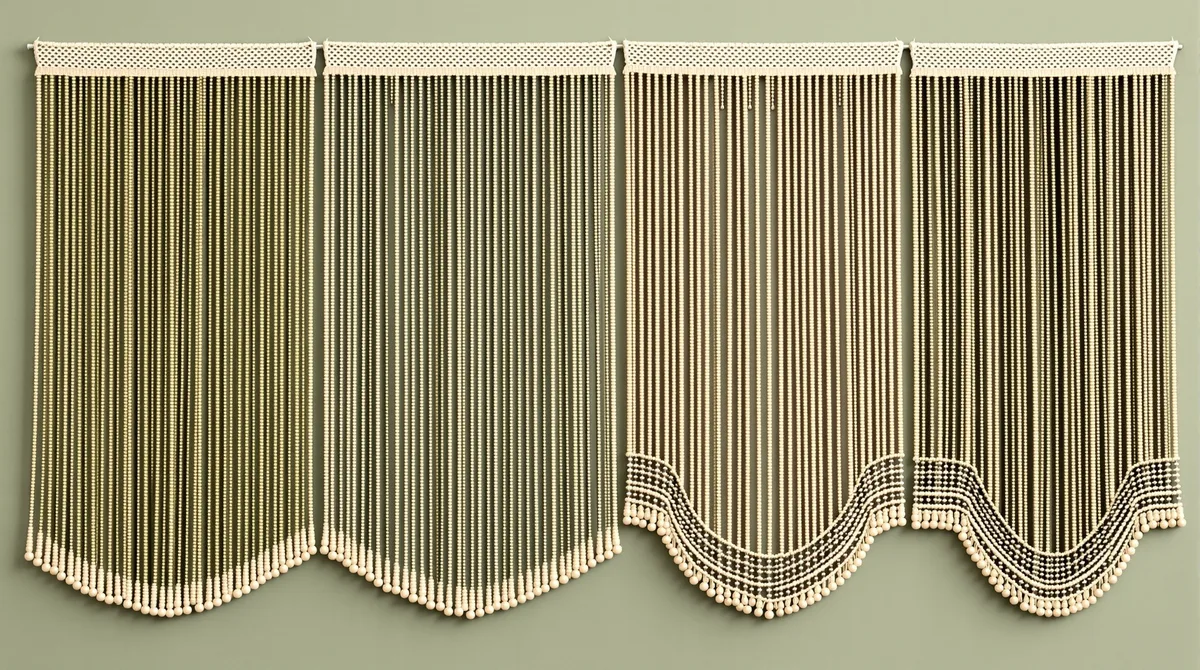
Guide · Choosing
The hem is set by strand lengths on the stringing sheet, which means a shaped hem costs the same as a straight one. It is the cheapest decision on the panel and the one most often left unmade.
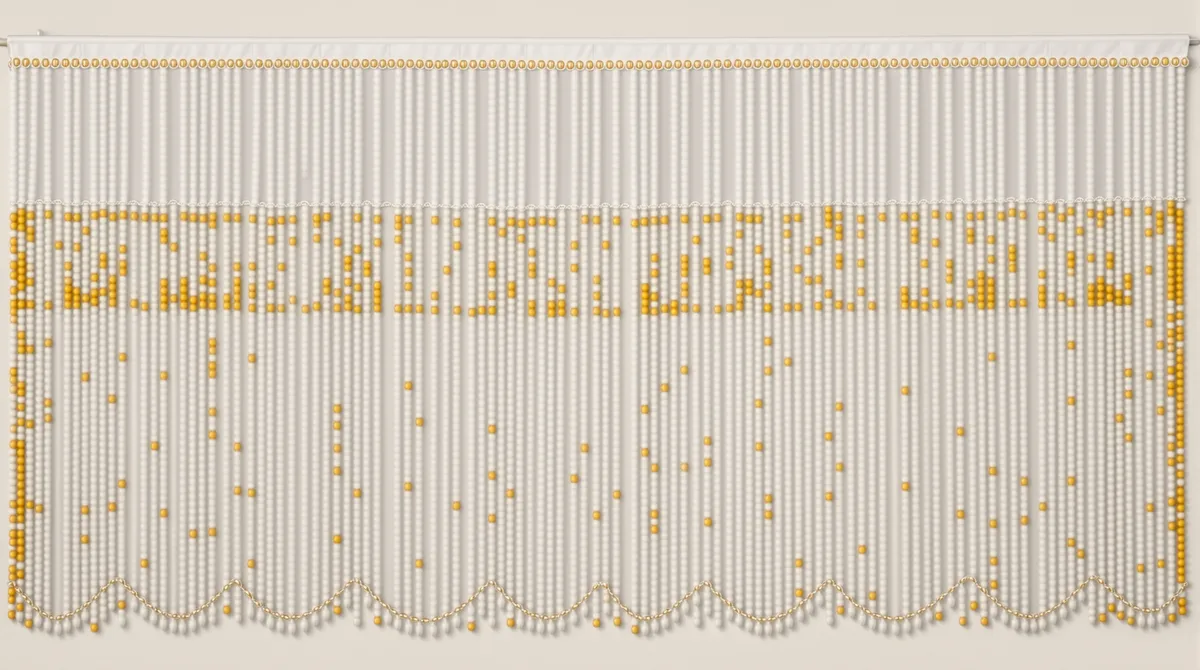
Four short beaded panels side by side at one head height, cut to four hem profiles: straight, a wide inverted V, a repeating fan arch and a scalloped chevron, all in olive, moss…
A bead panel's hem is set by varying strand lengths, so a shaped hem costs the same as a straight one. Straight suits a doorway, a scalloped arch suits a window or a valance, an arched cut makes a walk-through portal, and an uneven or staggered hem forgives a floor that is not level. Specify the longest and shortest drop.
Because it is made of strand lengths, and the stringing sheet has to specify strand lengths anyway.
On a fabric curtain, a shaped hem is a cutting and sewing operation that adds work. On a bead panel it is a column of numbers: strand one is 198 cm, strand two is 196 cm, and so on. The beadworker is reading a sheet either way.
Which means the hem is the highest-impact, lowest-cost decision available on the whole panel — and the one most often left as "straight" by default because nobody raised it.
Nine are in regular use, and the vocabulary is worth knowing because it is how a brief gets understood:
All nine are produced the same way: the colour-count sheet sets each strand's length, so every piece in a production run matches exactly.
Straight, in most cases, finishing just clear of the floor. A doorway reads as a rectangle, and a straight hem completes the rectangle. It is also the profile that gives the most coverage for the bead count, because no strand is shortened.
The exception is an arched cut, which removes the middle of the panel so there is a clear opening to walk through. That is a different object — a portal rather than a curtain — and it is a real, repeatedly reordered build: our Fallon beaded door and Naia curtain both use an arched-cut drop.
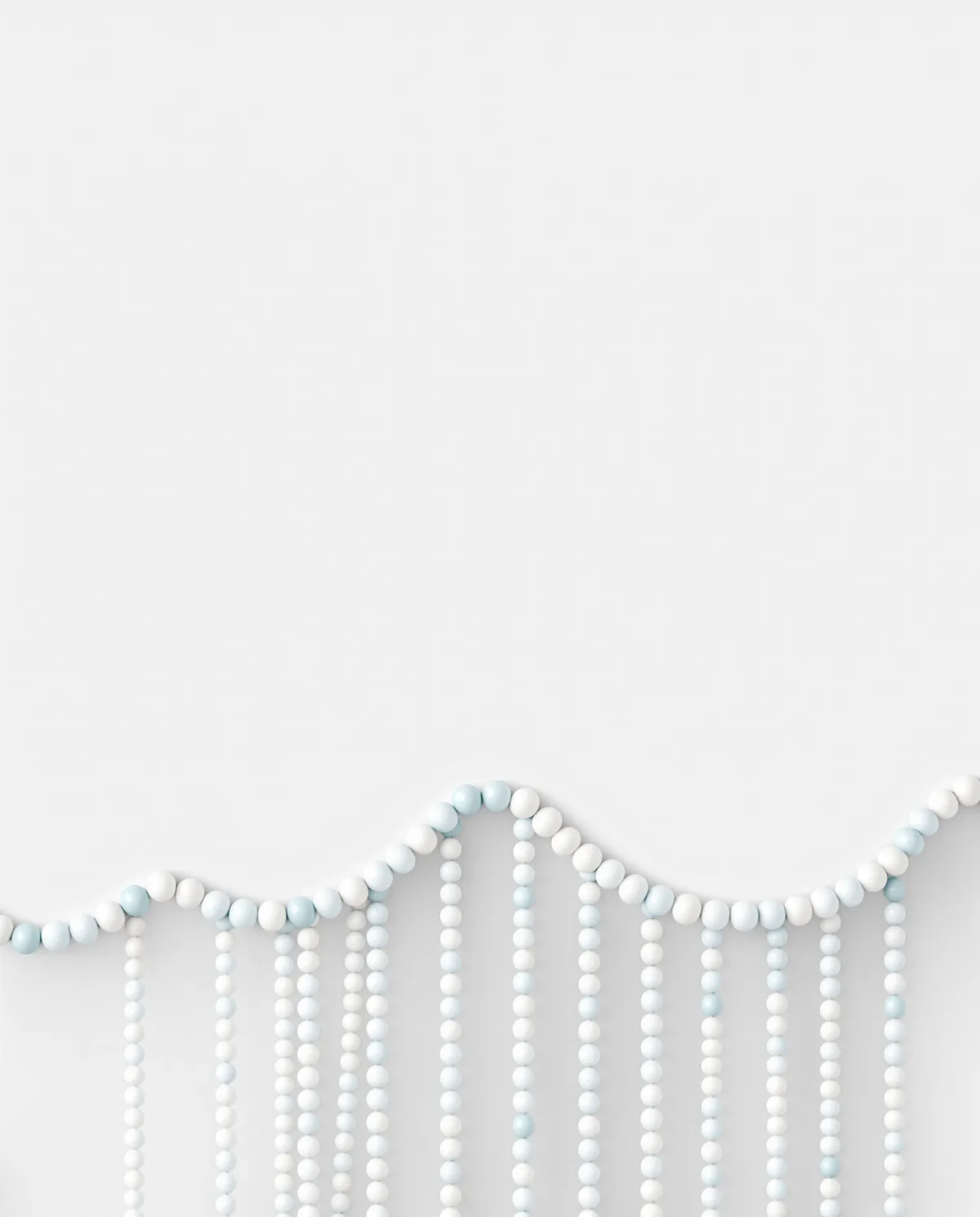
A shaped one. A scalloped arch, fullest at the sides and shortest in the centre, follows the way a window is seen and looks considerably better than a straight cut above a sill. Our frosted sea-glass valance ran from a 24 in longest strand down to a 10 in shortest on that profile, at a finished 30 × 24 in.
A V-point inverts the emphasis and draws the eye down the centre. An inverted-V opens the middle of the view, which matters if there is something outside worth looking at.
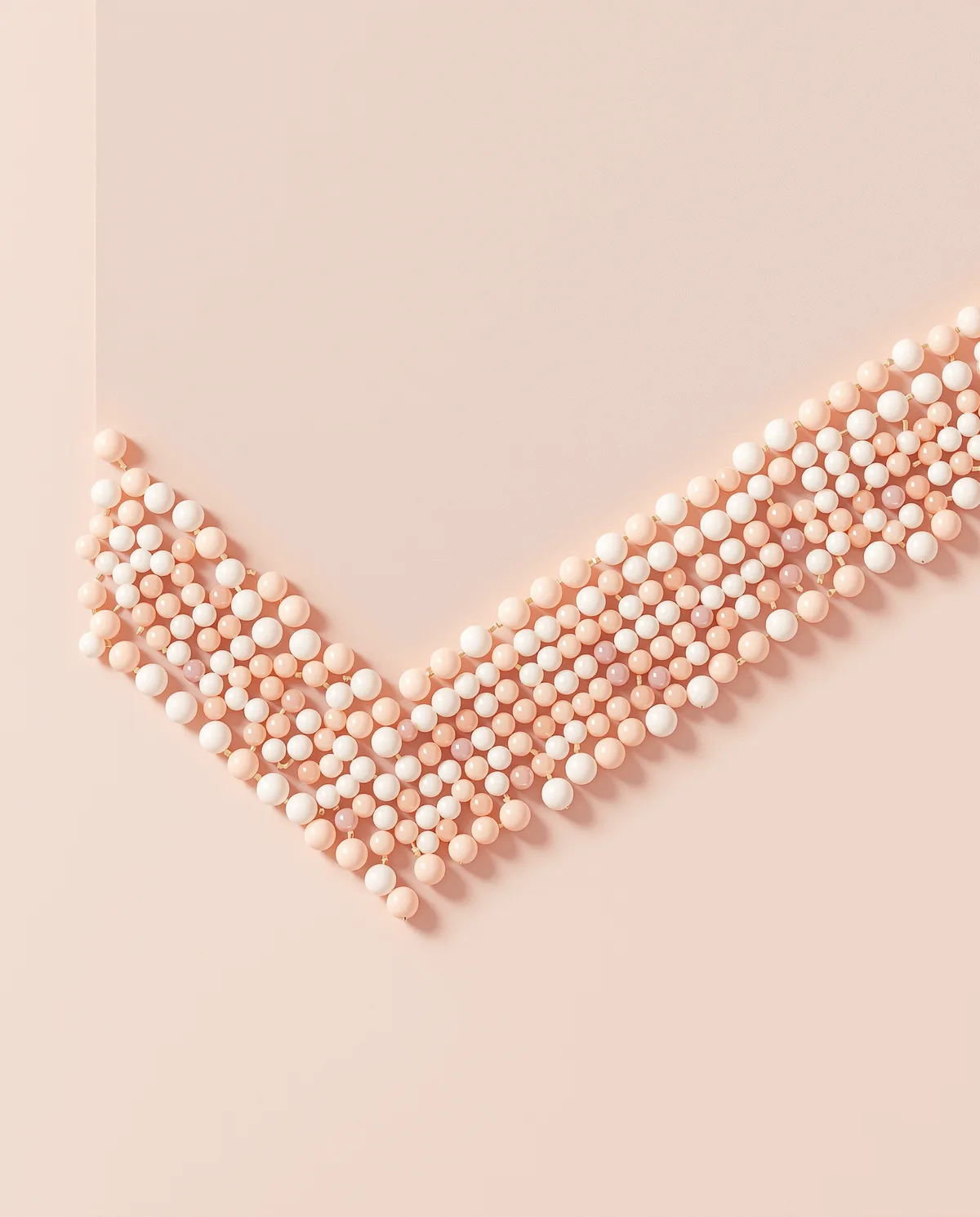
Repetition. An arch is a single continuous sweep across the whole panel. A chevron repeats the same step down-and-up several times across the width, producing a row of points.
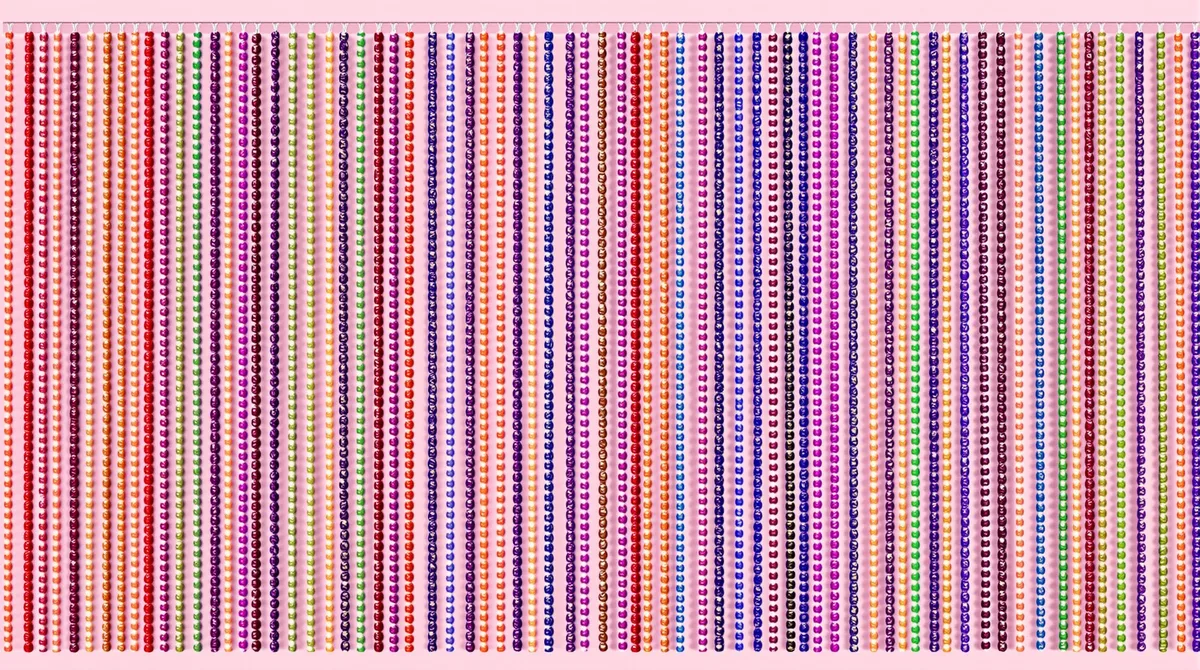
Our pink daisy café curtain finishes on a scalloped chevron; the sea-glass valance on a single arch. On a wide panel a chevron reads as pattern and an arch reads as architecture — and on a narrow panel a chevron can look busy, because each repeat gets too small to register.
Specify an uneven or staggered hem on purpose.
This is the practical use for a profile that otherwise sounds purely decorative. A straight hem over an unlevel floor shows the error immediately, because the eye compares the hem line to the floor line. A deliberately irregular hem gives the eye nothing to compare, and the floor's slope becomes invisible.
Old buildings, settled floors and tiled thresholds are all cases for this, and it costs nothing.
Yes, downwards. Any shaped hem shortens some strands, which removes beads. A scalloped arch on a valance can remove a significant fraction of the bead count relative to a straight cut at the longest drop.
That is why height sits in the cost levers at all: bead count follows drop, and a shaped hem is a partial reduction in drop across part of the panel. It is a modest saving compared with changing bead size, but it is a saving rather than a premium.
A great deal, because it is the most visible bead on the panel. The last bead on each strand both stops the strand and weights it, and on a shaped hem it traces the profile.
On light materials — acrylic, wood, bamboo — a deliberately heavier end bead is standard, because a light strand will not hang straight without one, and a hem that does not hang straight has no shape at all. On the sea-glass valance, larger plastic drop beads sat at the strand ends for exactly this purpose.
The longest drop and the shortest drop, plus which profile joins them. A single drop figure describes a straight hem and nothing else, and it is the most common omission on a shaped-hem brief.
For a repeating profile, say how many repeats across the width, or send a reference image and let the stringing sheet be set out from it. Either is fine; a number and a named profile is the fastest route to a sample that looks like what you imagined.
A short bead panel is the format where hem shape matters most, because there is least drop to carry a straight line. Beaded valances is the related format page. Choosing a bead size covers the end bead that actually traces the profile, and stringing specifications holds the strand-length data a hem is written from. For an opening that is not a rectangle, an arched opening explains the two places a curve can go. And a colourway is the other half of any brief that cares how the panel reads from across a room.
Good to know
No. The hem on a bead panel is produced by cutting each strand to a different length, which the stringing sheet specifies anyway. A scalloped arch and a straight cut take the same labour. What changes cost is the bead count, so a hem that shortens strands actually reduces it.
Nine are in regular use: straight, scalloped, pointed or V-point, inverted-V, swag, diagonal, staggered, uneven and fan. Strand lengths are set on the colour-count sheet, which is why every piece in a run matches — the hem is data rather than craft judgement.
Straight, in most cases, finishing just clear of the floor. A doorway is read as a rectangle and a straight hem completes it. The exception is an arched cut, which removes the centre of the panel to leave a clear walk-through and turns the curtain into a portal.
A scalloped arch — fullest at the sides, shortest in the centre — or a V-point. Both follow the way a window is seen and both look markedly better than a straight cut above a sill. Our frosted sea-glass valance ran a 24 inch longest strand to a 10 inch shortest on a scalloped arch.
An arch is one continuous sweep across the panel, fullest at the sides. A chevron repeats: strand lengths step down and up again several times across the width, giving a row of points. Our pink daisy café curtain finishes on a scalloped chevron; the sea-glass valance on a single arch.
An uneven or staggered hem, deliberately. If the hem is cut straight and the floor is not, the error is obvious; if the hem is designed to be irregular, nobody can tell. This is the practical use for a profile that otherwise sounds purely decorative.
The longest drop and the shortest drop, plus which profile joins them. A single drop figure describes a straight hem and nothing else. For a repeating profile like a chevron, say how many repeats across the width, or send a reference image and we will set it out.
Keep exploring
Pillar
Door curtains, portals, café lengths and valances: the standard sizes, the strand counts and the one question each format answers.
Read moreGuide
Across the strands or down each one: the distribution decision that matters more than the palette, plus grading by bead size.
Read the guideGuide
Resolution, weight, hang and hours — the four things one number decides, and how to trade between them.
How it is madeGuide
The lightest panel you can hang, the widest colour range, a light click rather than a chime, and no shatter risk.
Compare the optionsGuide
Valance, café length and half drop: three short formats, what each one does, and how bead count falls with height.
How it is madeSpecification
Straight, scalloped, V-point, inverted-V, swag, diagonal and staggered — each with its longest and shortest drop.
See the detail
Start a conversation
Send a reference, a colour chip or a sketch. Minimums are set per design and confirmed per quote; sampling is quoted separately and usually runs 16 to 20 days from an agreed brief.