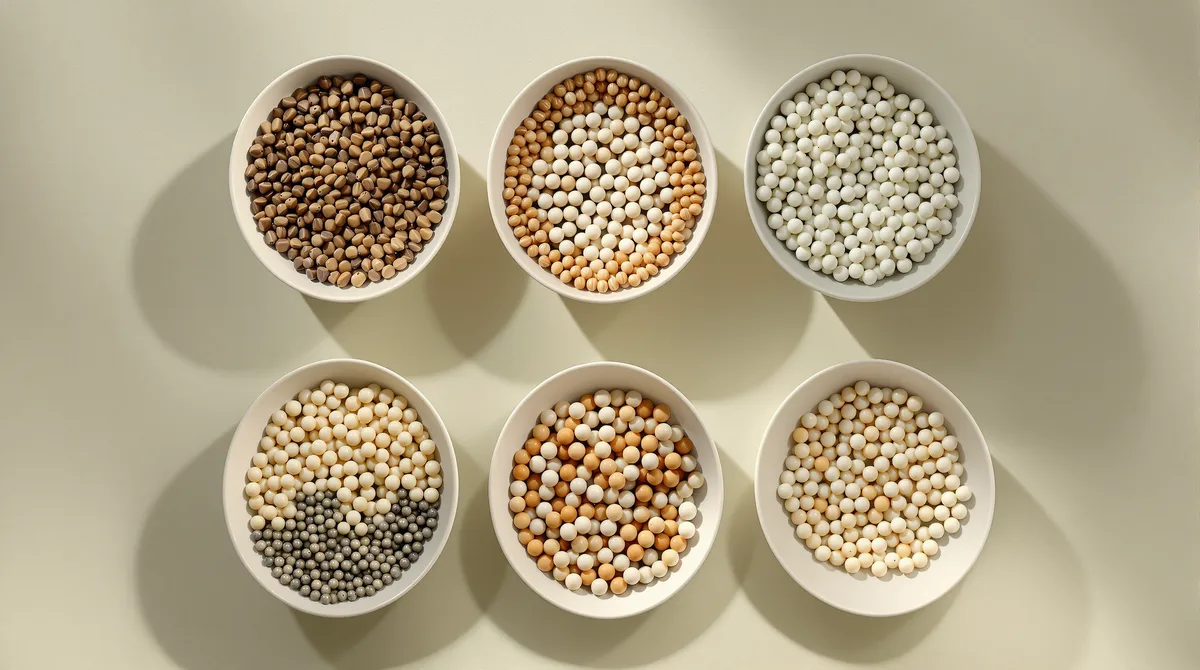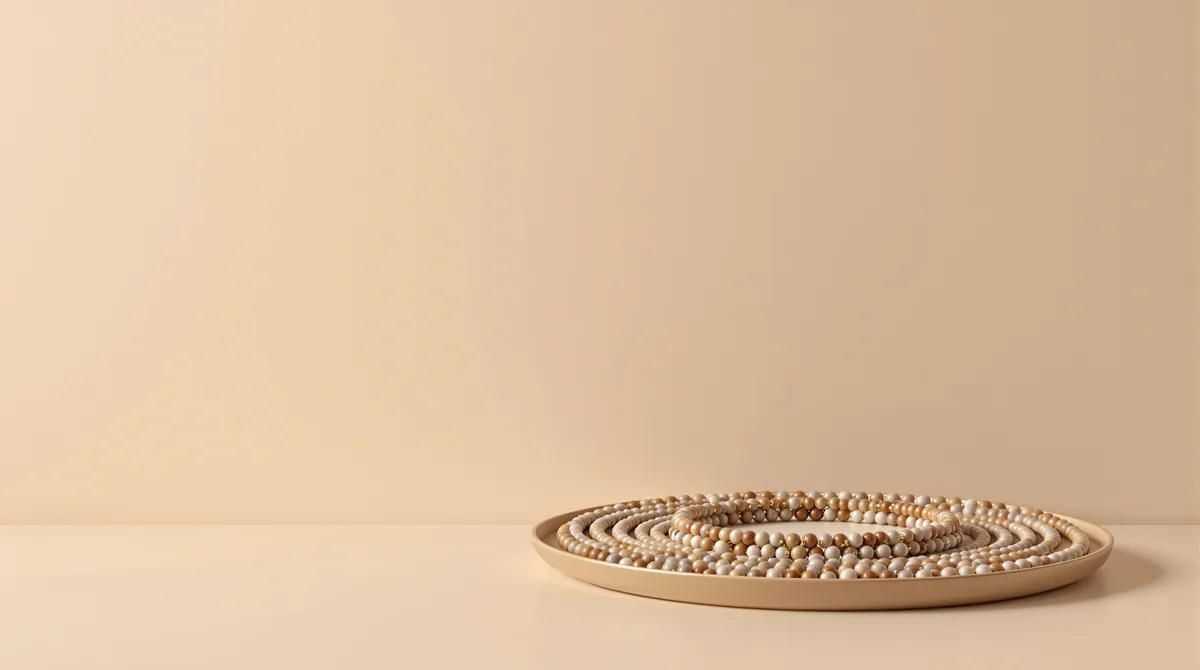
Style
The farmhouse look
Why the farmhouse look is nearly all turned wood, and what the garland archetype does and does not mean for us.
See the detail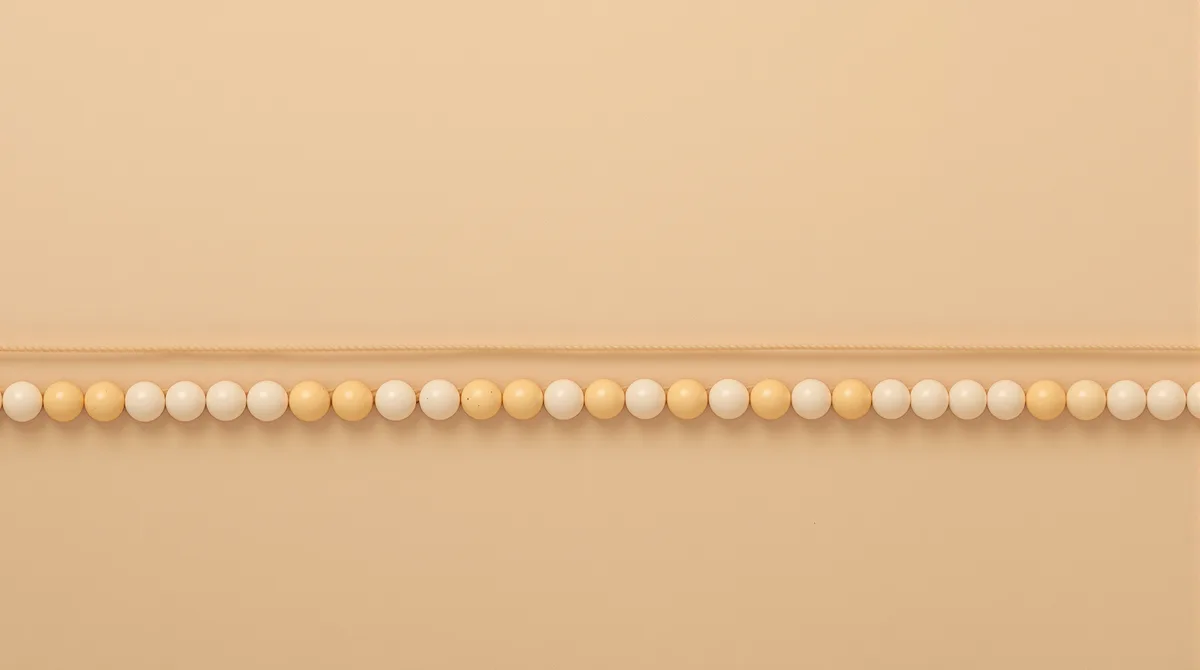
Craft topic
A wood-bead garland is four decisions long: the bead, the hole, the cord and the tassel. It is also the object we are asked about most often, and this page is craft rather than catalogue.
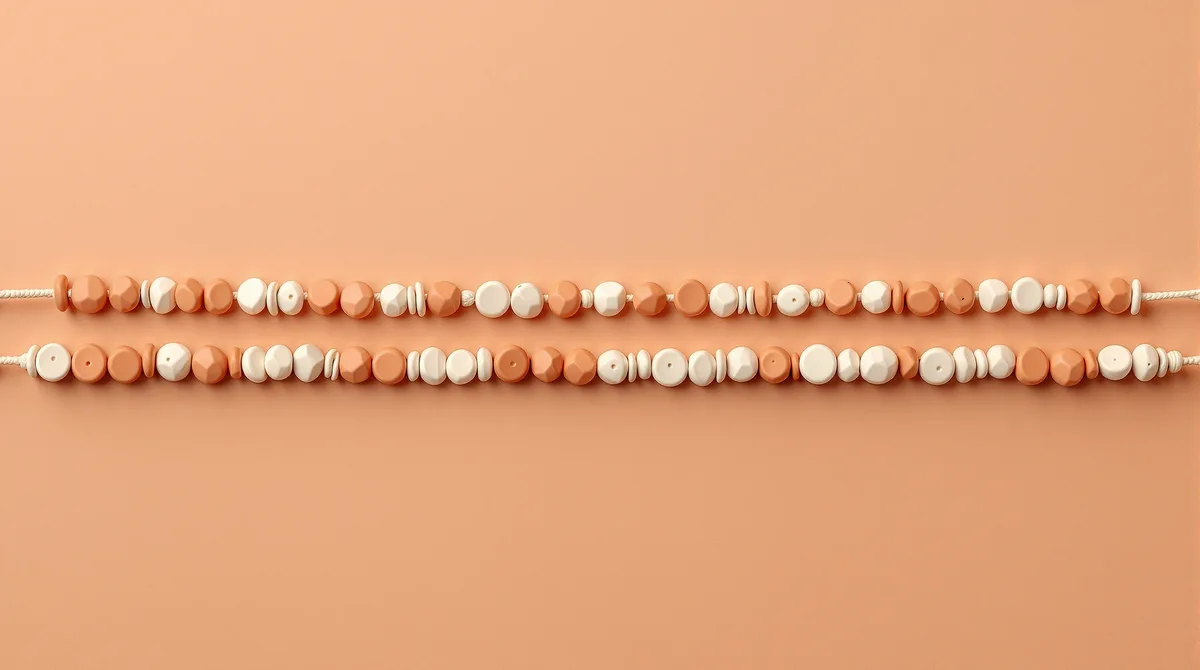
A single line of round turned wooden beads in cream, tan and honey wood tones threaded on cotton cord and laid out straight across the frame.
A wood-bead garland is turned beads drilled through the centre, strung on jute or cotton cord, knotted at each end and usually finished with a bound tassel. Hole concentricity is what decides whether it hangs straight. Gemixx turns wood and draws beads, but holds no beaded garland production record — one crocheted garland exists, and no beaded one.
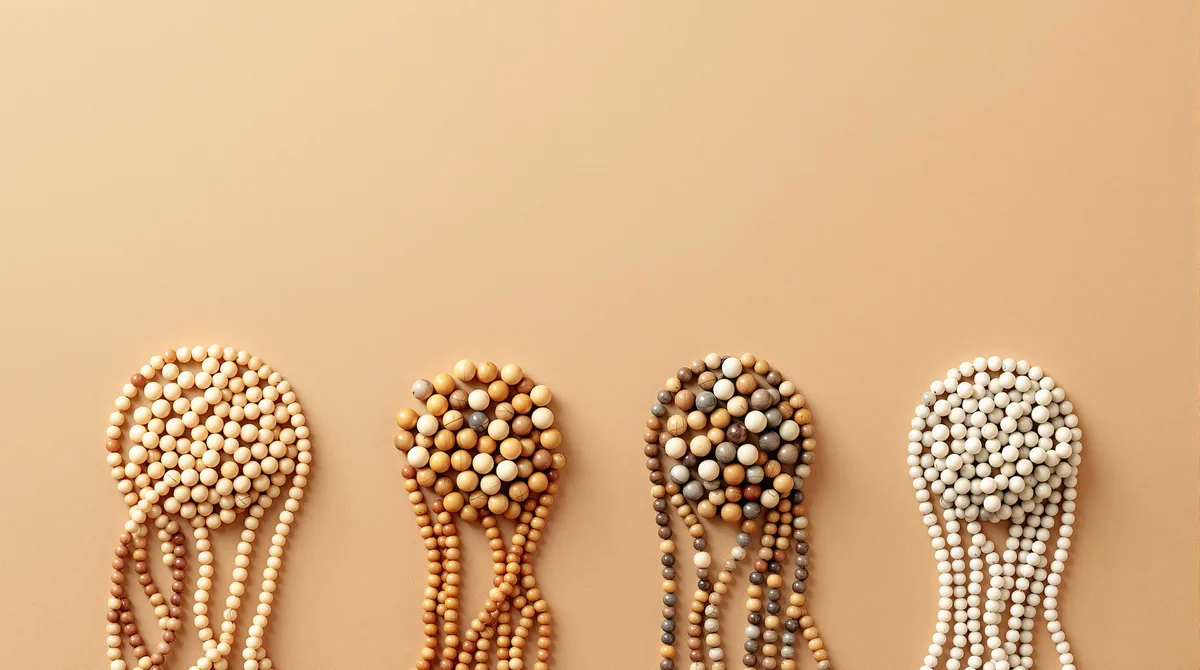
A bead garland is a length of large beads on cord, usually finished with a tassel, made to be draped rather than hung. It has become one of the most widely sold decorative objects in the world, under names like farmhouse garland and wood bead garland, and its popularity has almost nothing to do with the beads themselves.
Its form is borrowed. Counted devotional strands — the japamala, the rosary, the misbaha — are the same construction put to a different purpose: beads on a cord with a terminal marker. The decorative garland keeps the construction and drops the counting, which is why the tassel survives even though it no longer marks anything.
Four operations. A bead is turned on a lathe from a blank or cut from a dowel, which is what gives it its profile — the bead shapes here are round, rondelle, barrel and disc. Wood turning and drilling is one operation on one machine. It is drilled through the centre, normally on the lathe or in a jig. It is sanded and either left raw or finished with a stain, a wax or a limewash. Then the beads are strung onto jute twine or cotton cord, with a stopper knot at each end and a tassel below it.
Nothing about that is complicated, which is exactly why the quality variation between garlands is so wide: there is nowhere for a mistake to hide.

Because a bead with an off-centre hole does not hang level. It cocks, and the cord leaves it at an angle, so the next bead is pushed off line too. Across forty beads those small errors accumulate into a garland with a visible kink in it.
This is the single most useful thing to know about the category. Bead species, finish and colour are all visible in a photograph; hole concentricity is not, and it is what separates a garland that drapes cleanly from one that will not sit right on a shelf however carefully it is arranged.
The second hole decision is diameter, and it is a drill hole question before it is a design one. The cord has to fill the hole. A cord much thinner than the bore lets every bead rattle along the strand, which looks loose, sounds cheap and wears the cord through at the knots.
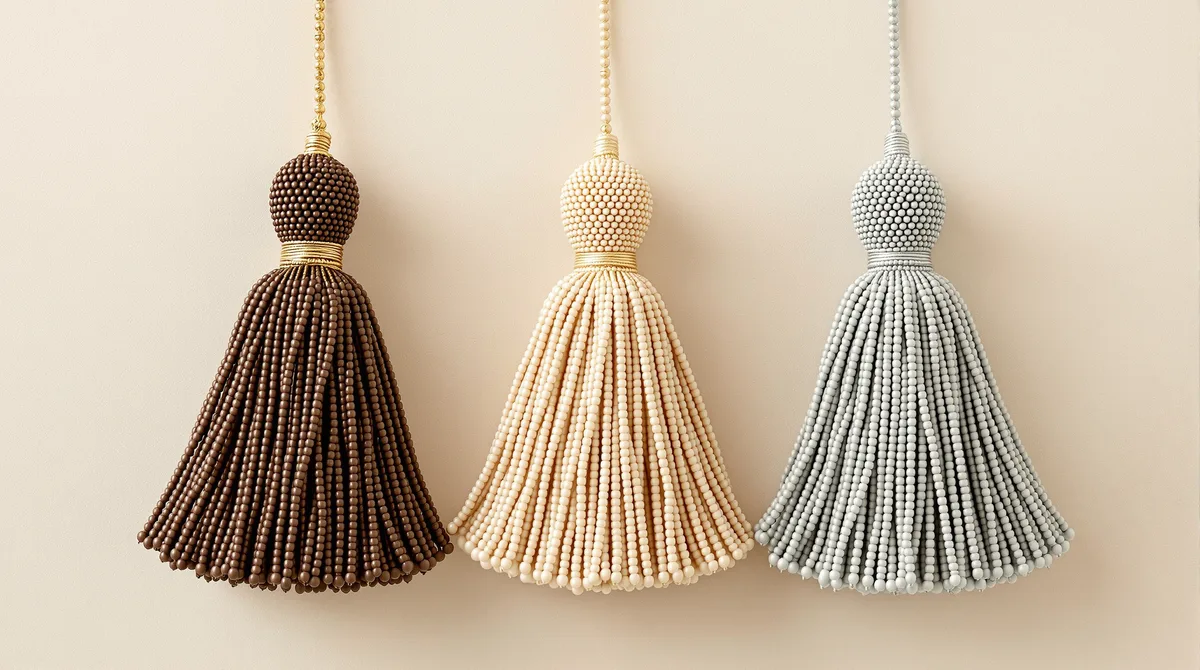
The neck. A tassel is a skirt of cord or thread gathered at the top, and the gather has to be bound — wrapped tightly with thread or fine wire and then covered, either by a wrap of the same cord or by a head bead seated over it. A glued neck is the standard shortcut and the standard failure: adhesive on a twisted natural fibre lets go, and when it does the whole skirt comes away in one piece.
Then skirt length. The strands should be cut level after binding, not before, because binding pulls them unevenly. A tassel trimmed before it was bound is obvious from a metre away.
Turned wood beads are the default, and species matters more for the hole than for the colour: a dense, close-grained wood drills cleanly and holds a thin wall, where a soft open-grained one tears at the bore. Beyond wood, the same construction is made in clay, in glazed ceramic beads, in bone beads and in glass, each with different weight and different breakage behaviour.
The techniques are wood turning, drilling, finishing, hand-stringing and tassel binding. All of them are ordinary craft operations, which is why the object is made at every scale from one person at a kitchen table to full container programmes.
A beaded garland is available to develop here rather than a line to order. The only garland on the bench today is a crocheted moon-and-stars piece, which is yarn rather than beadwork. The beads themselves we make — glass drawn in Firozabad, wood turned in Saharanpur, ceramic fired in Khurja — so a garland is a drawing, a cord specification and a sample away, and that is how it would be built.
What is real is the component capability. Wood is turned in our own Saharanpur wood factory, which already makes the dowels for our beaded curtains. Glass seed beads and larger glass are drawn and hand-strung in our own Firozabad glass works. Ceramic is glazed and fired in our own Khurja plant. A garland is well within that, and it has not been made.
Scale and tension, mostly. Our strung work is many parallel strands held at a header under their own weight, where every strand has to match its neighbours to a bead. A garland is one strand with no neighbour to agree with and nothing holding it taut.
That makes a garland easier in one respect and harder in another. There is no count sheet to hold across thirty strands, but there is also nothing to disguise a single bad bead: on a curtain one off bead in 11,800 disappears, and on a garland of forty it is the thing you see.
Hold it up by one end and look along it. Then roll a bead between finger and thumb and feel whether the cord sits tight in the hole. Then look at where the cord enters the end knot — a fibre already fraying at the knot on a new garland will fail early. Then the tassel neck. Then, last, the finish, because a finish is the only part of a garland that can be judged from a photograph and therefore the only part most buyers have already checked.
Everyone, at every scale: craft sellers making dozens, workshops across South and Southeast Asia making thousands, and factory programmes making container loads. That breadth is why quality is so uneven and why the retail price band is so wide for what is nominally the same object.
Dust or wipe dry. Keep it away from constant steam, because raw wood takes up moisture and swells around the hole, which loosens a finish and can split a thin bead wall. Do not soak it. Cord dries far more slowly than wood does, and the knots tighten unevenly as it dries.
Because our record will not support a product page, and a product page is what every other manufacturer in this category would publish. The crafts behind a garland are genuinely in our plants. The garland is not. Writing it up as a craft subject keeps the vocabulary accurate and keeps the claim honest, and those are the same thing.
Good to know
Not as a line. The only garland on the bench today is a crocheted moon-and-stars piece in the crochet family, which is yarn rather than beadwork. A beaded garland is available to develop — strung on cord from our own glass, wood or clay beads — and it would be built to a drawing and an approved sample like anything else.
Beads are turned on a lathe from a blank or a dowel, drilled through the centre, sanded and left raw or finished. They are then threaded onto jute twine or cotton cord, with a stopper knot at each end and often a bound tassel below it. The whole object is four decisions: the bead, the hole, the cord and the tassel.
Wood bead garland, prayer-bead garland and farmhouse garland all describe the same object in retail. The form borrows from devotional strands — japamala, rosary, misbaha — which are counted rather than hung, and the decorative garland keeps the construction while dropping the counting.
Hold it up by one end. A garland with concentric holes hangs in a straight line; one with off-centre holes kinks, and no amount of bead quality fixes that. Then check the cord against the hole: a cord much thinner than the hole lets the beads rattle and wears through at the knots. Then check the tassel neck is bound and covered rather than glued.
Draped rather than hung: over a tray, a stack of books, a pitcher handle, the corner of a mirror, a drawer pull. It is an object with no fixing, which is most of its retail appeal. Lengths between roughly 90 and 180 cm cover almost every use, and the tassel is what gives the drape a direction.
Dust or wipe with a dry cloth, and keep it out of constant steam or damp. Raw wood takes up moisture and swells around the hole, which loosens the finish and can split a thin bead wall. Never soak it: the cord takes far longer to dry than the beads and the knots tighten unevenly as it does.
Less than most objects on this part of the property. Wood turning and drilling is a capability in our own Saharanpur wood factory, which already turns the dowels for our beaded curtains, and bead stringing is the core of what the beadwork studios do. A garland development would need a bead profile, a hole specification, a cord gauge, a tassel construction and a size set. None of those exists yet.
Keep exploring
Style
Why the farmhouse look is nearly all turned wood, and what the garland archetype does and does not mean for us.
See the detailIndex
Seventeen beaded objects documented from inside the craft — what each one is, how the tradition builds it, and what it would take to develop one.
Read the guideCraft topic
The threshold hanging of Indian homes — its meaning, its materials from mango leaf to zari, and why it is not the same object as a door curtain.
See the detailCraft topic
Why clay took the garland market from wood, what polymer heishi and fired ceramic each give up, and the breakage the format carries.
See the detailCraft topic
Head, skirt and loop — how each part is built, and the neck that decides whether it survives.
Specs and sizesReference
Nine material families, what each gives in light, weight and colour, and how far our own manufacturing reaches into every one of them.
See the detail
Start a conversation
Send a reference, a colour chip or a sketch. Minimums are set per design and confirmed per quote; sampling is quoted separately and usually runs 16 to 20 days from an agreed brief.