Craft topic
Bead garlands
The bead, the hole, the cord and the tassel — how a wood-bead garland is actually made, and what separates a good one from a cheap one.
Compare the options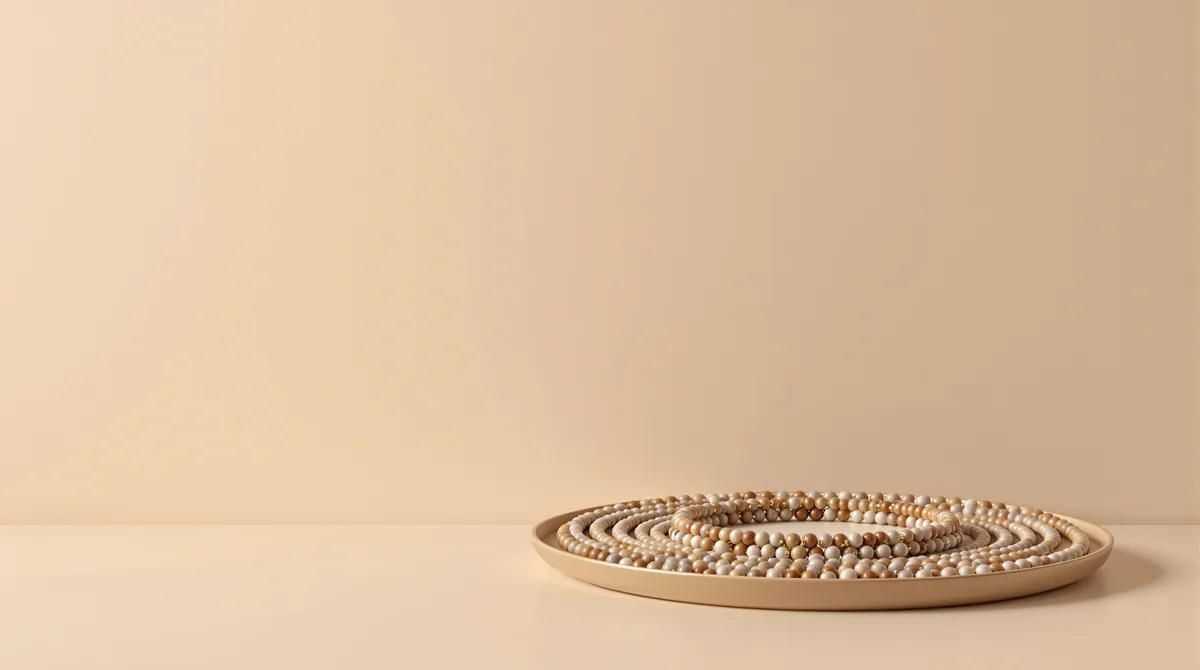
Style · Era
This is the one register in beadwork built on absence. No colour, no pattern, no shine — just scale, matte wood and a drilled hole you are meant to see.
A coiled beaded mat lying flat, strands of wood and glass beads wound in close concentric rounds.
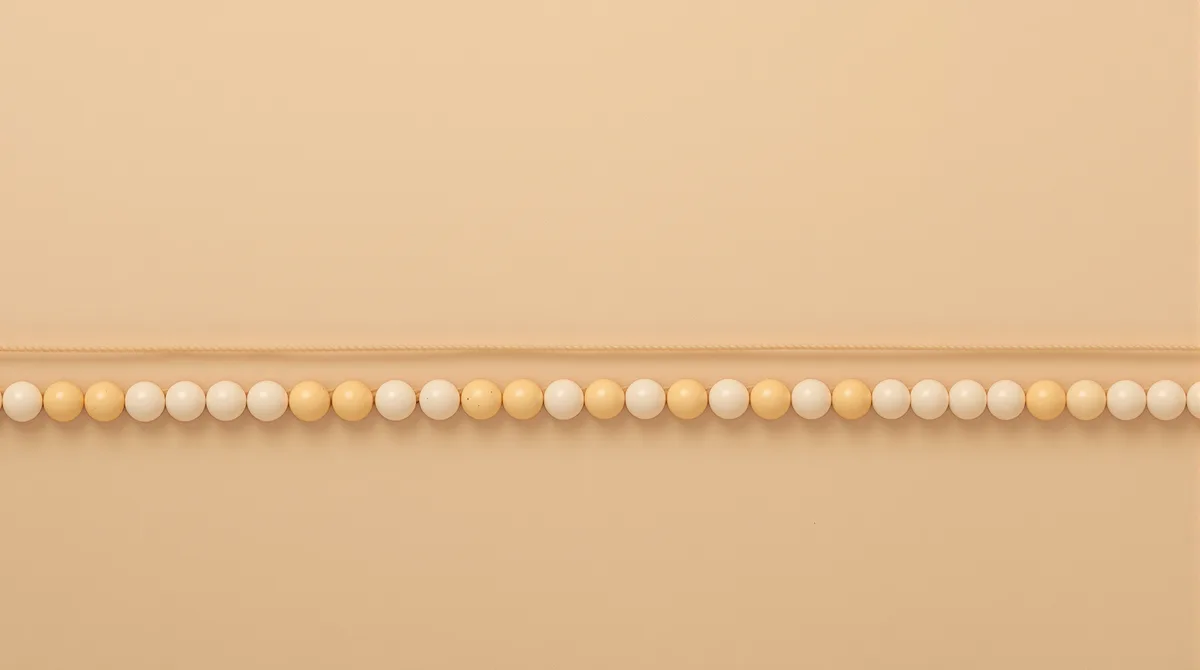
Scale and a matte natural finish define the farmhouse look, with colour deliberately absent. Large turned wood beads, unfinished or limed, run in one size at an even pitch and end in a cotton tie or a knotted tassel. Any gloss, any dye and any pattern moves the piece out of the register immediately.
Farmhouse as a décor language is a North American retail construction of the 2010s, assembled from Shaker plainness, French country colour and rural utility objects repurposed as ornament. Its beadwork element arrived almost entirely through one object: the large wooden prayer or worry bead strand, lengthened and hung as a decorative garland. That object is the whole origin story. Everything else in farmhouse beadwork is an extension of a strand of big plain wooden beads with a tassel on the end.
Scale and absence. The bead is large — ten to twenty millimetres — so each unit is an object rather than a pixel, and there is only one of it. No second bead size, no accent colour, no pattern, no gloss. The surface is matte and the hole is visible. The register is produced by what has been taken out, which makes it the exact inverse of the boho look it is often shelved beside.
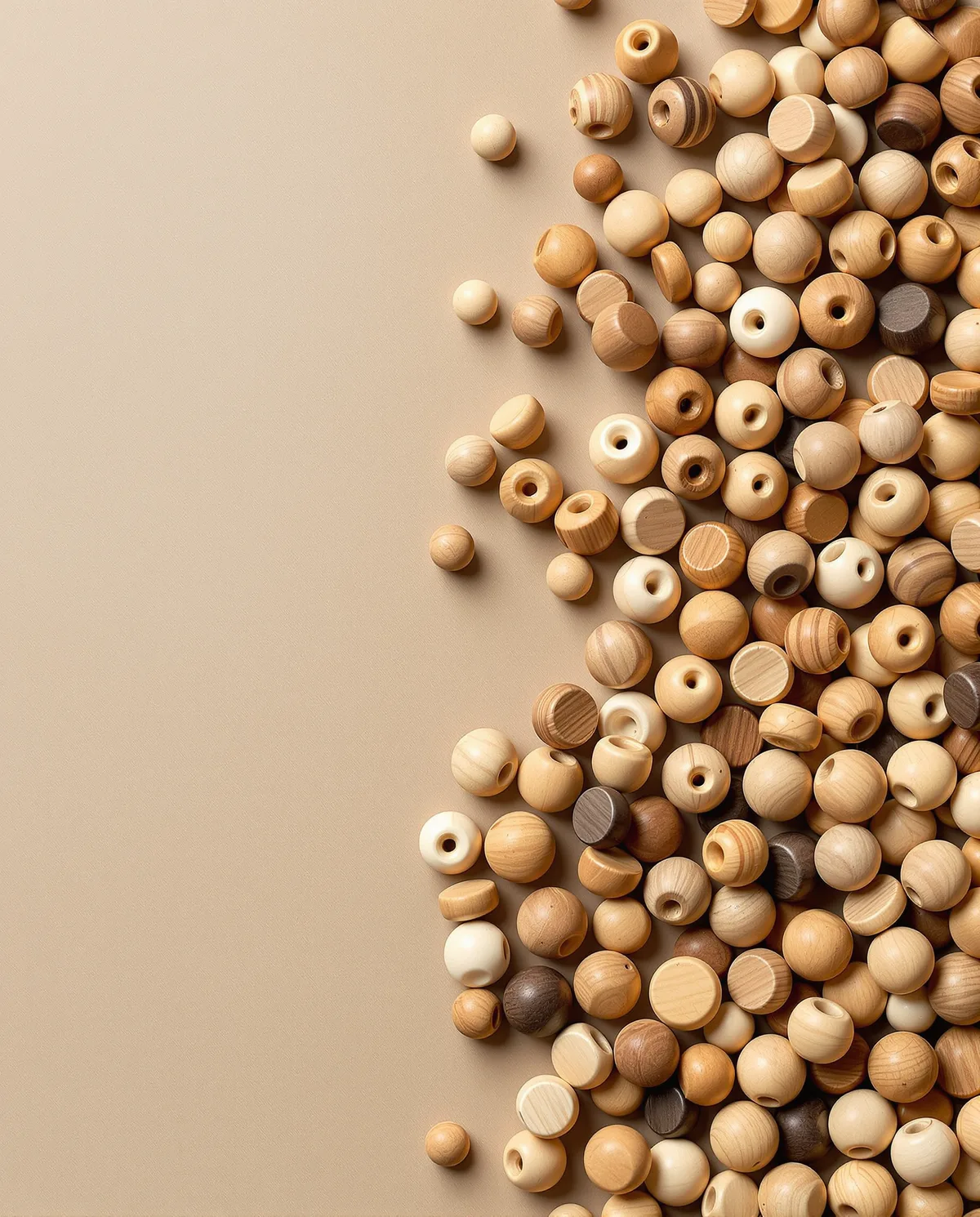
Turned wood rounds and flat discs, in natural, limed, whitewashed or walnut-stained finishes. Wood beads and curtain dowels are both turned in our own Saharanpur wood factory. The hem is almost never shaped: a straight cut, or a single knotted cotton tie at each end. Where a softer note is wanted, a glazed ceramic spacer from our Khurja plant in oatmeal or sage sits inside the register without breaking it.
A fixture that has been treated as a trend. The underlying object — a strand of plain large wooden beads — predates farmhouse styling by centuries and will outlive it. What cycles is the staging around it. A range built on the object rather than on the styling has a much longer life.
The original objects were devotional or working strands, made in one size because that was practical, with wear that came from use. The retail version reproduces the look and manufactures the wear, which is where it most often goes wrong: applied distressing on a new bead reads as a finish, not as age. Our position is to leave the wood honest. A clean limed surface ages genuinely; a painted-on patina does not.
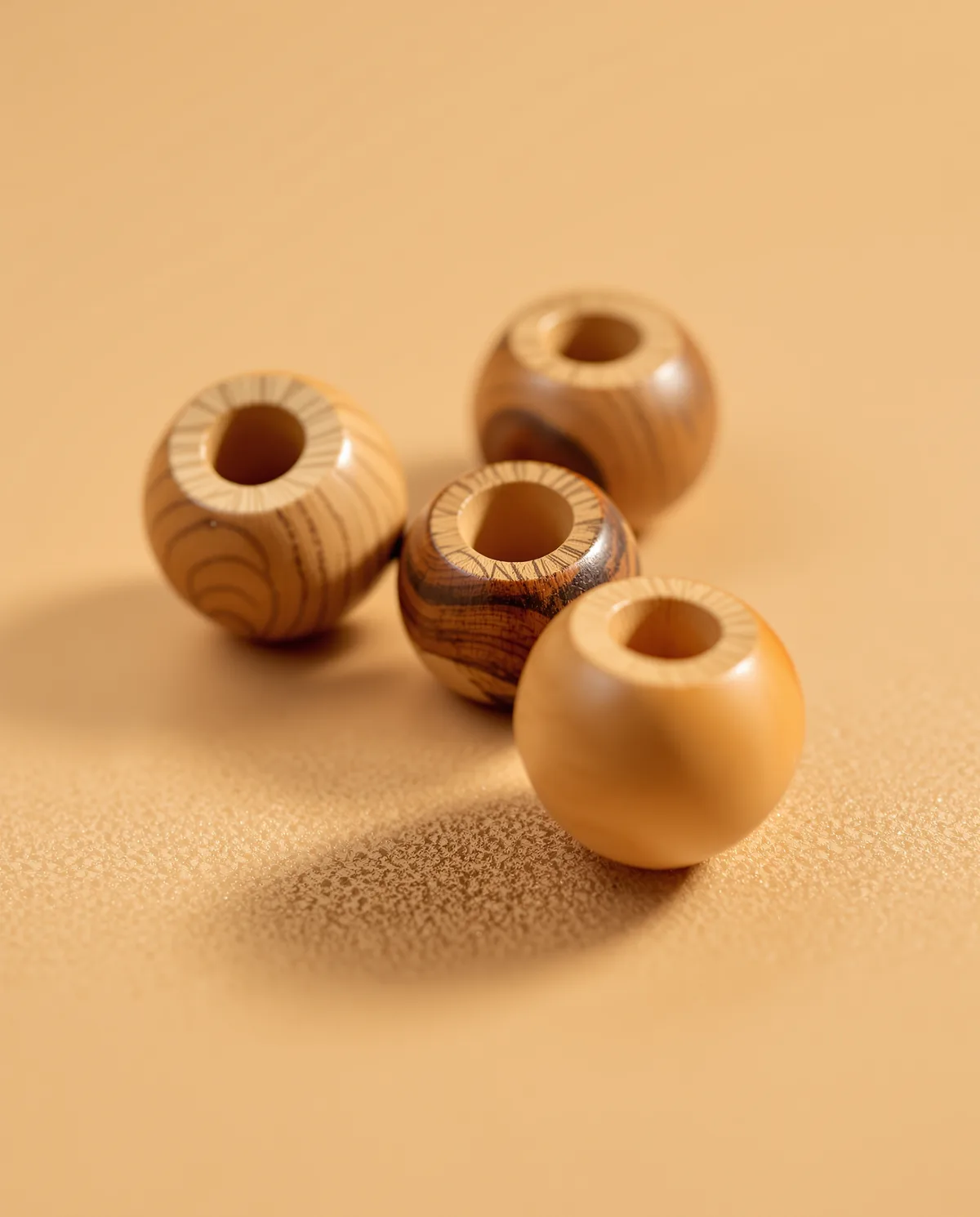
Almost none of them, and that is the point. Of the fourteen 2027 colour stories, only Olive Press — olive and moss through soft sage to oatmeal — sits comfortably in this register, and only in its palest half. The others are all built on colour relationships that farmhouse has no use for. When a farmhouse brief arrives, the design library is the wrong starting point; the bead materials reference is the right one.
It photographs very well and very easily, which is a large part of why it sells. One matte object, warm neutral ground, long raking light, visible grain. It sells as a stacked accessory — a garland over a mantel, a swag on a cabinet — which means it sells on styling imagery rather than on construction detail, the reverse of most beadwork.
Home retailers and e-commerce sellers in the decorative accessories aisle, gift and lifestyle stores, and brands buying under their own label. One note on scope: the archetypal farmhouse bead product is the wood-bead garland, and a beaded garland is available to develop rather than a current line — as is the beaded tassel that finishes it. The wood beads themselves are turned in our own Saharanpur factory, which is the half of that object we already make.
Acrylic moulded and printed to imitate wood grain. It fails on three details at once: the mould parting line runs around the bead, the hole is moulded rather than drilled so there is no open end grain, and the colour is perfectly uniform in a way real timber never is. Because this register has no pattern or colour to distract the eye, every one of those tells is immediately visible. If the budget cannot carry turned wood, a plain painted wood bead is a better answer than a wood imitation.
There is no pattern, so the whole quality question becomes uniformity. Bead diameter variance, hole alignment and strand length are the controlled dimensions, and the finish has to match across the lot — timber takes a lime or a stain unevenly if the blanks are not matched. First-article and lot inspection run through our own Greater Noida house, which is where that matching is actually caught.
This is close to the floor of the medium. One bead line, no colour matching, no accent, low bead count. The cost drivers that matter elsewhere — pattern complexity, number of picks, strand density — are all at their minimum. What remains is the wood and the finishing time, and the practical lever is bead diameter: a sixteen millimetre bead covers a given drop with far fewer units than a ten millimetre one.
Good to know
Short and horizontal ones. The look was built on garlands and swags rather than on full-length panels, and a two-metre drop of large wood beads is heavy, noisy and visually monotonous. A valance, a café length or a wall piece suits the register much better than a door curtain.
Keep the finish plain and the count low. Farmhouse pastiche is distressed paint, printed script and a jute bow on everything. Farmhouse done properly is one bead size, one natural finish, a plain cotton tie, and nothing else in the frame.
The wood-bead garland has been one of the most durable sellers in decorative home accessories for several years, which is a market observation rather than a figure from our own record.
Turned wood rounds in the ten to twenty millimetre range, natural or limed, with flat discs as spacers. Our wood beads and our curtain dowels are both turned in our own Saharanpur wood factory, and the timber lines there are FSC certified.
We can match the look, the bead sizes and the finish in new materials as an inspired design, and we do not reproduce another brand's protected design. Farmhouse references are usually easy to match because the vocabulary is narrow — the information worth taking is the bead diameter and the pitch.
Natural, limed, whitewashed and a dark walnut stain. That is the whole palette. A single soft putty or sage note can be introduced in a ceramic spacer, but any saturated colour reads as a different style wearing farmhouse materials.
No — it is close to the cheapest build in the medium. One bead line, no pattern, no colour matching and a low bead count per piece. The cost sits in the wood itself and in the finishing, because a matte natural surface shows every sanding fault.
Keep exploring
Craft topic
The bead, the hole, the cord and the tassel — how a wood-bead garland is actually made, and what separates a good one from a cheap one.
Compare the optionsMaterial
Turned and drilled in our own wood factory: grain variation you approve rather than eliminate, the finishes that hold colour, and the dowel from the same plant.
Compare the optionsIndex
Twenty-four named looks, each described by the material, palette, pitch and hem that actually produce it.
How it is madeStyle
Why deco needs pressed glass rather than seed beads, and why symmetry is the expensive part rather than the palette.
See the detailStyle
Turned wood in walnut tones, consistent sizes and straight hems — the quiet register, and why it is quieter than retro.
Specs and sizes
Start a conversation
Send a reference, a colour chip or a sketch. Minimums are set per design and confirmed per quote; sampling is quoted separately and usually runs 16 to 20 days from an agreed brief.